|
||||||||||||||||||||||||||||||
 |
||||||||||||||||||||||||||||||
|
||||||||||||||||||||||||||||||
|
||||||||||||||||||||||||||||||
 |
||||||||||||||||||||||||||||||
|
||||||||||||||||||||||||||||||
|
||||||||||||||||||||||||||||||
|
||||||||||||||||||||||||||||||
|
||||||||||||||||||||||||||||||
|
||||||||||||||||||||||||||||||
|
||||||||||||||||||||||||||||||
|
||||||||||||||||||||||||||||||
|
||||||||||||||||||||||||||||||
|
||||||||||||||||||||||||||||||


Moses, the Servant of God
(in 2 parts)


"And they sing the Song of Moses the
servant of God,
and the Song of the Lamb, saying,
Great and marvellous are Thy works, LORD God Almighty;
Just and True are Thy ways, Thou King of Saints"
(Revelation 15:3).

Portions from the Pentateuch,
the King James Version by The Holy Spirit through Moses
with notes by Katie Stewart
PART ONE
GENESIS
Chapter 1

 n The Beginning God created the heaven and the Earth. 2 And the Earth was without
form, and void; and darkness was upon the face of the deep. And the Spirit of God
moved upon the face of the waters. 3 And God said, Let there be light: and there was light. 4 And God saw the light, that
it was good: and God divided the light from the darkness. 5 And God called the light Day, and the darkness he called
Night. And the evening and the morning were the first day."
n The Beginning God created the heaven and the Earth. 2 And the Earth was without
form, and void; and darkness was upon the face of the deep. And the Spirit of God
moved upon the face of the waters. 3 And God said, Let there be light: and there was light. 4 And God saw the light, that
it was good: and God divided the light from the darkness. 5 And God called the light Day, and the darkness he called
Night. And the evening and the morning were the first day."
God Himself called Moses His "servant" many times, and on many occasions, even in the very Last
Book of His Word, the Book of Revelation.
"And they sing the Song of
Moses the servant of God,
and the Song of the Lamb, saying,
Great and marvellous are Thy works, LORD God Almighty;
Just and True are Thy ways, Thou King of Saints"
(Revelation 15:3).
Moses and the Lamb love to sing the same Song.
"Great and marvellous are Thy works, LORD
God Almighty." And their works on this
Earth reflected the depth of FAITH which they had in their Heavenly Father's Will,
a "FAITH which worketh by love" (Galatians 5:6). Moses, the creature man, and Jesus, the Creator Incarnate
Man, both desiring to "praise the Name
of God with a Song, and... magnify Him with thanksgiving" (Psalm 69:30). "Let us exalt His Name
together" (Psalm
34:3).
Moses testified to the Truth of God's Word by his faithful recording of it, via the
Holy Spirit. "1 That which was from
The Beginning, which we have heard, which we have seen with our eyes, which we have
looked upon, and our hands have handled, of the Word of Life; 2 (for The Life [Jesus Christ] was
manifested, and we have seen it, and bear witness, and show unto you that Eternal
Life, which was with the Father, and was manifested unto us;) 3
that which we have seen and heard declare we
unto you, that ye also may have fellowship with us: and truly our fellowship is with
the Father, and with His Son Jesus Christ"
(1John 1:1-3).
As we open the cover of our Bibles and begin to read from the very First Book, the
Book of Genesis, we immediately see the faithful servitude of Moses towards his God.
As the human tool used in the hand of God to author the first five Books of the Old
Testament, called the Pentateuch, Moses had to truly be "the
servant of God" (Revelation
15:3). The LORD had to have a man who would
trust Him so completely and believe Him so fully as to put on parchment the Record
of an event that no human being could have witnessed personally and still credit
its veracity as being from God. And this man would need to associate his name and
person with it. It is this Record that God's people have lovingly ever after called,
"The Creation".
"26 And God said, Let
Us make man in Our Image, after Our Likeness: and let them have dominion over the
fish of the sea, and over the fowl of the air, and over the cattle, and over all
the Earth, and over every creeping thing that creepeth upon the Earth. 27 So
God created man in His Own Image, in the Image of God created He him; male
and female created He them. 28 And God blessed them,
and God said unto them, Be fruitful, and multiply, and replenish the Earth, and subdue
it: and have dominion over the fish of the sea, and over the fowl of the air, and
over every living thing that moveth upon the Earth. 29 And God said, Behold,
I have given you every herb bearing seed, which is upon the face of all the Earth,
and every tree, in the which is the fruit of a tree yielding seed; to you it shall
be for meat. 30
And to every beast of the Earth, and to every
fowl of the air, and to every thing that creepeth upon the Earth, wherein there is
life, I have given every green herb for meat: and it was so. 31 And God saw every
thing that He had made, and, behold, it was very good. And the evening and the morning
were the sixth day. 2:1
Thus the heavens and the Earth were finished,
and all the host of them."
It took FAITH to be used of God in this way, and Moses was God's choice. Even today,
with all the understanding we have of the world we live in, testifying loudly of
the LORD's truly AWESOME Creation, men refuse to give God His due. "The heavens declare the glory of God; and the firmament showeth
His handiwork" (Psalm
19:1). So-called science explains away ALL
that our eyes behold, ALL manner of life that surrounds us and fills our planet,
as being products of their own perverted understanding and origins. "The God and Father of our LORD Jesus Christ, Which
is blessed for evermore, knoweth that I lie not" (2Corinthians
11:31). They would rather tout the devices
of egotistical presumption than admit the Record of God's faithful servant, Moses.
"And God saw every thing that HE HAD MADE,
and, behold, it was very good" (Genesis 1:31). Their vain
imaginings are a PROOF in themselves, that God's Word is True. "Every man is brutish in his knowledge" (Jeremiah 10:14).
The more men understand of the Truth, the more inexcusable they are for not obeying it, and the deeper the sin into which they will sink. "For unto whomsoever much is given, of him shall be much required" (Luke 12:48). "This is thy lot, the portion of thy measures from Me, saith the LORD; because thou hast forgotten Me, and trusted in falsehood" (Jeremiah 13:25). Denying the Truth in the Record that Moses gave us of Creation and of man's "Beginning" (Genesis 1:1), has been a foundation for calling God a liar and has led the way to ALL manner of uncleanness. Notice how the passage above (Romans 1:18-25) continues, in context, with the following reasoning:
(Romans 1:26-32)
"26 FOR THIS CAUSE God gave them up unto vile affections:
for even their women did change the natural use into that which is against nature: 27
and likewise also the men, leaving the natural
use of the woman, burned in their lust one toward another; men with men working that
which is unseemly, and receiving in themselves that recompense of their error which
was meet.
28 And even as they did not like to retain God in their
knowledge, God gave them over to a reprobate mind, to do those things which are
not convenient; 29 being filled with
all unrighteousness, fornication, wickedness, covetousness, maliciousness; full of
envy, murder, debate, deceit, malignity; whisperers,
30 backbiters, haters of God, despiteful, proud, boasters,
inventors of evil things, disobedient to parents,
31 without understanding, covenantbreakers, without natural
affection, implacable, unmerciful:
32 who knowing the Judgment of God, that they which
commit such things are worthy of death, not only do the same, but have PLEASURE in
them that do them."
The denial of Moses' Record of Creation and man's
origin has led to our present day sea of reprobation, with men committing all that
is abominable in God's sight; "as ye have
yielded your members servants to uncleanness and to iniquity unto iniquity" (Romans 6:19). Replacing the Omniscient, Omnipotent Creator with man's
invention of evolution as "The Way, The
Truth, and The Life" (John
14:16), has left us, today, with a substructure
of moral morass which has reached quicksand status, all the while lending credence
and respectability to all manner of perversion and deviant behaviors. This is "the time of the end: [when]
many shall run to and fro, and knowledge shall
be increased" (Daniel
12:4), and yet with all this "knowledge", men
do "not like to retain God in their knowledge" (Romans 1:28), and so Judgment MUST come. [Please
read selections from Prophecy For Your Information (PFYI): "The
Tribulation: The Seventieth Week of Daniel" ---New Window to understand
more of the soon coming Judgment of the Tribulation.]
EXODUS
Chapter 1
 nd Joseph died, and all his brethren,
and all that generation. 7
And the children of Israel were fruitful, and
increased abundantly, and multiplied, and waxed exceeding mighty; and the land was
filled with them.
nd Joseph died, and all his brethren,
and all that generation. 7
And the children of Israel were fruitful, and
increased abundantly, and multiplied, and waxed exceeding mighty; and the land was
filled with them.
8 Now there arose up a new king over Egypt, which knew not
Joseph. 9 And he said unto his people, Behold, the people of the children
of Israel are more and mightier than we: 10 Come on, let us deal
wisely with them; lest they multiply, and it come to pass, that, when there falleth
out any war, they join also unto our enemies, and fight against us, and so get them
up out of the land.
11 Therefore they did set over them taskmasters to afflict
them with their burdens. And they built for Pharaoh treasure cities, Pithom and Raamses.
12 But the more they afflicted them, the more they multiplied
and grew. And they were grieved because of the children of Israel. 13 And the Egyptians
made the children of Israel to serve with rigour: 14 and they made their
lives bitter with hard bondage, in mortar, and in brick, and in all manner of service
in the field: all their service, wherein they made them serve, was with rigour.
15 And the king of Egypt spake to the Hebrew midwives, of which
the name of the one was Shiphrah, and the name of the other Puah: 16 and he said, When
ye do the office of a midwife to the Hebrew women, and see them upon the stools;
if it be a son, then ye shall kill him: but if it be a daughter, then she shall live.
17 But the midwives feared God, and did not as the king
of Egypt commanded them, but saved the men children alive... 22 And Pharaoh charged
all his people, saying, Every son that is born ye shall cast into the river, and
every daughter ye shall save alive."
The midwives refused to obey the king because he had commanded something of them
that was not his to command. "7 Render
therefore to all their dues: tribute to whom tribute is due; custom
to whom custom; fear to whom fear; honour to whom honour. 8 Owe no man any thing,
but to love one another: for he that loveth another hath fulfilled the
Law. 9 For this, Thou shalt
not commit adultery, Thou shalt not kill, Thou shalt not steal, Thou shalt
not bear false witness, Thou shalt not covet; and if there be any other Commandment,
it is briefly comprehended in this saying, namely, Thou shalt love thy neighbour
as thyself. 10
Love worketh no ill to his neighbour:
therefore love is the fulfilling of the Law"
(Romans 13:7-10).
We are "to be subject unto the higher
powers. For there is no Power but of God"
(Romans 13:1),
but only if the "higher powers" are "due" the obedience. If we are to obey them, they must rule "for the LORD's sake"
(1Peter 2:13),
as "unto the LORD, the Most High God,
the Possessor of Heaven and Earth" (Genesis 14:22). If they demand
of us disobedience to our God-- our love for God overrides their demand. "If ye love Me, keep My Commandments" (John 14:15). The midwives, "Shiphrah,
and... Puah", would NOT be intimidated,
even by the confrontation of "the king
of Egypt". Therefore, "fear not them which kill the body, but are not able to kill
the soul: but rather fear Him [God Almighty] which is able to destroy both soul and body in Hell" (Matthew 10:28).
Exodus
/ Chapter 2
 here went a man of the house of
Levi, and took to wife a daughter of Levi."
here went a man of the house of
Levi, and took to wife a daughter of Levi."
The name of the father of Moses was Amram. The name of his mother was Jochebed. "And Amram took him Jochebed his father's sister to
wife; and she bare him Aaron and Moses: and the years of the life of Amram were an
hundred and thirty and seven years" (Exodus 6:20).
|
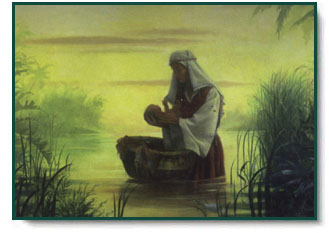
"2 And the woman conceived,
and bare a son: |
|
|
This art print, "Moses in the Bulrushes" by Keith Newton is provided courtesy of Christ-Centered Art ---New Window |
|
It is so truly hard to imagine one's self in this situation. How could a mother bring herself to this point of absolute FAITH in God? Though Jochebed was in a desperate situation in seeking safety for the life of her infant boy, we have reason to believe that the action she choose was NOT performed in desperation. The LORD had prepared His servant. "The preparations of the heart in man, and the answer of the tongue, is from the LORD" (Proverbs 16:1).
1. The people of Israel had been told of the Pharaoh's plan by the Hebrew midwives. "15 And the king of Egypt spake to the Hebrew midwives... 16 and he said, When ye do the office of a midwife to the Hebrew women, and see them upon the stools; if it be a son, then ye shall kill him: but if it be a daughter, then she shall live" (Exodus 1:15-16).
2. Jochebed and Amram had nine months to seek the LORD for their child's double deliverance, all the while being molded and formed themselves by the Creator, "the Author and Finisher of our FAITH" (Hebrews 12:2).
3. These parents had three amazing months of successfully hiding their child! "By FAITH Moses, when he was born, was hid three months of his parents, because they saw he was a proper child; and they were not afraid of the king's commandment" (Hebrews 11:23). Only the Providence of God could have guided them to see that kind of triumph. "For of Him, and through Him, and to Him, are all things: to Whom be glory for ever. Amen" (Romans 11:36).
4. The plan that Jochebed had could only have succeeded if God had intervened. Knowing this fact, we must conclude that the plan was revealed to this faithful mother by her All Wise God. Of course, if God was in this with her, then Jochebed could joyfully place her child in this blessed basket, the child He had formed and placed in her bowels. "The LORD that formed me from the womb to be His servant, to bring Jacob again to Him" (Isaiah 49:5).
Yes, this act took strong FAITH. "O woman, great is thy FAITH: be it unto thee even as thou wilt" (Matthew 15:28). But the LORD had prepared His servant for this exact moment.
"Righteousness shall go before Him; and
shall set us in the way of His steps"
(Psalm 85:13).
He gave her His plan, and she had confidence in Him. "Commit
thy way unto the LORD; trust also in Him; and He shall bring it to pass" (Psalm 37:5). While making the cradle-ark for her precious baby boy, Jochebed
might well have whispered her baby's intercession, certainly included the reminder,
that from the danger of an infant being placed alone in the water, he must surely
be delivered from a death by drowning. "17 He
sent from Above, He took me; He drew me out of many waters; 18
He delivered me from my strong enemy, and from
them that hated me: for they were too strong for me"
(2Samuel 22:17-18).
After all, Jochebed's justification in following this extreme exploit was her persuasion
that this was truly God's Master Plan to secure the deliverance of her baby's life.
"By Thee have I been holden up from the
womb" (Psalm
71:6). Jochebed knew God's hand guided her,
and we know this also, because "wisdom
is justified of her children" (Matthew 11:19).
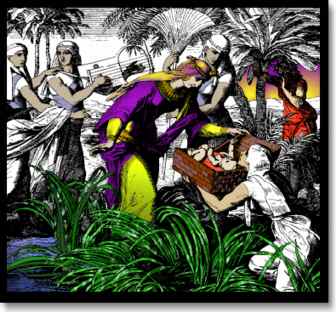 "4 And
his sister stood afar off, to wit what would be done to him. 5 And the daughter
of Pharaoh came down to wash herself at the river; and her maidens walked along by
the river's side; and when she saw the ark among the flags, she sent her maid to
fetch it. 6 And when she had opened it, she saw the child: and, behold,
the babe wept. And she had compassion on him, and said, This is one of the
Hebrews' children. 7
Then said his sister to Pharaoh's daughter,
Shall I go and call to thee a nurse of the Hebrew women, that she may nurse the child
for thee? 8 And Pharaoh's daughter said to her, Go. And the maid went
and called the child's mother. 9 And Pharaoh's daughter
said unto her, Take this child away, and nurse it for me, and I will give thee thy
wages. And the woman took the child, and nursed it. 10 And the child grew,
and she brought him unto Pharaoh's daughter, and he became her son. And she called
his name Moses: and she said, Because I drew him out of the water."
"4 And
his sister stood afar off, to wit what would be done to him. 5 And the daughter
of Pharaoh came down to wash herself at the river; and her maidens walked along by
the river's side; and when she saw the ark among the flags, she sent her maid to
fetch it. 6 And when she had opened it, she saw the child: and, behold,
the babe wept. And she had compassion on him, and said, This is one of the
Hebrews' children. 7
Then said his sister to Pharaoh's daughter,
Shall I go and call to thee a nurse of the Hebrew women, that she may nurse the child
for thee? 8 And Pharaoh's daughter said to her, Go. And the maid went
and called the child's mother. 9 And Pharaoh's daughter
said unto her, Take this child away, and nurse it for me, and I will give thee thy
wages. And the woman took the child, and nursed it. 10 And the child grew,
and she brought him unto Pharaoh's daughter, and he became her son. And she called
his name Moses: and she said, Because I drew him out of the water."
Scripture records the reason for the choice of the infant's name. Based upon
the occasion of his being pulled (literally, the Hebrew word "drawn") from
"the water", the Word of God reveals the LORD's willingness to answer a mother's
prayer. "When the time was come about
after Hannah had conceived, that she bare a son, and called his name Samuel, saying,
Because I have asked him of the LORD"
(1Samuel 1:20).
Again, only the Providence of God could have turned man's wrath into this perfection
of praise. "Surely the wrath of man shall
praise Thee: the remainder of wrath shalt Thou restrain" (Psalm 76:10). The baby's sister, Miriam, followed the ark, ready to offer her
mother as a nurse to her own brother. "God
is my Strength and Power: And He maketh my way perfect" (2Samuel 22:33). Miriam's prayer, while following her baby brother's Divinely protected
ark, might have been, "For Thy Name's
sake lead me, and guide me" (Psalm 31:3). As all intercessory
prayer is by it's very nature, Miriam's intercessory plea would be what Moses would
pray for himself, if he could. "Deliver
me out of the mire, and let me not sink: let me be delivered from them that hate
me, and out of the deep waters"
(Psalm 69:14).
(Read our article, "Intercession
Promises: Casting the Net" ---New Window.)
The LORD preserved Jochebed's maternal influence in her son's life by the truly miraculous
deliverance of her baby being sheltered in her homemade ark. It shouldn't surprise
those of us who know God's Character, that His Grace would provide for a mother's
love to nurture and guard the fruit of her own womb. "9 Take
this child away, and nurse it... And the woman took the child, and nursed
it. 10 And the child grew..." (Exodus
2:9-10). The Understanding LORD, Who nurtures
and suckles His Own children, answered this mother's plea. He saved the life of her
child from certain death many times during the short existence. He allowed the mother
and child to bond their God-given and God-preserved relationship by the natural sustenance
of milk nourishing the child from his own mother. "Thou
art He that took me out of the womb: Thou didst make me hope when I was upon my mother's
breasts" (Psalm
22:9). It makes Spiritual sense to assume that
this bond would be preserved even longer, thus allowing for the Spiritual training
of Moses. "Train up a child in the way
he should go: and when he is old, he will not depart from it" (Proverbs 22:6). There is no Biblical proof of accuracy in the popular "Hollywood"
account of Moses' early life being devoid of Godly influence. In fact, the Bible
Record upholds the Spiritual assertion, that since the mother's rights were honoured
and preserved in the child's early development, so could they be preserved even longer.
"] your children to wrath: but bring them
up in the nurture and admonition of the LORD"
(Ephesians 6:4).
The Scriptures lend much proof that the parents of Moses had the responsibility of
raising their son to be "the servant of
God" (Revelation
15:13), for this is the job of all Godly parents.
"I was cast upon Thee from the womb: Thou
art my God from my mother's belly" (Psalm 22:10). Parents are
given children from the LORD "that He
might seek a Godly seed" (Malachi 2:15).
And considering the kind of man that Moses turned
out to be, Godly parents must have contributed to his upbringing. Again, "wisdom is justified of her children" (Matthew 11:19).
"11 And it came to pass
in those days, when Moses was grown, that he went out unto his brethren, and
looked on their burdens: and he spied an Egyptian smiting an Hebrew, one of his
brethren."
Notice, Moses knew that he was born a Hebrew. Also notice his compassion and sense
of justice. "Therefore all things whatsoever
ye would that men should do to you, do ye even so to them: for this is the Law and
the prophets" (Matthew
7:12). Someone must have taught Moses what
pleased the LORD, for he did "learn to
do well; seek Judgment, [and] relieve the oppressed" (Isaiah
1:17).
"12 And he looked this
way and that way, and when he saw that there was no man, he slew the Egyptian,
and hid him in the sand. 13
And when he went out the second day, behold,
two men of the Hebrews strove together: and he said to him that did the wrong,
Wherefore smitest thou thy fellow? 14 And
he said, Who made thee a prince and a judge over us? intendest thou to kill me, as
thou killedst the Egyptian? And Moses feared, and said, Surely this thing is known.
15 Now when Pharaoh heard this thing, he sought to slay Moses.
But Moses fled from the face of Pharaoh, and dwelt in the land of Midian: and he
sat down by a well."
Moses tried to be a peacemaker between two of his Hebrew brethren. This is more Scriptural
proof that Moses was taught the Ways of God.
"Blessed are the peacemakers: for they shall be called the children of God" (Matthew 5:9). Moses also correctly discerned which of the two men had
sinned, for Scripture states clearly that Moses addressed "him
that did the wrong", indicating a sensitivity
to the leading of the Holy Spirit. "Brethren,
if a man be overtaken in a fault, ye which are Spiritual, restore such an one in
the spirit of meekness" (Galatians
6:1). As the LORD says by His Own mouth, concerning
His servant, Moses-- "Now the man Moses
was VERY MEEK, above all the men which were upon the face of the Earth" (Numbers 12:3). Moses felt a necessity to intercede, compelled as a Spiritual
man would, because "he that is Spiritual
judgeth all things" (1Corinthians
2:15). He was passionate for the oppressed,
making him a perfect candidate for the LORD's use in freeing the children of Israel
from the grip of Egypt.
The Israelite who snapped back at Moses was angry that Moses had "judged"
him, i.e., "Wherefore smitest thou thy
fellow?" (Exodus
2:13), and that Moses was interfering where
he wasn't wanted, i.e., "Who made thee
a prince and a judge over us?" (2:14). The erring Hebrew then
lashed out at Moses with an accusation of hate, i.e., "Intendest
thou to kill me, as thou killedst the Egyptian?"
(2:14). The wicked
hate the righteous. This sinning brother had been approached by Moses with the best
intentions of love, seeking restoration and peace for him. "19
Brethren, if any of you do err from
the Truth, and one convert [changes direction,
or turns] him; 20 let him know, that
he which converteth the sinner from the error of his way shall save a soul from death,
and shall hide a multitude of sins" (James 5:19-20). Moses must
now "suffer for righteousness' sake" (1Peter 3:14). He realized that his good deed in helping the beaten slave
by killing the oppressor is known by this backsliding "brother," and that
if others don't already know it also-- they will soon. "14 Surely this thing
is known. 15 Now when Pharaoh heard this thing, he sought to slay Moses" (Exodus 2:14-15). Moses has to run. As the Patriarch Joseph said to his
erring brothers, "As for you, ye thought
evil against me; but God meant it unto good, to bring to pass, as it is this day,
to save much people alive" (Genesis 50:20).
"The moment that Moses came to years of discretion we read that he 'refused to be called the son of Pharaoh's daughter.' Take that as the starting-point of the life of service. If your circumstances are making it impossible for you to carry out what would otherwise be the will of God, then drop your circumstances as Moses did; it rests with you to do it. Refuse any longer to be called the son of Pharaoh's daughter. You have been in the courts of men; you may have stood high in the favor of the people of this world, and your heirship may look exceedingly brilliant. You must choose whether you will take the heavenly inheritance or the earthly. There comes a point in every man's history when, if he wishes to be a sanctified vessel, meet for the Master's use, he must decide to drop everything that prevents a holy career and a life of perfect service among the people of the Lord. Would the devil be what he is if he did not gild his bullets, and if he did not find something to boast of to offset the glorious attraction of heaven? Of course Pharaoh's court, with all its grandeur, its learning, its talent, its science, its magnificent prospects and possibilities and power, attracts men, and they are drawn into its snare. Moses, the servant of God, calculated well, and he concluded that it would be better to endure the reproach of Christ than to have all the treasures of Egypt. Put the two side by side, the things of the world in one scale-pan, and the things of God in the other, and see which kicks the beam. Make your calculation, and say deliberately, 'I esteem the reproach of Christ greater riches than the treasures of the world.' -- H. W. WEBB-PEPLOE." --from "For Each New Day"
"16 Now the priest of
Midian had seven daughters: and they came and drew water, and filled the troughs
to water their father's flock. 17 And
the shepherds came and drove them away: but Moses stood up and helped them, and watered
their flock. 18
And when they came to Reuel their father, he
said, How is it that ye are come so soon to day?
 19 And they said, An
Egyptian delivered us out of the hand of the shepherds, and also drew water enough
for us, and watered the flock.
19 And they said, An
Egyptian delivered us out of the hand of the shepherds, and also drew water enough
for us, and watered the flock.
20 And he said unto his daughters, And where is he? why is
it that ye have left the man? call him, that he may eat bread."
Again, we see the Godly character of this man, Moses. "Take
My yoke upon you, and learn of Me; for I am Meek and Lowly in heart: and ye shall
find rest unto your souls" (Matthew 11:29). His compassion for the weak and
the wronged stirs up the groundwork of Righteous Justice and Judgment that had been
cultivated in him, equipping this meek man and constraining him to action. He intercedes
for the oppressed, i.e., "Moses stood
up and helped them, and watered their flock"
(Exodus 2:17).
At this point, we must make a detour from the story line, and ask the question, "What
is meekness?" We are not looking for a dictionary definition here. We want to
know, "What saith the Scripture?" (Romans 4:3).
Very simply put-- true meekness defends God, not self. "Great peace have they which love Thy Law: and nothing
shall offend them" (Psalm 119:165). The Godly meek of the Earth defend God's Word. "Receive with meekness the engrafted Word, which is
able to save your souls" (James 1:21). The truly meek
defend God's Character. "The fruit of
the Spirit is love, joy, peace, longsuffering, gentleness, goodness, FAITH, meekness,
temperance: against such there is no law"
(Galatians 5:22-23).
The meek promote God, not self. "Who is
a wise man and endued with knowledge among you? let him show out of a good conversation
his works with meekness of Wisdom" (James 3:13). And God promotes
His meek ones. "Blessed are the meek:
for they shall inherit the Earth... the meek shall inherit the Earth; and shall delight
themselves in the abundance of peace"
(Matthew 5:5; Psalm 37:11).
With such a man, a man God Himself called "very
meek", i.e., "Now
the man Moses was VERY MEEK, above all the men which were upon the face of the Earth" (Numbers 12:3), is it any wonder that, with such a SERVANT as was this
man Moses, that God had just the human interface He needed to free a whole nation--
enslaved and beaten-- from the clenched fists of the most powerful nation, at that
time, on "the face of the Earth."
From a Biblical perspective, it was Egypt that benefitted from "the famine [which] was over all the face of the Earth" (Genesis 41:56), lasting seven years, in which "all
countries came into Egypt to Joseph for to buy corn; because that the famine was
so sore in all lands" (Genesis
41:57). The citizenry of Egypt became servants
of the monarchy. The revenue of all Egypt went into the coffers of the government.
The revenue from the world poured into the financial
resources of the Egyptian monarchy. This made Egypt quite imposing by monetary standards.
So, by the time "there arose up a new
king over Egypt, which knew not Joseph"
(Exodus 1:8),
this Pharaoh could easily have been recognized as the most powerful ruler in the
world. In this light, we are not surprised to find egotism that sets "taskmasters to afflict
[the Israelites] with their burdens. And they
built for Pharaoh treasure cities, Pithom and Raamses" (Exodus 1:11).
It was this stronghold of wickedness, lying in the grasp of one man-- the King of
Egypt-- that must be overcome, if God's people were to be set free. The LORD God
needed a man to be His instrument of righteous Justice and Judgment, compassionate
to those mistreated. The man must represent God only-- not himself. The man MUST
be a meek man-- the meekest man "above
all the men which were upon the face of the Earth"
(Numbers 12:3).
God chose Moses!
Continuing with the story narration...
"21 And Moses was content to dwell with the man: and he gave
Moses Zipporah his daughter. 22 And she bare him
a son, and he called his name Gershom: for he said, I have been a stranger in a strange
land."
"23 And it came to pass
in process of time, that the king of Egypt died: and the children of Israel sighed
by reason of the bondage, and they cried, and their cry came up unto God by reason
of the bondage. 24
And God heard their groaning, and God remembered
His Covenant with Abraham, with Isaac, and with Jacob. 25 And God looked upon
the children of Israel, and God had respect unto them."
Exodus
/ Chapter 3
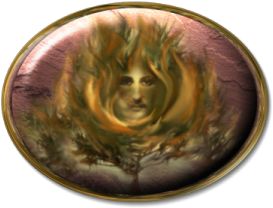
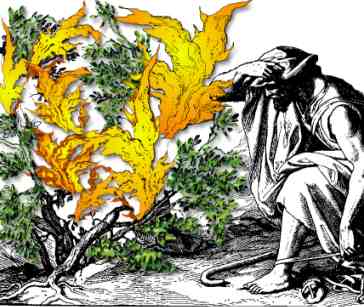
 ow Moses kept the flock
of Jethro his father in law, the priest of Midian: and he led the flock to the backside
of the desert, and came to the mountain of God, even to Horeb. 2 And the Angel of
the LORD appeared unto him in a Flame Of Fire out of the midst of a bush: and he
looked, and, behold, the bush burned with Fire, and the bush was not consumed. 3 And
Moses said, I will now turn aside, and see this great sight, why the bush is not
burnt. 4 And when the LORD
saw that he turned aside to see, God called unto him out of the midst of the bush,
and said, Moses, Moses. And he said, Here am I. 5 And He said, Draw
not nigh hither: put off thy shoes from off thy feet, for the place whereon thou
standest is holy ground. 6
Moreover He said, I Am the God of thy father,
the God of Abraham, the God of Isaac, and the God of Jacob. And Moses hid his face;
for he was afraid to look upon God. 7 And
the LORD said, I have surely seen the affliction of My people which are in Egypt,
and have heard their cry by reason of their taskmasters; for I know their sorrows;
8 And I am come down to deliver them out of the hand of the
Egyptians, and to bring them up out of that land unto a good land and a large, unto
a land flowing with milk and honey; unto the place of the Canaanites, and the Hittites,
and the Amorites, and the Perizzites, and the Hivites, and the Jebusites."
ow Moses kept the flock
of Jethro his father in law, the priest of Midian: and he led the flock to the backside
of the desert, and came to the mountain of God, even to Horeb. 2 And the Angel of
the LORD appeared unto him in a Flame Of Fire out of the midst of a bush: and he
looked, and, behold, the bush burned with Fire, and the bush was not consumed. 3 And
Moses said, I will now turn aside, and see this great sight, why the bush is not
burnt. 4 And when the LORD
saw that he turned aside to see, God called unto him out of the midst of the bush,
and said, Moses, Moses. And he said, Here am I. 5 And He said, Draw
not nigh hither: put off thy shoes from off thy feet, for the place whereon thou
standest is holy ground. 6
Moreover He said, I Am the God of thy father,
the God of Abraham, the God of Isaac, and the God of Jacob. And Moses hid his face;
for he was afraid to look upon God. 7 And
the LORD said, I have surely seen the affliction of My people which are in Egypt,
and have heard their cry by reason of their taskmasters; for I know their sorrows;
8 And I am come down to deliver them out of the hand of the
Egyptians, and to bring them up out of that land unto a good land and a large, unto
a land flowing with milk and honey; unto the place of the Canaanites, and the Hittites,
and the Amorites, and the Perizzites, and the Hivites, and the Jebusites."
In verse 1, we are told that "Moses kept
the flock of Jethro his father in law, the priest of Midian". Many may try to use this verse as an occasion to discredit the
Word of God as being inconsistent. In their eyes, God is two-faced. "Why did
God honour a man like Moses, who married an unsaved woman, and yet destroyed the
Earth by a flood for doing the exact same thing?" In our story of "Noah's Ark" ---New Window and The Flood, we remember,
that in those days:
"'It came to pass, when men began to multiply on the face of the Earth, and daughters were born unto them, 2 That the sons of God saw the daughters of men that they were fair; and they took them wives of all which they chose.' The LORD wants us to take special notice of the type of sin that was the most common just prior to the world's judgment. 'The sons of God' thought so little of the Almighty that they would actually join themselves in the most intimate way, to God's enemies. God's people are NOT to choose their spouses from among the ungodly. We are talking about two separate worlds, with opposite motives, antagonistic values, and NO common ground. Men obey God-- in ALL things-- or they don't. There is no middle ground. There are no shades of gray. There is only Divine Light, or darkness forever."
The passage in Numbers, chapter 12 ---New Window, reveals the LORD's anger, when Miriam and Aaron try to usurp Moses' authority by claiming he did sinfully wrong in marrying an "Ethiopian woman" (Numbers 12:1). Again, the LORD appeared unprincipled and unjust to those who don't understand. Yes, the LORD defended the actions of Moses. "7 My servant Moses is not so, who is faithful in all Mine house. 8 With him will I speak mouth to mouth, even apparently, and not in dark speeches; and the similitude of the LORD shall he behold: wherefore then were ye not afraid to speak against My servant Moses?" (12:7-8). But, to those of us who trust the LORD God, His Word, and His Character, the LORD's defense of His "faithful... servant Moses" conclusively proves that Zipporah was NOT an heathen woman, and that "Jethro his father in law, the priest of Midian" was NOT the priest of a heathen religion.
"The center of the Midianite country, where Moses sojourned, was on the east shore of the Gulf of Akaba, though they roamed far to the north and west. In Moses' day they controlled the rich pasture lands around Sinai. Moses married a Midianite woman, named Zipporah, daughter of Jethro, also called Reuel (18; 3:1). Jethro, as priest of Midian, must have been a ruler. Midianites were descended from Abraham, through Keturah (Genesis 23:2); and must have had traditions of Abraham's God." --from "Halley's Bible Handbook" by Henry H. Halley.
In Exodus 2:18, we are told that the daughters of Jethro "came to Reuel their father".
"Reuel, which means friend of God, seems to have been his personal name, and Jethro, his excellence, to have been his honorary title... After the passage of the Red Sea, which conducted the Israelites into the vicinity of Jethro's country... he rejoiced in the deliverance of the Israelites, [and] offered sacrifices to Jehovah." --from "Davis Dictionary of the Bible" by John D. Davis.
God's opinions are stated clearly when it comes to His people choosing the daughters of the heathen ---New Window -- and in this case, Midianites included.
|
"9 Now therefore, |
|
13 And Moses said unto God, Behold, when I come unto the children of
Israel, and shall say unto them, The God of your fathers hath sent me unto you; and
they shall say to me, What is his name? what shall I say unto them?
 14 And
God said unto Moses, I AM THAT I AM: and He said, Thus shalt thou say unto the children
of Israel, I AM hath sent me unto you.
14 And
God said unto Moses, I AM THAT I AM: and He said, Thus shalt thou say unto the children
of Israel, I AM hath sent me unto you.
15 And
God said moreover unto Moses, Thus shalt thou say unto the children of Israel, The
LORD God of your fathers, the God of Abraham, the God of Isaac, and the God of Jacob,
hath sent me unto you: this is my Name for ever, and this is My memorial unto all
generations. 16
Go, and gather the elders of Israel together,
and say unto them, The LORD God of your fathers, the God of Abraham, of Isaac, and
of Jacob, appeared unto me, saying, I have surely visited you, and seen that which
is done to you in Egypt: 17
And I have said, I will bring you up out of
the affliction of Egypt unto the land of the Canaanites, and the Hittites, and the
Amorites, and the Perizzites, and the Hivites, and the Jebusites, unto a land flowing
with milk and honey. 18
And they shall hearken to thy voice: and thou
shalt come, thou and the elders of Israel, unto the king of Egypt, and ye shall say
unto him, The LORD God of the Hebrews hath met with us: and now let us go, we beseech
thee, three days' journey into the wilderness, that we may sacrifice to the LORD
our God. 19 And I am sure that the king of Egypt will not let you
go, no, not by a mighty hand. 20 And I will stretch out
My hand, and smite Egypt with all My Wonders which I will do in the midst thereof:
and after that he will let you go. 21 And I will give this
people favour in the sight of the Egyptians: and it shall come to pass, that, when
ye go, ye shall not go empty: 22 But every woman shall borrow
of her neighbour, and of her that sojourneth in her house, jewels of silver, and
jewels of gold, and raiment: and ye shall put them upon your sons, and upon your
daughters; and ye shall spoil the Egyptians."
Exodus
/ Chapter 4
nd Moses answered and said, But,
behold, they will not believe me, nor hearken unto my voice: for they will
say, The LORD hath not appeared unto thee.
2 And the LORD said unto him, What is that in thine hand?
And he said, A rod.
3 And He said, Cast it on the ground.
And he cast it on the ground, and it became a serpent; and Moses fled from before
it.
4 And the LORD said unto Moses, Put forth thine hand, and
take it by the tail.
And he put forth his hand, and caught it, and it became a rod in his hand:
5 that they may believe that the LORD God of their
fathers, the God of Abraham, the God of Isaac, and the God of Jacob, hath appeared
unto thee. 6 And the LORD said furthermore unto him, Put now thine hand
into thy bosom.
And he put his hand into his bosom: and when he took it out, behold, his hand was
leprous as snow.
7 And He said, Put thine hand into thy bosom again.
And he put his hand into his bosom again; and plucked it out of his bosom, and, behold,
it was turned again as his other flesh.
8 And it shall come to pass, if they will not believe thee,
neither hearken to the voice of the first Sign, that they will believe the voice
of the latter Sign. 9
And it shall come to pass, if they will
not believe also these two Signs, neither hearken unto thy voice, that thou shalt
take of the water of the river, and pour it upon the dry land: and the water which
thou takest out of the river shall become blood upon the dry land."
It is a wicked people that need a Sign BEFORE they say they'll believe the LORD.
"38 Then certain of the scribes and of the Pharisees answered,
saying, Master, we would see a Sign from Thee. 39 But He answered and
said unto them, An evil and adulterous generation seeketh after a Sign; and
there shall no Sign be given to it, but the Sign of the prophet Jonas: 40
For as Jonas was three days and three nights
in the whale's belly; so shall the Son of Man be three days and three nights in the
heart of the Earth. 41 The men of Nineveh
shall rise in Judgment with this generation, and shall condemn it: because they repented
at the preaching of Jonas; and, behold, a Greater than Jonas is here" (Matthew 12:38-41). The "Sign" that the LORD spoke of is given to the wicked because of
their need to repent. It is given by God to show that repentance is necessary. Jonah
bore his sin in the belly of the whale-- a Sign from God the Father that he needed
to repent. Jesus bore the sin of the world in the belly (or "heart") of the Earth--
a Sign from God the Father that the world needed to repent..
"10 And Moses said unto the LORD, O my LORD, I am not eloquent,
neither heretofore, nor since Thou hast spoken unto Thy servant: but I am
slow of speech, and of a slow tongue. 11 And the LORD said
unto him, Who hath made man's mouth? or who maketh the dumb, or deaf, or the seeing,
or the blind? have not I the LORD? 12 Now therefore go, and I
will be with thy mouth, and teach thee what thou shalt say."
The LORD God always prepares His servants for the work He gives them. He sends them
in the Power of His Spirit. "12:11 And when they bring you unto the synagogues, and unto magistrates,
and powers, take ye no thought how or what thing ye shall answer, or what ye shall
say: 12 for the Holy Ghost
shall teach you in the same hour what ye ought to say... 21:14 Settle it therefore
in your hearts, not to meditate before what ye shall answer: 15 for I will give you
a mouth and wisdom, which all your adversaries shall not be able to gainsay nor resist" (Luke 12:11-12; 21:14-15).
"13 And he said, O my
LORD, send, I pray Thee, by the hand of him whom Thou wilt send."
Moses continued to sidestep the LORD's Will
by suggesting that "the hand of him", Moses, whom God chose, could choose someone else to go
in his stead. And even though the LORD was angry with Moses, God showed His mercy
and grace.
"14 And the anger of the LORD was kindled against Moses, and
He said, Is not Aaron the Levite thy brother? I know that he can speak well. And
also, behold, he cometh forth to meet thee: and when he seeth thee, he will be glad
in his heart. 15 And thou shalt
speak unto him, and put words in his mouth: and I will be with thy mouth, and with
his mouth, and will teach you what ye shall do. 16 And he shall be thy
spokesman unto the people: and he shall be, even he shall be to thee instead of
a mouth, and thou shalt be to him instead of God."
The LORD allowed Aaron to be the mouthpiece of Moses, but Moses was still to be the
mouthpiece of God
"17 And thou shalt take
this rod in thine hand, wherewith thou shalt do Signs.
18 And Moses went and returned to Jethro his father in law,
and said unto him, Let me go, I pray thee, and return unto my brethren which are
in Egypt, and see whether they be yet alive. And Jethro said to Moses, Go in peace.
19 And the LORD said unto Moses in Midian, Go, return into
Egypt: for all the men are dead which sought thy life."
The LORD prepared the way before His servant, providing for the servant's safety.
"All the men are dead which sought thy
life."
"20 And Moses took his
wife and his sons, and set them upon an ass, and he returned to the land of Egypt:
and Moses took the rod of God in his hand.
21 And the LORD said unto Moses, When thou goest to return
into Egypt, see that thou do all those Wonders before Pharaoh, which I have put in
thine hand: but I will harden his heart, that he shall not let the people go."
Again, the LORD prepared His servant, Moses, by telling him what to expect. Pharaoh
was to be the unwilling tool in the hand of God.
"22 And thou shalt say
unto Pharaoh, Thus saith the LORD, Israel is My son, even My firstborn: 23 and
I say unto thee, Let My son go, that he may serve Me: and if thou refuse to let him
go, behold, I will slay thy son, even thy firstborn.
27 And the LORD said to Aaron, Go into the wilderness to meet
Moses. And he went, and met him in the mount of God, and kissed him. 28 And
Moses told Aaron all the Words of the LORD Who had sent him, and all the Signs which He had
commanded him. 29
And Moses and Aaron went and gathered together
all the elders of the children of Israel: 30 And Aaron spake all
the Words which the LORD had spoken unto Moses, and did the Signs in the sight of the people.
31 And the people believed: and when they heard that the LORD
had visited the children of Israel, and that He had looked upon their affliction,
then they bowed their heads and worshipped."
Exodus
/ Chapter 5
nd afterward Moses and Aaron went
in, and told Pharaoh, Thus saith the LORD God of Israel, Let My people go, that they
may hold a feast unto Me in the wilderness. 2 And Pharaoh said,
Who is the LORD, that I should obey His voice to let Israel go? I know
not the LORD, neither will I let Israel go."
Truth is Truth, no matter who repeats it. And Pharaoh spoke God's Truth when he said
that he didn't know God. For to know God is to obey Him. "Know
ye not, that to whom ye yield yourselves servants to obey, his servants ye are to
whom ye obey; whether of sin unto death, or of obedience unto Righteousness?" (Romans 6:16).
"3 And they said, The
God of the Hebrews hath met with us: let us go, we pray thee, three days' journey
into the desert, and sacrifice unto the LORD our God; lest He fall upon us with pestilence,
or with the sword.
4 And the king of Egypt said unto them, Wherefore do ye, Moses
and Aaron, let the people from their works? get you unto your burdens. 5 And
Pharaoh said, Behold, the people of the land now are many, and ye make them rest
from their burdens. 6
And Pharaoh commanded the same day the taskmasters
of the people, and their officers, saying, 7 Ye shall no more
give the people straw to make brick, as heretofore: let them go and gather straw
for themselves. 8
And the tale of the bricks, which they did
make heretofore, ye shall lay upon them; ye shall not diminish ought thereof: for
they be idle; therefore they cry, saying, Let us go and sacrifice to our God. 9 Let
there more work be laid upon the men, that they may labour therein; and let them
not regard vain words."
To the wicked, the Word of God is foolishness, and the teaching of the Word-- worthlessness.
"Let them not regard vain words." It is only the Word of God that has Eternal Value.
"20 And they met Moses
and Aaron, who stood in the way, as they came forth from Pharaoh: 21 and they said unto
them, The LORD look upon you, and judge; because ye have made our savour to be abhorred
in the eyes of Pharaoh, and in the eyes of his servants, to put a sword in their
hand to slay us.
22 And Moses returned unto the LORD, and said, LORD, wherefore
hast Thou so evil entreated this people? why is it that Thou hast sent me? 23
For since I came to Pharaoh to speak in Thy
Name, he hath done evil to this people; neither hast Thou delivered Thy people at
all."
If there was one character area that Moses needed to heed as "the sin which doth so easily beset" (Hebrews 12:1) him, it would be that of having patience. Then Moses would "run with patience the race that is set before [him]" (12:1).
With the constant backslidings from the Israelites,
Moses was OFTEN tested in the area of having patience. "There
arose not a prophet since in Israel like unto Moses"
(Deuteronomy 34:10).
Most of the time, he passed his tests, as any child of God is required to do [read "What
the Bible Says About Temptation" ---New Window]. But we will read later, of a time when Moses lost his temper ---New Window,
and this provocation from the children of Israel caused Moses to NOT
enter into the Promised Land ---New
Window.
Exodus
/ Chapter 6
hen the LORD said unto Moses, Now
shalt thou see what I will do to Pharaoh: for with a strong hand shall he let them
go, and with a strong hand shall he drive them out of his land. 2 And God spake unto
Moses, and said unto him, I Am the LORD: 3 And
I appeared unto Abraham, unto Isaac, and unto Jacob, by the Name of God Almighty,
but by My Name JEHOVAH was I not known to them. 4 And I have also established
My Covenant with them, to give them the land of Canaan, the land of their pilgrimage,
wherein they were strangers. 5 And I have also heard
the groaning of the children of Israel, whom the Egyptians keep in bondage;
and I have remembered My Covenant. 6 Wherefore say unto the children
of Israel, I Am the LORD, and I will bring you out from under the burdens of the
Egyptians, and I will rid you out of their bondage, and I will redeem you with a
stretched out arm, and with Great Judgments: 7 And I will take you
to Me for a people, and I will be to you a God: and ye shall know that I Am the LORD
your God, which bringeth you out from under the burdens of the Egyptians. 8 And
I will bring you in unto the land, concerning the which I did swear to give it to
Abraham, to Isaac, and to Jacob; and I will give it you for an heritage: I Am the
LORD. 9 And Moses spake so unto the children of Israel: but they
hearkened not unto Moses for anguish of spirit, and for cruel bondage."
The Israelites were a suffering people. They had "23 sighed by reason of the
bondage, and they cried, and their cry came up unto God... 24 And God heard their groaning, and God remembered His Covenant
with Abraham, with Isaac, and with Jacob"
(Exodus 2:23-24).
If the LORD had not intervened for them, He would not have been able to fulfill the
Promise He had made to Abraham. "13 And
He said unto Abram, Know of a surety that thy seed shall be a stranger in a land
that is not theirs, and shall serve them; and they shall afflict them four hundred
years; 14 and also that nation, whom they shall serve, will I judge:
and afterward shall they come out with great substance... 18 In the same day the
LORD made a Covenant with Abram, saying, Unto thy seed have I given this land, from
the river of Egypt unto the great river, the river Euphrates: 19 the Kenites, and
the Kenizzites, and the Kadmonites, 20 and the Hittites, and the
Perizzites, and the Rephaims, 21 and the Amorites, and the Canaanites, and the Girgashites, and the
Jebusites" (Genesis
15:13-14,18-21). And so, for Abraham, the LORD
kept His Promise, and proceeded with His plan to free Israel, even though "they hearkened NOT unto Moses for anguish of spirit,
and for cruel bondage."
"10 And the LORD spake
unto Moses, saying, 11
Go in, speak unto Pharaoh king of Egypt, that
he let the children of Israel go out of his land. 12 And Moses spake before
the LORD, saying, Behold, the children of Israel have not hearkened unto me; how
then shall Pharaoh hear me, who am of uncircumcised lips? 13 And the LORD spake
unto Moses and unto Aaron, and gave them a charge unto the children of Israel, and
unto Pharaoh king of Egypt, to bring the children of Israel out of the land of Egypt.
28 And it came to pass on the day when the LORD spake unto
Moses in the land of Egypt, 29 that the LORD spake unto Moses,
saying, I Am the LORD: speak thou unto Pharaoh king of Egypt all that I say unto
thee."
The LORD's "charge" to us stands fast, whether it appears as if anyone will listen to
us, or not. The LORD's Word is the only Absolute that needs to be considered. This
is the position of FAITH. "And He said
unto them, Where is your FAITH? And they being afraid wondered, saying one to another,
What manner of Man is this! for He commandeth even the winds and water, and they
obey Him" (Luke
8:25).
Exodus
/ Chapter 7
nd the LORD said unto Moses, See,
I have made thee a god [or, as God] to Pharaoh: and Aaron thy brother shall be thy prophet.
2 Thou shalt speak all that I command thee: and Aaron thy
brother shall speak unto Pharaoh, that he send the children of Israel out of his
land. 3 And I will harden Pharaoh's heart, and multiply My Signs
and My Wonders in the land of Egypt. 4 But Pharaoh shall not hearken unto you, that I may lay
My hand upon Egypt, and bring forth Mine armies, and My people the children of Israel,
out of the land of Egypt by Great Judgments. 5 And the Egyptians
shall know that I Am the LORD, when I stretch forth Mine hand upon Egypt, and bring
out the children of Israel from among them.
6 And Moses and
Aaron did as the LORD commanded them, so did they.
7 And Moses was
fourscore years old, and Aaron fourscore and three years old, when they spake unto
Pharaoh.
8 And the LORD spake unto Moses and unto Aaron, saying, 9 When
Pharaoh shall speak unto you, saying, Show a miracle for you: then thou shalt say
unto Aaron, Take thy rod, and cast it before Pharaoh, and it shall become a serpent.
10 And Moses and Aaron went in unto Pharaoh, and they did
so as the LORD had commanded: and Aaron cast down his rod before Pharaoh, and
before his servants, and it became a serpent. 11 Then Pharaoh also
called the wise men and the sorcerers: now the magicians of Egypt, they also did
in like manner with their enchantments. 12 For they cast down
every man his rod, and they became serpents: but Aaron's rod swallowed up their rods.
13 And he hardened Pharaoh's heart, that he hearkened not unto
them; as the LORD had said."
Satan is the "prince of the power of the
air, the spirit that now worketh in the children of disobedience" (Ephesians 2:2), and as such, God has allowed Satan to have a limited amount
of liberty in his arsenal. His abilities imitate the "Only Wise God" (1Timothy 1:17). Satan's imitation
of God is NOT to glorify God-- but to usurp God altogether. "For thou [Satan] hast said in thine heart, I will ascend into Heaven, I
will exalt my throne above the stars of God"
(Isaiah 14:13).
Pharaoh's sorcerers imitated God's Power, but possessed
no Divine power in themselves. Their power was a counterfeit, for "the working of Satan with all power and signs and lying
wonders" (2Thessalonians
2:9) could not defeat Moses. This is illustrated
in the fact, that, "Aaron's rod swallowed
up their rods." When that happened in
front of Pharaoh's very own eyes, he was reminded of his finiteness, his limitations--
and it soured in his stomach and "hardened" his heart. This Divine Power of the Holy Spirit constantly
limits Satan, and restrains his devouring egotistical desires from overstepping the
purposes that God maintains. This has a tremendous hardening effect on the heart
of Satan, making him-- of ALL creatures-- "most
miserable" (1Corinthians
15:19).
"14 And the LORD said
unto Moses, Pharaoh's heart is hardened, he refuseth to let the people go. 15 Get
thee unto Pharaoh in the morning; lo, he goeth out unto the water; and thou shalt
stand by the river's brink against he come; and the rod which was turned to a serpent
shalt thou take in thine hand. 16 And thou shalt say unto him,
The LORD God of the Hebrews hath sent me unto thee, saying, Let My people go,
that they may serve Me in the wilderness: and, behold, hitherto thou wouldest
not hear. 17 Thus saith the LORD, In this thou shalt know that I Am
the LORD: behold, I will smite with the rod that is in Mine hand upon the waters
which are in the river, and they shall be turned to blood.
18 And the fish that is in the river shall die, and the river
shall stink; and the Egyptians shall loathe to drink of the water of the river. 19 And
the LORD spake unto Moses, Say unto Aaron, Take thy rod, and stretch out thine hand
upon the waters of Egypt, upon their streams, upon their rivers, and upon their ponds,
and upon all their pools of water, that they may become blood; and that there may
be blood throughout all the land of Egypt, both in vessels of wood, and in vessels
of stone."
In the Book of Revelation, one of the "two
witnesses" (Revelation
11:3) (we think he shall be Moses, with Elijah
being the other witness) shall again turn the waters to blood.
"Moses and Elijah are most probably the Two Witnesses indicated in this verse because of the similarity of their previous earthly ministries to the deeds of these Two Witnesses. Elijah 'shut heaven, that it rain[ed] not' (11:6), i.e., 'And Elijah the Tishbite, who was of the inhabitants of Gilead, said unto Ahab, As the LORD God of Israel liveth, before Whom I stand, there shall not be dew nor rain these years, but according to my word' (1Kings 17:1). Moses had 'power over [the] waters to turn them to blood' (11:6), i.e., '[Moses] turned their waters into blood, and slew their fish' (Psalm 105:29). Moses is remembered for the multitude of plagues that he called down upon Egypt, i.e., 'And the LORD said unto Moses, See, I have made thee a god to Pharaoh: and Aaron thy brother shall be thy prophet' (Exodus 7:1), while Elijah is remembered for calling down fire on the sacrifice on Mount Carmel. '37 Hear me, O LORD, hear me, that this people may know that Thou art the LORD God, and that Thou hast turned their heart back again. 38 Then the fire of the LORD fell, and consumed the burnt sacrifice, and the wood, and the stones, and the dust, and licked up the water that was in the trench' (1Kings 18:37-38)." -- from our "Commentary on the Book of Revelation" ---New Window, Chapter 11: The Two Witnesses and the Seventh Trumpet ---New Window. [And for more background on Elijah, please read our "Elijah and the Prophets of Baal" ---New Window]
"20 And Moses and Aaron
did so, as the LORD commanded; and he lifted up the rod, and smote the waters that
were in the river, in the sight of Pharaoh, and in the sight of his servants; and
all the waters that were in the river were turned to blood. 21 And the fish that was in the river died; and the river
stank, and the Egyptians could not drink of the water of the river; and there was
blood throughout all the land of Egypt. 22 And the magicians
of Egypt did so with their enchantments: and Pharaoh's heart was hardened, neither
did he hearken unto them; as the LORD had said. 23 And Pharaoh turned
and went into his house, neither did he set his heart to this also. 24 And
all the Egyptians digged round about the river for water to drink; for they could
not drink of the water of the river. 25 And seven days were
fulfilled, after that the LORD had smitten the river."
Notice the magicians could NOT lift the curse of God. They could only mock God's
Almightiness in imitation, using Satan's Divinely-limited power.
Exodus
/ Chapter 8
nd the LORD spake unto Moses, Go
unto Pharaoh, and say unto him, Thus saith the LORD, Let My people go, that they
may serve Me. 2
And if thou refuse to let them go, behold,
I will smite all thy borders with frogs: 3 and the river shall bring forth frogs abundantly, which
shall go up and come into thine house, and into thy bedchamber, and upon thy bed,
and into the house of thy servants, and upon thy people, and into thine ovens, and
into thy kneadingtroughs: 4
and the frogs shall come up both on thee, and
upon thy people, and upon all thy servants.
5 And the LORD spake unto Moses, Say unto Aaron, Stretch forth
thine hand with thy rod over the streams, over the rivers, and over the ponds, and
cause frogs to come up upon the land of Egypt. 6 And Aaron stretched out his hand over the waters of Egypt;
and the frogs came up, and covered the land of Egypt. 7 And the magicians
did so with their enchantments, and brought up frogs upon the land of Egypt. 8 Then
Pharaoh called for Moses and Aaron, and said, Entreat the LORD, that He may take
away the frogs from me, and from my people; and I will let the people go, that
they may do sacrifice unto the LORD."
Again, notice that the LORD allowed Pharaoh's magicians to add to the frogs, but
not to take the frogs away. This God devised for the purpose of hardening Pharaoh.
For the LORD "hath made the Earth by His
Power, He hath established the world by His Wisdom, and hath stretched out the heaven
by His Understanding" (Jeremiah
51:15).
"9 And Moses said unto
Pharaoh, Glory over me: WHEN shall I entreat for thee, and for thy servants,
and for thy people, to destroy the frogs from thee and thy houses, that they may
remain in the river only? 10 And he said, To morrow.
And he said, Be it according to thy word: that thou mayest know that there is
NONE LIKE unto the LORD our God. 11 And
the frogs shall depart from thee, and from thy houses, and from thy servants, and
from thy people; they shall remain in the river only."
Moses was a man of FAITH. God had worked it in him just for this service to which
he was now called. "And the LORD said
unto him [Moses],
Who hath made man's mouth? or who maketh the dumb, or deaf, or the seeing, or the
blind? have not I the LORD?" (Exodus 4:11). To proclaim
something to be in fact, that is not yet seen with eyes, takes FAITH. "And [Jesus] turned Him unto His disciples, and said privately, Blessed
are the eyes which see the things that ye see"
(Luke 10:23).
For the Law of the Kingdom has ordained, that it is "according to your FAITH be it unto you" (Matthew 9:29).
"'And Jesus said unto the centurion, Go thy way; and as thou hast believed, so be it done unto thee. And his servant was healed in the selfsame hour' (Matthew 8:13). This passage of Scripture brings before us one of the principal laws of the kingdom of heaven. In order to understand God's ways with His people, and our relations with the Lord, it is needful to understand this law thoroughly and not to deviate from it. Not only does God give or withhold His gifts according to the faith or unbelief of each, but they are granted in greater or lesser measure, only in proportion to the faith which receives them. God respects the right to decide which He has conferred on man. Therefore He can only bless us in the measure in which each yields himself up to His divine working, and opens all his heart to Him. Faith in God is nothing else than the full opening of the heart to receive everything from God; therefore man can only receive divine grace according to his faith; and this applies as much to divine healing as to any other grace of God." --from "Divine Healing" ---New Window by Andrew Murray.
For Moses to attribute the doing of it by Someone Whose face "no man can approach unto; Whom no man hath seen, nor can see: to Whom be honour and Power everlasting" (1Timothy 6:16), but Who is seen ONLY with the heart, this is "FAITH IN GOD" (Mark 11:22).
Note: No earthbound man has seen the face of God the Father. Not even Moses. And yet... ---New Window
So, when Moses insisted that Pharaoh choose the
time "when" (Exodus 8:9)
the frogs would leave, he was allowing Pharaoh this honour for one reason only. "Be it according to thy word: that thou mayest know
that there is NONE LIKE unto the LORD our God. And the frogs shall depart from thee" (10-11). This honour was actually a challenge. "Pharaoh, you pick the
day. I'll ask the LORD God. And then you'll see for yourself, 'that there is NONE LIKE unto the LORD our God.' For the LORD will do what you can't do. And to show you that it's
NO MERE COINCIDENCE, the LORD will let you choose when."
"12 And Moses and Aaron
went out from Pharaoh: and Moses cried unto the LORD because of the frogs which He
had brought against Pharaoh. 13 And the LORD did according
to the word of Moses; and the frogs died out of the houses, out of the villages,
and out of the fields. 14
And they gathered them together upon heaps:
and the land stank. 15
But when Pharaoh saw that there was respite,
he hardened his heart, and hearkened not unto them; as the LORD had said."
Events happened just "as the LORD had
said." That's why Pharaoh "hardened his heart"--
he coveted the Power that God possessed. Pharaoh was "of [his] father the
Devil, and the lusts of [his] father" (John 8:44) he did. The Devil
covets all that God Is, and so, also, did the Devil's child, Pharaoh. Instead of
"glorifying and praising God for all the
things that they had heard and seen, as it was told unto them" (Luke 2:20), the wicked father and son
"coveted after [God]... and pierced themselves through with many sorrows" (1Timothy 6:10).
"16 And the LORD said
unto Moses, Say unto Aaron, Stretch out thy rod, and smite the dust of the land,
that it may become lice throughout all the land of Egypt. 17 And they did so;
for Aaron stretched out his hand with his rod, and smote the dust of the Earth, and
it became lice in man, and in beast; all the dust of the land became lice
throughout all the land of Egypt. 18 And the magicians did so with
their enchantments to bring forth lice, but they could not: so there were
lice upon man, and upon beast. 19 Then the magicians said unto
Pharaoh, This is the finger of God: and Pharaoh's heart was hardened, and
he hearkened not unto them; as the LORD had said."
SIDE NOTE: Discontent Hardens a Heart. "Set Me as a seal upon thine heart, as a seal upon thine arm: for love is strong as death; jealousy is cruel as the grave: the coals thereof are coals of fire, which hath a most vehement flame" (Song of Solomon 8:6). With violence, the wicked refuse to be content. "34 For jealousy is the rage of a man: therefore he will NOT spare in the day of vengeance. 35 He will NOT regard any ransom; neither will he rest content, though thou givest many gifts" (Proverbs 6:34-35). Covetousness and pride were two of the offending sins that cast down Satan from his glorious position. "15 Thou wast perfect in thy ways from the day that thou wast created, till iniquity was found in thee... 17 Thine heart was lifted up because of thy beauty, thou hast corrupted thy wisdom by reason of thy brightness: I will cast thee to the ground, I will lay thee before kings, that they may behold thee" (Ezekiel 28:15,17). When the LORD's Judgment fell, it was swift. "I beheld Satan as lightning fall from Heaven" (Luke 10:18). "How art thou fallen from Heaven, O Lucifer, son of the morning! how art thou cut down to the ground, which didst weaken the nations!" (Isaiah 14:12). He and his following "angels which kept not their First Estate, but left their own habitation, [Almighty God] hath reserved in everlasting chains under darkness unto the Judgment of the Great Day" (Jude 1:6). "Wrath is cruel, and anger is outrageous; but who is able to stand before envy?" (Proverbs 27:4).
Even so, "if God spared not the angels that sinned, but cast them down to Hell, and delivered them into chains of darkness, to be reserved unto Judgment" (2Peter 2:4), then neither will He spare mere mortals that persist in sinning. "And then will I profess unto them, I never knew you: depart from Me, ye that work iniquity" (Matthew 7:23). For God does truly have a time when Judgment falls. "And Mine eye shall not spare thee, neither will I have pity: but I will recompense thy ways upon thee, and thine abominations shall be in the midst of thee: and ye shall know that I am the LORD" (Ezekiel 7:4).
And the Time of Judgment is near at hand! "For then shall be Great Tribulation ---New Window, such as was not since The Beginning of the world to this time, no, nor ever shall be" (Matthew 24:21).
"20 And the LORD said unto Moses, Rise up early in the morning,
and stand before Pharaoh; lo, he cometh forth to the water; and say unto him, Thus
saith the LORD, Let My people go, that they may serve Me. 21 Else, if thou wilt
not let My people go, behold, I will send swarms of flies upon thee, and upon thy
servants, and upon thy people, and into thy houses: and the houses of the Egyptians
shall be full of swarms of flies, and also the ground whereon they are. 22 And
I will sever in that day the land of Goshen, in which My people dwell, that NO swarms
of flies shall be there; to the end thou mayest know that I Am the LORD in
the midst of the Earth. 23 And I will put a
division between My people and thy people: to morrow shall this Sign be."
The LORD Creator of Heaven and Hell "put
a division between" His people and the
Devil's, "a great gulf fixed: so that
they [in Hell] which
would pass from hence [in Hell] to you [in Heaven]
cannot; neither can they [in Heaven] pass to us [in Hell], that would
come from thence [in Heaven]" (Luke
16:26). Heaven is a Holy Place, "and there shall in NO wise enter into it ANY thing
that defileth, neither whatsoever worketh abomination, or maketh a lie: but [only] they which
are written in the Lamb's Book of Life"
(Revelation 21:27).
God demonstrated to Pharaoh this Truth repeatedly, "that
ye may know how that the LORD doth put a difference between the Egyptians
and Israel" (Exodus
11:7). The LORD sets The Standard, and even
Himself, of course, lives by It. "That
be far from Thee to do after this manner, to slay the righteous with the wicked:
and that the righteous should be as the wicked, that be FAR from Thee: Shall
not the Judge of all the Earth do right?"
(Genesis 18:25).
And, since "the disciple is NOT above
his Master, nor the servant above his LORD"
(Matthew 10:24),
the Master requires His people to also LIVE BY The Standard.
"24 And the LORD did
so; and there came a grievous swarm of flies into the house of Pharaoh, and into
his servants' houses, and into all the land of Egypt: the land was corrupted by reason
of the swarm of flies. 25
And Pharaoh called for Moses and for Aaron,
and said, Go ye, sacrifice to your God in the land.
26 And Moses said, It is not meet so to do; for we shall sacrifice
the abomination of the Egyptians to the LORD our God: lo, shall we sacrifice the
abomination of the Egyptians before their eyes, and will they not stone us? 27 We
will go three days' journey into the wilderness, and sacrifice to the LORD our God,
as He shall command us.
28 And Pharaoh said, I will let you go, that ye may sacrifice
to the LORD your God in the wilderness; only ye shall not go very far away: entreat
for me.
29 And Moses said, Behold, I go out from thee, and I will entreat
the LORD that the swarms of flies may depart from Pharaoh, from his servants, and
from his people, to morrow: but let not Pharaoh deal deceitfully any more
in not letting the people go to sacrifice to the LORD."
Moses already knew what Pharaoh would do, because the LORD Omniscient told him that
Pharaoh's heart would be "hardened." But Moses wanted to let Pharaoh know that he understood
completely, Pharaoh's methods, and that he therefore warned him, "Let not Pharaoh deal deceitfully any more." When the LORD's people obey God in discerning the wicked,
then they are prepared for battle, "lest
Satan should get an advantage of us: for we are not ignorant of his devices" (2Corinthians 2:11).
"30 And Moses went out
from Pharaoh, and entreated the LORD. 31 And
the LORD did according to the word of Moses; and He removed the swarms of flies from
Pharaoh, from his servants, and from his people; there remained not one. 32 And
Pharaoh hardened his heart at this time also, neither would he let the people
go."
People who will not listen-- even with repeated opportunities-- are people who will
never listen, and who therefore conclude their trial on Earth with an everlasting
imprisonment in Hell, "whose damnation
is just" (Romans
3:8). The only Scriptural way to PROVE
that you ARE one who listens, is by present obedience. "And
hereby we do know that we know Him, if we keep His Commandments" (1John 2:3). [Please read "That
Ye May Know That Ye Have Eternal Life, Or, The Biblical Doctrine of the Assurance
of Salvation, Or, Only Those Who Abide in Christ May Know That They Have Eternal
Life ---New
Window", for more on this topic.]
Exodus
/ Chapter 9
hen the LORD said unto Moses, Go
in unto Pharaoh, and tell him, Thus saith the LORD God of the Hebrews, Let My
people go, that they may serve Me. 2 For
if thou refuse to let them go, and wilt hold them still, 3 Behold, the hand
of the LORD is upon thy cattle which is in the field, upon the horses, upon the asses,
upon the camels, upon the oxen, and upon the sheep: there shall be a very grievous
murrain (a highly infectious disease of cattle,
e.g., anthrax)."
Each Judgment that the LORD sent against Egypt increased in severity. The Tribulation
Judgments shall progress in intensity, also. (Read "Commentary on the Book of Revelation" ---New Window.)
"4 And the LORD shall
sever between the cattle of Israel and the cattle of Egypt: and there shall
nothing die of all that is the children's of Israel. 5 And the LORD appointed
a set time, saying, To morrow the LORD shall do this thing in the land. 6
And the LORD did that thing on the morrow,
and all the cattle of Egypt died: but of the cattle of the children of Israel died
not one."
This production was staged by the LORD. The decisions are His alone. He decides what
lives and what dies. He decides to whom it will happen and to whom it will not. He
decides the timing and He alone carries it out.
"The LORD is known by the Judgment which He executeth: the wicked
is snared in the work of his own hands"
(Psalm 9:16).
"7 And Pharaoh sent,
and, behold, there was not one of the cattle of the Israelites dead. And the
heart of Pharaoh was hardened, and he did NOT let the people go.
8 And the LORD said unto Moses and unto Aaron, Take to you
handfuls of ashes of the furnace, and let Moses sprinkle it toward the heaven in
the sight of Pharaoh. 9
And it shall become small dust in all the land
of Egypt, and shall be a boil breaking forth with blains upon man, and upon beast,
throughout all the land of Egypt. 10 And they took ashes of the
furnace, and stood before Pharaoh; and Moses sprinkled it up toward heaven; and it
became a boil breaking forth with blains upon man, and upon beast. 11
And the magicians could not stand before
Moses because of the boils; for the boil was upon the magicians, and upon
all the Egyptians. 12
And the LORD hardened the heart of Pharaoh,
and he hearkened not unto them; as the LORD had spoken unto Moses.
13 And the LORD said unto Moses, Rise up early in the morning,
and stand before Pharaoh, and say unto him, Thus saith the LORD God of the Hebrews,
Let My people go, that they may serve Me. 14 For I will at this time send all My plagues upon thine
heart, and upon thy servants, and upon thy people; that thou mayest know that
there is none like Me in all the Earth.
15 For now I will stretch out My hand, that I may smite thee
and thy people with pestilence; and thou shalt be cut off from the Earth. 16 And
in very deed for this cause have I raised thee up, for to show in thee My Power;
and that My Name may be declared throughout all the Earth."
If the LORD cannot receive praise from a heart that loves Him, then He will use the
hateful heart for His Own Purpose. "Surely
the wrath of man shall praise Thee: the remainder of wrath shalt Thou restrain" (Psalm 76:10). In Pharaoh's case, God used Pharaoh's wrath as
a target for the demonstration of His Divine Power, establishing His Mighty Name
as a Witness "throughout all the Earth." This is the reason that God even allowed Pharaoh the chance
to be born-- "for this cause" and "for this
same purpose"-- that God's "Power"
and "Name"
be "declared throughout all the Earth" (Exodus 9:16; Romans 9:17).
Side Note Question: Why doesn't God just force our wills to do whatever He wants?
"But do any of you object and say, why does not God make us willing? Is it not because he has reprobated us, that he does not change our hearts and make us willing? No, sinner, it is not because he has reprobated you; but because you are so obstinate that he cannot, wisely, and in consistency with the public good, take such measures as will convert you. Here you are waiting for God to make you willing to go to heaven, and all the while you are diligently using the means to get to hell; yes, exerting yourself with greater diligence to get to hell, than it would cost to insure your salvation, if applied with equal zeal in the service of your God. You tempt God, and then turn round and ask him why he does not make you willing? Now, sinner, let me ask you, do you think you are a reprobate? If so, what do you think the reason is that has led the infinitely benevolent God to reprobate you? There must be some reason; what do you suppose it is? Did you ever seriously ask yourself, what is the reason that a wise and infinitely benevolent God has never made me willing to accept salvation? It must be for one of the following reasons: either--
(1.) He is a malevolent being, and wills your damnation for its own sake; or--
(2.) He cannot make you willing if he would; or--
(3.) You behave in such a manner in the circumstances in which you are, that, to his infinitely benevolent mind it appears unwise to take such a course as would bring you to repentance. Such a change in the administration of his government as would make you willing, would not, upon the whole, be wise.
Now, which of these do you think it is? You will not probably take the ground that he is malevolent, and desires your damnation because he delights in misery; nor will you, I suppose, take the ground that he could not convert you if he would, that is, if he thought it wise to do so.
The other, then, must be the reason, to wit: that your heart, and conduct, and stubbornness, are so abominable in his sight, that, every thing considered, he sees that to use such further means with you as to secure your conversion, would, on the whole, do more hurt than good to his kingdom. I have not time at present to agitate the question whether you, as a moral agent, could not resist any possible amount of moral influence that could be brought to bear upon you, consistently with your moral freedom.
Do you ask how I know that the reason why God does not make you willing is, that he sees that it would be unwise in him to do so? I answer, that it is an irresistible inference, from these two facts, that he is infinitely benevolent, and that he does not actually make you willing. I do not believe that God would neglect anything that he saw to be wise and benevolent, in the great matter of man's salvation. Who can believe that he could give his only-begotten and well-beloved Son to die for sinners, and then neglect any wise and benevolent means for their salvation? No, sinner, if you are a reprobate, it is because God foresaw that you would do just as you are doing; that you would be so wicked as to defeat all the efforts that he could wisely, make for your salvation. What a variety of means he has used with you. At one time he has thrown you into the furnace of affliction; and when this has not softened you, he has turned round and loaded you with favours. He has sent you his word, he has striven by his Spirit, he has allured you by the cross; he has tried to melt you by the groanings of Calvary; and tried to drive you back from the way to death, by rolling in your ears the thunders of damnation. At one time clouds and darkness have been round about you; the heavens have thundered over your head; divine vengeance has hung out, all around your horizon, the portentous clouds of coming wrath. At another time mercy has smiled upon you from above like the noon-day sun, breaking through an ocean of storms. He urges every motive; he lays heaven, earth and hell, under perpetual contributions for considerations to move your stony heart. But you deafen your ears, and close your eyes, and harden your heart, and say, 'Cause the holy one of Israel to cease from before us.' And what is the inference from all this? How must all this end? 'Reprobate silver shall men call them, because the Lord has rejected them.'" --from "Lectures on Systematic Theology" ---New Window, Lecture 75 "Reprobation" ---New Window, by C. G. Finney ---New Window.
The bold aggression of Pharaoh towards God-- his
barefaced gall in opposing the Might and Power of the Great Jehovah, by REFUSING
GOD, in letting the Israelites go, equals insanity! God commanded, "Let My people go, that they may serve Me." The audacity of Pharaoh!
"17 As yet exaltest
thou thyself against MY people, that thou wilt NOT let them go?"
And yet, even in the face of such impudence, God has, and will have, His Way with
the wicked. "For it is written, As I live,
saith the LORD, EVERY knee shall bow to Me, and EVERY tongue shall confess to God...
That at the Name of Jesus EVERY knee should bow, of things in Heaven, and things
in Earth, and things under the Earth; and that EVERY tongue should confess that Jesus
Christ is LORD, to the glory of God the Father" (Romans 14:11; Philadelphia 2:10-11).
"18 Behold, to morrow about this time I will cause it to
rain a very grievous hail, such as hath not been in Egypt since the foundation
thereof even until now. 19
Send therefore now, and gather thy cattle,
and all that thou hast in the field; for upon every man and beast which shall be
found in the field, and shall not be brought home, the hail shall come down upon
them, and they shall die. 20 He that feared
the Word of the LORD among the servants of Pharaoh made his servants and his
cattle flee into the houses: 21 And he that regarded NOT
the Word of the LORD left his servants and his cattle in the field."
The lesson is simply put: "This do, and
LIVE; for I fear God" (Genesis
42:18). If you obey God's Word, you'll live
with Him forever. "Furthermore we have
had fathers of our flesh which corrected us, and we gave them reverence: shall we
not much rather be in subjection unto the Father of spirits, and live?" (Hebrews 12:9).
"22 And the LORD said
unto Moses, Stretch forth thine hand toward heaven, that there may be hail in all
the land of Egypt, upon man, and upon beast, and upon every herb of the field, throughout
the land of Egypt.
23 And Moses stretched forth his rod toward heaven: and the
LORD sent thunder and hail, and the fire ran along upon the ground; and the LORD
rained hail upon the land of Egypt. 24 So there was hail, and fire
mingled with the hail, very grievous, such as there was none like it in all
the land of Egypt since it became a nation. 25 And the hail smote
throughout all the land of Egypt all that was in the field, both man and beast; and
the hail smote every herb of the field, and brake every tree of the field. 26 Only
in the land of Goshen, where the children of Israel were, was there no hail.
27 And Pharaoh sent, and called for Moses and Aaron, and said
unto them, I have sinned this time: the LORD is righteous, and I and my people
are wicked. 28
Entreat the LORD (for it is enough) that there
be no more mighty thunderings and hail; and I will let you go, and ye shall stay
no longer.
29 And Moses said unto him, As soon as I am gone out of the
city, I will spread abroad my hands unto the LORD; and the thunder shall cease, neither
shall there be any more hail; that thou mayest know how that the Earth is the
LORD's. 30
But as for thee and thy servants, I know
that ye will NOT yet fear the LORD God.
31 And the flax and the barley was smitten: for the barley
was in the ear, and the flax was bolled. 32 But
the wheat and the rie were not smitten: for they were not grown up.
33 And Moses went out of the city from Pharaoh, and spread
abroad his hands unto the LORD: and the thunders and hail ceased, and the rain was
not poured upon the Earth. 34
And when Pharaoh saw that the rain and the
hail and the thunders were ceased, he sinned yet more, and hardened
his heart, he and his servants. 35 And
the heart of Pharaoh was hardened, neither would he let the children of Israel go;
as the LORD had spoken by Moses."
Exodus
/ Chapter 10
nd the LORD said unto Moses, Go
in unto Pharaoh: for I have hardened his heart, and the heart of his servants, that
I might show these My Signs before him:
2 and that thou mayest tell in the ears of thy son, and
of thy son's son, what things I have wrought in Egypt, and My Signs which I
have done among them; that ye may know how that I Am the LORD."
God used Pharaoh's stubbornness for His Own Purpose. God hardened even more a heart
that was destined never to repent, thereby giving God many occasions in which to
use His Miraculous Signs. He purposed to testify to His chosen people, both presently
and forever after, that they would "know
therefore that the LORD thy God, He is God, the Faithful God, which keepeth Covenant
and Mercy with them that love Him and keep His Commandments to a thousand
generations" (Deuteronomy
7:9). Was this not a Divinely-Wise use of a
wicked king's eternally-obstinate heart? "For
the wisdom of this world is foolishness with God. For it is written, He taketh the
wise in their own craftiness" (1Corinthians 3:19).
"3 And Moses and Aaron
came in unto Pharaoh, and said unto him, Thus saith the LORD God of the Hebrews,
How long wilt thou refuse to humble thyself before Me? Let My people go, that
they may serve Me. 4 Else, if thou refuse
to let My people go, behold, to morrow will I bring the locusts into thy coast: 5 and
they shall cover the face of the Earth, that one cannot be able to see the Earth:
and they shall eat the residue of that which is escaped, which remaineth unto you
from the hail, and shall eat every tree which groweth for you out of the field: 6 and
they shall fill thy houses, and the houses of all thy servants, and the houses of
all the Egyptians; which neither thy fathers, nor thy fathers' fathers have seen,
since the day that they were upon the Earth unto this day. And he turned himself,
and went out from Pharaoh."
God's ultimate goal for Israel is, "Let
My people go, that they may serve Me."
Six times He repeats this goal. And now, the LORD brings in the locust to destroy
ALL "the residue of that which is escaped,
which remaineth unto you from the hail".
One Judgment finishes what the previous Judgment restrained. Each Judgment has a
work to do, progressive in intensity as well as in scope, until all of God's Purposes
are fulfilled in His people. And, so will He do again in the Judgments of the Tribulation,
"which shall come upon all the world,
to try them that dwell upon the Earth"
(Revelation 3:10).
[Please see our article, "For
the Elect's Sake" ---New
Window, to read about "the
LORD God's merciful cutting short of the Tribulation Week" for the sake of those people who will be His.]
"7 And Pharaoh's servants
said unto him, How long shall this man be a snare unto us? let the men go, that they
may serve the LORD their God: knowest thou not yet that Egypt is destroyed?
8 And Moses and Aaron were brought again unto Pharaoh: and
he said unto them, Go, serve the LORD your God: but who are they that shall
go?
9 And Moses said, We will go with our young and with our old,
with our sons and with our daughters, with our flocks and with our herds will we
go; for we must hold a feast unto the LORD.
10 And he said unto them, Let the LORD be so with you, as I
will let you go, and your little ones: look to it; for evil is before you. 11 Not
so: go now ye that are men, and serve the LORD; for that ye did desire.
And they were driven out from Pharaoh's presence."
Even Pharaoh's own people were amazed at the stubbornness of their leader! "Knowest thou not yet that Egypt is destroyed?" At their prodding, Pharaoh conceded, "Go, serve the LORD your God".
Yet, no sooner were the words out of his mouth did he question with a "but who are they that shall go?" Moses told him that everyone would go-- "with our young and with our old"-- and not just all of the people, but also all of their cattle.
Pharaoh said, "I will let you go, and
your little ones". And again, no sooner
were his words spoken than that he was taking them back! "Not
so: go now ye that are men".
Only the men could go. Pharaoh just wouldn't let God have dominion!
"12 And the LORD said
unto Moses, Stretch out thine hand over the land of Egypt for the locusts,
that they may come up upon the land of Egypt, and eat every herb of the land, even
all that the hail hath left.
13 And Moses stretched forth his rod over the land of Egypt,
and the LORD brought an east wind upon the land all that day, and all that night;
and when it was morning, the east wind brought the locusts. 14 And the locusts went up over all the land of Egypt, and
rested in all the coasts of Egypt: very grievous were they; before them there
were no such locusts as they, neither after them shall be such. 15 For
they covered the face of the whole Earth, so that the land was darkened; and they
did eat every herb of the land, and all the fruit of the trees which the hail had
left: and there remained not any green thing in the trees, or in the herbs of the
field, through all the land of Egypt."
Locusts of another sort, demonic locusts, will cover the Earth during the Tribulation.
"The 5th Trumpet judgment is the plague of demonic locusts that the LORD releases upon wicked men for 5 months." (Read more about it: Tribulation Timeline (Part 3) ---New Window)
"16 Then Pharaoh called
for Moses and Aaron in haste; and he said, I have sinned against the LORD your God,
and against you. 17
Now therefore forgive, I pray thee, my sin
only this once, and entreat the LORD your God, that he may take away from me this
death only.
18 And he went out from Pharaoh, and entreated the LORD. 19 And
the LORD turned a mighty strong west wind, which took away the locusts, and cast
them into the Red Sea; there remained not one locust in all the coasts of
Egypt. 20 But the LORD hardened Pharaoh's heart, so that he would
not let the children of Israel go.
21 And the LORD said unto Moses, Stretch out thine hand toward
heaven, that there may be darkness over the land of Egypt, even darkness which
may be felt. 22
And Moses stretched forth his hand toward heaven;
and there was a thick darkness in all the land of Egypt three days: 23 They
saw not one another, neither rose any from his place for three days: but all the
children of Israel had light in their dwellings.
24 And Pharaoh called unto Moses, and said, Go ye, serve the
LORD; only let your flocks and your herds be stayed: let your little ones
also go with you.
25 And Moses said, Thou must give us also sacrifices
and burnt offerings, that we may sacrifice unto the LORD our God. 26 Our cattle also shall
go with us; there shall not an hoof be left behind; for thereof must we take
to serve the LORD our God; and we know not with what we must serve the LORD,
until we come thither.
27 But the LORD
hardened Pharaoh's heart, and he would not let them go. 28 And Pharaoh said
unto him, Get thee from me, take heed to thyself, see my face no more; for in that
day thou seest my face thou shalt die.
29 And Moses said, Thou hast spoken well, I will see thy face
again NO MORE."
A miserable man is Pharaoh! The LORD God has taken Pharaoh's freewill choice to oppose
"15 the Blessed and Only
Potentate, the King of kings, and Lord of lords; 16 Who Only hath
Immortality, dwelling in the Light which no man can approach unto; Whom no man hath
seen, nor can see: to Whom be Honour and Power Everlasting. Amen" (1Timothy 6:15-16), and has used it to demonstrate His Almightiness to an
eternal generation, of which we, in Christ, are partakers!
As Moses stands before Pharaoh this final time, the LORD directs His servant for
the Masterstroke that will bring Him Ruling Recognition from all the people and the
mental dethroning of Egypt's little god.
Exodus
/ Chapter 11
nd the LORD said unto Moses, Yet
will I bring ONE PLAGUE MORE upon Pharaoh, and upon Egypt; afterwards he WILL let
you go hence: when he shall let you go, he shall surely thrust you out hence ALTOGETHER.
2 Speak now in the ears of the people, and let every man borrow
of his neighbour, and every woman of her neighbour, jewels of silver, and jewels
of gold. 3 And the LORD gave the people favour in the sight
of the Egyptians. Moreover the man Moses was very great in the land of Egypt,
in the sight of Pharaoh's servants, and in the sight of the people."
This is the final confrontation, the "one
more plague", that forces Pharaoh to do
the one thing he has refused to do-- admit sovereignty to God.
"4 And Moses said, THUS
SAITH THE LORD, About midnight will I go out into the midst of Egypt: 5 and
ALL the firstborn in the land of Egypt shall die, from the firstborn of
Pharaoh that sitteth upon his throne, even unto the firstborn of the maidservant
that is behind the mill; and all the firstborn of beasts. 6 And there shall be
a great cry throughout all the land of Egypt, such as there was none like it, nor
shall be like it any more. 7
But against any of the children of Israel shall
not a dog move his tongue, against man or beast: that ye may know how that the
LORD doth put a difference between the Egyptians and Israel. 8
And all these thy servants shall come down
unto me, and bow down themselves unto me, saying, Get thee out, and all the people
that follow thee: and after that I will go out. And he
[Moses] went out from Pharaoh in a great
anger. 9 And the LORD said unto Moses, Pharaoh shall not hearken
unto you; that My Wonders may be multiplied in the land of Egypt. 10 And
Moses and Aaron did all these Wonders before Pharaoh: and the LORD hardened Pharaoh's
heart, so that he would not let the children of Israel go out of his land."
Anger, directed by God, is a good thing.
Exodus
/ Chapter 12
nd the LORD spake unto Moses and
Aaron in the land of Egypt, saying, 2 This
month shall be unto you the beginning of months: it shall be the first month of the
year to you. 3
Speak ye unto all the congregation of Israel,
saying, In the tenth day of this month they shall take to them every man a lamb,
according to the house of their fathers, a lamb for an house: 4 and if the household
be too little for the lamb, let him and his neighbour next unto his house take it
according to the number of the souls; every man according to his eating shall make
your count for the lamb. 5 Your lamb shall be
without blemish, a male of the first year: ye shall take it out from the sheep,
or from the goats: 6
and ye shall keep it up until the fourteenth
day of the same month: and the whole assembly of the congregation of Israel shall
kill it in the evening. 7
And they shall take of the blood, and strike
it on the two side posts and on the upper door post of the houses, wherein they shall
eat it. 11 ...it is the LORD'S
Passover. 12 For I WILL PASS THROUGH THE LAND OF EGYPT THIS NIGHT,
AND WILL SMITE ALL THE FIRSTBORN IN THE LAND OF EGYPT, BOTH MAN AND BEAST; AND AGAINST
ALL THE GODS OF EGYPT I WILL EXECUTE JUDGMENT: I AM THE LORD. 13 And THE BLOOD
SHALL BE TO YOU FOR A TOKEN upon the houses where ye are: and WHEN I SEE THE
BLOOD, I WILL PASS OVER YOU, AND THE PLAGUE SHALL NOT BE UPON YOU TO DESTROY YOU,
when I smite the land of Egypt."
Jesus Christ is the Sacrificial Passover Lamb, the Fulfillment of the above stated
"Law having a shadow of Good Things to
come, and not the very image of the Things"
(Hebrews 10:1).
"The days preceding the crucifixion of the LORD Jesus match the pattern of the feast of the Passover. A lamb was selected on the 10th of Abib for the Passover sacrifice. 'In the tenth day of this month they shall take to them every man a lamb' (Exodus 12:3). Jesus presented Himself as the Passover lamb on the very day that the Jews were picking out lambs for their Passover. That day was the 10th of Nisan (Abib), which we now call the Triumphal Entry of Christ. 'Rejoice greatly, O daughter of Zion; shout, O daughter of Jerusalem: behold, thy King cometh unto thee: He is just, and having salvation; lowly, and riding upon an ass, and upon a colt the foal of an ass' (Zechariah 9:9)... On that very day, Jesus wept and said, 'If thou hadst known, even thou, at least in this thy day, the things which belong unto thy peace! but now they are hid from thine eyes' (Luke 19:42).
Our LORD Jesus celebrated the Passover with His disciples on Wednesday, the 14th of Nisan, after sundown according to the pattern in Genesis, as observed by the conservative Pharisees of Jesus' day. That night after the Passover meal (now remembered by Christians as the Last Supper), Jesus was taken and interrogated. On Thursday morning-- still the 14th of Nisan-- Jesus was crucified at 9AM ('the third hour', Mark 15:25). He died at 3PM ('the ninth hour', Matthew 27:46, 50)-- still the 14th of Nisan. Remember, the Pharisees' day began in the evening at sundown (6PM) and continued 24 hours until it ended the next evening (6PM), according to the Genesis pattern, i.e. 'And God called the light Day, and the darkness He called Night. And the evening and the morning were the first day' (Genesis 1:5).
Because the Sanhedrin was controlled by the Sadducees, i.e. Caiaphas was the high priest (Matthew 26:57), the Passover was celebrated by the Sadducees in accord to the Greek reckoning of time. This was that a day began and ended at midnight-- like our present day-- instead of at sundown. This enabled Jesus to eat the Passover like the Pharisees on Wednesday evening and still die at the exact time the Sadducees were to kill their Passover lamb on Thursday at 3PM-- Exodus 12:6, literally, 'between the evening'. The Sadducees would eat their Passover meal on Thursday evening of the day Jesus was crucified. They considered that evening as part of the Passover, since their day did not end until midnight.
The New Testament fulfillment of Passover is the death of the LORD Jesus Christ on the cross of Calvary. He provided Himself as the sacrificial Passover lamb on the 14th day of the first month (Nisan). 'The next day John seeth Jesus coming unto him, and saith, Behold the Lamb of God, which taketh away the sin of the world' (John 1:29). Also, 'Christ our Passover is sacrificed for us' (1Corinthians 5:7)." --from our article, "The Appointed Times" ---New Window.
"22 And ye shall take
a bunch of hyssop, and dip it in the blood that is in the basin, and strike the lintel
and the two side posts with the blood that is in the basin; and none of you shall
go out at the door of his house until the morning. 23 For the LORD will
pass through to smite the Egyptians; and when He seeth the blood upon the lintel,
and on the two side posts, the LORD will pass over the door, and will not suffer
the destroyer to come in unto your houses to smite you. 24 And ye shall observe
this thing for an ordinance to thee and to thy sons for ever. 25 And it shall come
to pass, when ye be come to the land which the LORD will give you, according as He
hath promised, that ye shall keep this service. 26 And it shall come
to pass, when your children shall say unto you, What mean ye by this service? 27
That ye shall say, It is the sacrifice of the
LORD'S Passover, Who passed over the houses of the children of Israel in Egypt,
when He smote the Egyptians, and delivered our houses. And the people bowed the
head and worshipped. 28 And the children of Israel
went away, and did as the LORD had commanded Moses and Aaron, so did they.
29 And it came to pass, that at midnight the LORD smote
all the firstborn in the land of Egypt, from the firstborn of Pharaoh that sat on
his throne unto the firstborn of the captive that was in the dungeon; and all the
firstborn of cattle. 30
And Pharaoh rose up in the night, he, and all
his servants, and all the Egyptians; and there was a great cry in Egypt; for there
was not a house where there was not one dead.
31 And he called for Moses and Aaron by night, and said,
RISE UP, AND GET YOU FORTH FROM AMONG MY PEOPLE, both ye and the children of Israel;
and GO, SERVE THE LORD, as ye have said. 32 Also TAKE your flocks
and your herds, as ye have said, and BE GONE; and bless me also."
Defeated, humiliated, and robbed of his son, Pharaoh's resistance has been replaced
by grief and frustration. "But after thy
hardness and impenitent heart treasurest up unto thyself wrath against the day of
wrath and revelation of the Righteous Judgment of God; Who will render to every man
according to his deeds" (Romans
2:5-6).
"33 And the Egyptians
were urgent upon the people, that they might send them out of the land in haste;
for they said, We be ALL dead men.
34 And the people took their dough before it was leavened,
their kneadingtroughs being bound up in their clothes upon their shoulders. 35 And
the children of Israel did according to the word of Moses; and they borrowed of the
Egyptians jewels of silver, and jewels of gold, and raiment: 36 and the LORD gave
the people favour in the sight of the Egyptians, so that they lent unto them such
things as they required. And they spoiled the Egyptians.
37 And the children of Israel journeyed from Rameses to Succoth,
about six hundred thousand on foot that were men, beside children. 38 And a mixed multitude went up also with them; and flocks,
and herds, even very much cattle. 39 And they baked unleavened
cakes of the dough which they brought forth out of Egypt, for it was not leavened;
because they were thrust out of Egypt, and could not tarry, neither had they prepared
for themselves any victual."
40 Now the sojourning of the children of Israel, who dwelt
in Egypt, was four hundred and thirty years. 41 And it came to pass
at the end of the four hundred and thirty years, even the selfsame day it came
to pass, that ALL the hosts of the LORD went out from the land of Egypt. 42
It is a night to be much observed unto the
LORD for bringing them out from the land of Egypt: this is that night of the
LORD to be observed of all the children of Israel in their generations... 51 And
it came to pass the selfsame day, that the LORD did bring the children of Israel
out of the land of Egypt by their armies."
"God assayed to go and take
Him a nation from the midst of another nation, by temptations, by Signs, and by Wonders,
and by war, and by a Mighty Hand, and by a Stretched Out Arm, and by great terrors,
according to all that the LORD your God did for you in Egypt before your eyes...
because the LORD loved you, and because He would keep the Oath which He had sworn
unto your fathers, hath the LORD brought you out with a Mighty Hand, and redeemed
you out of the house of bondmen, from the hand of Pharaoh king of Egypt.
The LORD brought us forth out of Egypt with a Mighty Hand, and with an Outstretched
Arm, and with great terribleness, and with Signs, and with Wonders"
(Deuteronomy 4:34; 7:8; 26:8).
Exodus
/ Chapter 13
nd it came to pass, when Pharaoh
had let the people go, that God led them NOT through the way of the land of the Philistines,
although that was near; for God said, Lest peradventure the people repent when they
see war, and they return to Egypt: 18 but
God led the people about, through the way of the wilderness of the Red Sea:
and the children of Israel went up harnessed out of the land of Egypt.
19 And Moses took the bones of Joseph with him: for he had
straitly sworn the children of Israel, saying, God will surely visit you; and ye
shall carry up my bones away hence with you.
20 And they took their journey from Succoth, and encamped in
Etham, in the edge of the wilderness. 21 And the LORD went
before them by day in a pillar of a cloud, to lead them the way; and by night
in a pillar of fire, to give them light; to go by day and night: 22 He
took not away the pillar of the cloud by day, nor the pillar of fire by night, from
before the people."
As long as we keep in the Straight Path of God's Will it is the LORD's responsibility
to make His Way clear to us.
Exodus
/ Chapter 14
nd the LORD spake unto Moses, saying,
2 Speak unto the children of Israel, that they turn and encamp
before Pihahiroth, between Migdol and the sea, over against Baalzephon: before it
shall ye encamp by the sea. 3 For Pharaoh will say of the
children of Israel, They are entangled in the land, the wilderness hath shut them
in. 4 And I will harden Pharaoh's heart, that he shall follow
after them; and I will be honoured upon Pharaoh, and upon all his host; that
the Egyptians may know that I Am the LORD. And they did so.
5 And it was told the king of Egypt that the people fled:
and the heart of Pharaoh and of his servants was turned against the people, and they
said, Why have we done this, that we have let Israel go from serving us? 6 And
he made ready his chariot, and took his people with him:
7 and he took
six hundred chosen chariots, and ALL THE CHARIOTS OF EGYPT, and captains over every
one of them. 8
And the LORD hardened the heart of Pharaoh
king of Egypt, and he pursued after the children of Israel: and the children of Israel
went out with an High Hand. 9 But the Egyptians
pursued after them, ALL THE HORSES AND CHARIOTS OF PHARAOH, and his horsemen, and
his army, and overtook them encamping by the sea, beside Pihahiroth, before Baalzephon."
After "there was a great cry in Egypt;
for there was not a house where there was not one dead" (Exodus 12:30), Egypt-- including
its king-- couldn't wait another moment to rid themselves completely of these Israelites.
Pharaoh "called for Moses and Aaron by
night, and said, RISE UP, AND GET YOU FORTH FROM AMONG MY PEOPLE" (12:31). "And the Egyptians were
urgent upon the people, that they might send them out of the land in haste;
for they said, We be ALL dead men" (12:33). In order to be quickly
shed of them, Egypt even gave Israel whatever was asked of them, including "jewels of silver, and jewels of gold, and raiment...
so that they lent unto them such things as they required. And they spoiled the Egyptians" (12:35-36). Israel was told, "BE
GONE" (12:32)-- and yet, right after leaving, the captors forgot ALL
of God's Judgments-- even their dead firstborn! Hatred compelled them to insanely
ask, "Why have we done this, that
we have let Israel go from serving us?"
(14:5). The tears
they had shed were selfishly poured forth because of their own pain and loss-- not
for Godly sorrow for their sins. "For
Godly sorrow worketh repentance to Salvation NOT to be repented of: but the sorrow
of the world worketh death" (2Corinthians 7:10).
"10 And when Pharaoh
drew nigh, the children of Israel lifted up their eyes, and, behold, the Egyptians
marched after them; and they were sore afraid: and the children of Israel
cried out unto the LORD. 11 And
they said unto Moses, Because there were no graves in Egypt, hast thou taken us
away to die in the wilderness? wherefore hast thou dealt thus with us,
to carry us forth out of Egypt? 12 Is
not this the word that we did tell thee in Egypt, saying, Let us alone, that we may
serve the Egyptians? For it had been better for us to serve the Egyptians,
than that we should die in the wilderness."
"Wherefore hast thou dealt with
us?", as if Moses had done them a great
evil! In the face of all those Signs and Wonders wrought by the Hand of God recently
witnessed by these people, the Israelites proved, by their lack of FAITH in a Most
Merciful God, why they had spent all their lives in bondage. Before much time had
passed at all, they had already forgotten the LORD Who had brought them "forth out of Egypt with a Mighty Hand, and with an
Outstretched Arm, and with great terribleness, and with Signs, and with Wonders" (Deuteronomy 4:34; 7:8; 26:8).
"Unbelief is folly. It charges God foolishly. Man's are the weakness and failure, but never God's. My faith may be lacking but not His power. Memory and meditation, when rightly directed, correct unbelief. God has shown Himself great. He has always done wonders. He led even an unbelieving and murmuring people out of Egypt and for forty years through the wilderness, and His miracles of power and love were marvellous." --from "George Mueller of Bristol" by A. T. Pierson ---New Window, chapter 21: "The Church Life and Growth"
"13 And Moses said unto
the people, Fear ye not, stand still, and see the Salvation of the LORD, which
He will show to you to day: for the Egyptians whom ye have seen to day, ye shall
see them again no more for ever. 14 The
LORD shall fight for you, and ye shall hold your peace."
There are times when we are to "cry aloud,
spare not" (Isaiah
58:1), and then there are other times when
we are to "stand still" and watch God in the fight. Both take faith. Both are at
His leading. Both demonstrate confidence in the LORD ---New Window and in His ability
to "keep that which [we] have committed unto Him
against that day" (2Timothy
1:12).
"15 And the LORD said
unto Moses, Wherefore criest thou unto Me? speak unto the children of Israel, that
they go forward: 16
But lift thou up thy rod, and stretch out thine hand over the sea, and divide it:
and the children of Israel shall go on dry ground through the midst of the sea. 17 And
I, behold, I will harden the hearts of the Egyptians, and they shall follow them:
and I will get Me honour upon Pharaoh, and upon all his host, upon his chariots,
and upon his horsemen. 18
And the Egyptians shall know that I Am the
LORD, when I have gotten me honour upon Pharaoh, upon his chariots, and upon his
horsemen.
19 And the angel of God, which went before the camp of Israel,
removed and went behind them; and the pillar of the cloud went from before their
face, and stood behind them: 20 And it came between the camp
of the Egyptians and the camp of Israel; and it was a cloud and darkness to them,
but it gave light by night to these: so that the one came not near the other all
the night."
"21 And Moses stretched out his hand over the sea; and the LORD caused the sea to go back by a strong east wind all that night, and made the sea dry land, and the waters were divided. 22 And the children of Israel went into the midst of the sea upon the dry ground: and the waters were a wall unto them on their right hand, and on their left.
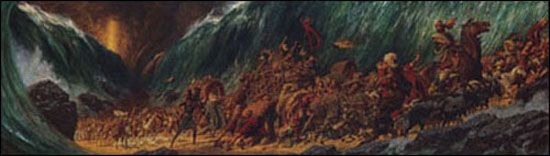
This art print, "The Parting of the Red Sea"
by Arnold Friberg is provided courtesy of Christ-Centered Art ---New Window
23 And the Egyptians pursued, and went in after them to the
midst of the sea, even ALL Pharaoh's horses, his chariots, and his horsemen. 24 And
it came to pass, that in the morning watch the LORD looked unto the host of the Egyptians
through the pillar of fire and of the cloud, and troubled the host of the Egyptians,
25 and took off their chariot wheels, that they drave
them heavily: so that the Egyptians said, Let us flee from the face of Israel; for
the LORD fighteth for them against the Egyptians."
26 And the LORD said unto Moses, Stretch out thine hand over
the sea, that the waters may come again upon the Egyptians, upon their chariots,
and upon their horsemen. 27
And Moses stretched forth his hand over the
sea, and the sea returned to his strength when the morning appeared; and the Egyptians
fled against it; and the LORD overthrew the Egyptians in the midst of the sea. 28 And
the waters returned, and covered the chariots, and the horsemen, and ALL THE HOST
OF PHARAOH that came into the sea after them; there remained not so much as one
of them."
"29 But the children
of Israel walked upon dry land in the midst of the sea; and the waters were
a WALL unto them on their right hand, and on their left. 30 Thus the LORD
saved Israel that day out of the hand of the Egyptians; and Israel saw the Egyptians
dead upon the sea shore. 31
And Israel saw that GREAT WORK which the LORD
did upon the Egyptians: and the people feared the LORD, and believed the LORD,
and His servant Moses."
Exodus
/ Chapter 15
The Song
hen sang Moses and
the children of Israel this Song unto the LORD, and spake, saying, I will
sing unto the LORD, for He hath triumphed gloriously: the horse and his rider
hath He thrown into the sea. 2 The LORD is my Strength and
Song, and He is become my Salvation: He is my God, and I will prepare Him an habitation;
my father's God, and I will exalt Him. 3 The
LORD is a Man of War: the LORD is His Name. 4 Pharaoh's chariots
and his host hath He cast into the sea: his chosen captains also are drowned
in the Red Sea. 5
The depths have covered them: they sank into the bottom as a stone. 6
Thy Right Hand, O LORD, is become glorious
in power: Thy Right Hand, O LORD, hath dashed in pieces the enemy. 7
And in the greatness of Thine excellency Thou
hast overthrown them that rose up against Thee: Thou sentest forth Thy wrath, which
consumed them as stubble.
 8 And
with the blast of Thy nostrils the waters were gathered together, the floods stood
upright as an heap, and the depths were congealed in the heart of the sea.
9 The enemy said, I will pursue, I will overtake, I will divide
the spoil; my lust shall be satisfied upon them; I will draw my sword, my hand shall
destroy them."
8 And
with the blast of Thy nostrils the waters were gathered together, the floods stood
upright as an heap, and the depths were congealed in the heart of the sea.
9 The enemy said, I will pursue, I will overtake, I will divide
the spoil; my lust shall be satisfied upon them; I will draw my sword, my hand shall
destroy them."
Truly, "the LORD saved Israel that day
out of the hand of the Egyptians." That
Great Day, recorded by Divine Inspiration from the hand of the very servant who held
his rod over the waters and saw them stand "upright
as an heap", recorded for the Divine purpose
that men would forever be encouraged by the "GREAT
WORK which the LORD did" for His people.
Dr. James A.
Wylie ---New Window (1808-1890) remembered this Bible Record when recounting a victorious
moment in history, attributing the triumph to "the
Great Judge [that]
had descended upon the scene":
"The tragedy of the Armada was a great sermon preached to the Popish and Protestant nations. The text of that sermon was that England had been saved by a Divine Hand. All acknowledged the skill and daring of the English admirals, and the patriotism and bravery of the English sailors and soldiers, but all at the same time confessed that these alone could not have saved the throne of Elizabeth. The Almighty Arm had been stretched out, and a work so stupendous had been wrought, as to be worthy of a place by the side of the wonders of old time.
There were a consecutiveness and a progression in the acts, a unity in the drama, and a sublimity in the terrible but righteous catastrophe in which it issued, that told the least reflective that the Armada's overthrow was not fortuitous, but the result of arrangement and plan. Even the Spaniards themselves confessed that the Divine Hand was upon them; that One looked forth at times from the storm cloud that pursued them, and troubled them. Christendom at large was solemnized: the ordinary course of events had been interrupted; the heavens had been bowed, and the Great Judge had descended upon the scene. While dismay reigned within the Popish kingdoms, the Protestant States joined in a chorus of thanksgiving. In England by the command of her Majesty, and in the United Provinces by order of the States-General, a day of festival was appointed, whereon all were commanded to repair to church, and 'render thanks unto God.' 'The aforesaid solemnity,' says the Dutch historian, 'was observed on the 29th of November, which day was wholly spent in fasting, prayer, and giving of thanks.' On that day Queen Elizabeth, royally attired, and followed by the estates and dignitaries of the realm, visited London, and rode through the streets of the City to the Cathedral of St. Paul's, in a triumphal chariot drawn by four white horses. The houses were hung with blue cloth; the citizens in their holiday dress lined the streets, ranged in companies, and displaying the ensigns and symbols of their various guilds and crafts. Eleven banners and flags which had been taken from the Spaniards hung displayed in front of St. Paul's. The queen with her clergy and nobles, having offered public thanks in the church, thereafter retired to Paul's Cross, where a sermon was preached from the same stone pulpit from which Ridley's and Latimer's voices had often been heard; and after the sermon the queen rose and addressed her assembled subjects, exhorting them to unite with her in extolling that merciful Power which had scattered her foes, and shielded from overthrow her throne and realm.
But the deliverance was a common one to the Protestant kingdoms. All shared in it with England, and each in turn took up this song of triumph. Zealand, in perpetual memory of the event, caused new coin of silver and brass to be struck, stamped on the one side with the arms of Zealand, and the words, 'Glory to God alone,' and on the other with a representation of certain great ships, and the words, 'The Spanish Fleet.' In the circumference round the ships was the motto, 'It came, went, and was. Anno 1588.' Holland, too, struck a commemorative medal of the Armada's destruction; and Theodore Beza, at Geneva, celebrated the event in Latin verse.
It seemed as if the days of Miriam, with their judgments and songs of triumph, had returned, and that the Hebrew prophetess had lent her timbrel to England, that she might sing upon it the destruction of a mightier host than that of Egypt, and the overthrow of a greater tyrant than he who lay drowned in the Red Sea. England began the song, as was meet, for around her isle had the Armada been led, a spectacle of doom; but soon, from beyond the German Ocean, from the foot of the Alps, from the shores of Scotland, other voices were heard swelling the anthem, and saying, 'Sing ye to the Lord, for he hath triumphed gloriously: the horse and his rider hath he thrown into the sea. The enemy said, I will pursue, I will overtake, I will divide the spoil; my lust shall be satisfied upon them; I will draw my sword, my hand shall destroy them. Thou didst blow with thy wind, the sea covered them: they sank as lead in the mighty waters.'" [Bold emphasis by WStS] --from "The History of Protestantism" ---New Window by J. A. Wylie, Vol.3, Book 23 ---New Window.
| "10 Thou didst blow with Thy wind, the sea covered them: they sank as lead in the mighty waters. 11 Who is like unto Thee, O LORD, among the gods? who is like Thee, glorious in Holiness, fearful in Praises, doing Wonders? | |
|
12 Thou stretchedst out Thy Right Hand, the Earth swallowed them. 13 Thou
in Thy mercy hast led forth the people which Thou hast Redeemed: Thou hast guided
them in Thy strength unto Thy holy habitation. till Thy people pass over, O
LORD, 17 Thou shalt bring them in, and plant them in the mountain of Thine inheritance, in the place, O LORD, which Thou hast made for Thee to dwell in, in the Sanctuary, O LORD, which Thy hands have established. 18 The LORD shall reign for ever and ever." |
|
Psalm 105
"23 Israel also came into Egypt; and Jacob sojourned in the land of Ham... 37 He brought them forth also with silver and gold: and there was not one feeble person among their tribes. 38 Egypt was glad when they departed: for the fear of them fell upon them. 39 He spread a Cloud for a covering; and Fire to give light in the night... 43 And He brought forth His people with joy, and His chosen with gladness: 44 And gave them the lands of the heathen: and they inherited the labour of the people; 45 that they might observe His Statutes, and keep His Laws. Praise ye the LORD."
THE END OF PART ONE
.
PART TWO OF "MOSES" in the "Stories of Faith" series

Section Index for Stories
Readers are permitted and encouraged to copy and freely share this article with others.

.
Homepage  Holy Bible
.Jehovah Jesus
Timeline .Prophecy Philadelphia Fellowship Promises Stories Poetry Links
Holy Bible
.Jehovah Jesus
Timeline .Prophecy Philadelphia Fellowship Promises Stories Poetry Links

Purpose ||.What's New
|| Tribulation Topics || Download Page || Today's Entry
Topical Links:
Salvation || Catholicism || Sound Doctrine || Prayer
Privacy Policy
.