|
||||||||||||||||||||||||||||||
 |
||||||||||||||||||||||||||||||
|
||||||||||||||||||||||||||||||
|
||||||||||||||||||||||||||||||
 |
||||||||||||||||||||||||||||||
|
||||||||||||||||||||||||||||||
|
||||||||||||||||||||||||||||||
|
||||||||||||||||||||||||||||||
|
||||||||||||||||||||||||||||||
|
||||||||||||||||||||||||||||||
|
||||||||||||||||||||||||||||||
|
||||||||||||||||||||||||||||||
|
||||||||||||||||||||||||||||||
|
||||||||||||||||||||||||||||||


Volume First - Book Second

|
. |
. |
|
|
|

| Chapter 1 | WICLIFFE: HIS BIRTH AND EDUCATION The Principle and the Rite — Rapid Growth of the One — Slow Progress and ultimate Triumph of the Other — England — Wicliffe — His Birthplace — His Education — Goes to Oxford — Enters Merton College — Its Fame — The Evangelical Bradwardine — His Renown — Pioneers the Way for Wicliffe — The Philosophy of those Days — Wicliffe's Eminence as a Scholastic — Studies also the Canon and Civil Laws — His Conversion — Theological Studies — The Black Death — Ravages Greece, Italy, etc. — Enters England — Its awful Desolations — Its Impression on Wicliffe — Stands Face to Face with Eternal Death — Taught not to Fear the Death of the Body. |
| Chapter 2 | WICLIFFE, AND THE POPE'S ENCROACHMENTS ON ENGLAND Personal Appearance of Wicliffe — His Academic Career — Bachelor of Theology — Lectures on the Bible — England Quarrels with the Pope — Wicliffe Defends the King's Prerogative — Innocent III. — The Pope Appoints to the See of Canterbury — King John Resists — England Smitten with Interdict — Terrors of the Sentence — The Pope Deposes the King — Invites the French King to Conquer England — John becomes the Pope's Vassal — The Barons extort Magna Charta — The Pope Excommunicates the Barons — Annuls the Charter — The Courage of the Barons Saves England — Demand of Urban V. — Growth of England — National Opposition to Papal Usurpations — Papal Abuses — Statutes of Provisors and Praemunire. |
| Chapter 3 | WICLIFFE'S BATTLE WITH ROME FOR ENGLAND'S INDEPENDENCE Impatience of the King and the Nation — Assembling of Lords and Commons — Shall England Bow to Rome? — The Debate — The Pope's Claim Unanimously Repudiated — England on the Road to Protestantism — Wicliffe's Influence — Wicliffe Attacked by an Anonymous Monk — His Reply — Vindicates the Nation's Independence — A Momentous Issue — A Greater Victory than Crecy — His Appeal to Rome Lost — Begins to be regarded as the Centre of a New Age. |
| Chapter 4 | WICLIFFE'S BATTLE WITH THE MENDICANT FRIARS Wicliffe's Mental Conflicts — Rise of the Monastic Orders — Fascinating Pictures of Monks and Monasteries — Early Corruption of the Orders — Testimony of Contemporary Witnesses — The New Monastic Orders — Reason for their Institution — St. Francis — His Early Life — His Appearance before Innocent III. — Commission to Found an Order — Rapid Increase of the Franciscans — St. Dominic — His Character — Founds the Dominicans — Preaching Missionaries and Inquisitors — Constitution of the New Orders — The Old and New Monks Compared — Their Vow of Poverty — How Evaded — Their Garb — Their Vast Wealth — Palatial Edifices — Their Frightful Degeneracy — Their Swarms Overspread England — Their Illegal Practices — The Battle against them Begun by Armachanus — He Complains against them to the Pope — His Complaint Disregarded — He Dies. |
| Chapter 5 | THE FRIARS VERSUS THE GOSPEL IN ENGLAND The Joy of the Friars — Wicliffe Resumes the Battle — Demands the Abolition of the Orders — The Arrogance of the Friars — Their Luxury — Their Covetousness — Their Oppression of the Poor — The Agitation in England — Questions touching the Gospel raised thereby — Is it from the Friar or from Christ that Pardon is to be had? — Were Christ and the Apostles Mendicants? — Wicliffe's Tractate, Objections to Friars — It launches him on his Career as a Reformer — Preaches in this Tractate the Gospel to England — Attack on the Power of the Keys — No Pardon but from God — Salvation without Money. |
| Chapter 6 | THE BATTLE OF THE PARLIAMENT WITH THE POPE Resume of Political Progress — Foreign Ecclesiastics appointed to English Benefices — Statutes of Provisors and Praemunire meant to put an End to the Abuse — The Practice still Continued — Instances — Royal Commissioners sent to Treat with the Pope concerning this Abuse — Wicliffe chosen one of the Commissioners — The Negotiation a Failure — Nevertheless of Benefit to Wicliffe by the Insight it gave him into the Papacy — Arnold Garnier — The "Good Parliament" — Its Battle with the Pope — A Greater Victory than Crecy — Wicliffe waxes Bolder — Rage of the Monks. |
| Chapter 7 | PERSECUTION OF WICLIFFE BY THE POPE AND THE HIERARCHY Wicliffe's Writings Examined — His Teaching submitted to the Pope — Three Bulls issued against him — Cited to appear before the Bishop of London — John of Gaunt Accompanies him — Portrait of Wicliffe before his Judges — Tumult — Altercation between Duke of Lancaster and Bishop of London — The Mob Rushes in — The Court Broken up — Death of Edward III. — Meeting of Parliament — Wicliffe Summoned to its Councils — Question touching the Papal Revenue from English Sees submitted to him — Its Solution — England coming out of the House of Bondage. |
| Chapter 8 | HIERARCHICAL PERSECUTION OF WICLIFFE RESUMED Arrival of the Three Bulls — Wicliffe's Anti-Papal Policy — Entirely Subversive of Romanism — New Citation — Appears before the Bishops at Lambeth — The Crowd — Its Reverent Behavior to Wicliffe — Message from the Queen — Dowager to the Court — Dismay of the Bishops — They abruptly Terminate the Sitting — English Tumults in the Fourteenth Century compared with French Revolutions in the Nineteenth — Substance of Wicliffe's Defense — The Binding and Loosing Power. |
| Chapter 9 | WICLIFFE'S VIEWS ON CHURCH PROPERTY AND CHURCH REFORM An Eternal Inheritance — Overgrown Riches — Mortmain — Its Ruinous Effects — These Pictured and Denounced by Wicliffe — His Doctrine touching Ecclesiastical Property — Tithes — Novelty of his Views — His Plan of Reform — How he Proposed to Carry it out — Rome a Market — Wicliffe's Independence and Courage — His Plan substantially Proposed in Parliament after his Death — Advance of England — Her Exodus from the Prison-house — Sublimity of the Spectacle — Ode of Celebration. |
| Chapter 10 | THE TRANSLATION OF THE SCRIPTURES, OR THE ENGLISH BIBLE. Peril of Wicliffe — Death of Gregory XI. — Death of Edward III. — Consequent Safety of Wicliffe — Schism in the Papal Chair — Division in Christendom — Which is the True Pope? — A Papal Thunderstorm — Wicliffe Retires to Lutterworth — His Views still Enlarging — Supreme Authority of Scripture — Sickness, and Interview with the Friars — Resolves to Translate the Bible — Early Translations — Bede, etc. — Wicliffe's Translation — Its Beauty — The Day of the Reformation has fairly Broken — Transcription and Publication - Impression produced — Right to Read the Bible — Denounced by the Priests -Defended by Wicliffe - Transformation accomplished on England. |
| Chapter 11 | WICLIFFE AND TRANSUBSTANTIATION Wicliffe Old – Continues the War – Attacks Transubstantiation – History of the Dogma – Wicliffe's Doctrine on the Eucharist – Condemned by the University Court – Wicliffe Appeals to the King and Parliament, and Retires to Lutterworth – The Insurrection of Wat Tyler – The Primate Sudbury Beheaded – Courtenay elected Primate – He cites Wicliffe before him – The Synod at Blackfriars – An Earthquake – The Primate reassures the Terrified Bishops – Wicliffe's Doctrine on the Eucharist Condemned – The Primate gains over the King – The First Persecuting Edict – Wicliffe's Friends fall away. |
| Chapter 12 | WICLIFFE'S APPEAL TO PARLIAMENT. Parliament meets – Wicliffe appears, and demands a Sweeping Reform – His Propositions touching the Monastic Orders – The Church's Temporalities – Transubstantiation – His growing Boldness – His Views find an echo in Parliament – The Persecuting Edict Repealed. |
| Chapter 13 | WICLIFFE BEFORE CONVOCATION IN PERSON, AND BEFORE THE ROMAN CURIA BY LETTER Convocation at Oxford — Wicliffe cited — Arraigned on the Question of Transubstantiation — Wicliffe Maintains and Reiterates the Teaching of his whole Life — He Arraigns his Judges — They are Dismayed — Wicliffe Retires Unmolested — Returns to Lutterworth — Cited by Urban VI. to Rome — Unable to go — Sends a Letter — A Faithful Admonition — Scene in the Vatican — Christ's and Antichrist's Portraits. |
| Chapter 14 | WICLIFFE'S LAST DAYS Anticipation of a Violent Death — Wonderfully Shielded by Events — Struck with Palsy — Dies December 31st, 1384 — Estimate of his Position and Work — Completeness of his Scheme of Reform — The Father of the Reformation — The Founder of England's Liberties. |
| Chapter 15 | WICLIFFE'S THEOLOGICAL AND CHURCH SYSTEM His Theology drawn from the Bible solely — His Teaching embraced the Following Doctrines: The Fall — Man's Inability — Did not formulate his Views into a System — His "Postils" — His Views on Church Order and Government — Apostolic Arrangements his Model — His Personal Piety — Lechler's Estimate of him as a Reformer. |
 RESEARCH INDEX ----New Window
WITH the revolving centuries we behold the world slowly emerging into the light.
The fifth century brought with it a signal blessing to Christianity in the guise
of a disaster. Like a tree that was growing too rapidly, it was cut down to its roots
that it might escape a luxuriance which would have been its ruin. From a Principle
that has its seat in the heart, and the fruit of which is an enlightened understanding
and a holy life, Religion, under the corrupting influences of power and riches, was
being transformed into a Rite, which, having its sphere solely in the senses, leaves
the soul in darkness and the life in bondage.
These two, the Principle and the Rite, began so early as the fourth and fifth centuries
to draw apart, and to develop each after its own kind. The rite rapidly progressed,
and seemed far to outstrip its rival. It built for itself gorgeous temples, it enlisted
in its service a powerful hierarchy, it added year by year to the number and magnificence
of its ceremonies, it expressed itself in canons and constitutions; and, seduced
by this imposing show, nations bowed down before it, and puissant kings lent their
swords for its defense and propagation.
Far otherwise was it with its rival. Withdrawing into the spiritual sphere, it appeared
to have abandoned the field to its antagonist. Not so, however. If it had hidden
itself from the eyes of men, it was that it might build up from the very foundation,
piling truth upon truth, and prepare in silence those mighty spiritual forces by
which it was in due time to emancipate the world. Its progress was consequently less
marked, but was far more real than that of its antagonist. Every error which the
one pressed into its service was a cause of weakness; every truth which the other
added to its creed was a source of strength. The uninstructed and superstitious hordes
which the one received into its communion were dangerous allies. They might follow
it in the day of its prosperity, but they would desert it and become its foes whenever
the tide of popular favor turned against it. Not so the adherents of the other. With
purified hearts and enlightened understandings, they were prepared to follow it at
all hazards. The number of its disciples, small at first, continually multiplied.
The purity of their lives, the meekness with which they bore the injuries inflicted
on them, and the heroism with which their death was endured, augmented from age to
age the moral power and the spiritual glory of their cause. And thus, while the one
reached its fall through its very success, the other marched on through oppression
and proscription to triumph.
We have arrived at the beginning of the fourteenth century. We have had no occasion
hitherto to speak of the British Isles, but now our attention must be turned to them.
Here a greater light is about to appear than any that had illumined the darkness
of the ages that had gone before.
In the North Riding of Yorkshire, watered by the Tees, lies the parish of Wicliffe.
In the manor-house of this parish, in the year 1324, [1] was born a child, who was named John. Here his ancestors
had lived since the time of the Conquest, and according to the manner of the times,
they took their surname from the place of their residence, and the son now born to
them was known as John de Wicliffe. Of his boyhood nothing is recorded. He was destined
from an early age for the Church, which gives us ground to conclude that even then
he discovered that penetrating intelligence which marked his maturer years, and that
loving sympathy which drew him so often in after life to the homesteads and the sick-beds
of his parish of Lutterworth. Schools for rudimental instruction were even then pretty
thickly planted over England, in connection with the cathedral towns and the religious
houses; and it is probable that the young Wicliffe received his first training at
one of these seminaries in his own neighborhood.[2]
At the age of sixteen or thereabouts, Wicliffe was sent to Oxford. Here he
became first a scholar, and next a fellow of Merton College, the oldest foundation
save one in Oxford.[3]
The youth of England, athirst for knowledge, the fountains of which had long
been sealed up, were then crowding to the universities, and when Wicliffe entered
Merton there were not fewer than 30,000 students at Oxford. These numbers awaken
surprise, but it is to be taken into account that many of the halls were no better
than upper schools. The college which Wicliffe joined was the most distinguished
at that seat of learning. The fame, unrivaled in their own day, which two of its
scholars, William Occam and Duns Scotus, had attained, shed a luster upon it. One
of its chairs had been filled by the celebrated Bradwardine,[4] who was closing his career at Merton about the time that
the young Wicliffe was opening his in Oxford. Bradwardine was one of the first mathematicians
and astronomers of his day; but having been drawn to the study of the Word of God,
he embraced the doctrines of free grace, and his chair became a fountain of higher
knowledge than that of natural science. While most of his contemporaries, by the
aid of a subtle scholasticism, were endeavoring to penetrate into the essence of
things, and to explain all mysteries, Bradwardine was content to accept what God
had revealed in His Word, and this humility was rewarded by his finding the path
which others missed. Lifting the veil, he unfolded to his students, who crowded round
him with eager attention and admiring reverence, the way of life, warning them especially
against that Pelagianism which was rapidly substituting a worship of externals for
a religion of the heart, and teaching men to trust in their power of will for a salvation
which can come only from the sovereign grace of God. Bradwardine was greater as a
theologian than he had been as a philosopher. The fame of his lectures filled Europe,
and his evangelical views, diffused by his scholars, helped to prepare the way for
Wicliffe and others who were to come after him. It was around his chair that the
new day was seen first to break.
A quick apprehension, a penetrating intellect, and a retentive memory, enabled the
young scholar of Merton to make rapid progress in the learning of those days. Philosophy
then lay in guesses rather than in facts. Whatever could be known from having been
put before man in the facts of Nature or the doctrines of Revelation, was deemed
not worth further investigation. It was too humble an occupation to observe and to
deduce. In the pride of his genius, man turned away from a field lying at his feet,
and plunged boldly into a region where, having no data to guide him and no ground
for solid footing, he could learn really nothing. From this region of vague speculation
the explorer brought back only the images of his own creating, and, dressing up these
fancies as facts, he passed them off as knowledge.
Such was the philosophy that invited the study of Wicliffe.[5] There was scarce enough in it to reward his labor, but he
thirsted for knowledge, and giving himself to it "with his might," he soon
became a master in the scholastic philosophy, and did not fear to encounter the subtlest
of all the subtle disputants in the schools of Oxford. He was "famously reputed,"
says Fox, "for a great clerk, a deep schoolman, and no less expert in all kinds
of philosophy." Walden, his bitter enemy, writing to Pope Martin V. respecting
him, says that he was "wonderfully astonished" at the "vehemency and
force of his reasonings," and the "places of authority" with which
they were fortified.[6]
To his knowledge of scholastics he added great proficiency in both the canon
and civil laws. This was a branch of knowledge which stood him in more stead in after
years than the other and more fashionable science. By these studies he became versed
in the constitution and laws of his native country, and was fitted for taking an
intelligent part in the battle which soon thereafter arose between the usurpations
of the Pontiff and the rights of the crown of England. "He had an eye for the
most different things," says Lechler, speaking of Wicliffe, "and took a
lively interest in the most multifarious questions."[7]
But the foundation of Wicliffe's greatness was laid in a higher teaching than
any that man can give. It was the illumination of his mind and the renewal of his
heart by the instrumentality of the Bible that made him the Reformer — certainly,
the greatest of all the Reformers who appeared before the era of Luther. Without
this, he might have been remembered as an eminent scholastic of the fourteenth century,
whose fame has been luminous enough to transmit a few feeble rays to our own age;
but he never would have been known as the first to bear the axe into the wilderness
of Papal abuses, and to strike at the roots of that great tree of which others had
been content to lop off a few of the branches. The honor would not have been his
to be the first to raise that Great Protest, which nations will bear onwards till
it shall have made the circuit of the earth, proclaiming, "Fallen is every idol,
razed is every stronghold of darkness and tyranny, and now is come salvation, and
the kingdom of our Lord and of His Christ, and He shall reign for ever."
How Wicliffe came to a knowledge of the truth it is not difficult to guess. He was,
D'Aubigne informs us, one of the scholars of the evangelical Bradwardine.[8] As he heard the great master discourse day by day on the
sovereignty of grace and the freeness of salvation, a new light would begin to break
upon the mind of the young scholastic. He would turn to a diviner page than that
of Plato. But for this Wicliffe might have entered the priesthood without ever having
studied a single chapter of the Bible, for instruction in theology formed no part
of preparation for the sacred office in those days.
No doubt theology, after a fashion, was studied, yet not a theology whose substance
was drawn from the Bible, but a man-invented system. The Bachelors of Theology of
the lowest grade held readings in the Bible. Not so, however, the Bachelors of the
middle and highest grades: these founded their prelections upon the Sentences of
Peter Lombard. Puffed up with the conceit of their mystical lore, they regarded it
beneath their dignity to expound so elementary a book as the Holy Scriptures. The
former were named contemptuously .Biblicists; the latter were honorably designated
Sententiarii, or Men of the Sentences.[9]
"There was no mention," says Fox, describing the early days of Wicliffe,
"nor almost any word spoken of Scripture. Instead of Peter and Paul, men occupied
their time in studying Aquinas and Scotus, and the Master of Sentences." "Scarcely
any other thing was seen in the temples or churches, or taught or spoken of in sermons,
or finally intended or gone about in their whole life, but only heaping up of certain
shadowed ceremonies upon ceremonies; neither was there any end of their heaping.
The people were taught to worship no other thing but that which they did see, and
they did see almost nothing which they did not worship."[10] In the midst of these groveling superstitions, men were startled
by the approach of a terrible visitant. The year 1348 was fatally signalized by the
outbreak of a fearful pestilence, one of the most destructive in history. Appearing
first in Asia, it took a westerly course, traversing the globe like the pale horse
and his rider in the Apocalypse, terror marching before it, and death following in
its rear. It ravaged the Shores of the Levant, it desolated Greece, and going on
still toward the west, it struck Italy with terrible severity. Florence, the lovely
capital of Etruria, it turned into a charnel-house. The genius of Boccaccio painted
its horrors, and the muse of Petrarch bewailed its desolations. The latter had cause,
for Laura was among its victims. Passing the Alps it entered Northern Europe, leaving,
say some contemporary historians, only a tenth of the human race alive. This we know
is an exaggeration; but it expresses the popular impression, and sufficiently indicates
the awful character of those ravages, in which all men heard, as it were, the footsteps
of coming death. The sea as well as the land was marked with its devastating prints.
Ships voyaging afar on the ocean were overtaken by it, and when the winds piloted
them to land, they were found to be freighted with none but the dead.
On the 1st of August the plague touched the shores of England. "Beginning at
Dorchester," says Fox, "every day twenty, some days forty, some fifty,
and more, dead corpses, were brought and laid together in one deep pit." On
the 1st day of November it reached London, "where," says the same chronicler,
"the vehement rage thereof was so hot, and did increase so much, that from the
1st day of February till about the beginning of May, in a church-yard then newly
made by Smithfield [Charterhouse], about two hundred dead corpses every day were
buried, besides those which in other church-yards of the city were laid also."[11]
"In those days," says another old chronicler, Caxton, "was
death without sorrow, weddings without friendship, flying without succor; scarcely
were there left living folk for to bury honestly them that were dead." Of the
citizens of London not fewer than 100,000 perished. The ravages of the plague were
spread over all England, and a full half of the nation was struck down. From men
the pestilence passed to the lower animals. Putrid carcasses covered the fields;
the labors of the husbandman were suspended; the soil ceased to be ploughed, and
the harvest to be reaped; the courts of law were closed, and Parliament did not meet;
everywhere reigned terror, mourning, and death.
This dispensation was the harbinger of a very different one. The tempest that scathed
the earth opened the way for the shower which was to fertilize it. The plague was
not without its influence on that great movement which, beginning with Wicliffe,
was continued in a line of confessors and martyrs, till it issued in the Reformation
of Luther and Calvin. Wicliffe had been a witness of the passage of the destroyer;
he had seen the human race fading from off the earth as if the ages had completed
their cycle, and the end of the world was at hand. He was then in his twenty-fifth
year, and could not but be deeply impressed by the awful events passing around him.
"This visitation of the Almighty," says D'Aubigne, "sounded like the
trumpet of the judgment-day in the heart of Wicliffe."[12] Bradwardine had already brought him to the Bible, the plague
brought him to it a second time; and now, doubtless, he searched its page more earnestly
than ever. He came to it, not as the theologian, seeking in it a deeper wisdom than
any mystery which the scholastic philosophy could open to him; nor as the scholar,
to refine his taste by its pure models, and enrich his understanding by the sublimity
of its doctrines; nor even as the polemic, in search of weapons wherewith, to assail
the dominant superstitions; he now came to the Bible as a lost sinner, seeking how
he might be saved. Nearer every day came the messenger of the Almighty. The shadow
that messenger cast before him was hourly deepening; and we can hear the young student,
who doubtless in that hour felt the barrenness and insufficiency of the philosophy
of the schools, lifting up with increasing vehemency the cry, "Who shall deliver
me from the wrath to come?"
It would seem to be a law that all who are to be reformers of their age shall first
undergo a conflict of soul. They must feel in their own ease the strength of error,
the bitterness of the bondage in which it holds men, and stand face to face with
the Omnipotent Judge, before they can become the deliverers of others. This only
can inspire them with pity for the wretched captives whose fetters they seek to break,
and give them courage to brave the oppressors from whose cruelty they labor to rescue
them. This agony of soul did Luther and Calvin undergo; and a distress and torment
similar in character, though perhaps not so great in degree, did Wicliffe endure
before beginning his work. His sins, doubtless, were made a heavy burden to him —
so heavy that he could not lift up his head. Standing on the brink of the pit, he
says, he felt how awful it was to go down into the eternal night, "and inhabit
everlasting burnings." The joy of escape from a doom so terrible made him feel
how small a matter is the life of the body, and how little to be regarded are the
torments which the tyrants of earth have it in their power to inflict, compared with
the wrath of the Ever-living God. It is in these fires that the reformers have been
hardened. It is in this school that they have learned to defy death and to sing at
the stake. In this armor was Wicliffe clad before he was sent forth into the battle.
CHAPTER 2 Back
to Top
WICLIFFE, AND THE POPE'S ENCROACHMENTS ON ENGLAND
Personal Appearance of Wicliffe — His Academic Career — Bachelor of Theology — Lectures
on the Bible — England Quarrels with the Pope — Wicliffe Defends the King's Prerogative
— Innocent III. — The Pope Appoints to the See of Canterbury — King John Resists
— England Smitten with Interdict — Terrors of the Sentence — The Pope Deposes the
King — Invites the French King to Conquer England — John becomes the Pope's Vassal
— The Barons extort Magna Charta — The Pope Excommunicates the Barons — Annuls the
Charter — The Courage of the Barons Saves England — Demand of Urban V. — Growth of
England — National Opposition to Papal Usurpations — Papal Abuses — Statutes of Provisors
and Praemunire.
OF the merely personal incidents of Wicliffe's life almost nothing is recorded.
The services done for his own times, and for the ages that were to follow, occupy
his historians to the exclusion of all strictly personal matters. Few have acted
so large a part, and filled so conspicuous a place in the eyes of the world, of whom
so few private reminiscences and details have been preserved. The charm of a singular
sweetness, and the grace of a rare humility and modesty, appear to have characterized
him. These qualities were blended with a fine dignity, which he wore easily, as those
nobly born do the insignia of their rank. Not blameless merely, but holy, was the
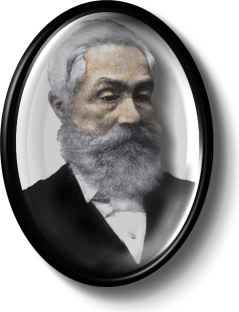
life he lived in an age of unexampled degeneracy. "From his portrait,"
says the younger M'Crie, "which has been preserved, some idea may be formed
of the personal appearance of the man. He must have been a person of noble aspect
and commanding attitude. The dark piercing eye, the aquiline features, and firm-set
lips, with the sarcastic smile that mantles over them, exactly agree with all we
know of the bold and unsparing character of the Reformer."[1]
A few sentences will suffice to trace the various stages of Wicliffe's academic career.
He passed twenty years at Merton College, Oxford — first as a scholar and next as
a fellow. In 1360 he was appointed to the Mastership of Balliol College. This preferment
he owed to the fame he had acquired as a scholastic.[2]
Having become a Bachelor of Theology, Wicliffe had now the privilege of giving
public lectures in the university on the Books of Scripture. He was forbidden to
enter the higher field of the Sentences of Peter of Lombardy — if, indeed, he was
desirous of doing so. This belonged exclusively to the higher grade of Bachelors
and Doctors in Theology. But the expositions he now gave of the Books of Holy Writ
proved of great use to himself. He became more profoundly versed in the knowledge
of divine things; and thus was the professor unwittingly prepared for the great work
of reforming the Church, to which the labors of his after-life were to be directed.[3]
He was soon thereafter appointed (1365) to be head of Canterbury Hall. This
was a new college, founded by Simon de Islip,,[4] Archbishop of Canterbury. The constitution of this college
ordained that its fellowships should be held by four monks and eight secular priests.
The rivalship existing between the two orders was speedily productive of broils,
and finally led to a conflict with the university authorities; and the founder, finding
the plan unworkable, dismissed the four monks, replaced them with seculars, and appointed
Wicliffe as Master ,or Warden. Within a year Islip died, and was succeeded in the
primacy by Langham, who, himself a monk, restored the expelled regulars, and, displacing
Wicliffe from his Wardenship, appointed a new head to the college. Wicliffe then
appealed to the Pope; but Langham had the greater influence at Rome, and after a
long delay, in 1370, the cause was given against Wicliffe.[5]
It was pending this decision that events happened which opened to Wicliffe
a wider arena than the halls of Oxford. Henceforth, it was not against the monks
of Canterbury Hall, or even the Primate of England — it was against the Prince Pontiff
of Christendom that Wicliffe was to do battle. In order to understand what we are
now to relate, we must go back a century.
The throne of England was then filled by King John, a vicious, pusillanimous, and
despotic monarch, but nevertheless capable by fits and starts of daring and brave
deeds. In 1205, Hubert, the Primate of England, died. The junior canons of Canterbury
met clandestinely that very night, and without any conge d'elire, elected Reginald,
their sub-prior, Archbishop of Canterbury, and installed him in the archiepiscopal
throne before midnight.[6]
By the next dawn Reginald was on his way to Rome, whither he had been dispatched
by his brethren to solicit the Pope's confirmation of his election. When the king
came to the knowledge of the transaction, he was enraged at its temerity, and set
about procuring the election of the Bishop of Norwich to the primacy. Both parties
— the king and the canons — sent agents to Rome to plead their cause before the Pope.
The man who then filled the chair of Peter, Innocent III., was vigorously prosecuting
the audacious project of Gregory VII., of subordinating the rights and power of princes
to the Papal See, and of taking into his own hands the appointment to all the episcopal
sees of Christendom, that through the bishops and priests, now reduced to an absolute
monarchy entirely dependent upon the Vatican, he might govern at his will all the
kingdoms of Europe. No Pope ever was more successful in this ambitious policy than
the man before whom the King of England on the one hand, and the canons of Canterbury
on the other, now carried their cause. Innocent annulled both elections — that of
the canons and that of the king — and made his own nominee, Cardinal Langton, be
chosen to the See of Canterbury.[7]
But this was not all. The king had appealed to the Pope; and Innocent saw
in this a precedent, not to be let slip, for putting in the gift of the Pontiff in
all time coming what, after the Papal throne, was the most important dignity in the
Roman Church.
John could not but see the danger, and feel the humiliation implied in the step taken
by Innocent. The See of Canterbury was the first seat of dignity and jurisdiction
in England, the throne excepted. A foreign power had appointed one to fill that august
seat. In an age in which the ecclesiastical was a more formidable authority than
the temporal, this was an alarming encroachment on the royal prerogative and the
nation's independence. Why should the Pope be content to appoint to the See of Canterbury?
Why should he not also appoint to the throne, the one other seat in the realm that
rose above it? The king protested with many oaths that the Pope's nominee should
never sit in the archiepiscopal chair. He waxed bold for the moment, and began the
battle as if he meant to win it. He turned the canons of Canterbury out of doors,
ordered all the prelates and abbots to leave the kingdom, and bade defiance to the
Pope. It was not difficult to foresee what would be the end of a conflict carried
on by the weakest of England's monarchs, against the haughtiest and most powerful
of Rome's Popes. The Pontiff smote England with interdict;[8] the king had offended, and the whole nation must be punished
along with him. Before we can realize the terrors of such a sentence, we must forget
all that the past three centuries have taught us, and surrender our imaginations
to the superstitious beliefs which armed the interdict with its tremendous power.
The men of those times, on whom this doom fell, saw the gates of heaven locked by
the strong hand of the Pontiff, so that none might enter who came from the unhappy
realm lying under the Papal ban. All who departed this life must wander forlorn as
disembodied ghosts in some doleful region, amid unknown sufferings, till it should
please him who carried the keys to open the closed gates. As the earthly picture
of this spiritual doom, all the symbols of grace and all the ordinances of religion
were suspended. The church-doors were closed; the lights at the altar were extinguished;
the bells ceased to be rung; the crosses and images were taken down and laid on the
ground; infants were baptized in the church-porch; marriages were celebrated in the
church-yard; the dead were buried in ditches or in the open fields. No one durst
rejoice, or eat flesh, or shave his beard, or pay any decent attention to his person
or apparel. It was meet that only signs of distress and mourning and woe should be
visible throughout a land over which there rested the wrath of the Almighty; for
so did men account the ban of the Pontiff.
King John braved this state of matters for two whole years. But Pope Innocent was
not to be turned from his purpose; he resolved to visit and bow the obstinacy of
the monarch by a yet more terrible infliction. He pronounced sentence of excommunication
upon John, deposing him from his throne, and absolving his subjects from allegiance.
To carry out this sentence it needed an armed force, and Innocent, casting his eyes
around him, fixed on Philip Augustus, King of France, as the most suitable person
to deal the blow on John, offering him the Kingdom of England for his pains. It was
not the interest of Philip to undertake such an enterprise, for the same boundless
and uncontrollable power which was tumbling the King of England from his throne might
the next day, on some ghostly pretense or other, hurl King Philip Augustus from his.
But the prize was a tempting one, and the monarch of France, collecting a mighty
armament, prepared to cross the Channel and invade England.[9]
When King John saw the brink on which he stood, his courage or obstinacy forsook
him. He craved an interview with Pandulf, the Pope's legate, and after a short conference,
he promised to submit himself unreservedly to the Papal See. Besides engaging to
make full restitution to the clergy for the losses they had suffered, he "resigned
England and Ireland to God, to St. Peter, and St. Paul, and to Pope Innocent, and
to his successors in the apostolic chair; he agreed to hold these dominions as feudatory
of the Church of Rome by the annual payment of a thousand marks; and he stipulated
that if he or his successors should ever presume to revoke or infringe this charter,
they should instantly, except upon admonition they repented of their offense, forfeit
all right to their dominions." The transaction was finished by the king doing
homage to Pandulf, as the Pope's legate, with all the submissive rites which the
feudal law required of vassals before their liege lord and superior. Taking off his
crown, it is said, John laid it on the ground; and the legate, to show the mightiness
of his master, spurning it with his foot, kicked it about like a worthless bauble;
and then, picking it out of the dust, placed it on the craven head of the monarch.
This transaction took place on the 15th May, 1213. There is no moment of profounder
humiliation than this in the annals of England.[10]
But the barons were resolved not to be the slaves of a Pope; their intrepidity
and patriotism wiped off the ineffable disgrace which the baseness of the monarch
had inflicted on the country. Unsheathing their swords, they vowed to maintain the
ancient liberties of England, or die in the attempt. Appearing before the king at
Oxford, April, 1215, "here," said they, "is the charter which consecrates
the liberties confirmed by Henry II., and which you also have solemnly sworn to observe."
The king stormed. "I will not," said he, "grant you liberties which
would make me a slave." John forgot that he had already become a slave. But
the barons were not to be daunted by haughty words which the king had no power to
maintain: he was odious to the whole nation; and on the 15th of June, 1215, John
signed the Magna Charta at Runnymede.[11]
This was in effect to tell Innocent that he revoked his vow of vassalage,
and took back the kingdom which he had laid at his feet.
When tidings were carried to Rome of what John had done, the ire of Innocent III.
was kindled to the uttermost. That he, the vicar of God, who held all the crowns
of Christendom in his hand, and stood with his foot planted upon all its kingdoms,
should be so affronted and so defied, was not to be borne! Was he not the feudal
lord of the kingdom? was not England rightfully his? had it not been laid at his
feet by a deed and covenant solemnly ratified? Who were these wretched barons, that
they should withstand the Pontifical will, and place the independence of their country
above the glory of the Church? Innocent instantly launched an anathema against these
impious and rebellious men, at the same time inhibiting the king from carrying out
the provisions of the Charter which he had signed, or in any way fulfilling its stipulations.[12]
But Innocent went still farther. In the exercise of that singular prescience
which belongs to that system by which this truculent holder of the tiara was so thoroughly
inspired, and of which he was so perfect an embodiment, he divined the true nature
of the transaction at Runnymede. Magna Charta was a great political protest against
himself and his system. It inaugurated an order of political ideas, and a class of
political rights, entirely antagonistic to the fundamental principles and claims
of the Papacy. Magna Charta was constitutional liberty standing up before the face
of the Papal absolutism, and throwing down the gage of battle to it. Innocent felt
that he must grapple now with this hateful and monstrous birth, and strangle it in
its cradle; otherwise, should he wait till it was grown, it might be too strong for
him to crush. Already it had reft away from him one of the fairest of those realms
which he had made dependent upon the tiara; its assaults on the Papal prerogative
would not end here; he must trample it down before its insolence had grown by success,
and other kingdoms and their rulers, inoculated with the impiety of these audacious
barons, had begun to imitate their example. Accordingly, fulminating a bull from
the plenitude of his apostolic power, and from the authority of his commission, as
set by God over the kingdoms "to pluck up and destroy, to build and to plant,"
he annulled and abrogated the Charter, declaring all its obligations and guarantees
void.[13]
In the signing of the Great Charter we see a new force coming into the field,
to make war against that tyranny which first corrupted the souls of men before it
enslaved their bodies. The divine or evangelic element came first, political liberty
came after. The former is the true nurse of the latter; for in no country can liberty
endure and ripen its fruits where it has not had its beginning in the moral part
of man. Innocent was already contending against the evangelical principle in the
crusades against the Albigenses in the south of France, and now there appeared, among
the hardy nations of the North, another antagonist, the product of the first, that
had come to strengthen the battle against a Power, which from its seat on the Seven
Hills was absorbing all rights and enslaving all nations. The bold attitude of the
barons saved the independence of the nation. Innocent went to the grave; feebler
men succeeded him in the Pontifical chair; the Kings of England mounted the throne
without taking the oath of fealty to the Pope, although they continued to transmit,
year by year, the thousand marks which John had agreed to pay into the Papal treasury.
At last, in the reign of Edward II., this annual payment was quietly dropped. No
remonstrance against its discontinuance came from Rome.
But in 1365, after the payment of the thousand marks had been intermitted for thirty-five
years, it was suddenly demanded by Pope Urban V. The demand was accompanied with
an intimation that should the king, Edward III., fail to make payment, not only of
the annual tribute, but of all arrears, he would be summoned to Rome to answer before
his liege lord, the Pope, for contumacy. This was in effect to say to England, "Prostrate
yourself a second time before the Pontifical chair." The England of Edward III.
was not the England of King John; and this demand, as unexpected as it was insulting,
stirred the nation to its depths. During the century which had elapsed since the
Great Charter was signed, England's growth in all the elements of greatness had been
marvelously rapid. She had fused Norman and Saxon into one people; she had formed
her language; she had extended her commerce; she had reformed her laws; she had founded
seats of learning, which had already become renowned; she had fought great battles
and won brilliant victories; her valor was felt and her power feared by the Continental
nations; and when this summons to do homage as a vassal of the Pope was heard, the
nation hardly knew whether to meet it with indignation or with derision.
What made the folly of Urban in making such a demand the more conspicuous, was the
fact that the political battle against the Papacy had been gradually strengthening
since the era of Magna Charta. Several stringent Acts had been passed with the view
of vindicating the majesty of the law, and of guarding the property of the nation
and the liberties of the subject against the persistent and ambitious encroachments
of Rome. Nor were these Acts unneeded. Swarm after swarm of aliens, chiefly Italians,
had invaded the kingdom, and were devouring its substance and subverting its laws.
Foreign ecclesiastics were nominated by the Pope to rich livings in England; and,
although they neither resided in the country nor performed any duty in it, they received
the revenues of their English livings, and expended them abroad. For instance, in
the sixteenth year of Edward III., two Italian cardinals were named to two vacancies
in the dioceses of Canterbury and York, worth annually 2,000 marks. "The first-fruits
and reservations of the Pope," said the men of those times, "are more hurtful
to the realm than all the king's wars."[14]
In a Parliament held in London in 1246, we find it complained of, among other
grievances, that "the Pope, not content with Peter's pence, oppressed the kingdom
by extorting from the clergy great contributions without the king's consent; that
the English were forced to prosecute their rights out of the kingdom, against the
customs and written laws thereof; that oaths, statutes, and privileges were enervated;
and that in the parishes where the Italians were beneficed, there were no alms, no
hospitality, no preaching, no divine service, no care of souls, nor any reparations
done to the parsonage houses."[15]
A worldly dominion cannot stand without revenues. The ambition and the theology
of Rome went hand in hand, and supported one another. Not an article was there in
her creed, not a ceremony in her worship, not a department in her government, that
did not tend to advance her power and increase her gain. Her dogmas, rites, and orders
were so many pretexts for exacting money. Images, purgatory, relics, pilgrimages,
indulgences, jubilees, canonisations, miracles, masses, were but taxes under another
name. Tithes, annats, investitures, appeals, reservations, expectatives, bulls, and
briefs were so many drains for conveying the substance of the nations of Christendom
to Rome. Every new saint cost the country of his birth 100,000 crowns. A consecrated
pall for an English archbishop was bought for £1,200. In the year 1250, Walter
Gray, Archbishop of York, paid £10,000 for that mystic ornament, without which
he might not presume to call councils, make chrism, dedicate churches, or ordain
bishops and clerks. According to the present value of money, the price of this trifle
may amount to £100,000. With good reason might the Carmelite, Baptista Mantuan,
say, "If Rome gives anything, it is trifles only. She takes your gold, but,
gives nothing more solid in return than words. Alas! Rome is governed only by money."[16]
These and similar usurpations were rapidly converting the English soil into
an Italian glebe. The land was tilled that it might feed foreign monks, and Englishmen
were becoming hewers of wood and drawers of water to the Roman hierarchy. If the
cardinals of Rome must have sumptuous banquets, and purple robes, and other and more
questionable delights, it is not we, said the English people, that ought, to be fleeced
to furnish these things; we demand that a stop be put to this ruinous game before
we are utterly beggared by it.[17]
To remedy these grievances, now become intolerable, a series of enactments
were passed by Parliament. In the twentieth year of Edward's reign, all alien monks
were ordered to depart the kingdom by Michaelmas, and their livings were given to
English scholars.[18]
By another Act, the revenues of all livings held by foreign ecclesiastics,
cardinals, and others, were given to the king during their lives.[19] It was further enacted — and the statute shows the extraordinary
length to which the abuse had gone — "that all such alien enemies as be advanced
to livings here in England (being in their own country shoemakers, tailors, or chamberlains
to cardinals) should depart before Michaelmas, and their livings be disposed to poor
English scholars."[20]
The payment of the 2,000 marks to the two cardinals already mentioned was
stopped. It was "enacted further, that no Englishman should bring into the realm,
to any bishop, or other, any bull, or any other letters from Rome, or any alien,
unless he show the same to the Chancellor or Warden of the Cinque Ports, upon loss
of all he hath."[21]
One person, not having the fear of this statute
before his eyes, ventured to bring a Papal bull into England; but he had nearly paid
the forfeit of his life for his rashness; he was condemned to the gallows, and would
have been hanged but for the intercession of the Chancellor.[22]
We can hardly wonder at the popular indignation against these abuses, when
we think of the host of evils they brought in their train. The power of the king
was weakened, the jurisdiction of the tribunals was invaded, and the exchequer was
impoverished. It was computed that the tax paid to the Pope for ecclesiastical dignities
was five-fold that paid to the king from the whole realm.[23] And, further, as the consequence of this transportation to
other countries of the treasure of the nation, learning and the arts were discouraged,
hospitals were falling into decay, the churches were becoming dilapidated, public
worship was neglected, the lands were falling out of tillage, and to this cause the
Parliament attributed the frequent famines and plagues that had of late visited the
country, and which had resulted in a partial depopulation of England.
Two statutes in particular were passed during this period to set bounds to the Papal
usurpations; these were the well-known and famous statutes of Provisors and Praemunire.
The first declared it illegal to procure any presentations to any benefice from the
Court of Rome, or to accept any living otherwise than as the law directed through
the chapters and ordinary electors. All such appointments were to be void, the parties
concerned in them were to be punished with fine and imprisonment, and no appeal was
allowed beyond the king's court. The second statute, which came three years afterwards,
forbade all appeals on questions of property from the English tribunals to the courts
at Rome, under pain of confiscation of goods and imprisonment during the king's pleasure.[24] Such appeals had become
very common, but a stop was now put to them by the vigorous application of the statute;
but the law against foreign nominations to benefices it was not so easy to enforce,
and the enactment, although it abated, did not abolish the abuse.
CHAPTER 3 Back
to Top
WICLIFFE'S BATTLE WITH ROME FOR ENGLAND'S INDEPENDENCE
Impatience of the King and the Nation — Assembling of Lords and Commons — Shall England
Bow to Rome? — The Debate — The Pope's Claim Unanimously Repudiated — England on
the Road to Protestantism — Wicliffe's Influence — Wicliffe Attacked by an Anonymous
Monk — His Reply — Vindicates the Nation's Independence — A Momentous Issue — A Greater
Victory than Crecy — His Appeal to Rome Lost — Begins to be regarded as the Centre
of a New Age.
WHEN England began to resist the Papacy it began to grow in power and wealth.
Loosening its neck from the yoke of Rome, it lifted up its head proudly among the
nations. Innocent III., crowning a series of usurpations by the submission of King
John — an act of baseness that stands alone in the annals of England — had sustained
himself master of the kingdom. But the great Pontiff was bidden, somewhat gruffly,
stand off. The Northern nobles, who knew little about theology, but cared a great
deal for independence, would be masters in their own isle, and they let the haughty
wearer of the tiara know this when they framed Magna Charta. Turning to King John
they told him, in effect, that if he was to be the slave of an Italian priest, he
could not be the master of Norman barons. The tide once turned continued to flow;
the two famous statutes of Provisors and Praemunire were enacted. These were a sort
of double breast-work: the first was meant to keep out the flood of usurpations that
was setting in from Rome upon England; and the second was intended to close the door
against the tithes, revenues, appeals, and obedience, which were flowing in an ever-augmenting
stream from England to the Vatican. Great Britain never performed an act of resistance
to the Papacy but there came along with it a quickening of her own energies and a
strengthening of her liberty. So was it now; her soul began to bound upwards.
This was the moment chosen by Urban V. to advance his insolent demand. How often
have Popes failed to read the signs of the times! Urban had signally failed to do
so. The nation, though still submitting to the spiritual burdens of Rome, was becoming
restive under her supremacy and pecuniary exactions. The Parliament had entered on
a course of legislation to set bounds to these avaricious encroachments. The king
too was getting sore at this "defacing of the ancient laws, and spoiling of
his crown," and with the laurels of Crecy on his brow, he was in no mood for
repairing to Rome as Urban commanded, and paying down a thousand marks for permission
to wear the crown which he was so well able to defend with his sword. Edward assembled
his Parliament in 1366, and, laying the Pope's letter before it, bade it take counsel
and say what answer should be returned.
"Give us," said the estates of the realm, "a day to think over the
matter."[1]
The king willingly granted them that space of time. They assembled again on
the morrow — prelates, lords, and commons. Shall England, now becoming mistress of
the seas, bow at the feet of the Pope? It is a great crisis! We eagerly scan the
faces of the council, for the future of England hangs on its resolve. Shall the nation
retrograde to the days of John, or shall it go forward to even higher glory than
it has achieved under Edward? Wicliffe was present on that occasion, and has preserved
a summary of the speeches. The record is interesting, as perhaps the earliest reported
debate in Parliament, and still more interesting from the gravity of the issues depending
thereon.[2]
A military baron is the first to rise. "The Kingdom of England,"
said he, opening the debate, "was won by the sword, and by that sword has been
defended. Let the Pope then gird on his sword, and come and try to exact this tribute
by force, and I for one am ready to resist him." This is not spoken like an
obedient son of the Church, but all the more a leal subject of England. Scarcely
more encouraging to the supporters of the Papal claim was the speech of the second
baron. "He only," said he, "is entitled to secular tribute who legitimately
exercises secular rule, and is able to give secular protection. The Pope cannot legitimately
do either; he is a minister of the Gospel, not a temporal ruler. His duty is to give
ghostly counsel, not corporal protection. Let us see that he abide within the limits
of his spiritual office, where we shall obey him; but if he shall choose to transgress
these limits, he must take the consequences." "The Pope," said a third,
following in the line of the second speaker, "calls himself the servant of the
servants of God. Very well: he can claim recompense only for service done. But where
are the services which he renders to this land? Does he minister to us in spirituals?
Does he help us in temporals? Does he not rather greedily drain our treasures, and
often for the benefit of our enemies? I give my voice against this tribute."
"On what grounds was this tribute originally demanded?" asked another.
"Was it not for absolving King John, and relieving the kingdom from interdict?
But to bestow spiritual benefits for money is sheer simony; it is a piece of ecclesiastical
swindling. Let the lords spiritual and temporal wash their hands of a transaction
so disgraceful. But if it is as feudal superior of the kingdom that the Pope demands
this tribute, why ask a thousand marks? why not ask the throne, the soil, the people
of England? If his title be good for these thousand marks, it is good for a great
deal more. The Pope, on the same principle, may declare the throne vacant, and fill
it with whomsoever he pleases." "Pope Urban tells us" — so spoke another
— "that all kingdoms are Christ's, and that he as His vicar holds England for
Christ; but as the Pope is peccable, and may abuse his trust, it appears to me that
it were better that we should hold our land directly and alone of Christ." "Let
us," said the last speaker, "go at once to the root of this matter. King
John had no right to gift away the Kingdom of England without the consent of the
nation. That consent was never given. The golden seal of the king, and the seals
of the few nobles whom John persuaded or coerced to join him in this transaction,
do not constitute the national consent. If John gifted his subjects to Innocent like
so many chattels, Innocent may come and take his property if he can. We the people
of England had no voice in the matter; we hold the bargain null and void from the
beginning."[3]
So spake the Parliament of Edward III. Not a voice was raised in support of
the arrogant demand of Urban. Prelate, baron, and commoner united in repudiating
it as insulting to England; and these men expressed themselves in that plain, brief,
and pithy language which betokens deep conviction as well as determined resolution.
If need were, these bold words would be followed by deeds equally bold. The hands
of the barons were on the hilts of their swords as they uttered them. They were,
in the first place, subjects of England; and, in the second place, members of the
Church of Rome. The Pope accounts no one a good Catholic who does not reverse this
order and put his spiritual above his temporal allegiance — his Church before his
country. This firm attitude of the Parliament put an end to the matter. The question
which Urban had really raised was this, and nothing less than this: Shall the Pope
or the king be sovereign of England? The answer of the Parliament was, "Not
the Pope, but the king;" and from that hour the claim of the former was not
again advanced, at least in explicit terms.
The decision at which the Parliament arrived was unanimous. It reproduced in brief
compass both the argument and spirit of the speeches. Few such replies were in those
days carried to the foot of the Papal throne. "Forasmuch" — so ran the
decision of the three estates of the realm — "as neither King John, nor any
other king, could bring his realm and kingdom into such thraldom and subjection but
by common assent of Parliament, the which was not given, therefore that which he
did was against his oath at his coronation, besides many other causes. If, therefore,
the Pope should attempt anything against the king by process, or other matters in
deed, the king, with all his subjects, should, with all their force and power, resist
the same."[4]
Thus far had England, in the middle of the fourteenth century, advanced on
the road to the Reformation. The estates of the realm had unanimously repudiated
one of the two great branches of the Papacy. The dogma of the vicarship binds up
the spiritual and the temporal in one anomalous jurisdiction. England had denied
the latter; and this was a step towards questioning, and finally repudiating, the
former. It was quite natural that the nation should first discover the falsity of
the temporal supremacy, before seeing the equal falsity of the spiritual. Urban had
put the matter in a light in which no one could possibly mistake it. In demanding
payment of a thousand marks annually, he translated, as we say, the theory of the
temporal supremacy into a palpable fact. The theory might have passed a little longer
without question, had it not been put into this ungracious form. The halo which encompassed
the Papal fabric during the Middle Ages began to wane, and men took courage to criticize
a system whose immense prestige had blinded them hitherto. Such was the state of
mind in which we now find the English nation. It betokened a reformation at no very
great distance.
But largely, indeed mainly, had Wicliffe contributed to bring about this state of
feeling in England. He had been the teacher of the barons and commons. He had propounded
these doctrines from his chair in Oxford before they were proclaimed by the assembled
estates of the realm. But for the spirit and views with which he had been quietly
leavening the nation, the demand of Urban might have met a different reception. It
would not, we believe, have been complied with; the position England had now attained
in Europe, and the deference paid her by foreign nations, would have made submission
impossible; but without Wicliffe the resistance would not have been placed on so
intelligible a ground, nor would it have been urged with so resolute a patriotism.
The firm attitude assumed effectually extinguished the hopes of the Vatican, and
rid England ever after of all such imitating and insolent demands.
That Wicliffe's position in this controversy was already a prominent one, and that
the sentiments expressed in Parliament were but the echo of his teachings in Oxford,
are attested by an event which now took place. The Pope found a supporter it England,
though not in Parliament. A monk, whose name has not come down to us, stood forward
to demonstrate the righteousness of the claim of Urban V. This controversialist laid
down the fundamental proposition that, as vicar of Christ, the Pope is the feudal
superior of monarchs, and the lord paramount of their kingdoms. Thence he deduced
the following conclusions: — that all sovereigns owe him obedience and tribute; that
vassalage was specially due from the English monarch in consequence of the surrender
of the kingdom to the Pope by John; that Edward had clearly forfeited his throne
by the non-payment of the annual tribute; and, in fine, that all ecclesiastics, regulars
and seculars, were exempt from the civil jurisdiction, and under no obligation to
obey the citation or answer before the tribunal of the magistrate. Singling out Wicliffe
by name, the monk challenged him to disprove the propositions he had advanced.
Wicliffe took up the challenge which had been thrown down to him. The task was one
which involved tremendous hazard; not because Wicliffe's logic was weak, or his opponent's
unanswerable; but because the power which he attacked could ill brook to have its
foundations searched out, and its hollowness exposed, and because the more completely
Wicliffe should triumph, the more probable was it that he would feel the heavy displeasure
of the enemy against whom he did battle. He had a cause pending in the Vatican at
that very moment, and if he vanquished the Pope in England, how easy would it be
for the Pope to vanquish him at Rome! Wicliffe did not conceal from himself this
and other greater perils; nevertheless, he stepped down into the arena. In opening
the debate, he styles himself "the king's peculiar clerk,"[5] from which we infer that the royal eye had already lighted
upon him, attracted by his erudition and talents, and that one of the royal chaplaincies
had been conferred upon him.
The controversy was conducted on Wicliffe's side with great moderation. He contents
himself with stating the grounds of objection to the temporal power, rather than
working out the argument and pressing it home. These are — the natural rights of
men, the laws of the realm of England, and the precepts of Holy Writ. "Already,"
he says, "a third and more of England is in the hands of the Pope. There cannot,"
he argues, "be two temporal sovereigns in one country; either Edward is king
or Urban is king. We make our choice. We accept Edward of England and refuse Urban
of Rome." Then he falls back on the debate in Parliament, and presents a summary
of the speeches of the spiritual and temporal lords.[6] Thus far Wicliffe puts the estates of the realm in the front,
and covers himself with the shield of their authority: but doubtless the sentiments
are his; the stamp of his individuality and genius is plainly to be seen upon them.
From his bow was the arrow shot by which the temporal power of the Papacy in England
was wounded. If his courage was shown in not declining the battle, his prudence and
wisdom were equally conspicuous in the manner in which he conducted it. It was the
affair of the king and of the nation, and not his merely; and it was masterly tactics
to put it so as that it might be seen to be no contemptible quarrel between an unknown
monk and an Oxford doctor, but a controversy between the King of England and the
Pontiff of Rome.[7]
And the service now rendered by Wicliffe was great. The eyes of all the European
nations were at that moment on England, watching with no little anxiety the issue
of the conflict which she was then waging with a power that sought to reduce the
whole earth to vassalage. If England should bow herself before the Papal chair, and
the victor of Crecy do homage to Urban for his crown, what monarch could hope to
stand erect, and what nation could expect to rescue its independence from the grasp
of the tiara? The submission of England would bring such an accession of prestige
and strength to the Papacy, that the days of Innocent III. would return, and a tempest
of excommunications and interdicts would again lower over every throne, and darken
the sky of every kingdom, as during the reign of the mightiest of the Papal chiefs.
The crisis was truly a great one. It was now to be seen whether the tide was to advance
or to go back. The decision of England determined that the waters of Papal tyranny
should henceforth recede, and every nation hailed the result with joy as a victory
won for itself. To England the benefits which accrued from this conflict were lasting
as well as great. The fruits reaped from the great battles of Crecy and Poitiers
have long since disappeared; but as regards this victory won over Urban V., England
is enjoying at this very hour the benefits which resulted from it. But it must not
be forgotten that, though Edward III. and his Parliament occupied the foreground,
the real champion in this battle was Wicliffe.[8]
It is hardly necessary to say that Wicliffe was nonsuited at Rome. His wardenship
of Canterbury Hall, to which he was appointed by the founder, and from which he had
been extruded by Archbishop Lingham, was finally lost. His appeal to the Pope was
made in 1367; but a long delay took place, and it was not till 1370 that the judgment
of the court of Rome was pronounced, ratifying his extrusion, and putting Langham's
monks in sole possession of Canterbury College. Wicliffe had lost his wardenship,
but he had largely contributed to save the independence of his country. In winning
this fight he had done more for it than if he had conquered on many battle-fields.
He had yet greater services to render to England, and yet greater penalties to pay
for his patriotism. Soon after this he took his degree of Doctor in Divinity — a
distinction more rare in those days than in ours; and the chair of theology, to which
he was now raised, extended the circle of his influence, and paved the way for the
fulfillment of his great mission. From this time Wicliffe began to be regarded as
the center of a new age.
CHAPTER 4 Back
to Top
WICLIFFE'S BATTLE WITH THE MENDICANT FRIARS
Wicliffe's Mental Conflicts — Rise of the Monastic Orders — Fascinating Pictures
of Monks and Monasteries — Early Corruption of the Orders — Testimony of Contemporary
Witnesses — The New Monastic Orders — Reason for their Institution — St. Francis
— His Early Life — His Appearance before Innocent III. — Commission to Found an Order
— Rapid Increase of the Franciscans — St. Dominic — His Character — Founds the Dominicans
— Preaching Missionaries and Inquisitors — Constitution of the New Orders — The Old
and New Monks Compared — Their Vow of Poverty — How Evaded — Their Garb — Their Vast
Wealth — Palatial Edifices — Their Frightful Degeneracy — Their Swarms Overspread
England — Their Illegal Practices — The Battle against them Begun by Armachanus —
He Complains against them to the Pope — His Complaint Disregarded — He Dies.
WE come now to relate briefly the second great battle which our Reformer was called
to wage; and which, if we have regard to the prior date of its origin — for it was
begun before the conclusion of that of which we have just spoken — ought to be called
the first. We refer to his contest with the mendicant friars. It was still going
on when his battle against the temporal power was finished; in fact it continued,
more or less, to the end of his life. The controversy involved great principles,
and had a marked influence on the mind of Wicliffe in the way of developing his views
on the whole subject of the Papacy. From questioning the mere abuse of the Papal
prerogative, he began to question its legitimacy. At every step a new doubt presented
itself; this sent him back again to the Scriptures. Every page he read shed new light
into his mind, and discovered some new invention or error of man, till at last he
saw that the system of the Gospel and the system of the Papacy were utterly and irreconcilably
at variance, and that if he would follow the one he must finally renounce the other.
This decision, as we gather from Fox, was not made without many tears and groans.
"After he had a long time professed divinity in Oxford," says the chronicler,
"and perceiving the true doctrine of Christ's Gospel to be adulterate, and defiled
with so many filthy inventions of bishops, sects of monks, and dark errors, and that
he after long debating and deliberating with himself (with many secret sighs and
bewailings in his mind the general ignorance of the whole world) could no longer
suffer or abide the same, he at the last determined with himself to help and to remedy
such things as he saw to be wide and out of the way. But forasmuch as he saw that
this dangerous meddling could not be attempted or stirred without great trouble,
neither that these things, which had been so long time with use and custom rooted
and grafted in men's minds, could be suddenly plucked up or taken away, he thought
with himself that this matter should be done by little and little. Wherefore he,
taking his original at small occasions, thereby opened himself a way or mean to greater
matters. First he assailed his adversaries in logical and metaphysical questions
... by these originals the way was made unto greater points, so that at length he
came to touch the matters of the Sacraments, and other abuses of the Church."[1]
The rise of the monastic orders, and their rapid and prodigious diffusion
over all Christendom, and even beyond it, are too well known to require minute or
lengthy narration. The tombs of Egypt, the deserts of Thebais, the mountains of Sinai,
the rocks of Palestine, the islands of the AEgean and Tuscan Seas, were peopled with
colonies of hermits and anchorites, who, fleeing from the world, devoted themselves
to a life of solitude and spiritual meditation. The secularity and corruption of
the parochial clergy, engendered by the wealth which flowed in upon the Church in
early times, rendered necessary, it was supposed, a new order, which might exhibit
a great and outstanding example of virtue. Here, in these anchorites, was the very
pattern, it was believed, which the age needed. These men, living in seclusion, or
gathered in little fraternities, had renounced the world, had taken a vow of poverty
and obedience, and were leading humble, laborious, frugal, chaste, virtuous lives,
and exemplifying, in a degenerate time, the holiness of the Gospel. The austerity
and poverty of the monastery redeemed Christianity from the stain which the affluence
and pride of the cathedral had brought upon it. So the world believed, and felt itself
edified by the spectacle.
For a while, doubtless, the monastery was the asylum of a piety which had been banished
from the world. Fascinating pictures have been drawn of the sanctity of these establishments.
Within their walls peace made her abode when violence distracted the outer world.
The land around them, from the skillful and careful cultivation of the brotherhood,
smiled like a garden, while the rest of the soil, through neglect or barbarism, was
sinking into a desert; here letters were cultivated, and the arts of civilized life
preserved, while the general community, engrossed in war, prosecuted but languidly
the labors of peace. To the gates of the monastery came the halt, the blind, the
deaf; and the charitable inmates never failed to pity their misery and supply their
necessities. In fine, while the castle of the neighboring baron resounded with the
clang of weapons, or the noise of wassail, the holy chimes ascending from the monastery
at morn and eve, told of the devotions, the humble prayers, and the fervent praises
in which the Fathers passed their time.
These pictures are so lovely, and one is so gratified to think that ages so rude,
and so ceaselessly buffeted by war, had nevertheless their quiet retreats, where
the din of arms did not drown the voice of the muses, or silence the song of piety,
that we feel almost as if it were an offense against religion to doubt their truth.
But we confess that our faith in them would have been greater if they had been painted
by contemporary chroniclers, instead of being mostly the creation of poets who lived
in a later age. We really do not know where to look in real history for the originals
of these enchanting descriptions. Still, we do not doubt that there is a measure
of truth in them; that, during the early period of their existence, these establishments
did in some degree shelter piety and preserve art, did dispense alms and teach industry.
And we know that even down to nearly the Reformation there were instances of men
who, hidden from the world, here lived alone with Christ, and fed their piety at
the fountains of the Word of God. These instances were, however, rare, and suggested
comparisons not favorable to the rest of the Fathers. But one thing history leaves
in no wise doubtful, even that the monastic orders speedily and to a fearful degree
became corrupt. It would have been a miracle if it had been otherwise. The system
was in violation of the fundamental laws of nature and of society, as well as of
the Bible. How can virtue be cultivated apart from the exercise of it? If the world
is a theater of temptation, it is still more a school of discipline, and a nursery
of virtue. "Living in them," says a nun of Cambray, a descendant of Sir
Thomas More, "I can speak by experience, if one be not in a right course of
prayer, and other exercises between God and our soul, one's nature groweth much worse
than ever it would have been if she had lived in the world."[2] It is in society, not in solitude, that we can be trained
to self-denial, to patience, to loving-kindness and magnanimity. In solitude there
is nothing to be borne with or overcome, save cold, or hunger, or the beasts of the
desert, which, however much they may develop the powers of the body, cannot nourish
the virtues of the soul.
In point of fact, these monasteries did, we know, become eventually more corrupt
than the world which their inmates had forsaken. By the year 1100 one of their advocates
says he gives them up.[3]
The pictures which some Popish writers have given us of them in the thirteenth
century — Clemangis, for instance — we dare not transfer to our pages. The repute
of their piety multiplied the number of their patrons, and swelled the stream of
their benefactions. With riches came their too frequent concomitants, luxury and
pride. Their vow of poverty was no barrier; for though, as individuals, they could
possess no property, they might as a body corporate own any amount of wealth. Lands,
houses, hunting-grounds, and forests; the tithing of tolls, of orchards, of fisheries,
of kine, and wool, and cloth, formed the dowry of the monastery. The vast and miscellaneous
inventory of goods which formed the common property of the fraternity, included everything
that was good for food and pleasant to the eye; curious furniture for their apartments,
dainty apparel for their persons; the choice treasures of the field, of the tree,
and the river, for their tables; soft-paced mules by day, and luxurious couches at
night. Their head, the abbot, equaled princes in wealth, and surpassed them in pride.
Such, from the humble beginnings of the cell, with its bed of stone and its diet
of herbs, had come to be the condition of the monastic orders long before the days
of Wicliffe. From being the ornament of Christianity, they were now its opprobrium;
and from being the buttress of the Church of Rome, they had now become its scandal.
We shall quote the testimony of one who was not likely to be too severe in reproving
the manners of his brethren. Peter, Abbot of Cluny, thus complains: "Our brethren
despise God, and having passed all shame, eat flesh now all the days of the week
except Friday. They run here and there, and, as kites and vultures, fly with great
swiftness where the most smoke of the kitchen is, and where they smell the best roast
and boiled. Those that wilt not do as the rest, they mock and treat as hypocrites
and profane. Beans, cheese, eggs, and even fish itself, can no more please their
nice palates; they only relish the flesh-pots of Egypt. Pieces of boiled and roasted
pork, good fat veal, otters and hares, the best geese and pullets, and, in a word,
all sorts of flesh and fowl do now cover the tables of our holy monks. But why do
I talk? Those things are grown too common, they are cloyed with them. They must have
something more delicate. They would have got for them kids, harts, boars, and wild
bears. One must for them beat the bushes with a great number of hunters, and by the
help of birds of prey must one chase the pheasants, and partridges, and ring-doves,
for fear the servants of God (who are our good monks) should perish with hunger."[4]
St. Bernard, in the twelfth century, wrote an apology for the monks of Cluny,
which he addressed to William, Abbot of St. Thierry. The work was undertaken on purpose
to recommend the order, and yet the author cannot restrain himself from reproving
the disorders which had crept into it; and having broken ground on this field, he
runs on like one who found it impossible to stop. "I can never enough admire,"
says he, "how so great a licentiousness of meals, habits, beds, equipages, and
horses, can get in and be established as it were among monks." After enlarging
on the sumptuousness of the apparel of the Fathers, the extent of their stud, the
rich trappings of their mules, and the luxurious furniture of their chambers, St.
Bernard proceeds to speak of their meals, of which he gives a very lively description.
"Are not their mouths and ears," says he, "equally filled with victuals
and confused voices? And while they thus spin out their immoderate feasts, is there
any one who offers to regulate the debauch? No, certainly. Dish dances after dish,
and for abstinence, which they profess, two rows of fat fish appear swimming in sauce
upon the table. Are you cloyed with these? the cook has art sufficient to prick you
others of no less charms. Thus plate is devoured after plate, and such natural transitions
are made from one to the other, that they fill their bellies, but seldom blunt their
appetites. And all this," exclaims St. Bernard, "in the name of charity,
because consumed by men who had taken a vow of poverty, and must needs therefore
be denominated 'the poor.'" From the table of the monastery, where we behold
course following course in quick and bewildering succession, St. Bernard takes us
next to see the pomp with which the monks ride out. "I must always take the
liberty," says he, "to inquire how the salt of the earth comes to be so
depraved. What occasions men, who in their lives ought to be examples of humility,
by their practice to give instructions and examples of vanity? And to pass by many
other things, what a proof of humility is it to see a vast retinue of horses with
their equipage, and a confused train of valets and footmen, so that the retinue of
a single abbot outshines that of two bishops! May I be thought a liar if it be not
true, that I have seen one single abbot attended by above sixty horse. Who could
take these men for the fathers of monks, and the shepherds of souls? Or who would
not be apt to take them rather for governors of cities and provinces? Why, though
the master be four leagues off, must his train of equipage reach to his very doors?
One would take these mighty preparations for the subsistence of an army, or for provisions
to travel through a very large desert."[5]
But this necessitated a remedy. The damage inflicted on the Papacy by the
corruption and notorious profligacy of the monks must be repaired — but how? The
reformation of the early orders was hopeless; but new fraternities could be called
into existence. This was the method adopted. The order of Franciscans was instituted
by Innocent III. in the year 1215, and the Dominicans were sanctioned by his successor
Honorius III. a few years later (1218).[6]
The object of their institution was to recover, by means of their humility,
poverty, and apostolic zeal, the credit which had been lost to the Church through
the pride, wealth, and indolence of the elder monks. Moreover, the new times on which
the Church felt that she was entering, demanded new services. Preachers were needed
to confute the heretics, and this was carefully kept in view in the constitution
of the newly-created orders.
The founders of these two orders were very unlike in their natural disposition and
temper.
St. Francis, the founder of the Franciscans, or Minorites, as they came to be termed,
was born at Assisi, in Umbria, in 1182. His father was a rich merchant of that town.
The historians of St. Francis relate that certain signs accompanied his birth, which
prognosticated his future greatness. His mother, when her time had come, was taken
in labor so severe, and her pains were prolonged for so many days, that she was on
the point of death. At that crisis an angel, in the guise of a pilgrim, presented
himself at her door, and demanded alms. The charity sought was instantly bestowed,
and the grateful pilgrim proceeded to tell the inmates what they must do in order
that the lady of the mansion might become the joyful mother of a son. They were to
take up her couch, carry her out, and lay her in the stable. The pilgrim's instructions
were followed, the pains of labor were now speedily ended, and thus it came to pass
that the child first saw the light among the "beasts." "This was the
first prerogative," remarks one of his historians, "in which St. Francis
resembled Jesus Christ — he was born in a stable."[7]
Despite these auguries, betokening a more than ordinary sanctity, Francis
grew up "a debauched youth," says D'Emillianne, "and, having robbed
his father, was disinherited, but he seemed not to be very much troubled at it."[8] He was seized with a
malignant fever, and the frenzy that it induced appears never to have wholly left
him. He lay down on his bed of sickness a gay profligate and spendthrift, and he
rose up from it entirely engrossed with the idea that all holiness and virtue consisted
in poverty. He acted out his theory to the letter. He gave away all his property,
he exchanged garments with a beggar whom he met on the highway; and, squalid, emaciated,
covered with dirt and rags, his eyes burning with a strange fire, he wandered about
the country around his native town of Assisi, followed by a crowd of boys, who hooted
and jeered at the madman, which they believed him to be. Being joined by seven disciples,
he made his way to Rome, to lay his project before the Pope. On arriving there he
found Innocent III. ailing himself on the terrace of his palace of the Lateran.
What a subject for a painter! The haughtiest of the Pontiffs — -the man who, like
another Jove, had but to nod and kings were tumbled from their thrones, and nations
were smitten down with interdict — was pacing to and fro beneath the pillared portico
of his palace, revolving, doubtless, new and mightier projects to illustrate the
glory and strengthen the dominion of the Papal throne. At times his eye wanders as
far as the Apennines, so grandly walling in the Campagna, which lies spread out beneath
him — not as now, a blackened expanse, but a glorious garden sparkling with villas,
and gay with vineyards and olive and fig-trees. If in front of his palace was this
goodly prospect, behind it was another, forming the obverse of that on which the
Pontiff's eye now rested. A hideous gap, covered with the fragments of what had once
been temples and palaces, and extending from the Lateran to the Coliseum, marred
the beauty of the Pontifical city. This unsightly spectacle was the memorial of the
war of Investitures, and would naturally carry the thoughts of Innocent back to the
times of Hildebrand, and the fierce struggles which his zeal for the exaltation of
the Papal chair had provoked in Christendom.
What a tide of prosperous fortune had flowed in upon Rome, during the century which
had elapsed since Gregory VII. swayed the scepter that Innocent now wielded! Not
a Pontificate, not a decade, that had not witnessed an addition to the height of
that stupendous Babel which the genius and statesmanship of all the Popes from Gregory
to Innocent had been continuously and successfully occupied in rearing. And now the
fabric stood complete, for higher it was hardly possible to conceive of its being
carried. Rome was now more truly mistress of the world than even in the days of the
Caesars. Her sway went deeper into the heart and soul of the nations. Again was she
sending forth her legates, as of old her pro-consuls, to govern her subject kingdoms;
again was she issuing her edicts, which all the world obeyed; again were kings and
suppliant princes waiting at her gates; again were her highways crowded with ambassadors
and suitors from every quarter of Christendom; from the most distant regions came
the pilgrim and the devotee to pray at her holy shrines; night and day, without intermission,
there flowed from her gates a spiritual stream to refresh the world; crosiers and
palls, priestly offices and mystic virtues, pardons and dispensations, relics and
amulets, benedictions and anathemas; and, in return for this, the tribute of all
the earth was being carried into her treasuries. On these pleasurable subjects, doubtless,
rested the thoughts of Innocent as Francis of Assisi drew near.
The eye of the Pontiff lights upon the strange figure. Innocent halts to survey more
closely the man. His dress is that of a beggar, his looks are haggard, his eye is
wild, yet despite these untoward appearances there is something about him that seems
to say, "I come with a mission, and therefore do I venture into this presence.
I am here not to beg, but to give alms to the Popedom;" and few kings have had
it in their power to lay greater gifts at the feet of Rome than that which this man
in rags had come to bestow. Curious to know what he would say, Innocent permitted
his strange visitor to address him. Francis hurriedly described his project; but
the Pope failed to comprehend its importance, or to credit Francis with the power
of carrying it out; he ordered the enthusiast to be gone; and Francis retired, disappointed
and downcast, believing his scheme to be nipped in the bud.[9]
The incident, however, had made a deeper impression upon the Pontiff than
he was aware. As he lay on his couch by night, the beggar seemed again to stand before
him, and to plead his cause. A palm-tree — so Innocent thought in his sleep — suddenly
sprang up at his feet, and waxed into a goodly stature. In a second dream Francis
seemed to stretch out his hand to prop up the Lateran, which was menaced with overthrow.[10] When the Pope awoke,
he gave orders to seek out the strange man from Umbria, and bring him before him.
Convening his cardinals, he gave them an opportunity of hearing the project. To Innocent
and his conclave the idea of Francis appeared to be good; and to whom, thought they,
could they better commit the carrying of it out than to the enthusiast who had conceived
it? To this man in rags did Rome now give her commission. Armed with the Pontifical
sanction, empowering him to found, arrange, and set a-working such an order as he
had sketched out, Francis now left the presence of the Pope and cardinals, and departed
to begin his work.[11]
The enthusiasm that burned so fiercely in his own brain kindled a similar
enthusiasm in that of others. Soon St. Francis found a dozen men willing to share
his views and take part in his project. The dozen speedily multiplied into a hundred,
and the hundred into thousands, and the increase went on at a rate of which history
scarcely affords another such example. Before his death, St. Francis had the satisfaction
of seeing 5,000 of his monks assemble in his convent in Italy to hold a general chapter,
and as each convent sent only two delegates, the convocation represented 2,500 convents.[12] The solitary fanatic
had become an army; his disciples filled all the countries of Christendom; every
object and idea they subordinated to that of their chief; and, bound together by
their vow, they prosecuted with indefatigable zeal the service to which they had
consecrated themselves. This order has had in it five Popes and forty-five cardinals.[13]
St. Dominic, the founder of the Dominicans, was born in Arragon, 1170. He
was cast in a different mold from St. Francis. His enthusiasm was as fiery, his zeal
as intense;[14]
but to these qualities he added a cool judgment, a firm will, a somewhat stern
temper, and great knowledge of affairs. Dominic had witnessed the ravages of heresy
in the southern provinces of France; he had also had occasion to mark the futility
of those splendidly equipped missions, that Rome sent forth from time to time to
convert the Albigenses. He saw that these missionaries left more heretics on their
departure than they had found on their arrival. Mitered dignitaries, mounted on richly
caparisoned mules, followed by a sumptuous train of priests and monks, and other
attendants, too proud or too ignorant to preach, and able only to dazzle the gaze
of the multitude by the magnificence of their ceremonies, attested most conclusively
the wealth of Rome, but did not attest with equal conclusiveness the truth of her
tenets. Instead of bishops on palfreys, Dominic called for monks in wooden soles
to preach to the heretics.
Repairing to Rome, he too laid his scheme before Innocent, offering to raise an army
that would perambulate Europe in the interests of the Papal See, organized after
a different fashion, and that, he hoped, would be able to give a better account of
the heretics. Their garb as humble, their habits as austere, and their speech as
plain as those of the peasants they were to address, these missionaries would soon
win the heretics from the errors into which they had been seduced; and, living on
alms, they would cost the Papal exchequer nothing. Innocent, for some reason or other,
perhaps from having sanctioned the Franciscans so recently, refused his consent.
But Pope Honorius was more compliant; he confirmed the proposed order of Dominic;
and from beginnings equally small with those of the Franciscans, the growth of the
Dominicans in popularity and numbers was equally rapid.[15]
The Dominicans were divided into two bands. The business of the one was to
preach, that of the other to slay those whom the first were not able to convert.[16] The one refuted heresy,
the other exterminated heretics. This happy division of labor, it was thought, would
secure the thorough doing of the work. The preachers rapidly multiplied, and in a
few years the sound of their voices was heard in almost all the cities of Europe.
Their learning was small, but their enthusiasm kindled them into eloquence, and their
harangues were listened to by admiring crowds. The Franciscans and Dominicans did
for the Papacy in the centuries that preceded the Reformation, what the Jesuits have
done for it in the centuries that have followed it.
Before proceeding to speak of the battle which Wicliffe was called to wage with the
new fraternities, it is necessary to indicate the peculiarities in their constitution
and organization that fitted them to cope with the emergencies amid which their career
began, and which had made it necessary to call them into existence. The elder order
of monks were recluses. They had no relation to the world which they had abandoned,
and no duties to perform to it, beyond the example of austere piety which they offered
for its edification. Their sphere was the cell, or the walls of the monastery, where
their whole time was presumed be spent in prayer and meditation.
The newly-created orders, on the other hand, were not confined to a particular spot.
They had convents, it is true, but these were rather hotels or temporary abodes,
where they might rest when on their preaching tours. Their sphere was the world;
they were to perambulate provinces and cities, and to address all who were willing
to listen to them. Preaching had come to be one of the lost arts. The secular or
parochial clergy seldom entered a pulpit; they were too ignorant to write a sermon,
too indolent to preach one even were it prepared to their hand. They instructed their
flocks by a service of ceremonials, and by prayers and litanies, in a language which
the people did not understand. Wicliffe assures us that in his time "there were
many unable curates that knew not the ten commandments, nor could read their psalter,
nor could understand a verse of it."[17]
The friars, on the other hand, betook themselves to their mother tongue, and,
mingling familiarly with all classes of the community, they revived the forgotten
practice of preaching, and plied it assiduously Sunday and week-day. They held forth
in all places, as well as on all days, erecting their pulpit in the market, at the
streetscorner, or in the chapel. In one point especially the friars stood out in
marked and advantageous contrast to the old monastic orders. The latter were scandalously
rich, the former were severely and edifyingly poor. They lived on alms, and literally
were beggars; hence their name of Mendicants. Christ and His apostles, it was affirmed,
were mendicants; the profession, therefore, was an ancient and a holy one. The early
monastic orders, it is true, equally with the Dominicans and Franciscans, had taken
a vow of poverty; but the difference between the elder and the later monks lay in
this, that while the former could not in their individual capacity possess property,
in their corporate capacity they might and did possess it to an enormous amount;
the latter, both as individuals and as a body, were disqualified by their vow from
holding any property whatever. They could not so much as possess a penny in the world;
and as there was nothing in their humble garb and frugal diet to belie their profession
of poverty, their repute for sanctity was great, and their influence with all classes
was in proportion. They seemed the very men for the times in which their lot was
cast, and for the work which had been appointed them. They were emphatically the
soldiers of the Pope, the household troops of the Vatican, traversing Christendom
in two bands, yet forming one united army, which continually increased, and which,
having no impedimenta to retard its march, advanced alertly and victoriously to combat
heresy, and extended the fame and dominion of the Papal See.
If the rise of the Mendicant orders was unexampled in its rapidity, equally unexampled
was the rapidity of their decline. The rock on which they split was the same which
had proved so fatal to their predecessors — riches. But how was it possible for wealth
to enter when the door of the monastery was so effectually barred by a most stringent
vow of poverty? Neither as individuals nor as a corporation, could they accept or
hold a penny. Nevertheless, the fact was so; their riches increased prodigiously,
and their degeneracy, consequent thereon, was even more rapid than the declension
which former ages had witnessed in the Benedictines and Augustinians.
The original constitution of the Mendicant orders remained unaltered, their vow of
poverty still stood unrepealed; they still lived on the alms of the faithful, and
still wore their gown of coarse woolen cloth,[18] white in the case of the Dominicans, and girded with a broad
sash; brown in the case of the Franciscans, and tied with a cord of three knots:
in both cases curiously provided with numerous and capacious pouches, in which little
images, square bits of paper, amulets, and rosaries, were mixed with bits of bread
and cheese, morsels of flesh, and other victuals collected by begging.[19]
But in the midst of all these signs of poverty, and of the professed observance
of their vow, their hoards increased every day. How came this? Among the brothers
were some subtle intellects, who taught them the happy distinction between proprietors
and stewards. In the character of proprietors they could possess absolutely nothing;
in the character of stewards they might hold wealth to any amount, and dispense it
for the ends and uses of their order.[20]
This ingenious distinction unlocked the gates of their convents, and straightway
a stream of gold, fed by the piety of their admirers, began to flow into them. They
did not, like the other monastic fraternities, become landed proprietors — this kind
of property not coming within the scope of that interpretation by which they had
so materially qualified their vow — but in other respects they claimed a very ample
freedom. The splendor of their edifices eclipsed those of the Benedictines and Augustinians.
Churches which the skill of the architect and the genius of the painter did their
utmost to glorify, convents and cloisters which monarchs might have been proud to
inhabit,[21] rose in all countries
for the use of the friars. With this wealth came a multiform corruption — indolence,
insolence, a dissolution of manners, and a grievous abuse of those vast privileges
and powers which the Papal See, finding them so useful, had heaped upon them. "It
is an awful presage," exclaims Matthew Paris, only forty years after their institution,
"that in 300 years, nay, in 400 years and more, the old monastic orders have
not so entirely degenerated as these fraternities."
Such was the state in which Wicliffe found the friars. Nay, we may conclude that
in his time the corruption of the Mendicants far exceeded what it was in the days
of Matthew Paris, a century earlier. He found in fact a plague fallen upon the kingdom,
which was daily spreading and hourly intensifying its ravages. It was in 1360 that
he began his public opposition to them. The Dominican friars entered England in 1321.
In that year Gilbert de Fresney and twelve of his brethren settled at Oxford.[22] The same causes that favored their growth on the Continent
operated equally in England, and this little band recruited their ranks so rapidly,
that soon they spread their swarms over all the kingdom. Forty-three houses of the
Dominicans were established in England, where, from their black cloak and hood, they
were popularly termed the Black Friars.[23]
Finding themselves now powerful, they attacked the laws and privileges of
the University of Oxford, where they had established themselves, claiming independence
of its jurisdiction. This drew on a battle between them and the college authorities.
The first to oppose their encroachments was Fitzralph (Armachanus), who had been
appointed to the chancellorship of Oxford in 1333, and in 1347 became Archbishop
of Armagh. Fitzralph declared that under this "pestiferous canker," as
he styled mendicancy, everything that was good and fair — letters, industry, obedience,
morals — was being blighted. He carried his complaints all the way to Avignon, where
the Popes then lived, in the hope of effecting a reformation of this crying evil.
The heads of the address which he delivered before the Pontiff were as follow: —
That the friars were propagating a pestiferous doctrine, subversive of the testament
of Jesus Christ; that, owing to their machinations, the ministers of the Church were
decreasing; that the universities were decaying; that students could not find books
to carry on their studies; that the friars were recruiting their ranks by robbing
and circumventing children; that they cherished ambition under a feigned humility,
that they concealed riches under a simulated poverty; and crept up by subtle means
to be lords, archbishops, cardinals, chancellors of kingdoms, and privy councilors
of monarchs.
We must give a specimen of his pleading before the Pontiff, as Fox has preserved
it. "By the privileges," says Armachanus, "granted by the Popes to
the friars, great enormities do arise." Among other abuses, he enumerates the
following: — "The true shepherds do not know the faces of their flock. Item,
great contention and sometimes blows arise between the friars and the secular curates,
about titles, impropriations, and other avails. Item, divers young men, as well in
universities as in their fathers' houses, are allured craftily by the friars, their
confessors, to enter their orders; from whence, also, they cannot get out, though
they would, to the great grief of their parents, and no less repentance to the young
men themselves. No less inconvenience and danger also by the said friars riseth to
the clergy, forsomuch as laymen, seeing their children thus to be stolen from them
in the universities by the friars, do refuse therefore to send them to their studies,
rather willing to keep them at home to their occupation, or to follow the plough,
than so to be circumvented and defeated of their sons at the university, as by daily
experience doth manifestly appear. For, whereas, in my time there were in the university
of Oxford 30,000 students, now there are not to be found 6,000. The occasion of this
great decay is to be ascribed to no other cause than the circumvention only of the
friars above mentioned."
As the consequence of these very extraordinary practices of the friars, every branch
of science and study was decaying in England. "For that these begging friars,"
continues the archbishop, "through their privileges obtained of the Popes to
preach, to hear confessions, and to bury, and through their charters of impropriations,
did thereby grow to such great riches and possessions by their begging, craving,
catching, and intermeddling with Church matters, that no book could stir of any science,
either of divinity, law, or physic, but they were both able and ready to buy it up.
So that every convent having a great library, full, stuffed, and furnished with all
sorts of books, and being so many convents within the realm, and in every convent
so many friars increasing daily more and more, by reason thereof it came to pass
that very few books or none at all remain for other students."
"He himself sent to the university four of his own priests or chaplains, who
sent him word again that they neither could find the Bible, nor any other good profitable
book of divinity profitable for their study, and so they returned to their own country."[24]
In vain had the archbishop undertaken his long journey. In vain had he urged
these complaints before the Pontiff at Avignon. The Pope knew that these charges
were but too well-founded; but what did that avail? The friars were indispensable
to the Pope; they had been created by him, they were dependent upon him, they lived
for him, they were his obsequious tools; and weighed against the services they were
rendering to the Papal throne, the interests of literature in England were but as
dust in the balance. Not a finger must be lifted to curtail the privileges or check
the abuses of the Mendicants. The archbishop, finding that he had gone on a bootless
errand, returned to England, and died three years after.
CHAPTER 5 Back
to Top
THE FRIARS VERSUS THE GOSPEL IN ENGLAND
The Joy of the Friars — Wicliffe Resumes the Battle — Demands the Abolition of the
Orders — The Arrogance of the Friars — Their Luxury — Their Covetousness — Their
Oppression of the Poor — The Agitation in England — Questions touching the Gospel
raised thereby — Is it from the Friar or from Christ that Pardon is to be had? —
Were Christ and the Apostles Mendicants? — Wicliffe's Tractate, Objections to Friars
— It launches him on his Career as a Reformer — Preaches in this Tractate the Gospel
to England — Attack on the Power of the Keys — No Pardon but from God — Salvation
without Money.
THE joy of the friars when they heard that their enemy was dead was great; but
it was of short duration. The same year in which the archbishop died (1360) Wicliffe
stood up and began that opposition to the Mendicants which he maintained more or
less to the very close of his life. "John Wicliffe," says an unknown writer,
"the singular ornament of his time, began at Oxford in the year of our Lord
1360, in his public lectures, to correct the abuses of the clergy, and their open
wickedness, King Edward III. being living, and continued secure a most valiant champion
of the truth among the tyrants of Sodom."[1]
Wicliffe saw deeper into the evil than Armachanus had done. The very institution
of the order was unscriptural and corrupt, and while it existed, nothing, he felt,
but abuse could flow from it; and therefore, not content, as his predecessor would
have been, with the reformation of the order, he demanded its abolition. The friars,
vested in an independent jurisdiction by the Pope, were overriding the canons and
regulations of Oxford, where their head-quarters were pitched; they were setting
at defiance the laws of the State; they were inveigling young children into their
"rotten habit;" they were perambulating the country; and while they would
allow no one but themselves to preach, their sermons were made up, Wicliffe tells
us, "of fables, chronicles of the world, and stories from the siege of Troy."
The Pope, moreover, had conferred on them the right of shriving men; and they performed
their office with such a hearty good-will, and gave absolution on terms so easy,
that malefactors of every description flocked to them for pardon, and the consequence
was a frightful increase of immorality and crime.[2] The alms which ought to have been given to the "bed-rid,
the feeble, the crooked," they intercepted and devoured. In flagrant contempt
of the declared intention of their founder, and their own vow of poverty, their hoards
daily increased. The wealth thus gathered they expended in palatial buildings, in
sumptuous tables, or other delights; or they sent it abroad to the impoverishing
of the kingdom. Not the money only, but the secrets of the nation they were suspected
of discovering to the enemies of the realm. To obey the Pope, to pray to St. Francis,
to give alms to the friar, were the sum of all piety. This was better than all learning
and all virtue, for it could open the gates of heaven. Wicliffe saw nothing in the
future, provided the Mendicants were permitted to carry on their trade, but the speedy
ruin of both Church and State.
The controversy on which Wicliffe now entered was eminently wholesome — wholesome
to himself and to the nation. It touched the very foundations of Christianity, and
compelled men to study the nature of the Gospel. The Mendicants went through England,
selling to men the pardons of the Pope. Can our sins be forgiven for a little money?
men were led to ask. Is it with Innocent or with God that we have to do? This led
them to the Gospel, to learn from it the ground of the acceptance of sinners before
God. Thus the controversy was no mere quarrel between the regulars and the seculars;
it was no mere collision between the jurisdiction of the Oxford authorities and the
jurisdiction of the Mendicants; the question was one between the Mendicants and the
Gospel. Is it from the friars or from Jesus Christ that we are to obtain the forgiveness
of our sins? This was a question which the England of that age eminently needed to
have stirred.
The arguments, too, by which the friars endeavored to cover the lucrative trade they
were driving, helped to import a salutary element into the controversy. They pleaded
the sanction of the Savior for their begging. Christ and the apostles, said they,
were mendicants, and lived on alms.[3]
This led men to look into the New Testament, to see if this really were so.
The friars had made an unwitting appeal to the right of private judgment, and advertised
a book about which, had they been wise for their own interests, they would have been
profoundly silent. Wicliffe, especially, was led to the yet closer study of the Bible.
The system of truth in Holy Scripture revealed itself more and more to him; he saw
how widely the Church of Rome had departed from the Gospel of Christ, and what a
gulf separated salvation by the blood of the Lamb from salvation by the pardons of
the Pope. It was now that the Professor of Divinity in Oxford rose up into the Reformer
of England — the great pioneer and founder of the Reformation of Christendom.
About this time he published his Objections to Friars, which fairly launched him
on his career as a Reformer. In this tractate he charges the friars with "fifty
heresies and errors, and many moe, if men wole seke them well out."[4] Let us mark that in this tract the Reformer does not so much
dispute with the friars as preach the Gospel to his countrymen. "There cometh,"
says Wicliffe, "no pardon but of God." "The worst abuses of these
friars consist in their pretended confessions, by means of which they affect, with
numberless artifices of blasphemy, to purify those whom they confess, and make them
clear from all pollution in the eyes of God, setting aside the commandments and satisfaction
of our Lord."
"There is no greater heresy than for a man to believe that he is absolved from
his sins if he give money, or if a priest lay his hand on this head, and say that
he absolveth thee; for thou must be sorrowful in thy heart, and make amends to God,
else God absolveth thee not." "Many think if they give a penny to a pardoner,
they shall be forgiven the breaking of all the commandments of God, and therefore
they take no heed how they keep them. But I say this for certain, though thou have
priests and friars to sing for thee, and though thou, each day, hear many masses,
and found churches and colleges, and go on pilgrimages all thy life, and give all
thy goods to pardoners, this will not bring thy soul to heaven." "May God
of His endless mercy destroy the pride, covetousness, hypocrisy, and heresy of this
reigned pardoning, and make men busy to keep His commandments, and to set fully their
trust in Jesus Christ."
"I confess that the indulgences of the Pope, if they are what they are said
to be, are a manifest blasphemy. The friars give a color to this blasphemy by saying
that Christ is omnipotent, and that the Pope is His plenary vicar, and so possesses
in everything the same power as Christ in His humanity. Against this rude blasphemy
I have elsewhere inveighed. Neither the Pope nor the Lord Jesus Christ can grant
dispensations or give indulgences to any man, except as the Deity has eternally determined
by His just counsel."[5]
Thus did John Wicliffe, with the instincts of a true Reformer, strike at that
ghostly principle which serves the Pope as the foundation-stone of his kingdom. Luther's
first blows were in like manner aimed at the same principle. He began his career
by throwing down the gauntlet to the pardon-mongers of Rome. It was "the power
of the keys" which gave to the Pope the lordship of the conscience; for he who
can pardon sin — open or shut the gate of Paradise — is God to men. Wicliffe perceived
that he could not shake into ruin that great fabric of spiritual and temporal power
which the Pontiffs had reared, and in which, as within a vast prison-house, they
kept immured the souls and bodies of men, otherwise than by exploding the false dogma
on which it was founded. It was this dogma therefore, first of all, which he challenged.
Think not, said he, in effect, to his countrymen, that God has given "the keys"
to Innocent of Rome; think not that the friar carries heaven in his wallet; think
not that God sends his pardons wrapped up in those bits of paper which the Mendicants
carry about with them, and which they sell for a piece of silver. Listen to the voice
of the Gospel: "Ye are not redeemed with corruptible things such as silver and
gold, but with the precious blood of Christ, the Lamb without blemish and without
spot." God pardons men without money and without price. Thus did Wicliffe begin
to preach "the acceptable year of the Lord," and to proclaim "liberty
to the captive, and the opening of the prison to them that are bound."
CHAPTER 6 Back
to Top
THE BATTLE OF THE PARLIAMENT WITH THE POPE
Resume of Political Progress — Foreign Ecclesiastics appointed to English Benefices
— Statutes of Provisors and Praemunire meant to put an End to the Abuse — The Practice
still Continued — Instances — Royal Commissioners sent to Treat with the Pope concerning
this Abuse — Wicliffe chosen one of the Commissioners — The Negotiation a Failure
— Nevertheless of Benefit to Wicliffe by the Insight it gave him into the Papacy
— Arnold Garnier — The "Good Parliament" — Its Battle with the Pope — A
Greater Victory than Crecy — Wicliffe waxes Bolder — Rage of the Monks.
WE have already spoken of the encroachments of the Papal See on the independence
of England in the thirteenth century; the cession of the kingdom to Innocent III.
by King John; the promise of an annual payment to the Pope of a thousand marks by
the English king; the demand preferred by Urban V. after payment of this tribute
had lapsed for thirty-five years; the reply of the Parliament of England, and the
share Wicliffe had in the resolution to which the Lords temporal and spiritual came
to refuse the Papal impost. We have also said that the opposition of Parliament to
the encroachments of the Popes on the liberties of the kingdom did not stop at this
point, that several stringent laws were passed to protect the rights of the crown
and the property of the subjects, and that more especially the Statutes of Provisors
and Praemunire were framed with this view. The abuses which these laws were meant
to correct had long been a source of national irritation. There were certain benefices
in England which the Pope, in the plenitude of his power, reserved to himself. These
were generally the more wealthy livings. But it might be inconvenient to wait till
a vacancy actually occurred, accordingly the Pope, by what he termed a provisor,
issued an appointment beforehand. The rights of the chapter, or of the crown, or
whoever was patron, were thus set aside, and the legal presentee must either buy
up the provisor, or permit the Pope's nominee, often a foreigner, to enjoy the benefice.
The very best of these dignities and benefices were enjoyed by Italians, Frenchmen,
and other foreigners, who were, says Lewis, "some of them mere boys; and not
only ignorant of the English language, but even of Latin, and who never so much as
saw their churches, but committed the care of them to those they could get to serve
them the cheapest; and had the revenues of them remitted to them at Rome or elsewhere,
by their proctors, to whom they let their tithes."[1] It was to check this abuse that the Statute of Provisors
was passed; and the law of Praemunire, by which it was followed, was intended to
fortify it, and effectually to close the drain of the nation's wealth by forbidding
any one to bring into the kingdom any bull or letter of the Pope appointing to an
English benefice.
The grievances were continued nevertheless, and became even more intolerable. The
Parliament addressed a new remonstrance to the king, setting forth the unbearable
nature of these oppressions, and the injury they were doing to the royal authority,
and praying him to take action on the point. Accordingly, in 1373, the king appointed
four commissioners to proceed to Avignon, where Pope Gregory XI. was residing, and
laying the complaints of the English nation before him, request that for the future
he would forbear meddling with the reservations of benefices. The ambassadors were
courteously received, but they could obtain no redress.[2] The Parliament renewed their complaint and request that "remedy
be provided against the provisions of the Pope, whereby he reaps the first-fruits
of ecclesiastical dignities, the treasure of the realm being thereby conveyed away,
which they cannot bear." A Royal Commission was issued in 1374 to inquire into
the number of ecclesiastical benefices and dignities in England held by aliens, and
to estimate their exact value. It was found that the number of livings in the hands
of Italians, Frenchmen, and other foreigners was so great that, says Fox, "were
it all set down, it would fill almost half a quire of paper."[3] The clergy of England was rapidly becoming an alien and a
merely nominal one. The sums drained from the kingdom were immense.
The king resolved to make another attempt to arrange this matter with the Papal court.
He named another commission, and it is an evidence of the growing influence of Wicliffe
that his name stands second on the list of these delegates. The first named is John,
Bishop of Bangor, who had served on the former commission; the second is John de
Wicliffe, S.T.P. The names that follow are John Guter, Dean of Sechow; Simon de Moulton,
LL.D.; William de Burton, Knight; Robert Bealknap, and John de Henyngton.[4]
The Pope declined receiving the king's ambassadors at Avignon. The manners
of the Papal court in that age could not bear close inspection. It was safer that
foreign eyes should contemplate them from a distance. The Pope made choice of Bruges,
in the Netherlands, and thither he sent his nuncios to confer with the English delegates.[5] The negotiation dragged
on for two years: the result was a compromise; the Pope engaging, on his part to
desist from the reservation of benefices; and the king promising, on his, no more
to confer them by his writ "quare impedit." This arrangement left the power
of the Pope over the benefices of the Church of England at least equal to that of
the sovereign. The Pope did not renounce his right, he simply abstained from the
exercise of it — tactics exceedingly common and very convenient in the Papal policy
— and this was all that could be obtained from a negotiation of two years. The result
satisfied no one in England: it was seen to be a hollow truce that could not last;
nor indeed did it, for hardly had the commissioners returned home, when the Pope
began to make as free with English benefices and their revenues as though he had
never tied his hands by promise or treaty.[6]
There is cause, indeed, to suspect that the interests of England were betrayed
in this negotiation. The Bishop of Bangor, on whom the conduct of the embassy chiefly
devolved, on his return home was immediately translated to the See of Hereford, and
in 1389 to that of St. David's. His promotion, in both instances the result of Papal
provisors, bore the appearance of being the reward of subserviency. Wicliffe returned
home in disgust at the time which had been wasted, and the little fruit which had
been obtained. But these two years were to him far from lost years. Wicliffe had
come into communication with the Italian, Spanish, and French dignitaries of the
Church, who enjoyed the confidence of the Pope and the cardinals. There was given
him an insight into a circle which would not have readily opened to his view in his
own country. Other lessons too he had been learning, unpleasant no doubt, but most
important. He had not been so far removed from the Papal court but he could see the
principles that reigned there, and the motives that guided its policy. If he had
not met the Pope he had met his representatives, and he had been able to read the
master in his servants; and when he returned to England it was to proclaim on the
house-tops what before he had spoken in the closet. Avarice, ambition, hypocrisy,
these were the gods that were worshipped in the Roman curia — these were the virtues
that adorned the Papal throne. So did Wicliffe proclaim. In his public lectures he
now spoke of the Pope as "Antichrist, the proud worldly priest of Rome, and
the most cursed of clippers and purse-kervers." And in one of his tracts that
remain he thus speaks: — "They [the Pope and his collectors] draw out of our
land poor men's livelihood, and many thousand marks by the year, of the king's money,
for Sacraments and spiritual things, that is cursed heresy of simony, and maketh
all Christendom assent and meyntene his heresy. And certes though our realm had a
huge hill of gold, and never other man took thereof but only this proud worldly priest's
collector, by process of time this hill must be spended; for he taketh ever money
out of our land, and sendeth nought agen but God's curse for his simony."[7] Soon after his return
from Bruges, Wicliffe was appointed to the rectorship of Lutterworth, in Leicestershire,
and as this preferment came not from the Pope but the king, it may be taken as a
sign of the royal approval of his conduct as a commissioner, and his growing influence
at the court.
The Parliament, finding that the negotiation at Bruges had come to nothing, resolved
on more decisive measures. The Pope took advantage of the king's remissness in enforcing
the statutes directed against the Papal encroachments, and promised many things,
but performed nothing. He still continued to appoint aliens to English livings, notwithstanding
his treaties to the contrary. If these usurpations were allowed, he would soon proceed
to greater liberties, and would appoint to secular dignities also, and end by appropriating
as his own the sovereignty of the realm. It was plain to the Parliament that a battle
must be fought for the country's independence, and there were none but themselves
to fight it. They drew up a bill of indictment against the Papal usurpations. In
that document they set forth the manifold miseries under which the country was groaning
from a foreign tyranny, which had crept into the kingdom under spiritual pretexts,
but which was rapaciously consuming the fruits of the earth and the goods of the
nation. The Parliament went on to say that the revenue drawn by the Pope from the
realm was five times that which the king received; that he contrived to make one
and the same dignity yield him six several taxes; that to increase his gains he frequently
shifted bishops from one see to another; that he filled livings with ignorant and
unworthy persons, while meritorious Englishmen were passed over, to the great discouragement
of learning and virtue; that everything was venal in "the sinful city of Rome;"
and that English patrons, corrupted by this pestilential example, had learned to
practice simony without shame or remorse; that the Pope's collector had opened an
establishment in the capital with a staff of officers, as if it were one of the great
courts of the nation, "transporting yearly to the Pope twenty thousand marks,
and most commonly more;" that the Pope received a richer revenue from England
than any prince in Christendom drew from his kingdom; that this very year he had
taken the first-fruits of all benefices; that he often imposed a special tax upon
the clergy, which he sometimes expended in subsidizing the enemies of the country;
that "God hath given His sheep to the Pope to be pastured, and not shorn and
shaven;" that "therefore it would be good to renew all the statutes against
provisions from Rome," and that "no Papal collector or proctor should remain
in England, upon pain of life and limb; and that no Englishman, on the like pain,
should become such collector or proctor, or remain at the court of Rome."[8]
In February, 1372, there appeared in England an agent of the Pope, named Arnold
Garnier, who traveled with a suite of servants and six horses through England, and
after remaining uninterruptedly two and a half years in the country, went back to
Rome with no inconsiderable sum of money. He had a royal license to return to England,
of which he afterwards made use. He was required to swear that in collecting the
Papal dues he would protect the rights and interests of the crown and the country.
He took the oath in 1372 in the Palace of Westminster, in presence of the councilors
and dignitaries of the crown. The fears of patriots were in no way allayed by the
ready oath of the Papal agent; and Wicliffe in especial wrote a treatise to show
that he had sworn to do what was a contradiction and an impossibility.[9]
It was Wicliffe who breathed this spirit into the Commons of England, and
emboldened them to fight this battle for the prerogatives of their prince, and their
own rights as the free subjects of an independent realm. We recognize his graphic
and trenchant style in the document of the Parliament. The Pope stormed when he found
the gage of battle thrown down in this bold fashion. With an air of defiance he hastened
to take it up, by appointing an Italian to an English benefice. But the Parliament
stood firm; the temporal Lords sided with the Commons. "We will support the
crown," said they, "against the tiara." The Lords spiritual adopted
a like course; reserving their judgment on the ecclesiastical sentences of the Pope,
they held that the temporal effects of his sentences were null, and that the Papal
power availed nothing in that point against the royal prerogative. The nation rallied
in support of the Estates of the Realm. It pronounced no equivocal opinion when it
styled the Parliament which had enacted these stringent edicts against the Papal
bulls and agents "the Good Parliament." The Pope languidly maintained the
conflict for a few years, but he was compelled ultimately to give way before the
firm attitude of the nation. The statutes no longer remained a dead letter. They
were enforced against every attempt to carry out the Papal appointments in England.
Thus were the prerogatives of the sovereign and the independence of the country vindicated,
and a victory achieved more truly valuable in itself, and more lasting in its consequences,
than the renowned triumphs of Crecy and Poitiers, which rendered illustrious the
same age and the same reign.
This was the second great defeat which Rome had sustained. England had refused to
be a fief of the Papal See by withholding the tribute to Urban; and now, by repelling
the Pontifical jurisdiction, she claimed to be mistress in her own territory. The
clergy divined the quarter whence these rebuffs proceeded. The real author of this
movement, which was expanding every day, was at little pains to conceal himself.
Ever since his return from Brages, Wicliffe had felt a new power in his soul, propelling
him onward in this war. The unscriptural constitution and blasphemous assumptions
of the Papacy had been more fully disclosed to him, and he began to oppose it with
a boldness, an eloquence, and a force of argument which he had not till now been
able to wield. Through many channels was he leavening the nation — his chair in Oxford;
his pulpit in Lutterworth; the Parliament, whose debates and edicts he inspired;
and the court, whose policy he partly molded. His sentiments were finding an echo
in public opinion. The tide was rising. The hierarchy took the alarm. They cried
for help, and the Pope espoused their cause, which was not theirs only, but his as
well. "The whole glut of monks or begging friars," says Fox, "were
set in a rage or madness, which (even as hornets with their stings) did assail this
good man on every side, fighting (as is said) for their altars, paunches, and bellies.
After them the priests, and then after them the archbishop took the matter in hand,
being then Simon Sudbury."[10]
CHAPTER 7 Back
to Top
PERSECUTION OF WICLIFFE BY THE POPE AND THE HIERARCHY
Wicliffe's Writings Examined — His Teaching submitted to the Pope — Three Bulls issued
against him — Cited to appear before the Bishop of London — John of Gaunt Accompanies
him — Portrait of Wicliffe before his Judges — Tumult — Altercation between Duke
of Lancaster and Bishop of London — The Mob Rushes in — The Court Broken up — Death
of Edward III. — Meeting of Parliament — Wicliffe Summoned to its Councils — Question
touching the Papal Revenue from English Sees submitted to him — Its Solution — England
coming out of the House of Bondage.
THE man who was the mainspring of a movement so formidable to the Papacy must
be struck down. The writings of Wicliffe were examined. It was no difficult matter
to extract from his works doctrines which militated against the power and wealth
of Rome. The Oxford professor had taught that the Pope has no more power than ordinary
priests to excommunicate or absolve men; that neither bishop nor Pope can validly
excommunicate any man, unless by sin he has first made himself obnoxious to God;
that princes cannot give endowments in perpetuity to the Church; that when their
gifts are abused they have the right to recall them; and that Christ has given no
temporal lordship to the Popes, and no supremacy over kings. These propositions,
culled from the tracts of the Reformer, were sent to Pope Gregory XI.[1]
These doctrines were found to be of peculiarly bad odor at the Papal court.
They struck at a branch of the Pontifical prerogative on which the holders of the
tiara have always put a special value. If the world should come to be of Wicliffe's
sentiments, farewell to the temporal power of the Popes, the better half of their
kingdom. The matter portended a terrible disaster to Rome, unless prevented in time.
For broaching a similar doctrine, Arnold of Brescia had done expiation amid the flames.
Wicliffe had been too long neglected; he must be immediately attended to.
Three separate bulls were drafted on the same day, May 22nd, 1377, [2] and dispatched to England. These bulls hinted surprise at
the supineness of the English clergy in not having ere now crushed this formidable
heresy which was springing up on their soil, and they commanded them no longer to
delay, but to take immediate steps for silencing the author of that heresy. One of
the bulls was addressed to Simon Sudbury, Archbishop of Canterbury, and William Courtenay,
Bishop of London; the second was addressed to the king, and the third to the University
of Oxford. They were all of the same tenor. The one addressed to the king dwelt on
the greatness of England, "as glorious in power and richness, but more illustrious
for the piety of its faith, and for its using to shine with the brightness of the
sacred page."[3]
The Scriptures had not yet been translated into the vernacular tongue, and
the Papal compliment which turns on this point is scarcely intelligible.
The university was commanded to take care that tares did not spring up among its
wheat, and that from its chairs propositions were not taught "detestable and
damnable, tending to subvert the state of the whole Church, and even of the civil
government." The bull addressed to the bishops was expressed in terms still
more energetic. The Pope could not help wishing that the Rector of Lutterworth and
Professor of Divinity "was not a master of errors, and had run into a kind of
detestable wickedness, not only and openly publishing, but also vomiting out of the
filthy dungeon of his breast divers professions, false and erroneous conclusions,
and most wicked and damnable heresies, whereby he might defile the faithful sort,
and bring them from the right path headlong into the way of perdition." They
were therefore to apprehend the said John Wicliffe, to shut him up in prison, to
send all proofs and evidence of his heresy to the Pope, taking care that the document
was securely sealed, and entrusted to a faithful messenger, and that meanwhile they
should retain the prisoner in safe custody, and await further instructions. Thus
did Pope Gregory throw the wolfs hide over Wicliffe, that he might let slip his Dominicans
in full cry upon his track,[4]
The zeal of the bishops anticipated the orders of the Pope. Before the bulls
had arrived in England the prosecution of Wicliffe was begun. At the instance of
Courtenay, Bishop of London, Wicliffe was cited to appear on the 19th of February,
1377, in Our Lady's Chapel in St. Paul's, to answer for his teaching. The rumor of
what was going on got wind in London, and when the day came a great crowd assembled
at the door of St. Paul's. Wicliffe, attended by two powerful friends — John, Duke
of Lancaster, better known as John of Gaunt, and Lord Percy, Earl Marshal of England
— appeared at the skirts of the assemblage. The Duke of Lancaster and Wicliffe had
first met, it is probable, at Bruges, where it chanced to both to be on a mission
at the same time. Lancaster held the Reformer in high esteem, on political if not
on religious grounds. Favoring his opinions, he resolved to go with him and show
him countenance before the tribunal of the bishops. "Here stood Wicliffe in
the presence of his judges, a meager form dressed in a long light mantle of black
cloth, similar to those worn at this day by doctors, masters, and students in Cambridge
and Oxford, with a girdle round the middle; his face, adorned with a long thick beard,
showed sharp bold features, a clear piercing eye, firmly closed lips, which bespoke
decision; his whole appearance full of great earnestness, significance, and character."[5]
But the three friends had found it no easy matter to elbow their way through
the crowd. In forcing a passage something like an uproar took place, which scandalized
the court. Percy was the first to make his way into the Chapel of Our Lady, where
the clerical judges were assembled in their robes and insignia of office.
"Percy," said Bishop Courtenay, sharply — more offended, it is probable,
at seeing the humble Rector of Lutterworth so powerfully befriended, than at the
tumult which their entrance had created — "if I had known what masteries you
would have kept in the church, I would have stopped you from coming in hither."
"He shall keep such masteries," said John of Gaunt, gruffly, "though
you say nay."
"Sit down, Wicliffe," said Percy, having but scant reverence for a court
which owed its authority to a foreign power — "sit down; you have many things
to answer to, and have need to repose yourself on a soft seat."
"He must and shall stand," said Courtenay, still more chafed; "it
is unreasonable that one on his trial before his ordinary should sit." "Lord
Percy's proposal is but reasonable," interposed the Duke of Lancaster; "and
as for you," said he, addressing Bishop Courtenay, "who are grown so arrogant
and proud, I will bring down the pride not of you alone, but that of all the prelacy
in England."
To this menace the bishop calmly replied "that his trust was in no friend on
earth, but in God." This answer but the more inflamed the anger of the duke,
and the altercation became yet warmer, till at last John of Gaunt was heard to say
that "rather than take such words from the bishop, he would drag him out of
the court by the hair of the head."
It is hard to say what the strife between the duke and the bishop might have grown
to, had not other parties suddenly appeared upon the scene. The crowd at the door,
hearing what was going on within, burst the barrier, and precipitated itself en masse
into the chapel. The angry contention between Lancaster and Courtenay was instantly
drowned by the louder clamors of the mob. All was now confusion and uproar. The bishops
had pictured to themselves the humble Rector of Lutterworth standing meekly if not
tremblingly at their bar. It was their turn to tremble. Their citation, like a dangerous
spell which recoils upon the man who uses it, had evoked a tempest which all their
art and authority were not able to allay. To proceed with the trial was out of the
question. The bishops hastily retreated; Wicliffe returned home; "and so,"
says one, "that council, being broken up with scolding and brawling, was dissolved
before nine o'clock."[6]
The issues of the affair were favorable to the Reformation. The hierarchy
had received a check, and the cause of Wicliffe began to be more widely discussed
and better understood by the nation. At this juncture events happened in high places
which tended to shield the Reformer and his opinions. Edward III., who had reigned
with glory, but lived too long for his fame, now died (June 21st, 1377). His yet
more renowned son, the Black Prince, had preceded him to the grave, leaving as heir
to the throne a child of eleven years, who succeeded on his grandfather's death,
under the title of Richard II. His mother, the dowager Princess of Wales, was a woman
of spirit, friendly to the sentiments of Wicliffe, and not afraid, as we shall see,
to avow them. The new sovereign, two months after his accession, assembled his first
Parliament. It was composed of nearly the same men as the "Good Parliament"
which had passed such stringent edicts against the "provisions" and other
usurpations of the Pope. The new Parliament was disposed to carry the war against
the Papacy a step farther than its predecessor had done. It summoned Wicliffe to
its councils. His influence was plainly growing. The trusted commissioner of princes,
the counselor of Parliaments, he had become a power in England. We do not wonder
that the Pope singled him out as the man to be struck down. While the bulls which
were meant to crush the Reformer were still on their way to England, the Parliament
unequivocally showed the confidence it had in his wisdom and integrity, by submitting
the following question to him: "Whether the Kingdom of England might not lawfully,
in case of necessity, detain and keep back the treasure of the Kingdom for its defense,
that it be not carried away to foreign and strange nations, the Pope himself demanding
and requiring the same, under pain of censure." This appears a very plain matter
to us, but our ancestors of the fourteenth century found it encompassed with great
difficulties. The best and bravest of England at that day were scared by the ghostly
threat with which the Pope accompanied his demand, and they durst not refuse it till
assured by Wicliffe that it was a matter in which the Pope had no right to command,
and in which they incurred no sin and no danger by disobedience. Nothing could better
show the thraldom in which our fathers were held, and the slow and laborious steps
by which they found their way out of the house of their bondage.
But out of what matter did the question now put to Wicliffe arise? It related to
an affair which must have been peculiarly irritating to Englishmen. The Popes were
then enduring their "Babylonish captivity," as they called their residence
at Avignon. All through the reign of Edward III., the Papacy, banished from Rome,
had made its abode on the banks of the Rhone. One result of this was that each time
the Papal chair became vacant it was filled with a Frenchman. The sympathies of the
French Pope were, of course, with his native country, in the war now waging between
France and England, and it was natural to suppose that part at least of the treasure
which the Popes received from England went to the support of the war on the French
side. Not only was the country drained of its wealth, but that wealth was turned
against the country from which it was taken. Should this be longer endured? It was
generally believed that at that moment the Pope's collectors had a large sum in their
hands ready to send to Avignon, to be employed, like that sent already to the same
quarter, in paying soldiers to fight against England. Had they not better keep this
gold at home? Wicliffe's reply was in the affirmative, and the grounds of his opinion
were briefly and plainly stated. He did not argue the point on the canon law, or
on the law of England, but on that of nature and the Bible. God, he said, had given
to every society the power of self-preservation; and any power given by God to any
society or nation may, without doubt, be used for the end for which it was given.
This gold was England's own, and might unquestionably be retained for England's use
and defense. But it might be objected, Was not the Pope, as God's vice-regent, supreme
proprietor of all the temporalities, of all the sees and religious corporations in
Christendom? It was on the ground of his temporal supremacy that he demanded this
money, and challenged England at its peril to retain it. But who, replied the Reformer,
gave the Pope this temporal supremacy? I do not find it in the Bible. The Apostle
Peter could give the Pope only what he himself possessed, and Peter possessed no
temporal lordship. The Pope, argued Wicliffe, must choose between the apostleship
and the kingship; if he prefers to be a king, then he can claim nothing of us in
the character of an apostle; or should he abide by his apostleship, even then he
cannot claim this money, for neither Peter nor any one of the apostles ever imposed
a tax upon Christians; they were supported by the free-will offerings of those to
whom they ministered. What England gave to the Papacy she gave not as a tribute,
but as alms. But alms could not be righteously demanded unless when the claimant
was necessitous. Was the Papacy so? Were not its coffers overflowing? Was not England
the poorer of the two? Her necessities were great, occasioned by a two-fold drain,
the exactions of the Popes and the burdens of the war. Let charity, then, begin at
home, and let England, instead of sending her money to these poor men of Avignon,
who are clothed in purple and fare sumptuously every day, keep her own gold for her
own uses. Thus did the Reformer lead on his countrymen, step by step, as they were
able to follow.
CHAPTER 8 Back
to Top
HIERARCHICAL PERSECUTION OF WICLIFFE RESUMED
Arrival of the Three Bulls — Wicliffe's Anti-Papal Policy — Entirely Subversive of
Romanism — New Citation — Appears before the Bishops at Lambeth — The Crowd — Its
Reverent Behavior to Wicliffe — Message from the Queen — Dowager to the Court — Dismay
of the Bishops — They abruptly Terminate the Sitting — English Tumults in the Fourteenth
Century compared with French Revolutions in the Nineteenth — Substance of Wicliffe's
Defense — The Binding and Loosing Power.
MEANWHILE, the three bulls of the Pope had arrived in England. The one addressed
to the king found Edward in his grave. That sent to the university was but coldly
welcomed. Not in vain had Wicliffe taught so many years in its halls. Oxford, moreover,
had too great a regard for its own fame to extinguish the brightest luminary it contained.
But the bull addressed to the bishops found them in a different mood. Alarm and rage
possessed these prelates. Mainly by the instrumentality of Wicliffe had England been
rescued from sheer vassalage to the Papal See. It was he, too, who had put an extinguisher
upon the Papal nominations, thereby vindicating the independence of the English Church.
He had next defended the right of the nation to dispose of its own property, in defiance
of the ghostly terrors by which the Popes strove to divert it into their own coffers.
Thus, guided by his counsel, and fortified by the sanction of his name, the Parliament
was marching on and adopting one bold measure after another. The penetrating genius
of the man, his sterling uprightness, his cool, cautious, yet fearless courage, made
the humble Rector of Lutterworth a formidable antagonist. Besides, his deep insight
into the Papal system enabled him to lead the Parliament and nation of England, so
that they were being drawn on unawares to deny not merely the temporal claims, but
the spiritual authority also of Rome. The acts of resistance which had been offered
to the Papal power were ostensibly limited to the political sphere, but they were
done on principles which impinged on the spiritual authority, and could have no other
issue than the total overthrow of the whole fabric of the Roman power in England.
This was what the hierarchy foresaw; the arrival of the Papal bulls, therefore, was
hailed by them with delight, and they lost no time in acting upon them.
The primate summoned Wicliffe to appear before him in April, 1378. The court was
to sit in the archbishop's chapel at Lambeth. The substance of the Papal bulls on
which the prelates acted we have given in the preceding chapter. Following in the
steps of condemned heresiarchs of ancient times, Wicliffe (said the Papal missive)
had not only revived their errors, but had added new ones of his own, and was to
be dealt with as men deal with a "common thief." The latter injunction
the prelates judged it prudent not to obey. It might be safe enough to issue such
an order at Avignon, or at Rome, but not quite so safe to attempt to execute it in
England. The friends of the Reformer, embracing all ranks from the prince downward,
were now too numerous to see with unconcern Wicliffe seized and incarcerated as an
ordinary caitiff. The prelates, therefore, were content to cite him before them,
in the hope that this would lead, in regular course, to the dungeon in which they
wished to see him immured. When the day came, a crowd quite as great as and more
friendly to the Reformer than that which besieged the doors of St. Paul's on occasion
of his first appearance, surrounded the Palace of Lambeth, on the right bank of the
Thames, opposite Westminster, where several councils had been held since the times
of Anselm of Canterbury. Wicliffe now stood high in popular favor as a patriot, although
his claims as a theologian and Reformer were not yet acknowledged, or indeed understood.
Hence this popular demonstration in his favor.
To the primate this concourse gave anything but an assuring augury of a quiet termination
to the trial. But Sudbury had gone too far to retreat. Wicliffe presented himself,
but this time no John Gaunt was by his side. The controversy was now passing out
of the political into the spiritual sphere, where the stout and valorous baron, having
a salutary dread of heresy, and especially of the penalties thereunto annexed, feared
to follow. God was training His servant to walk alone, or rather to lean only upon
Himself. But at the gates of Lambeth, Wicliffe saw enough to convince him that if
the batons were forsaking him, the people were coming to his side. The crowd opened
reverently to permit him to pass in, and the citizens, pressing in after him, filled
the chapel, and testified, by gestures and speeches more energetic than courtly,
their adherence to the cause, and their determination to stand by its champion. It
seemed as if every citation of Wicliffe was destined to evoke a tempest around the
judgment-seat. The primate and his peers were consulting how they might eject or
silence the intruders, when a messenger entered, who added to their consternation.
This was Sir Lewis Clifford, who had been dispatched by the queen-mother to forbid
the bishops passing sentence upon the Reformer. The dismay of the prelates was complete,
and the proceedings were instantly stopped. "At the wind of a reed shaken,"
says Walsingham, who describes the scene, "their speech became as soft as oil,
to the public loss of their own dignity, and the damage of the whole Church. They
were struck with such a dread, that you would think them to be as a man that heareth
not, and in whose mouth are no reproofs."[1] The only calm and self-possessed man in all that assembly
was Wicliffe. A second time he returned unhurt and uncondemned from the tribunal
of his powerful enemies. He had been snatched up and carried away, as it were, by
a whirlwind.
A formidable list of charges had been handed to Wicliffe along with his citation.
It were tedious to enumerate these; nor is it necessary to go with any minuteness
into the specific replies which he had prepared, and was about to read before the
court when the storm broke over it, which brought its proceedings so abruptly to
a close. But the substance of his defense it is important to note, because it enables
us to measure the progress of the Reformer's own emancipation: and the stages of
Wicliffe's enlightenment are just the stages of the Reformation. We now stand beside
the cradle of Protestantism in England, and we behold the nation, roused from its
deep sleep by the Reformer's voice, making its first essay to find the road of liberty.
If a little noise accompanies these efforts, if crowds assemble, and raise fanatical
cries, and scare prelates on the judgment-seat, this rudeness must be laid at the
door of those who had withheld that instruction which would have taught the people
to reform religion without violating the laws, and to utter their condemnation of
falsehoods without indulging their passions against persons. Would it have been better
that England should have lain still in her chains, than that she should disturb the
repose of dignified ecclesiastics by her efforts to break them? There may be some
who would have preferred the torpor of slavery. But, after all, how harmless the
tumults which accompanied the awakening of the English people in the fourteenth century,
compared with the tragedies, the revolutions, the massacres, and the wars, amid which
we have seen nations since — which slept on while England awoke — inaugurate their
liberties![2] The paper handed in
by Wicliffe to his judges, stripped of its scholastic form — for after the manner
of the schools it begins with a few axioms, runs out in numerous divisions, and reaches
its conclusions through a long series of nice disquisitions and distinctions — is
in substance as follows: — That the Popes have no political dominion, and that their
kingdom is one of a spiritual sort only; that their spiritual authority is not absolute,
so as that they may be judged of none but God; on the contrary, the Pope may fall
into sin like other men, and when he does so he ought to be reproved, and brought
back to the path of duty by his cardinals; and if they are remiss in calling him
to account, the inferior clergy and even the laity "may medicinally reprove
him and implead him, and reduce him to lead a better life;" that the Pope has
no supremacy over the temporal possessions of the clergy and the religious houses,
in which some priests have vested him, the better to evade the taxes and burdens
which their sovereign for the necessities of the State imposes upon their temporalities;
that no priest is at liberty to enforce temporal demands by spiritual censures; that
the power of the priest in absolving or condemning is purely ministerial; that absolution
will profit no one unless along with it there comes the pardon of God, nor will excommunication
hurt any one unless by sin he has exposed himself to the anger of the great Judge.[3]
This last is a point on which Wicliffe often insists; it goes very deep, striking
as it does at one of the main pillars on which the Pope's kingdom stands, and plucking
from his grasp that terrible trident which enables him to govern the world — the
power of anathema. On this important point, "the power of the keys," as
it has been technically designated, the sum of what Wicliffe taught is expressed
in his fourteenth article. "We ought," says he, "to believe that then
only does a Christian priest bind or loose, when he simply obeys the law of Christ;
because it is not lawful for him to bind or loose but in virtue of that law, and
by consequence not unless it be in conformity to it."[4]
Could Wicliffe have dispelled the belief in the Pope's binding and loosing
power, he would have completely rent the fetters which enchained the conscience of
his nation. Knowing that the better half of his country's slavery lay in the thraldom
of its conscience, Wicliffe, in setting free its soul, would virtually, by a single
stroke, have achieved the emancipation of England.
CHAPTER 9 Back
to Top
WICLIFFE'S VIEWS ON CHURCH PROPERTY AND CHURCH REFORM
Rome founded on the Dogma of Persecution – Begins to act upon it – Territory of the
Albigenses – Innocent III. – Persecuting Edicts of Councils – Crusade preached by
the Monks of Citeaux – First Crusade launched – Paradise – Simon de Montfort – Raymond
of Toulouse – His Territories Overrun and Devastated – Crusade against Raymond Roger
of Beziers – Burning of his Towns – Massacre of their Inhabitants – Destruction of
the Albigenses.
THERE was another matter to which Wicliffe often returned, because he held it
as second only in importance to "the power of the keys." This was the property
of the Church. The Church was already not only enormously rich, but she had even
proclaimed a dogma which was an effectual preventive against that wealth ever being
less by so much as a single penny; nay, which secured that her accumulations should
go on while the world stood. What is given to the Church, said the canon law, is
given to God; it is a devoted thing, consecrated and set apart for ever to a holy
use, and never can it be employed for any secular or worldly end whatever; and he
who shall withdraw any part thereof from the Church robs God, and commits the awful
sin of sacrilege. Over the man, whoever he might be, whether temporal baron or spiritual
dignitary, who should presume to subtract so much as a single acre from her domains
or a single penny from her coffers, the canon law suspended a curse. This wealth
could not even be recovered: it was the Church's sole, absolute, and eternal inheritance.
This grievance was aggravated by the circumstance that these large possessions were
exempt from taxes and public burdens. The clergy kept no connection with the country
farther than to prey on it. The third Council of the Lateran forbade all laics, under
the usual penalties, to exact any taxes from the clergy, or lay any contributions
upon them or upon their Churches.[1]
If, however, the necessities of the State were great, and the lands of the
laity insufficient, the priests might, of their own good pleasure, grant a voluntary
subsidy. The fourth General Council of Lateran renewed this canon, hurling excommunication
against all who should disregard it, but graciously permitting the clergy to aid
in the exigencies of the State if they saw fit and the Pope were willing.[2] Here was "a kingdom of priests," the owners of
half the soil, every inch of which was enclosed within a sacred rail, so that no
one durst lay a finger upon it, unless indeed their foreign head, the Pontiff, should
first give his consent.
In these overgrown riches Wicliffe discerned the source of innumerable evils. The
nation was being beggared and the Government was being weakened. The lands of the
Church were continually growing wider, and the area which supported the burdens of
the State and furnished the revenues of the Crown was constantly growing narrower.
Nor was the possession of this wealth less hurtful to the corporation that owned
it, than its abstraction was to that from whom it had been torn. Whence flowed the
many corruptions of the Church, the pride, the luxury, the indolence of Churchmen?
Manifestly, from these enormous riches. Sacred uses! So was it pleaded. The more
that wealth increased, the less sacred the uses to which it was devoted, and the
more flagrant the neglect of the duties which those who possessed it were appointed
to discharge. But Wicliffe's own words will best convey to us an idea of his feelings
on this point, and the height to which the evil had grown.
"Prelates and priests," says he, "cry aloud and write that the king
hath no jurisdiction or power over the persons and goods of Holy Church. And when
the king and the secular Lords, perceiving that their ancestors' alms are wasted
in pomp and pride, gluttony and other vanities, wish to take again the superfluity
of temporal goods, and to help the land and themselves and their tenants, these worldly
clerks bawl loudly that they ought to be cursed for intromitting with the goods of
Holy Church, as if secular Lords and Commons were no part of Holy Church."
And again he complains that property which was not too holy to be spent in "gluttony
and other vanities," was yet accounted too holy to bear the burdens of the State,
and contribute to the defense of the realm. "By their new law of decretals,"
says he, "they have ordained that our clergy shall pay no subsidy nor tax for
keeping of our king and realm, without leave and assent of the worldly priest of
Rome. And yet many times this proud worldly priest is an enemy of our land, and secretly
maintains our enemies in war against us with our own gold. And thus they make an
alien priest, and he the proudest of all priests, to be the chief lord of the whole
of the goods which clerks possess in the realm, and that is the greatest part thereof."[3] Wicliffe was not a mere
corrector of abuses; he was a reformer of institutions, and accordingly he laid down
a principle which menaced the very foundations of this great evil.
Those acres, now covering half the face of England, those cathedral and conventual
buildings, those tithes and revenues which constitute the "goods" of the
Church are not, Wicliffe affirmed, in any legal or strict sense the Church's property.
She neither bought it, nor did she win it by service in the field, nor did she receive
it as a feudal, unconditional gift. It is the alms of the English nation. The Church
is but the administrator of this property; the nation is the real proprietor, and
the nation is bound through the king and Parliament, its representatives, to see
that the Church devotes this wealth to the objects for which it was given to her;
and if it shall find that it is abused or diverted to other objects, it may recall
it. The ecclesiastic who becomes immoral and fails to fulfill the duties of his office,
forfeits that office with all its temporalities, and the same law which applies to
the individual applies to the whole corporation or Church. Such, in brief, was the
doctrine of Wicliffe.[4]
But further, the Reformer distinguished between the lands of the abbacy or
the monastery, and the acres of the neighboring baron. The first were national property,
the second were private; the first were held for spiritual uses, the second for secular;
and by how much the issues depending on the right use of the first, as regarded both
the temporal and eternal interests of mankind, exceeded those depending upon the
right use of the second, by so much was the nation bound closely to oversee, and
jealously to guard against all perversion and abuse in the case of the former. The
baron might feast, hunt, and ride out attended by ever so many men-at-arms; he might
pass his days in labor or in idleness, just as suited him. But the bishop must eschew
these delights and worldly vanities. He must give himself to reading, to prayer,
to the ministry of the Word; he must instruct the ignorant, and visit the sick, and
approve himself in all things as a faithful minister of Jesus Christ.[5]
But while Wicliffe made this most important distinction between ecclesiastical
and lay property, he held that as regarded the imposts of the king, the estates of
the bishop and the estates of the baron were on a level. The sovereign had as good
a right to tax the one as the other, and both were equally bound to bear their fair
share of the expense of defending the country. Further, Wicliffe held the decision
of the king, in all questions touching ecclesiastical property, to be final. And
let no one, said the Reformer in effect, be afraid to embrace these opinions, or
be deterred from acting on them, by terror of the Papal censures. The spiritual thunder
hurts no one whose cause is good.
Even tithes could not now be claimed, Wicliffe held, on a Divine authority. The tenth
of all that the soil yielded was, by God's command, set apart for the support of
the Church under the economy of Moses. But that enactment, the Reformer taught, was
no longer binding. The "ritual" and the "polity" of that dispensation
had passed away, and only the "moral" remained. And that "moral"
Wicliffe summed up in the words of the apostle, "Let him that is taught in the
word minister to him that teacheth in all good things." And while strenuously
insisting on the duty of the instructed to provide for their spiritual teachers,
he did not hesitate to avow that where the priest notoriously failed in his office
the people were under no obligation to support him; and if he should seek by the
promise of Paradise, or the threat of anathema, to extort a livelihood, for work
which he did not do and from men whom he never taught, they were to hold the promise
and the threat as alike empty and futile. "True men say," wrote Wicliffe,
"that prelates are more bound to preach truly the Gospel than their subjects
are to pay them dymes [tithes]; for God chargeth that more, and it is more profitable
to both parties. Prelates, therefore, are more accursed who cease from their preaching
than are their subjects who cease to pay tithes, even while their prelates do their
office well."[6]
These were novel and startling opinions in the age of Wicliffe. It required no ordinary
independence of mind to embrace such views. They were at war with the maxims of the
age; they were opposed to the opinions on which Churches and States had acted for
a thousand years; and they went to the razing of the whole ecclesiastical settlement
of Christendom. If they were to be applied, all existing religious institutions must
be remodeled. But if true, why should they not be carried out? Wicliffe did not shrink
from even this responsibility.
He proposed, and not only did he propose, he earnestly pleaded with the king and
Parliament, that the whole ecclesiastical estate should be reformed in accordance
with the principles he had enunciated. Let the Church surrender all her possessions
— her broad acres, her palatial building, her tithes, her multiform dues — and return
to the simplicity of her early days, and depend only on the free-will offerings of
the people, as did the apostles and first preachers of the Gospel. Such was the plan
Wicliffe laid before the men of the fourteenth century.[7] We may well imagine the amazement with which he was listened
to.
Did Wicliffe really indulge the hope that his scheme would be carried into effect?
Did he really think that powerful abbots and wealthy prelates would sacrifice their
principalities, their estates and honors, at the call of duty, and exchanging riches
for dependence, and luxurious ease for labor, go forth to instruct the poor and ignorant
as humble ministers of the Gospel? There was not faith in the world for such an act
of self-denial. Had it been realized, it would have been one of the most marvelous
things in all history. Nor did Wicliffe himself expect it to happen. He knew too
well the ecclesiastics of his time, and the avarice and pride that animated them,
from their head at Avignon down to the bare-footed mendicant of England, to look
for such a miracle. But his duty was not to be measured by his chance of success.
Reform was needed; it must be attempted if Church and State were to be saved, and
here was the reform which stood enjoined, as he believed, in the Scriptures, and
which the example of Christ and His apostles confirmed and sanctioned; and though
it was a sweeping and comprehensive one, reversing the practice of a thousand years,
condemning the maxims of past ages, and necessarily provoking the hostility of the
wealthiest and most powerful body in Christendom, yet he believed it to be practicable
if men had only virtue and courage enough. Above all, he believed it to be sound,
and the only reform that would meet the evil; and therefore, though princes were
forsaking him, and Popes were fulminating against him, and bishops were summoning
him to their bar, he fearlessly did his duty by displaying his plan of reform in
all its breadth before the eyes of the nation, and laying it at the foot of the throne.
But Wicliffe, a man of action as well as of thought, did not aim at carrying this
revolution by a stroke. All great changes, he knew, must proceed gradually. What
he proposed was that as benefices fell vacant, the new appointments should convey
no right to the temporalities, and thus in a short time, without injury or hardship
to any one, the whole face of England would be changed. "It is well known,"
says he, "that the King of England, in virtue of his regalia, on the death of
a bishop or abbot, or any one possessing large endowments, takes possession of these
endowments as the sovereign, and that a new election is not entered upon without
a new assent; nor will the temporalities in such a case pass from their last occupant
to his successor without that assent. Let the king, therefore, refuse to continue
what has been the great delinquency of his predecessors, and in a short time the
whole kingdom will be freed from the mischiefs which have flowed from this source."
It may perhaps be objected that thus to deprive the Church of her property was to
injure vitally the interests of religion and civilization. With the abstract question
we have here nothing to do; let us look at the matter practically, and as it must
have presented itself to Wicliffe. The withdrawal of the Church's property from the
service of religion was already all but complete. So far as concerned the religious
instruction and the spiritual interests of the nation, this wealth profited about
as little as if it did not exist at all. It served but to maintain the pomps of the
higher clergy, and the excesses which reigned in the religious houses. The question
then, practically, was not, Shall this property be withdrawn from religious uses?
but, Shall it be withdrawn from its actual uses, which certainly are not religious,
and be devoted to other objects more profitable to the commonwealth? On that point
Wicliffe had a clear opinion; he saw a better way of supporting the clergy, and he
could not, he thought, devise a worse than the existing one. "It is thus,"
he says, "that the wretched beings of this world are estranged from faith, and
hope, and charity, and become corrupt in heresy and blasphemy, even worse than heathens.
Thus it is that a clerk, a mere collector of pence, who can neither read nor understand
a verse in his psalter, nor repeat the commandments of God, bringeth forth a bull
of lead, testifying in opposition to the doom of God, and of manifest experience,
that he is able to govern many souls. And to act upon this false bull he will incur
costs and labor, and often fight, and get fees, and give much gold out of our land
to aliens and enemies; and many are thereby slaughtered by the hand of our enemies,
to their comfort and our confusion."[8]
Elsewhere he describes Rome as a market, where the cure of souls was openly
sold, and where the man who offered the highest price got the fattest benefice. In
that market, virtue, piety, learning were nought. The only coin current was gold.
But the men who trafficked there, and came back invested with a spiritual office,
he thus describes: "As much, therefore, as God's Word, and the bliss of heaven
in the souls of men, are better than earthly goods, so much are these worldly prelates,
who withdraw the great debt of holy teaching, worse than thieves; more accursedly
sacrilegious than ordinary plunderers, who break into churches, and steal thence
chalices, and vestments, and never so much gold."[9]
Whatever may be the reader's judgment of the sentiments of Wicliffe on this
point, there can be but one opinion touching his independence of mind, and his fidelity
to what he believed to be the truth. Looking back on history, and looking around
in the world, he could see only a unanimous dissent from his doctrine. All the ages
were against him; all the institutions of Christendom were against him. The Bible
only, he believed, was with him. Supported by it, he bravely held and avowed his
opinion. His peril was great, for he had made the whole hierarchy of Christendom
his enemy. He had specially provoked the wrath of that spiritual potentate whom few
kings in that age could brave with impunity. But he saw by faith Him who is invisible,
and therefore he feared not Gregory. The evil this wealth was doing, the disorders
and weakness with which it was afflicting the State, the immorality and ignorance
with which it was corrupting society, and the eternal ruin in which it was plunging
the souls of men, deeply affected him; and though the riches which he so earnestly
entreated men to surrender had been a million of times more than they were, they
would have been in his account but as dust in the balance compared with the infinite
damage which it cost to keep them, and the infinite good which would be reaped by
parting with them.
Nor even to the men of his own time did the measure of the Reformer seem so very
extravagant. Doubtless the mere mention of it took away the breath from those who
had touched this gold; but the more sober and thoughtful in the nation began to see
that it was not so impracticable as it looked, and that instead of involving the
destruction it was more likely to be the saving of the institutions of learning and
religion. About twenty-four years after the Reformer's death, a great measure of
Church reform, based on the views of Wicliffe, was proposed by the Commons. The plan
took shape in a petition which Parliament presented to the king, and which was to
the following effect: — That the crown should take possession of all the property
of the Church; that it should appoint a body of clergy, fifteen thousand in number,
for the religious service of the kingdom; that it should assign an annual stipend
to each; and that the surplus of the ecclesiastical property should be devoted to
a variety of State purposes, of which the building and support of almshouses was
one.[10]
Those who had the power could not or would not see the wisdom of the Reformer.
Those who did see it had not the power to act upon it, and so the wealth of the Church
remained untouched; and, remaining untouched, it continued to grow, and along with
it all the evils it engendered, till at last these were no longer bearable. Then
even Popish governments recognized the wisdom of Wicliffe's words, and began to act
upon his plan. In Germany, under the treaty of Westphalia, in Holland, in our own
country, many of the richest benefices were secularized. When, at a later period,
most of the Catholic monarchies suppressed the Jesuits, the wealth of that opulent
body was seized by the sovereign. In these memorable examples we discover no trace
of property, but simply the resumption by the State of the salaries of its public
servants, when it deemed their services or the mode of them no longer useful.
These examples are the best testimony to the substantial soundness of Wicliffe's
views; and the more we contemplate the times in which he formed them, the more are
we amazed at the sagacity, the comprehensiveness, the courage, and the faith of the
Reformer.
In these events we contemplate the march of England out of the house of her bondage.
Wicliffe is the one and only leader in this glorious exodus. No Aaron marches by
the side of this Moses. But the nation follows its heroic guide, and steadfastly
pursues the sublime path of its emancipation. Every year places a greater distance
between it and the slavery it is leaving, and brings it nearer the liberty that lies
before it. What a change since the days of King John! Then Innocent III. stood with
his heel on the country. England was his humble vassal, fain to buy off his interdicts
and curses with its gold, and to bow down even to the dust before his legates; but
now, thanks to John Wicliffe, England stands erect, and meets the haughty Pontiff
on at least equal terms.
And what a fine logical sequence is seen running through the process of the emancipation
of the country! The first step was to cast off its political vassalage to the Papal
chair; the second was to vindicate the independence of its Church against her who
haughtily styles herself the "Mother and Mistress of all Churches;" the
third was to make good the sole and unchallenged use of its own property, by forbidding
the gold of the nation to be carried across the sea for the use of the country's
foes. And now another step forward is taken. A proposal is heard to abate the power
of superstition within the realm, by curtailing its overgrown resources, heedless
of the cry of sacrilege, the only weapon by which the Church attempted to protect
the wealth that had been acquired by means not the most honorable, and which was
now devoted to ends not the most useful. England is the first of the European communities
to flee from that prison-house in which the Crowned Priest of the Seven Hills had
shut up the nations. That cruel taskmaster had decreed an utter and eternal extinction
of all national independence and of all human rights. But He who "openeth the
eyes of the blind," and "raiseth them that are bowed down," had pity
on those whom their oppressor had destined to endless captivity, and opened their
prison-doors. We celebrate in songs the Exodus of early times. We magnify the might
of that Hand and the strength of that Arm which broke the power of Pharaoh; which
"opened the gates of brass, and cut the bars of iron in sunder;" which
divided the sea, and led the marshalled hosts of the Hebrews out of bondage. Here
is the reality of which the other was but the figure. England comes forth, the first
of the nations, led on by Wicliffe, and giving assurance to the world by her reappearance
that all the captive nationalities which have shared her bondage shall, each in its
appointed season, share her deliverance. Rightly understood, is there in all history
a grander spectacle, or a drama more sublime? We forget the wonders of the first
Exodus when we contemplate the mightier scale and the more enduring glories of the
second. When we think of the bitterness and baseness of the slavery which England
left behind her, and the glorious of freedom and God-given religion to which she
now began to point her steps, we can find no words in which to vent our gratitude
and praise but those of the Divine Ode written long before, and meant at once to
predict and to commemorate this glorious emancipation:
"He brought them out of darkness and the shadow of death, and brake their bands in sunder. Oh that men would praise the Lord for his goodness, and for his wonderful works to the sons of men." (Psalm 107:14, 15) [11]
CHAPTER 10 Back
to Top
THE TRANSLATION OF THE SCRIPTURES, OR THE ENGLISH BIBLE.
Peril of Wicliffe — Death of Gregory XI. — Death of Edward III. — Consequent Safety
of Wicliffe — Schism in the Papal Chair — Division in Christendom — Which is the
True Pope? — A Papal Thunderstorm — Wicliffe Retires to Lutterworth — His Views still
Enlarging — Supreme Authority of Scripture — Sickness, and Interview with the Friars
— Resolves to Translate the Bible — Early Translations — Bede, etc. — Wicliffe's
Translation — Its Beauty — The Day of the Reformation has fairly Broken — Transcription
and Publication - Impression produced — Right to Read the Bible — Denounced by the
Priests -Defended by Wicliffe - Transformation accomplished on England.
WHILE Wicliffe was struggling to break first of all his own fetters, and next
the fetters of an enslaved nation, God was working in the high places of the earth
for his preservation. Every day the number of his enemies increased. The shield of
John of Gaunt no longer covered his head. Soon not a friend would there be by his
side, and he would be left naked and defenseless to the rage of his foes. But He
who said to the patriarch of old, "Fear not, I am thy shield," protected
his own chosen champion. Wicliffe had ,offered inexpiable affront to Gregory; he
had plucked England as a prey out of his very teeth; he had driven away his taxgatherers,
who continually hovered like a flock of cormorants round the land. But not content
with clipping the talons of the Papacy and checking her rapacity in time to come,
he was even now meditating how he might make her reckon for the past, and disgorge
the wealth which by so many and so questionable means she had already devoured, and
send forth abbot and monk as poor as were the apostles and first preachers. This
was not to be borne. For a hundredth part of this, how many men had ere this done
expiation in the fire! No wonder that Wicliffe was marked out as the man to be struck
down. Three bulls did Gregory dispatch with this object. The university, the hierarchy,
the king: on all were the Pontifical commands laid to arrest and imprison the heretic
— the short road to the stake. Wicliffe was as good as dead; so doubtless was it
thought at Avignon. Death was about to strike, but it was on Gregory XI. that the
blow was destined to fall. Instead of a stake at Oxford, there was a bier at the
Vatican. The Pope a little while before had returned to Rome, so terminating the
"Babylonish captivity;" but he had returned only to die (1378). But death
struck a second time: there was a bier at Westminster as well as at the Vatican.
When Courtenay, Bishop of London, was about to summon Wicliffe to his bar, Edward
III., whose senility the bishop was likely to take advantage of against the Reformer,
died also, and John of Gaunt became regent of the kingdom. So now, when the Papal
toils were closing around Wicliffe, death suddenly stiffened the hand that had woven
them, and the commission of delegates which the now defunct Gregory had appointed
to try, and which he had commanded to condemn the Reformer, was dissolved.[1]
In another way did the death of the Pope give a breathing-time to the Reformer
and the young Reformation of England. On the 7th of April, 1378, the cardinals assembled
in the Quirinal to elect a successor to Gregory. The majority of the sacred college
being Frenchmen, the Roman populace, fearing that they would place one of their own
nation in the vacant chair, and that the Pontifical court would again retire to Avignon,
gathered round the palace where the cardinals were met, and with loud tumult and
terrible threats demanded a Roman for their Pope. Not a cardinal should leave the
hall alive, so did the rioters threaten, unless their request was complied with.
An Italian, the Archbishop of Bari, was chosen; the mob was soothed, and instead
of stoning the cardinals it saluted them with "Vivas." But the new Pope
was austere, penurious, tyrannical, and selfish; the cardinals soon became disgusted,
and escaping from Rome they met and chose a Frenchman — Robert, Bishop of Geneva
— for the tiara, declaring the former election null on the plea that the choice had
been made under compulsion. Thus was created the famous schism in the Papal chair
which for a full half-century divided and scandalized the Papal world.
Christendom now saw, with feelings bordering on affright, two Popes in the chair
of Peter. Which was the true vicar, and which carried the key that alone could open
and shut the gates of Paradise? This became the question of the age, and a most momentous
question it was to men who believed that their eternal salvation hung upon its solution.
Consciences were troubled; council was divided against council; bishop baffled with
bishop; and kings and governments were compelled to take part in the quarrel. Germany
and England, and some of the smaller States in the center of Europe, sided with the
first-elected Pope, who took possession of the Vatican under the title of Urban VI.
Spain, France, and Scotland espoused the cause of the second, who installed himself
at Avignon under the name of Clement VII. Thus, as the first dawn of the Gospel day
was breaking on Christendom, God clave the Papal head in twain, and divided the Papal
world.[2]
But for this schism Wicliffe, to all human appearance, would have been struck
down, and his work in England stamped out. But now the Popes found other work than
to pursue heresy. Fast and furious from Rome to Avignon, and from Avignon back again
to Rome, flew the Papal bolts. Far above the humble head of the Lutterworth rector
flashed these lightnings and rolled these thunders. While this storm was raging Wicliffe
retired to his country charge, glad doubtless to escape for a little while from the
attacks of his enemies, and to solace himself in the bosom of his loving flock. He
was not idle however. While the Popes were hurling curses at each other, and shedding
torrents of blood — for by this time they had drawn the sword in support of their
rival claims to be Christ's vicar while flagrant scandals and hideous corruptions
were ravaging the Church, and frightful crimes and disorder were distracting the
State (for it would take "another Iliad,"[3] as Fox says, to narrate all the miseries and woes that afflicted
the world during this schism), Wicliffe was sowing by the peaceful waters of the
Avon, and in the rural homesteads of Lutterworth, that Divine seed which yields righteousness
and peace in this world, and eternal life in that which is to come.
It was now that the Reformer opened the second part of his great career. Hitherto
his efforts had been mainly directed to breaking the political fetters in which the
Papacy had bound his countrymen. But stronger fetters held fast their souls. These
his countrymen needed more to have rent, though perhaps they galled them less, and
to this higher object the Reformer now exclusively devoted what of life and strength
remained to him. In this instance, too, his own fuller emancipation preceded that
of his countrymen. The "schism," with the scandals and crimes that flowed
from it, helped to reveal to him yet more clearly the true character of the Papacy.
He published a tract On the Schism of the Popes, in which he appealed to the nation
whether those men who were denouncing each other as the Antichrist were not, in this
case, speaking the truth, and whether the present was not an opportunity given them
by Providence for grasping those political weapons which He had wrested from the
hands of the hierarchy, and using them in the destruction of those oppressive and
iniquitous laws and customs under which England had so long groaned. "The fiend,"
he said, "no longer reigns in one but in two priests, that men may the more
easily, in Christ's name, overcome them both."[4]
We trace from this time a rapid advance in the views of the Reformer. It was
now that he published his work On the Truth and Meaning of Scripture. In this work
he maintains "the supreme authority of Scripture," "the right of private
judgment," and that "Christ's law sufficeth by itself to rule Christ's
Church." This was to discrown the Pope, and to raze the foundations of his kingdom.
Here he drops the first hint of his purpose to translate the Bible into the English
vernacular — a work which was to be the crown of his labours.[5]
Wicliffe was now getting old, but the Reformer was worn out rather by the
harassing attacks of his foes, and his incessant and ever-growing labors, than with
the weight of years, for he was not yet sixty. He fell sick. With unbounded joy the
friars heard that their great enemy was dying. Of course he was overwhelmed with
horror and remorse for the evil he had done them, and they would hasten to his bedside
and receive the expression of his penitence and sorrow. In a trice a little crowd
of shaven crowns assembled round the couch of the sick man — delegates from the four
orders of friars. "They began fair," wishing him "health and restoration
from his, distemper;" but speedily changing their tone, they exhorted him, as
one on the brink of the grave, to make full confession, and express his unfeigned
grief for the injuries he had inflicted on their order. Wicliffe lay silent till
they should have made an end, then, making his servant raise him a little on his
pillow, and fixing his keen eyes upon them, he said with a loud voice, "I shall
not die, but live and declare the evil deeds of the friars." The monks rushed
in astonishment and confusion from the chamber.[6] As Wicliffe had foretold so it came to pass. His sickness
left him, and he rose from his bed to do the most daring of his impieties as his
enemies accounted it, the most glorious of his services as the friends of humanity
will ever esteem it. The work of which so very different estimates have been formed,
was that of giving the Bible to the people of England in their own tongue. True,
there were already copies of the Word of God in England, but they were in a language
the commonalty did not understand, and so the revelation of God to man was as completely
hidden from the people as if God had never spoken.
To this ignorance of the will of God, Wicliffe traced the manifold evils that afflicted
the kingdom. "I will fill England with light," he might have said, "and
the ghostly terrors inspired by the priests, and the bondage in which they keep the
people through their superstitious fears, will flee away as do the phantoms of the
night when the sun rises. I will re-open the appointed channel of holy influence
between earth and the skies, and the face of the world will be renewed." It
was a sublime thought.
Till the seventh century we meet with no attempt to give the Bible to the people
of England in their mother-tongue. Caedmon, an Anglo-Saxon monk, was the first to
give the English people a taste of what the Bible contained. We cannot call his performance
a translation. Caedmon appears to have possessed a poetic genius, and deeming the
opening incidents of inspired history well fitted for the drama, he wove them into
a poem, which, beginning with the Creation, ran on through the scenes of patriarchal
times, the miracles of the Exodus, the journey through the desert, till it terminated
at the gates of Palestine and the entrance of the tribes into the Promised Land.
Such a book was not of much account as an instruction in the will of God and the
way of Life. Others followed with attempts at paraphrasing rather than translating
portions of the Word of God, among whom were Alfric and Alfred the Great. The former
epitomized several of the books of the Old Testament; the latter in the ninth century
summoned a body of learned men to translate the Scriptures, but scarcely was the
task begun when the great prince died, and the work was stopped.
The attempt of Bede in the eighth century deserves our notice. He is said to have
translated into the Anglo-Saxon tongue the Gospel of John. He was seized with a fatal
illness after beginning, but he vehemently longed to finish before breathing forth
his spirit. He toiled at his task day by day, although the malady continued, and
his strength sank lower and lower. His life and his work were destined to end together.
At length the morning of that day dawned which the venerable man felt would be his
last on earth.
There remained yet one chapter to be translated. He summoned the amanuensis to his
bed-side. "Take your pen," said Bede, who felt that every minute was precious
— "quick, take your pen and write." The amanuensis read verse by verse
from the Vulgate, which, rendered into Anglo-Saxon by Bede, was taken down by the
swift pen of the writer. As they pursued their joint labor, they were interrupted
by the entrance of some officials, who came to make arrangements to which the assent
of the dying man was required. This over, the loving scribe was again at his task.
"Dear master," said he, "there is yet one verse." "Be quick,"
said Bede. It was read in Latin, repeated in Anglo-Saxon, and put down in writing.
"It is finished," said the amanuensis in a tone of exultation. "Thou
hast truly said it is finished," responded in soft and grateful accents the
dying man. Then gently raising his hands he said, "Glory be to the Father, and
to the Son, and to the Holy Ghost," and expired.[7]
From the reign of Alfred in the ninth century till the age of Wicliffe there
was no attempt if we except that; of Richard Roll, Hermit of Hampole, in the same
century with Wicliffe — to give a literal translation of any portion of the Bible.[8] And even if the versions
of which we have spoken had been worthier and more complete, they did not serve the
end their authors sought. They were rarely brought beyond the precincts of the cell,
or they were locked up as curiosities in the library of some nobleman at whose expense
copies had been made. They did not come into the hands of the people.
Wicliffe's idea was to give the whole Bible in the vernacular to the people of England,
so that every man in the realm might read in the tongue wherein he was born the wonderful
works of God. No one in England had thought of such a thing before. As one who turns
away from the sun to guide his steps by the light of a taper, so did the men of those
days turn to tradition, to the scholastic philosophy, to Papal infallibility; but
the more they followed these guides, the farther they strayed from the true path.
God was in the world; the Divine Light was in the pavilion of the Word, but no one
thought of drawing aside the curtain and letting that light shine upon the path of
men. This was the achievement Wicliffe now set himself to do. If he could accomplish
this he would do more to place the liberties of England on an immutable foundation,
and to raise his country to greatness, than would a hundred brilliant victories.
He had not, however, many years in which to do his great work. There remained only
the portion of a decade of broken health. But his intellectual rigor was unimpaired,
his experience and graces were at their ripest. What had the whole of his past life
been but a preparation for what was to be the glorious task of his evening? He was
a good Latin scholar. He set himself down in his quiet Rectory of Lutterworth. He
opened the Vulgate Scriptures, that book which all his life he had studied, and portions
of which he had already translated. The world around him was shaken with convulsions;
two Popes were hurling their anathemas at one another. Wicliffe pursued his sublime
work undisturbed by the roar of the tempest.
Day by day he did his self-appointed task. As verse after verse was rendered into
the English tongue, the Reformer had the consolation of thinking that another ray
had been shot into the darkness which brooded over his native land, that another
bolt had been forged to rend the shackles which bound the souls of his countrymen.
In four years from beginning his task, the Reformer had completed it. The message
of Heaven was now in the speech of England. The dawn of the Reformation had fairly
broken. Wicliffe had assistance in his great work. The whole of the New Testament
was translated by himself; but Dr. Nicholas de Hereford, of Oxford, is supposed to
have been the translator of the Old Testament, which, however, was partly revised
by Wicliffe. This version is remarkably truthful and spirited. The antique Saxon
gives a dramatic air to some passages.[9]
Wicliffe's version of the Bible rendered other services than the religious
one, though that was pre-eminent and paramount. It powerfully contributed to form
the English tongue, in the way of perfecting its structure and enlarging its vocabulary.
The sublimity and purity of the doctrines reacted on the language into which they
were rendered, communicating to it a simplicity, a beauty, a pathos, a precision,
and a force unknown to it till then. Wicliffe has been called the Father of English
Prose, as Chaucer is styled the Father of English Poetry. No man in his day wrote
so much as Wicliffe. Writing for the common people, he studied to be simple and clear.
He was in earnest, and the enthusiasm of his soul supplied him with direct and forcible
terms. He wrote on the highest themes, and his style partook of the elevation of
his subject; it is graphic and trenchant, and entirely free from those conceits and
puerilities which disfigure the productions of all the other writers of his day.
But his version of the Bible surpasses all his other compositions in tenderness,
and grace, and dignity.[10]
Lechler has well said on this point: "If we compare, however, Wicliffe's
Bible, not with his own English writings, but with the other English literature before
and after him, a still more important consideration suggests itself. Wicliffe's translation
marks in its own way quite as great an epoch in the development of the English language,
as Luther's translation does in the history of the German language. Luther's Bible
opened the period of the new high German, Wicliffe's Bible stands at the top of the
medieval English. It is true, Geoffrey Chaucer, the Father of English Poetry, and
not Wicliffe, is generally considered as the pioneer of medieval English literature.
But with much more reason have later philologists assigned that rank to the prose
of Wicliffe's Bible. Chaucer has certainly some rare traits — liveliness of description,
charming grace of expression, genuine English humor, and masterly power of language
— but such qualities address themselves more to men of culture. They are not adapted
to be a form of speech for the mass of the people. That which is to propagate a new
language must be something on which the weal and woe of mankind depend, which therefore
irresistibly seizes upon all, the highest as well as the lowest, and, as Luther says,
'fills the heart.' It must be a moral, religious truth, which, grasped with a new
inspiration, finds acceptance and diffusion in a new form of speech. As Luther opened
up in Germany a higher development of the Teutonic language, so Wicliffe and his
school have become through his Bible the founders of the medieval English, in which
last lie the fundamental features of the new English since the sixteenth century."[11]
The Reformer had done his great work (1382). What an epoch in the history
of England! What mattered it when a dungeon or a grave might close over him? He had
kindled a light which could never be put out. He had placed in the hands of his countrymen
their true Magna Charta. That which the barons at Runnymede had wrested from King
John would have been turned to but little account had not this mightier charter come
after. Wicliffe could now see the Saxon people, guided by this pillar of fire, marching
steadily onward to liberty. It might take one or it might take five centuries to
consummate their emancipation; but, with the Bible in their mother-tongue, no power
on earth could retain them in thraldom. The doors of the house of their bondage had
been flung open.
When the work of translating was ended, the nearly as difficult work of publishing
began. In those days there was no printing-press to multiply copies by the thousand
as in our times, and no publishing firm to circulate these thousands over the kingdom.
The author himself had to see to all this. The methods of publishing a book in that
age were various. The more common way was to place a copy in the hall of some convent
or in the library of some college, where all might come and read, and, if the book
pleased, order a copy to be made for their own use; much as, at this day, an artist
displays his picture in a hall or gallery, where its merits find admirers and often
purchasers. Others set up pulpits at cross-ways, and places of public resort, and
read portions of their work in the hearing of the audiences that gathered round them,
and those who liked what they heard bought copies for themselves. But Wicliffe did
not need to have recourse to any of these expedients. The interest taken in the man
and in his work enlisted a hundred expert hands, who, though they toiled to multiply
copies, could scarcely supply the many who were eager to buy. Some ordered complete
copies to be made for them; others were content with portions; the same copy served
several families in many instances, and in a very short time Wicliffe's English Bible
had obtained a wide circulation,[12]
and brought a new life into many an English home.
As when the day opens on some weary traveler who, all night long, has been groping
his way amid thickets and quagmires, so was it with those of the English people who
read the Word of Life now presented to them in their mother-tongue. As they were
toiling amid the fatal pitfalls of superstition, or were held fast in the thorny
thickets of a skeptical scholasticism, suddenly this great light broke upon them.
They rejoiced with an exceeding great joy. They now saw the open path to the Divine
Mercy-seat; and putting aside the many mediators whom Rome had commissioned to conduct
them to it, but who in reality had hidden it from them, they entered boldly by the
one Mediator, and stood in the presence of Him who sitteth upon the Throne.
The hierarchy, when they learned what Wicliffe had done, were struck with consternation.
They had comforted themselves with the thought that the movement would die with Wicliffe,
and that he had but a few years to live. They now saw that another instrumentality,
mightier than even Wicliffe, had entered the field; that another preacher was destined
to take his place, when the Reformer's voice should be silent. This preacher they
could not bind to a stake and burn. With silent foot he was already traversing the
length and breadth of England. When head of princely abbot and lordly prelate reposed
on pillow, this preacher, who "did not know sleep with his eye day nor night,"
was executing his mission, entering the homes and winning the hearts of the people.
They raised a great cry. Wicliffe had attacked the Church; he wished to destroy religion
itself. This raised the question of the right of the people to read the Bible. The
question was new in England, for the plain reason that till now there had been no
Bible to read. And for the same reason there was no law prohibiting the use of the
Bible by the people, it being deemed both useless and imprudent to enact a law against
an offense it was then impossible to commit. The Romaunt version, the venacular of
the south of Europe in the Middle Ages, had been in existence for two centuries,
and the Church of Rome had forbidden its use. The English was the first of the modern
tongues into which the Word of God was translated, and though this version was to
fall under the ban of the Church,[13]
as the Romaunt had done before it, the hierarchy, taken unawares, were not
yet ready with their fulmination, and meanwhile the Word of God spread mightily.
The Waters of Life were flowing through the land, and spots of verdure were beginning
to beautify the desert of England.
But if not a legal, a moral interdict was instantly promulgated against the reading
of the Bible by the people. Henry de Knighton, Canon of Leicester, uttered a mingled
wail of sorrow and denunciation. "Christ," said he, "delivered His
Gospel to the clergy and doctors of the Church, that they might administer to the
laity and to weaker persons, according to the state of the times and the wants of
men. But this Master John Wicliffe translated it out of Latin into English, and thus
laid it more open to the laity, and to women who could read, than it had formerly
been to the most learned of the clergy, even to those of them who had the best understanding.
And in this way the Gospel pearl is cast abroad, and trodden under foot of swine,
and that which was before precious to both clergy and laity is rendered, as it were,
common jest to both."[14]
In short, a great clamor was raised against the Reformer by the priests and
their followers, unhappily the bulk of the nation. He was a heretic, a sacreligious
man; he had committed a crime unknown to former ages; he had broken into the temple
and stolen the sacred vessels; he had fired the House of God. Such were the terms
in which the man was spoken of, who had given to his country the greatest boon England
ever received. Wicliffe had to fight the battle alone. No peer or great man stood
by his side. It would seem as if there must come, in the career of all great reformers
— and Wicliffe stands in the first rank — a moment when, forsaken of all, and painfully
sensible of their isolation, they must display the perfection and sublimity of faith
by leaning only on One, even God.
Such a moment had come to the Reformer of the fourteenth century. Wicliffe stood
alone in the storm. But he was tranquil; he looked his raging foes calmly in the
face. He retorted on them the charges they had hurled against himself. You say, said
he, that "it is heresy to speak of the Holy Scriptures in English." You
call me a heretic because I have translated the Bible into the common tongue of the
people. Do you know whom you blaspheme? Did not the Holy Ghost give the Word of God
at first in the mother-tongue of the nations to whom it was addessed? Why do you
speak against the Holy Ghost? You say that the Church of God is in danger from this
book. How can that be? Is it not from the Bible only that we learn that God has set
up such a society as a Church on the earth? Is it not the Bible that gives all her
authority to the Church? Is it not from the Bible that we learn who is the Builder
and Sovereign of the Church, what are the laws by which she is to be governed, and
the rights and privileges of her members? Without the Bible, what charter has the
Church to show for all these? It is you who place the Church in jeopardy by hiding
the Divine warrant, the missive royal of her King, for the authority she wields and
the faith she enjoins.[15]
The circulation of the Scriptures had arrayed the Protestant movement in the panoply
of light. Wielding the sword of the Spirit, which is the Word of God, it was marching
on, leaving behind it, as the monuments of its prowess, in many an English homestead,
eyes once blind now opened; hearts lately depraved now purified. Majestic as the
morning when, descending from the skies, she walks in steps of silent glory over
the earth, so was the progress of the Book of God. There was a track of light wherever
it had passed in the crowded city, in the lofty baronial hall, in the peasant's humble
cot. Though Wicliffe had lived a thousand years, and occupied himself during all
of them in preaching, he could not have hoped for the good which he now saw in course
of being accomplished by the silent action of the English Bible.
CHAPTER 11 Back
to Top
WICLIFFE AND TRANSUBSTANTIATION
Wicliffe Old – Continues the War – Attacks Transubstantiation – History of the Dogma
– Wicliffe's Doctrine on the Eucharist – Condemned by the University Court – Wicliffe
Appeals to the King and Parliament, and Retires to Lutterworth – The Insurrection
of Wat Tyler – The Primate Sudbury Beheaded – Courtenay elected Primate – He cites
Wicliffe before him – The Synod at Blackfriars – An Earthquake – The Primate reassures
the Terrified Bishops – Wicliffe's Doctrine on the Eucharist Condemned – The Primate
gains over the King – The First Persecuting Edict – Wicliffe's Friends fall away.
DID the Reformer now rest? He was old and sickly, and needed repose. His day had
been a stormy one; sweet it were at its even-tide to taste a little quiet. But no.
He panted, if it were possible and if God were willing, to see his country's emancipation
completed, and England a reformed land, before closing his eyes and descending into
his grave. It was, he felt, a day of visitation. That day had come first of all to
England. Oh that she were wise, and that in this her day she knew the things that
belonged to her peace! If not, she might have to buy with many tears and much blood,
through years, and it might be centuries, of conflict, what seemed now so nearly
within her reach. Wicliffe resolved, therefore, that there should be no pause in
the war. He had just ended one battle, he now girded himself for another. He turned
to attack the doctrinal system of the Church of Rome.
He had come ere this to be of opinion that the system of Rome's doctrines, and the
ceremonies of her worship, were anti-Christian –
a "new religion, founded of sinful men," and opposed to "the rule of Jesus Christ given by Him to His apostles;"
but in beginning this new battle he selected one particular dogma, as the object
of attack. That dogma was Transubstantiation. It is here that the superstition of
Rome culminates: it is in this more than in any other dogma that we find the sources
of her prodigious authority, and the springs of her vast influence. In making his
blow to fall here, Wicliffe knew that the stroke would have ten-fold more effect
than if directed against a less vital part of the system. If he could abolish the
sacrifice of the priest, he would bring back the sacrifice of Christ, which alone
is the Gospel, because through it is the "remission of sins," and the "life
everlasting."
Transubstantiation, as we have already shown, was invented by the monk Paschasius
Radbertus in the ninth century; it came into England in the train of William the
Conqueror and his Anglo-Norman priests; it was zealously preached by Lanfranc, a
Benedictine monk and Abbot of St. Stephen of Caen in Normandy,[1] who was raised to the See of Canterbury under William; and
from the time of Lanfranc to the days of Wicliffe this teller was received by the
Anglo-Norman clergy of England.[2]
It was hardly to be expected that they would very narrowly or critically examine
the foundations of a doctrine which contributed so greatly to their power; and as
regards the laity of those days, it was enough for them if they had the word of the
Church that this doctrine was true.
In the spring of 1381, Wicliffe posted up at Oxford twelve propositions denying the
dogma of transubstantiation, and challenging all of the contrary opinion to debate
the matter with him.[3]
The first of these propositions was as follows: –
"The consecrated Host, which we see upon the altar, is neither Christ nor any part of Him, but an efficacious sign of Him."
He admitted that the words of consecration invest the elements with a mysterious
and venerable character, but that they do in nowise change their substance. The bread
and wine are as really bread and wine after as before their consecration. Christ,
he goes on to reason, called the elements "bread" and "My body;"
they were "bread" and they were Christ's "body," as He Himself
is very man and very God, without any commingling of the two natures; so the elements
are "bread" and "Christ's body" – "bread" really, and
"Christ's body" figuratively and spiritually. Such, in brief, is what Wicliffe
avowed as his opinion on the Eucharist at the commencement of the controversy, and
on this ground he continued to stand all throughout it.[4]
Great was the commotion at Oxford. There were astonished looks, there was a buzz
of talk, heads were laid close together in earnest and subdued conversation; but
no one accepted the challenge of Wicliffe. All shouted heresy; on that point there
was a clear unanimity of opinion, but no one ventured to prove it to the only man
in Oxford who needed to have it proved to him. The chancellor of the university,
William de Barton, summoned a council of twelve – four secular doctors and eight
monks. The council unanimously condemned Wicliffe's opinion as heretical, and threatened
divers heavy penalties against any one who should teach it in the university, or
listen to the teaching of it.[5]
The council, summoned in haste, met, it would seem, in comparative secrecy,
for Wicliffe knew nothing of what was going on. He was in his classroom, expounding
to his students the true nature of the Eucharist, when the door opened, and a delegate
from the council made his appearance in the hall. He held in his hand the sentence
of the doctors, which he proceeded to read. It enjoined silence on Wicliffe as regarded
his opinions on transubstantiation, under pain of imprisonment, suspension from all
scholastic functions, and the greater excommunication. This was tantamount to his
expulsion from the university. "But," interposed Wicliffe, "you ought
first to have shown me that I am in error." The only response was to be reminded
of the sentence of the court, to which, he was told, he must submit himself, or take
the penalty. "Then," said Wicliffe, "I appeal to the king and the
Parliament."[6]
But some time was to elapse before Parliament should meet; and meanwhile the
Reformer, watched and lettered in his chair, thought best to withdraw to Lutterworth.
The jurisdiction of the chancellor of the university could not follow him to his
parish. He passed a few quiet months ministering the "true bread" to his
loving flock; being all the more anxious, since he could no longer make his voice
heard at Oxford, to diffuse through his pulpit and by his pen those blessed truths
which he had drawn from the fountains of Revelation. He needed, moreover, this heavenly
bread for his own support. "Come aside with Me and rest awhile," was the
language of this Providence. In communion with his Master he would efface the pain
of past conflicts, and arm himself for new ones. His way hitherto had been far from
smooth, but what remained of it was likely to be even rougher. This, however, should
be as God willed; one thing he knew, and oh, how transporting the thought! – that
he should find a quiet home at the end of it.
New and unexpected clouds now gathered in the sky. Before Wicliffe could prosecute
his appeal in Parliament, an insurrection broke out in England. The causes and the
issues of that insurrection do not here concern us, farther than as they bore on
the fate of the Reformer. Wat Tyler, and a priest of the name of John Ball, traversed
England, rousing the passions of the populace with fiery harangues preached from
the text they had written upon their banners: –
"When Adam delved and Eve span,
Who was then the gentleman?"
These tumults were not confined to England, they extended to France and other
Continental countries, and like the sudden yawning of a gulf, they show us the inner
condition of society in the fourteenth century. How different from its surface! –
the theater of wars and pageants, which alone the historian thinks it worth his while
to paint. There was nothing in the teaching of Wicliffe to minister stimulus to such
ebullitions of popular wrath, yet it suited his enemies to lay them at his door,
and to say, "See what comes of permitting these strange and demoralizing doctrines
to be taught." It were a wholly superfluous task to vindicate Wicliffe or the
Gospel on this score.
But in one way these events did connect themselves with the Reformer. The mob apprehended
Sudbury the primate, and beheaded him.[7]
Courtenay, the bitter enemy of Wicliffe, was installed in the vacant see.
And now we look for more decisive measures against him. Yet God, by what seemed an
oversight at Rome, shielded the venerable Reformer. The bull appointing Courtenay
to the primacy arrived, but the pall did not come with it. The pall, it is well known,
is the most essential of all those badges and insignia by which the Pope conveys
to bishops the authority to act under him. Courtenay was too obedient a son of the
Pope knowingly to transgress one of the least of his father's commandments. He burned
with impatience to strike the head of heresy in England, but his scrupulous conscience
would not permit him to proceed even against Wicliffe till the pall had given him
full investiture with office.[8]
Hence the refreshing quiet and spiritual solace which the Reformer continued
to enjoy at his country rectory. It was now that Wicliffe shot another bolt – the
Wicket.
At last the pall arrived. The primate, in possession of the mysterious and potent
symbol, could now exercise the full powers of his great office. He immediately convoked
a synod to try the Rector of Lutterworth. The court met on the 17th of May, 1382,
in a place of evil augury – when we take into account with whom Wicliffe's life-battle
had been waged – the Monastery of Blackfriars, London. The judges were assembled,
including eight prelates, fourteen doctors of the canon and of the civil law, six
bachelors of divinity, four monks, and fifteen Mendicant friars. They had taken their
seats, and were proceeding to business, when an ominous sound filled the air, and
the building in which they were assembled began to rock. The monastery and all the
city of London were shaken by an earthquake.[9]
Startled and terrified, the members of the court, turning to the president,
demanded an adjournment. It did seem as if "the stars in their courses"
were fighting against the primate. On the first occasion on which he summoned Wicliffe
before him, the populace forced their way into the hall, and the court broke up in
confusion. The same thing happened over again on the second occasion on which Wicliffe
came to his bar; a popular tempest broke over the court, and the judges were driven
from the judgment-seat. A third time Wicliffe is summoned, and the court meets in
a place where it was easier to take precautions against interference from the populace,
when lo! the ground is suddenly rocked by an earthquake. But Courtenay had now got
his pall from Rome, and was above these weak fears. So turning to his brother judges,
he delivered to them a short homily on the earthly uses and mystic meanings of earthquakes,
and bade them be of good courage and go on. "This earthquake," said he,
"portends the purging of the kingdom from heresies. For as there are shut up
in the bowels of the earth many noxious spirits, which are expelled in an earthquake,
and so the earth is cleansed, but not without great violence: so there are many heresies
shut up in the hearts of reprobate men, but by the condemnation of them the kingdom
is to be cleansed, but not without irksomeness and great commotion."[10] The court accepting, on the archbishop's authority, the earthquake
as a good omen, went on with the trial of Wicliffe.
An officer of the court read out twenty-six propositions selected from the writings
of the Reformer. The court sat three days in "good deliberation" over them.[11] It unanimously condemned
ten of them as heretical, and the remainder as erroneous. Among those specially branded
as heresies, were the propositions relating to transubstantiation, the temporal emoluments
of the hierarchy, and the supremacy of the Pope, which last Wicliffe admitted might
be deduced from the emperor, but certainly not from Christ. The sentence of the court
was sent to the Bishop of London and all his brethren, the suffragans of the diocese
of Canterbury, as also to the Bishop of Lincoln, Wicliffe's diocesan, accompanied
by the commands of Courtenay, as "Primate of all England," that they should
look to it that these pestiferous doctrines were not taught in their dioceses.[12]
Besides these two missives, a third was dispatched to the University of Oxford,
which was, in the primate's eyes, nothing better than a hot-bed of heresy. The chancellor,
William de Barton, who presided over the court that condemned Wicliffe the year before,
was dead, and his office was now filled by Robert Rigge, who was friendly to the
Reformer. Among the professors and students were many who had imbibed the sentiments
of Wicliffe, and needed to be warned against the "venomous serpent," to
whose seductions they had already began to listen. When the primate saw that his
counsel did not find the ready ear which he thought it entitled to from that learned
body, but that, on the contrary, they continued to toy with the danger, he resolved
to save them in spite of themselves. He carried his complaint to the young king,
Richard II. "If we permit this heretic," said he, "to appeal continually
to the passions of the people, our destruction is inevitable; we must silence these
lollards."[13]
The king was gained over. He gave authority "to confine in the prisons
of the State any who should maintain the condemned propositions."[14]
The Reformation was advancing, but it appeared at this moment as if the Reformer
was on the eve of being crushed. He had many friends – every day was adding to their
number – but they lacked courage, and remained in the background. His lectures at
Oxford had planted the Gospel in the schools, the Bible which he had translated was
planting it in the homes of England. But if the disciples of the Reformation multiplied,
so too did the foes of the Reformer. The hierarchy had all along withstood and persecuted
him, now the mailed hand of the king was raised to strike him. When this was seen,
all his friends fell away from him. John of Gaunt had deserted him at an earlier
stage. This prince stood stoutly by Wicliffe so long as the Reformer occupied himself
in simply repelling encroachments of the hierarchy upon the prerogatives of the crown
and independence of the nation. That was a branch of the controversy the duke could
understand. But when it passed into the doctrinal sphere, when the bold Reformer,
not content with cropping off a few excrescences, began to lay the axe to the root
– to deny the Sacrament and abolish the altar – the valiant prince was alarmed; he
felt that he had stepped on ground which he did not know, and that he was in danger
of being drawn into a bottomless pit of heresy. John of Gaunt, therefore, made all
haste to draw off. But others too, of whom better things might have been expected,
quailed before the gathering storm, and stood aloof from the Reformer. Dr. Nicholas
Hereford, who had aided him in translating the Old Testament, and John Ashton, the
most eloquent of those preachers whom Wicliffe had sent forth to traverse England,
consulted their own safety rather than the defense of their leader, and the honor
of the cause they had espoused.[15]
This conduct doubtless grieved, but did not dismay Wicliffe. Not an iota of
heart or hope did he abate therefore. Nay, he chose this moment to make a forward
movement, and to aim more terrible blows at the Papacy than any he had yet dealt
it.
CHAPTER 12 Back
to Top
WICLIFFE'S APPEAL TO PARLIAMENT.
Parliament meets – Wicliffe appears, and demands a Sweeping Reform – His Propositions
touching the Monastic Orders – The Church's Temporalities – Transubstantiation –
His growing Boldness – His Views find an echo in Parliament – The Persecuting Edict
Repealed.
THE Parliament met on the 19th November, 1382 [1] . Wicliffe could now prosecute his appeal to the king against
the sentence of the university court, condemning his twelve propositions. But the
prelates had been beforehand with him. They had inveigled the sovereign into lending
them the sword of the State to wield at will against Wicliffe, and against all who
should doubt the tremendous mystery of transubstantiation. Well, they might burn
him tomorrow, but he lived today, and the doors of Parliament stood open. Wicliffe
made haste to enter with his appeal and complaint. The hierarchy had secretly accused
him to the king, he openly arraigns them before the Estates of the Realm.
The complaint presented by Wicliffe touched on four heads, and on each it demanded
a very sweeping measure of reform. The first grievance to be abated or abolished
was the monastic orders. The Reformer demanded that they should be released from
the unnatural and immoral vow which made them the scandal of the Church, and the
pests of society. "Since Jesus Christ shed His blood to free His Church,"
said Wicliffe, "I demand its freedom. I demand that every one may leave these
gloomy walls [the convents] within which a tyrannical law prevails, and embrace a
simple and peaceful life under the open vault of heaven."
The second part of the complaint had reference to the temporalities of the Church.
The corruption and inefficiency of the clergy, Wicliffe traced largely to their enormous
wealth. That the clergy themselves would surrender these overgrown revenues he did
not expect; he called, therefore, for the interference of the State, holding, despite
the opposite doctrine promulgated by the priests, that both the property and persons
of the priesthood were under the jurisdiction of the king. "Magistracy,"
he affirms, is "God's ordinance;" and he remarks that the Apostle Paul,
"who putteth all men in subjection to kings, taketh out never a one." And
analogous to this was the third part of the paper, which related to tithes and offerings.
Let these, said Wicliffe, be remodeled. Let tithes and offerings be on a scale which
shall be amply sufficient for the support of the recipients in the discharge of their
sacred duties, but not such as to minister to their luxury and pride; and if a priest
shall be found to be indolent or vicious, let neither tithe nor offering be given
him. "I demand," he said, "that the poor inhabitants of our towns
and villages be not constrained to furnish a worldly priest, often a vicious man
and a heretic, with the means of satisfying his ostentation, his gluttony and his
licentiousness – of buying a showy horse, costly saddles, bridles with tinkling bells,
rich garments and soft furs, while they see the wives and children of their neighbors
dying of hunger."[2]
The last part of the paper went deeper. It touched on doctrine, and on that
doctrine which occupies a central place in the Romish system – transubstantiation.
His own views on the dogma he did not particularly define in this appeal to Parliament,
though he did so a little while after before the Convocation; he contented himself
with craving liberty to have the true doctrine of the Eucharist, as given by Christ
and His apostles, taught throughout England. In his Trialogus, which was composed
about this time, he takes a luminous view of the dogma of transubstantiation. Its
effects, he believed, were peculiarly mischievous and far-extending. Not only was
it an error, it was an error which enfeebled the understanding of the man who embraced
it, and shook his confidence in the testimony of his senses, and so prepared the
way for any absurdity or error, however much in opposition to reason or even to sense.
The doctrine of the "real presence," understood in a corporeal sense, he
declares to be the offspring of Satan, whom he pictures as reasoning thus while inventing
it: "Should I once so far beguile the faithful of the Church, by the aid of
Antichrist my vicegerent, as to persuade them to deny that this Sacrament is bread,
and to induce them to regard it as merely an accident, there will be nothing then
which I will not bring them to receive, since there can be nothing more opposite
to the Scriptures, or to common discernment. Let the life of a prelate be then what
it may, let him be guilty of luxury, simony, or murder, the people may be led to
believe that he is really no such man – nay, they may then be persuaded to admit
that the Pope is infallible, at least with respect to matters of Christian faith;
and that, inasmuch as he is known by the name Most Holy Father, he is of course free
from sin."[3]
"It thus appears," says Dr. Vaughan, commenting on the above,
"that the object of Wicliffe was to restore the mind of man to the legitimate guidance of reason and of the senses, in the study of Holy Writ, and in judging of every Christian institute; and that if the doctrine of transubstantiation proved peculiarly obnoxious to him, it was because that dogma was seen as in the most direct opposition to this generous design. To him it appeared that while the authority of the Church was so far submitted to as to involve the adoption of this monstrous tenet, no limit could possibly be assigned to the schemes of clerical imposture and oppression."
The enemies of the Reformer must have been confounded by this bold attack. They had persuaded themselves that the hour was come when Wicliffe must yield. Hereford, Repingdon, Ashton – all his friends, one after the other, had reconciled themselves to the hierarchy. The priests waited to see Wicliffe come forward, last of all, and bow his majestic head, and then they would lead him about in chains as a trophy of their victory, and a proof of the complete suppression of the movement of Reform. He comes forward, but not to retract, not even to apologize, but with heart which grows only the stouter as his years increase and his enemies multiply, to reiterate his charges and again to proclaim in the face of the whole nation the corruption, tyranny, and errors of the hierarchy. His sentiments found an echo in the Commons, and Parliament repealed the persecuting edict which the priests and the king had surreptitiously passed. Thus the gain remained with Wicliffe
CHAPTER 13 Back
to Top
WICLIFFE BEFORE CONVOCATION IN PERSON, AND BEFORE THE ROMAN
CURIA BY LETTER
Convocation at Oxford — Wicliffe cited — Arraigned on the Question of Transubstantiation
— Wicliffe Maintains and Reiterates the Teaching of his whole Life — He Arraigns
his Judges — They are Dismayed — Wicliffe Retires Unmolested — Returns to Lutterworth
— Cited by Urban VI. to Rome — Unable to go — Sends a Letter — A Faithful Admonition
— Scene in the Vatican — Christ's and Antichrist's Portraits.
BAFFLED before the Parliament, the primate turned to Convocation. Here he could
more easily reckon on a subservient court. Courtenay had taken care to assemble,
a goodly number of clergy to give eclat to the trial, and to be the spectators, as
he fondly hoped, of the victory that awaited him.
There were, besides the primate, six bishops, many doctors in divinity, and a host
of inferior clergy. The concourse was swelled by the dignitaries and youth of Oxford.
The scene where the trial took place must have recalled many memories to Wicliffe
which could not but deeply stir him. It was now forty years since he had entered
Oxford as a scholar; these halls had witnessed the toils of his youth and the labors
of his manhood. Here had the most brilliant of his achievements been performed; here
had his name been mentioned with honor, and his renown as a man of erudition and
genius formed not the least constituent in the glory of his university.
But this day Oxford opened her venerable gates to receive him in a new character.
He came to be tried, perchance to be condemned; and, if his judges were able, to
be delivered over to the civil power and punished as a heretic. The issue of the
affair might be that that same Oxford which had borrowed a luster from his name would
be lit up with the flames of his martyrdom.
The indictment turned specially upon transubstantiation. Did he affirm or deny that
cardinal doctrine of the Church? The Reformer raised his venerable head in presence
of the vast assembly; his eyes sought out Courtenay, the archbishop, on whom he fixed
a steady and searching gaze, and proceeded. In this, his last address before any
court, he retracts nothing; he modifies nothing; he reiterates and confirms the whole
teaching of his life on the question of the Eucharist. His address abounded in distinctions
after the manner of that scholastic age, but it extorted praise for its unrivaled
acuteness even from those who dissented from it.
Throughout it Wicliffe unmistakably condemns the tenet of transubstantiation, affirming
that the bread still continues bread, that there is no fleshly presence of Christ
in the Sacrament, nor other presence save a sacramental and spiritual one.[1]
Wicliffe had defended himself with a rare acuteness, and with a courage yet
more rare. But acquittal he will neither crave nor accept from such a court. In one
of those transformations which it is given to only majestic moral natures to effect,
he mounts the judgment-seat and places his judges at the bar. Smitten in their consciences,
they sat chained to their seats, deprived of the power to rise and go away, although
the words of the bold Reformer must have gone like burning arrows to their heart.
"They were the heretics," he said, "who affirmed that the Sacrament
was an accident without a subject. Why did they propagate such errors? Why, because,
like the priests of Baal, they wanted to vend their masses. With whom, think you,"
he asked in closing, "are ye contending? with an old man on the brink of the
grave? No! with Truth — Truth which is stronger than you, and will overcome you."[2] With these words he
turned to leave the court. His enemies had not power to stop him. "Like his
Divine Master at Nazareth," says D'Aubigne, "he passed through the midst
of them."[3]
Leaving Oxford, he retired to his cure at Lutterworth.
Wicliffe must bear testimony at Rome also. It was Pope Urban, not knowing what he
did, who arranged that the voice of this great witness, before becoming finally silent,
should be heard speaking from the Seven Hills. One day about this time, as he was
toiling with his pen in his quiet rectory — for his activity increased as his infirmities
multiplied, and the night drew on in which he could not work — he received a summons
from the Pontiff to repair to Rome, and answer for his heresy before the Papal See.
Had he gone thither he certainly would never have returned. But that was not the
consideration that weighed with Wicliffe. The hand of God had laid an arrest upon
him. He had had a shock of palsy, and, had he attempted a journey so toilsome, would
have died on the way long before he could have reached the gates of the Pontifical
city. But though he could not go to Rome in person, he could go by letter, and thus
the ends of Providence, if not the ends of Urban, would be equally served. The Pontiff
and his conclave and, in short, all Christendom were to have another warning — another
call to repentance — addressed to them before the Reformer should descend into the
tomb.
John Wicliffe sat down in his rectory to speak, across intervening mountains and
seas, to Urban of Rome. Than the epistle of the Rector of Lutterworth to the Pontiff
of Christendom nothing can be imagined keener in its satire, yet nothing could have
been more Christian and faithful in its spirit. Assuming Urban to be what Urban held
himself to be, Wicliffe went on to say that there was no one before whom he could
so joyfully appear as before Christ's Vicar, for by no one could he expect Christ's
law to be more revered, or Christ's Gospel more loved. At no tribunal could he expect
greater equity than that before which he now stood, and therefore if he had strayed
from the Gospel, he was sure here to have his error proved to him, and the path of
truth pointed out. The Vicar of Christ, he quietly assumes, does not affect the greatness
of this world; oh, no; he leaves its pomps and vanities to worldly men, and contenting
himself with the lowly estate of Him who while on earth had not where to lay His
head, he seeks no glory save the glory of resembling his Master. The "worldly
lordship" he is compelled to bear is, he is sure, an unwelcome burden, of which
he is fain to be rid. The Holy Father ceases not, doubtless, to exhort all his priests
throughout Christendom to follow herein his own example, and to feed with the Bread
of Life the flocks committed to their care. The Reformer closes by reiterating his
willingness, if in aught he had erred, "to be meekly amended, if needs be, by
death."[4]
We can easily imagine the scowling faces amid which this letter was opened
and read in the Vatican. Had Wicliffe indulged in vituperative terms, those to whom
this epistle was addressed would have felt only assailed; as it was, they were arraigned,
they felt themselves standing at the bar of the Reformer. With severe and truthful
hand Wicliffe draws the portrait of Him whose servants Urban and his cardinals professed
to be, and holding it up full in their sight, he asks, "Is this your likeness?
Is this the poverty in which you live? Is this the humility you cultivate?"
With the monuments of their pride on every hand — their palaces, their estates, their
gay robes, their magnificent equipages, their luxurious tables — their tyranny the
scourge and their lives the scandal of Christendom — they dared not say, "This
is our likeness." Thus were they condemned: but it was Christ who had condemned
them. This was all that Urban had gained by summoning Wicliffe before him. He had
but erected a pulpit on the Seven Hills, from the lofty elevation of which the English
Reformer was able to proclaim, in the hearing of all the nations of Europe, that
Rome was the Antichrist.
CHAPTER 14 Back
to Top
WICLIFFE'S LAST DAYS
Anticipation of a Violent Death — Wonderfully Shielded by Events — Struck with Palsy
— Dies December 31st, 1384 — Estimate of his Position and Work — Completeness of
his Scheme of Reform — The Father of the Reformation — The Founder of England's Liberties.
WHEN Wicliffe had indited and dispatched this letter, he had "finished his
testimony." It now remained only that he should rest a little while on earth,
and then go up to his everlasting rest. He himself expected that his death would
be by violence — that the chariot which should carry him to the skies would be a
"chariot of fire." The primate, the king, the Pope, all were working to
compass his destruction; he saw the iron circle contracting day by day around him;
a few months, or a few years, and it would close and crush him. That a man who defied
the whole hierarchy, and who never gave way by so much as a foot-breadth, but was
always pressing on in the battle, should die at last, not in a dungeon or at a stake,
but in his own bed, was truly a marvel. He stood alone; he did not consult for his
safety. But his very courage, in the hand of God, was his shield; for while meaner
men were apprehended and compelled to recant, Wicliffe, who would burn but not recant,
was left at liberty. "He that loveth his life shall lose it." The political
troubles of England, the rivalry of the two Popes, one event after another came to
protect the life and prolong the labors of the Reformer, till his work attained at
last a unity, a completeness, and a grandeur, which the more we contemplate it appears
the more admirable. That it was the fixed purpose of his enemies to destroy him cannot
be doubted; they thought they saw the opportune moment coming. But while they waited
for it, and thought that now it was near, Wicliffe had departed, and was gone whither
they could not follow.
On the last Sunday of the year 1384, he was to have dispensed the Eucharist to his
beloved flock in the parish church of Lutterworth; and as he was in the act of consecrating
the bread and wine, he was struck with palsy, and fell on the pavement. This was
the third attack of the malady. He was affectionately borne to the rectory, laid
on his bed, and died on the 31st of December, his life and the year closing together.
How fitting a conclusion to his noble life! None of its years, scarcely any of its
days, were passed unprofitably on the bed of sickness. The moment his great work
was finished, that moment the Voice spake to him which said, "Come up hither."
As he stood before the earthly symbols of his Lord's passion, a cloud suddenly descended
upon him; and when its darkness had passed, and the light had returned, serener and
more bright than ever was dawn or noon of earthly day, it was no memorial or symbol
that he saw; it was his Lord Himself, in the august splendor of His glorified humanity.
Blessed transition! The earthly sanctuary, whose gates he had that morning entered,
became to him the vestibule of the Eternal Temple; and the Sabbath, whose services
he had just commenced, became the dawn of a better Sabbath, to be closed by no evening
with its shadows, and followed by no week-day with its toils.
If we can speak of one center where the light which is spreading over the earth,
and which is destined one day to illuminate it all, originally arose, that center
is England. And if to one man the honour of beginning that movement which is renewing
the world can be ascribed beyond controversy, that man is John Wicliffe. He came
out of the darkness of the Middle Ages — a sort of Melchisedek. He had no predecessor
from whom he borrowed his plan of Church reform, and he had no successor in his office
when he died; for it was not till more than 100 years that any other stood up in
England to resume the work broken off by his death. Wicliffe stands apart, distinctly
marked off from all the men in Christendom. Bursting suddenly upon a dark age, he
stands before it in a light not borrowed from the schools, nor from the doctors of
the Church, but from the Bible. He came preaching a scheme of re-institution and
reformation so comprehensive, that no Reformer since has been able to add to it any
one essential principle. On these solid grounds he is entitled to be regarded as
the Father of the Reformation. With his rise the night of Christendom came to an
end, and the day broke which has ever since continued to brighten. Wicliffe possessed
that combination of opposite qualities which marks the great man. As subtle as any
schoolman of them all, he was yet as practical as any Englishman of the nineteenth
century. With intuitive insight he penetrated to the root of all the evils that afflicted
England, and with rare practical sagacity he devised and set agoing the true remedies.
The evil he saw was ignorance, the remedy with which he sought to cure it was light.
He translated the Bible, and he organized a body of preachers — simple, pious, earnest
men — who knew the Gospel, and were willing to preach it at crossroads and in market-places,
in city and village and rural lane — everywhere, in short. Before he died he saw
that his labors had been successful to a degree he had not dared to hope. "His
doctrine spread," said Knighton, his bitter enemy, "like suckers from the
root of a tree." Wicliffe himself reckoned that a third of the priests of England
were of his sentiment on the question of the Eucharist; and among the common people
his disciples were innumerable. "You could not meet two men on the highway,"
said his enemies, "but one of them is a Wicliffite."[1]
The political measures which Parliament adopted at Wicliffe's advice, to guard
the country against the usurpations of the Popes, show how deeply he saw into the
constitution of the Papacy, as a political and worldly confederacy, wearing a spiritual
guise only the better to conceal its true character and to gain its real object,
which was to prey on the substance and devour the liberty of nations. Matters were
rapidly tending to a sacerdotal autocracy. Christendom was growing into a kingdom
of shorn and anointed men, with laymen as hewers of wood and drawers of water. Wicliffe
said, "This shall not be;" and the best proof of his statesmanship is the
fact that since his day all the other States of Europe, one after the other, have
adopted the same measures of defense to which England had recourse in the fourteenth
century. All of them, following in our wake, have passed laws to guard their throne,
to regulate the appointment of bishops, to prevent the accumulation of property by
religious houses, to restrict the introduction of bulls and briefs. They have done,
in short, what we did, though to less advantage, because they did it later in the
day. England foresaw the evil and took precautions in time; other countries suffered
it to come, and began to protect themselves only after it had all but effected their
undoing.
It was under Wicliffe that English liberty had its beginnings. It is not the political
constitution which has come out of the Magna Charta of King John and the barons,
but the moral constitution which came out of that Divine Magna Charta, that Wicliffe
gave her in the fourteenth century, which has been the sheet-anchor of England. The
English Bible wrote, not merely upon the page of the Statute Book, but upon the hearts
of the people of England, the two great commandments: Fear God; honor the king. These
two sum up the whole duty of nations, and on these two hangs the prosperity of States.
There is no mysterious or latent virtue in our political constitution which, as some
seem to think, like a. good genius protects us, and with invisible hand guides past
our shores the tempests that cover other countries with the memorials of their devastating
fury. The real secret of England's greatness is her permeation, at the very dawn
of her history, with the principles of order and liberty by means of the English
Bible, and the capacity for freedom thereby created. This has permitted the development,
by equal stages, of our love for freedom and our submission to law; of our political
constitution and our national genius; of our power and our self-control — the two
sets of qualities fitting into one another, and growing into a well-compacted fabric
of political and moral power unexampled on earth. If nowhere else is seen a similar
structure, so stable and so lofty, it is because nowhere else has a similar basis
been found for it. It was Wicliffe who laid that basis.
But above all his other qualities — above his scholastic genius, his intuitive insight
into the working of institutions, his statesmanship — was his fearless submission
to the Bible. It was in this that the strength of Wicliffe's wisdom lay. It was this
that made him a Reformer, and that placed him in the first rank of Reformers. He
held the Bible to contain a perfect revelation of the will of God, a full, plain,
and infallible rule of both what man is to believe and what he is to do; and turning
away from all other teachers, from the precedents of the thousand years which had
gone before, from all the doctors and Councils of the Church, he placed himself before
the Word of God, and bowed to God's voice speaking in that Word, with the docility
of a child.
And the authority to which he himself so implicitly bowed, he called on all men to
submit to. His aim was to bring men back to the Bible. The Reformer restored to the
Church, first of all, the principle of authority. There must be a Divine and infallible
authority in the Church. That authority cannot be the Church herself, for the guide
and those whom he guides cannot be the same. The Divine infallible authority which
Wicliffe restored for the guidance of men was the Bible — God speaking in His Word.
And by setting up this Divine authority he displaced that human and fallible authority
which the corruption of the ages had imposed upon the Church. He turned the eyes
of men from Popes and Councils to the inspired oracles of God.[2]
Wicliffe, by restoring authority to the Church, restored to her liberty also.
While he taught that the Bible was a sufficient and all-perfect rule, he taught also
that every man had a right to interpret the Word of God for his own guidance, in
a dependence upon the promised aid of the Holy Spirit. Thus he taught men to cast
off that blind submission to the teaching of mere human authority, which is bondage,
and to submit their understandings and consciences to God speaking in His Word, which
alone is liberty.
These are the two first necessities of the Church of God — authority and liberty;
an infallible Guide, and freedom to follow Him. These two must ever go together,
the one cannot exist without the other. Without authority there can be no liberty,
for liberty without order becomes anarchy; and without freedom there can be no Divine
authority, for if the Church is not at liberty to obey the will of her Master, authority
is overthrown. In the room of the rule of God is put the usurpation of man. Authority
and freedom, like the twins of classic story, must together flourish or together
die.
CHAPTER 15 Back
to Top
WICLIFFE'S THEOLOGICAL AND CHURCH SYSTEM
His Theology drawn from the Bible solely — His Teaching embraced the Following Doctrines:
The Fall — Man's Inability — Did not formulate his Views into a System — His "Postils"
— His Views on Church Order and Government — Apostolic Arrangements his Model — His
Personal Piety — Lechler's Estimate of him as a Reformer.
STANDING before the Bible, Wicliffe forgot all the teaching of man. For centuries
before his day the human mind had been busy in the field of theology. Systems had
been invented and built up; the glosses of doctors, the edicts of Councils, and the
bulls of Popes had been piled one above the other till the structure looked imposing
indeed. Wicliffe dug down through it all till he came to the first foundations, to
those even which the hands of prophets and apostles had laid. Hence the apostolic
simplicity and purity of his doctrine.[1]
With all the early Fathers he gave prominence to the free grace of God in
the matter of man's salvation; in fact, he ascribed it entirely to grace. He taught
the eternal Godhead of Christ — very God and very man; His substitution in the room
of the guilty; His work of obedience; His sacrifice upon the cross, and the free
justification of the sinner through faith in that sacrifice. "Here we must know,"
says he, "the story of the old law... As a right looking on that adder of brass
saved the people from the venom of serpents, so a right looking by full belief on
Christ saveth His people. Christ died not for His own sins as thieves do for theirs,
but as our Brother, who Himself might not sin, He died for the sins that others had
done."[2]
What Wicliffe did in the field of theology was not to compile a system, but
to give a plain exposition of Scripture; to restore to the eyes of men, from whom
they had long been hidden, those truths which are for the healing of their souls.
He left it for those who should come after him to formulate the doctrines which he
deduced from the inspired page. Traversing the field of revelation, he plucked its
flowers all fresh as they grew, regaling himself and his flock therewith, but bestowing
no pains on their classification. Of the sermons, or "postils," of Wicliffe,
some 300 remain. The most of these have now been given to the world through the press,
and they enable us to estimate with accuracy the depth and comprehensiveness of the
Reformer's views. The men of the sixteenth century had not the materials for judging
which we possess; and their estimate of Wicliffe as a theologian, we humbly think,
did him no little injustice. Melanchthon, for instance, in a letter to Myconius,
declared him to be ignorant of the "righteousness of faith." This judgment
is excusable in the circumstances in which it was formed; but it is not the less
untrue, for the passages adduced above make it unquestionable that Wicliffe both
knew and taught the doctrine of God's grace, and of man's free justification through
faith in the righteousness of Christ.[3]
The early models of Church government and order Wicliffe also dug up from
underneath the rubbish of thirteen centuries. He maintained that the Church was made
up of the whole body of the faithful; he discarded the idea that the clergy alone
are the Church; the laity, he held, are equally an essential part of it; nor ought
there to be, he held, among its ministers, gradation of rank or official pre-eminence.
The indolence, pride, and dissensions which reigned among the clergy of his day,
he viewed as arising from violation of the law of the Gospel, which declares "it
were better for the clerks to be all of one estate." "From the faith of
the Scriptures," says he in his Trialogus, "it seems to me to be sufficient
that there should be presbyters and deacons holding that state and office which Christ
has imposed on them, since it appears certain that these degrees and orders have
their origin in the pride of Caesar." And again he observes, "I boldly
assert one thing, namely, that in the primitive Church, or in the time of Paul, two
orders of the clergy were sufficient — that is, a priest and a deacon. In like manner
I affirm that in the time of Paul, the presbyter and bishop were names of the same
office. This appears from the third chapter of the first Epistle to Timothy, and
in the first chapter of the Epistle to Titus."[4]
As regards the claims of the clergy alone to form the Church, and to wield ecclesiastical
power, Wicliffe thus expresses himself: "When men speak of Holy Church, anon,
they understand prelates and priests, with monks, and canons, and friars, and all
men who have tonsures, though they live accursedly, and never so contrary to the
law of God. But they call not the seculars men of Holy Church, though they live never
so truly, according to God's law, and die in perfect charity... Christian men, taught
in God's law, call Holy Church the congregation of just men, for whom Jesus Christ
shed His blood, and not mere stones and timber and earthly dross, which the clerks
of Antichrist magnify more than the righteousness of God, and the souls of men."[5] Before Wicliffe could
form these opinions he had to forget the age in which he lived, and place himself
in the midst of apostolic times; he had to emancipate himself from the prestige which
a venerable antiquity gave to the institutions around him, and seek his model and
principles in the Word of God. It was an act of stupendous obedience done in faith,
but by that act he became the pioneer of the Reformation, and the father of all those,
in any age or country, who confess that, in their efforts after Reformation, they
seek a "City" which hath its "foundations" in the teachings of
prophets and apostles, and whose "Builder and Maker" is the Spirit of God.
"That whole circle of questions," says Dr. Hanna, "concerning the
canon of Scripture, the authority of Scripture, and the right of private interpretation
of Scripture, with which the later controversies of the Reformation have made us
so familiar, received their first treatment in this country at Wicliffe's hands.
In conducting this fundamental controversy, Wicliffe had to lay all the foundations
with his own unaided hand. And it is no small praise to render to his work to say
that it was even as he laid them, line for line, and stone for stone, that they were
relaid by the master builders of the Reformation."[6]
Of his personal piety there can be no doubt. There remain, it is true, scarce
any memorials, written or traditional, of his private life; but his public history
is an enduring monument of his personal Christianity. Such a life nothing could have
sustained save a deep conviction of the truth, a firm trust in God, a love to the
Savior, and an ardent desire for the salvation of men. His private character, we
know, was singularly pure; none of the vices of the age had touched him; as a pastor
he was loving and faithful, and as a patriot he was enlightened, incorruptible, and
courageous. His friends fell away, but the Reformer never hesitated, never wavered.
His views continued to grow, and his magnanimity and zeal grew with them. Had he
sought fame, or wealth, or promotion, he could not but have seen that he had taken
the wrong road: privation and continual sacrifice only could he expect in the path
he had chosen. He acted on the maxim which he taught to others, that "if we
look for an earthly reward our hope of eternal life perisheth."
His sermons afford us a glimpse into his study at Lutterworth, and show us how his
hours there were passed, even in meditation on God's Word, and communion with its
Author. These are remarkable productions, expressed in vigorous rudimentary English,
with no mystic haze in their thinking, disencumbered from the phraseology of the
schools, simple and clear as the opening day, and fragrant as the breath of morning.
They burst suddenly upon us like a ray of pure light from the very heart of the darkness,
telling us that God's Word in all ages is Light, and that the Holy Spirit has ever
been present in the Church to discharge His office of leading "into all truth"
those who are willing to submit their minds to His guidance.
"If we look from Wicliffe," says Lechler, "backwards, in order to
compare him with the men before him, and arrive at a scale of measurement for his
own power, the fact is brought before us that Wicliffe concentratedly represented
that movement towards reform of the foregoing centuries, which the degeneracy of
the Church, arising from its secular possessions and simonies, rendered necessary.
That which, in Gregory VII.'s time, Arnold of Brescia, and the community of the Waldenses,
Francis of Assisi, and the begging orders of the Minorites strove after, what the
holy Bernard of Clairvaux longed for, the return of the Church to apostolic order,
that filled Wicliffe's soul specially at the beginning of his public career... In
the collective history of the Church of Christ Wicliffe makes an epoch, in so far
as he is the first reforming personality. Before him arose, it is true, here and
there many schemes and active endeavors, which led also to dissensions and collisions,
and ultimately to the formation of separate communities; but Wicliffe is the first
important personality who devoted himself to the work of Church reform with the whole
bent of his mind, with all the thinking power of a superior intellect, and the full
force of will and joyful self-devotion of a man in Christ Jesus. He worked at this
his life long, out of an earnest, conscientious impulse, and in the confident trust
that the work is not in vain in the Lord (1 Corinthians 15:58). He did not conceal
from himself that the endeavors of evangelical men would in the first place be combated,
persecuted, and repressed. Notwithstanding this, he consoled himself with the thought
that it would yet come in the end to a renewing of the Church according to the apostolic
pattern." "How far Wicliffe's thoughts have been, first of all, rightly
understood, faithfully preserved, and practically valued, till at last all that was
true and well proved in them deepened and strengthened, and were finally established
in the Reformation of the sixteenth century, must be proved by the history of the
following generations."[7]
Wicliffe, had he lived two centuries later, would very probably have been
to England what Luther was to Germany, and Knox to Scotland. His appearance in the
fourteenth century enabled him to discharge an office that in some respects was higher,
and to fill a position that is altogether unique in the religious history of Christendom.
With Wicliffe the world changes from stagnancy to progress. Wicliffe introduces the
era of moral revivals. He was the Forerunner of all the Reformers, and the Father
of all the Reformations of Christendom.
FOOTNOTES
VOLUME FIRST
BOOK SECOND
VOLUME FIRST- BOOK SECOND- CHAPTER 1
[1] Lewis, Life of Wiclif, p. 1; Oxford ed., 1820.
[2] Lechler thinks that "probably it was the pastor of the same-named village who was his first teacher." (Johann von Wiclif, und die Vorgeschichte der Reformation, vol. 1, p. 271; Leipzig, 1873.)
[3] Of the twenty and more colleges that now constitute Oxford University, only five then existed, viz. — Merton (1274), Balliol (1260 — 82), Exeter (1314), Oriel (1324), and University College (1332). These foundations were originally intended for the support of poor scholars, who were under the rule of a superior, and received both board and instruction.
[4] Lewis, Life of Wiclif, p. 2.
[5] The study of the artes liberales, from which the Faculty of Arts takes its name were, first, Trivium, comprehending grammar, dialectics, and rhetoric; then Quadrivium, comprehending arithmetic, geometry, astronomy, and music. It was not uncommon to study ten years at the university — four in the Faculty of Arts, and seven, or at least five, in theology. If Wicliffe entered the university in 1335, he probably ended his studies in 1345. He became successively Bachelor of Arts, Master of Arts, and, after an interval of several years, Bachelor of Theology, or as they then expressed it, Sacra Pagina.
[6] Fox, Acts and Mon., vol. 1, p. 554; Lond., 1641.
[7] Lechler, Johann von Wiclif, vol. 1, p. 726.
[8] D'Aubigne, Hist. of Reform., vol. 5, p. 110.
[9] Lechler, Johann von Wiclif, und die Vorgeschichte der Reformation, vol. 1, p. 284; Leipzig, 1873.
[10] Fox, Acts and Mon., vol. 1, p. 555. After the Sentences of Peter Lombard, in the study of theology, came the patristic and scholastic divines, and especially the Summa of Thomas Aquinas.
[11] Fox, Acts and Mon., vol. 1, p. 507.
[12] D'Aubigne, Hist. of Reform., vol. 5, p. 110.
VOLUME FIRST- BOOK SECOND- CHAPTER 2
[1] Thomas M'Crie, D.D., LL.D., Annals of English Presbytery, p. 36; Lond., 1872.
[2] Lechler, 1. 137.
[3] Lewis, Life of Wiclif, p. 10; Oxford, 1820. Vaughan, Life of John de Wicliffe, vol. 1, pp. 268 — 270.
[4] This primate was a good man, but not exempt from the superstition of his age. Fox tells us that he presented one of his churches with the original vestments in which St. Peter was supposed to have celebrated mass! Their sanctity, doubtless, had defended these venerable robes from the moths!
[5] Lechler, Johann von Wiclif, vol. 1, p. 293. Lewis, Life of Wiclif, p. 17. Vaughan, Life of John de Wicliffe, vol. 1, p. 301.
[6] Gabriel d'Emillianne, Hist. of Monast. Orders, Preface; Lond., 1693. Hume, Hist. of England, vol. 1, chap. 11, p. 185; Lond., 1826. Fox, Acts and Mon., vol. 1, p. 325; Lond., 1641.
[7] Gabriel d'Emillianne, Hist. of Monast. Orders, Preface. Hume, Hist. of Eng., Reign of King John.
[8] Fox, Acts and Mon., vol. 1, p. 327. Hume, Hist. of Eng., p. 186.
[9] Hume. Hist. of Eng., Reign of King John, chap. 11, p.189.
[10] Ibid. Fox, Acts and Mon., vol 1, p. 329.
[11] Hume, Hist. of Eng., chap. 11, p. 194. Cobbett, Parliament. Hist. of Eng., p. 9; Lond., 1806.
[12] Hume, Hist. of Eng., vol. 1., p. 196.
[13] Hume, Hist. of Eng., vol; 1, p. 196.
[14] Fox, Acts and Mon., vol. 1, p. 551.
[15] Cobbett, Parl. Hist. Eng., vol. 1, cols. 22, 23; Lond., 1806.
[16] "Si quid Roma dabit, nugas dabit, accipit aurum, Verba dat, heu! Romae nunc sola pecunia regnat."
[17] Hume, Hist. of Eng., Reign of Edw. III., chap. 16.
[18] Fox, Acts and Mon., vol. 1, p. 551.
[19] Fox, Acts and Mon.., vol. 1, p. 551.
[20] Ibid.
[21] Ibid.
[22] D'Aubigne, Hist. of Reform., vol 5, p. 103; Edin., 1853.
[23] Cotton's Abridgment, p. 128, 50 Edw. III., apud Lewis Life of Wiclif, p. 34; Oxford, 1820. Fox, Acts and Mon. vol. 1, p. 552.
[24] Hume, Hist. of Eng., vol. 1, p. 335; Lond., 1826.
VOLUME FIRST- BOOK SECOND- CHAPTER 3
[1] Fox, Acts and Mon., vol. 1, p. 552.
[2] Lechler makes the bold supposition that Wicliffe was a member of this Parliament. He founds it upon a passage in Wicliffe's treatise, The Church, to the effect that the Bishop of Rochester told him (Wicliffe) in public Parliament, with great vehemence, that conclusions were condemned by the Roman Curia. He thinks it probable from this that the Reformer had at one time been in Parliament. (Lechler, Johann von Wiclif, vol. 1, p. 332.)
[3] These speeches are reported by Wicliffe in a treatise preserved in the Selden MSS., and printed by the Rev. John Lewis in his Life of Wiclif, App. No. 30, p. 349; Oxford, 1820.
[4] Fox, Acts and Mon., vol. 1, p. 552. Lewis, Life of Wiclif, p. 19. Vaughan, Life of John de Wicliffe, vol 1, p. 266; Lond., 1828.
[5] "But inasmuch as I am the king's peculiar clerk [peculiaris regis clericus], I the more willingly undertake the office of defending and counseling that the king exercises his just rule in the realm of England when he refuses tribute to the Roman Pontiff." (Codd. MSS. Joh. Seldeni; Lewis, Life of Wiclif, Appendix, No. 30.)
[6] The same from which we have already quoted.
[7] See Wicliffe's Tractate, which Lewis gives in his Appendix, Life of Wiclif, p. 349.
[8] Wicliffe had pioneers who contested the temporal power of the Pope. One of these, we have already seen, was Arnold of Brescia. Nearer home he had two notable precursors: the first, Marsilius Patavinus, who in his work, Defensor Pacis, written in defense of the Emperor Lewis, excommunicated by Clement VI., maintains that "the Pope hath no superiority above other bishops, much less above the king" (Fox, Acts and Mon., vol. 1, p. 509); and the second, William Occam, in England, also a strenuous opponent of the temporal power. See his eight propositions on the temporal power of the Papacy, in Fox.
VOLUME FIRST- BOOK SECOND- CHAPTER 4
[1] Fox, Acts and Mon., vol 1, p. 556.
[2] Gertrude More, Confessions, p. 246.
[3] "One great butt of Wicliffe's sarcasm," says Lechler, "was the monks. Once, in speaking of the prayers of the monks, he remarked, 'a great inducement to the founding of cloisters was the delusion that the prayers of the inmates were of more value than all worldly goods, and yet it does not seem as if the prayers of those cloistered people are so mightily powerful; nor can we understand why they should be so, unless God hears them for their rosy cheeks and fat lips.'" (Lechler, vol. 1, p. 737.)
[4] Petrus Abbas Cluniaci, lib. vi., epit. 7; apud Gabriel d'Emillianne, p. 92.
[5] Dupin, Life of St. Bernard, cent. 12, chap. 4.
[6] Dupin, Eccles. Hist., cent. 13, chap. 10.
[7] Storia degli Ordini Monastici, Religiosi, e Militari, etc., tradotto dal Franzese del P. Giuseppe Francesco Fontana, Milanese, tom. 7, cap. 1, p. 2; edit. Lucca, 1739, con licenza de Superiori.
[8] Gabriel d'Emillianne, History of Monastical Orders, p. 158; Lond., 1693. Francesco Fontana, Storia degli Ordini Monastici, tom. 7, cap. 1, pp. 6, 7. Alban Butler, Lives of the Saints, vol. 10, p. 71; Lond., 1814.
[9] Storia degli Ordini Monastici, tom. 7, cap. 1, p. 14.
[10] Ibid. Alb. Butler, Lives of the Saints, vol 10, p. 77.
[11] Dupin, Eccles. Hist., cent. 13, vol. 11, chap. 10; Lond., 1699. Storia degli Ordini Monastici, tom. 7, cap. 1, pp. 14, 15.
[12] Storia degli Ordini Monastici, tom. 7, cap. 1, p. 19. Gabriel d'Emillianne, Hist. of Monast. Orders, p. 171.
[13] Alb. Butler, Lives of the Saints, 5. 10, p. 100.
[14] Gabriel d'Emillianne, Hist. of Monast. Order's. This author says that the mother of St. Dominic before his birth dreamed that she was brought to bed of a dog (some say a wolf) carrying a burning torch in its mouth, wherewith it set the world on fire (p. 147).
[15] Gabriel d'Emillianne, Hist. of Monast. Orders, p. 148.
[16] Ibid. "A troop of merciless fellows, whom he [St. Dominic] maintained to cut the throats of heretics when he was a-preaching; he called them the Militia of Jesus Christ."
[17] Lewis, Life of Wiclif, p. 40. By a council held in Oxford, 1222, it was provided that the archdeacons in their visitations should "see that the clergy knew how to pronounce aright the form of baptism, and say the words of consecration in the canon of the mass."
[18] Their habit or dress is described by Chaucer as consisting of a great hood, a scaplerie, a knotted girdle, and a wide cope. (Jack Upland.)
[19] The curiously knotted cord with which they gird themselves, "they say, hath virtue to heal the sick, to chase away the devil and all dangerous temptations, and serve what turn they please." (Gabriel d'Emillianne, Hist. of Monast. Orders, p. 174.)
[20] This distinction is sanctioned by the Constitution issued by Nicholas III. in 1279, explaining and confirming the rule of St. Francis. This Constitution is still extant in the Jus. Canon., lib. 6, tit. 12, cap. 3, commonly called Constitution Exiit, from its commencing, Exiit, etc.
[21] No traveler can have passed from Perugia to Terni without having had his attention called to the convent of St. Francis d'Assisi, which stands on the lower slope of the Apennines, overlooking the vale of the Clitumnus. It is in splendor a palace, and in size it is almost a little town. In this magnificent edifice is the tomb of the man who died under a borrowed cloak.
[22] Vaughan, Life of Wicliffe, vol. 1, pp. 250, 251.
[23] Sharon Turner, Hist. of England, vol. 5, p. 101; Lond., 1830. "This order hath given to the Church 5 Popes, 48 cardinals, 23 patriarchs, 1,500 bishops, 600 archbishops, and a great number of eminent doctors and writers." (Alban Butler.)
[24] Fox, Acts and Mon., bk. 5. See there the story of Armachanus and his oration against the friars.
VOLUME FIRST- BOOK SECOND- CHAPTER 5
[1] MS. in Hyper. Bodl., 163; apud Lewis, Life of Wiclif, p. 9.
[2] "I have in my diocese of Armagh," says the Archbishop and Primate of Ireland, Armachanus, "about 2,000 persons, who stand condemned by the censures of the Church denounced every year against murderers, thieves, and such-like malefactors, of all which number scarce fourteen have applied to me or to my clergy for absolution; yet they all receive the Sacraments, as others do, because they are absolved, or pretend to be absolved, by friars." (Fox, Acts and Mon.)
[3] Vaughan, Life of John de Wicliffe, vol. 2, p. 228.
[4] Lewis, Life of Wiclif, p. 22.
[5] See Lewis, Life of Wiclif, chap. 2. Vaughan, Life of John de Wicliffe. Also Wicliffe and the Huguenots, by the Rev. Dr. Hanna, pp. 61 — 63; Edin. 1860.
VOLUME FIRST- BOOK SECOND- CHAPTER 6
[1] Lewis, Life of Wiclif, chap. 3, p. 31.
[2] Barnes, Life of King Edward III., p. 864. Lewis, Life of Wiclif, p. 32.
[3] Fox, Acts and Mon., vol. 1, p. 561. Fox gives a list of the benefices, with the names of the incumbents and the worth of their sees. (See pp. 561, 562.)
[4] Barnes, Life of King Edward III., p. 866. Lewis, Life of Wiclif, p. 33.
[5] Bruges was then a large city of 200,000 inhabitants, the seat of important industries, trade, wealth, municipal freedom, and political power.
[6] Lewis, Life of Wiclif, p. 34. Vaughan, Life of John de Wicliffe, vol 1, pp. 326, 327.
[7] Great Sentence of Curse Expounded, c. 21; MSS. apud Lewis. Life of Wiclif.
[8] Fox, Acts and Mon., vol. 1, p. 561. Sir Robert Cotton's Abridgment, p. 128. Lewis, Life of Wiclif, pp. 34 — 37. Hume, Edw. III., chap. 16.
[9] Lechler, Johann von Wiclif; MSS. in the Royal Library at Vienna, No. 1,337; vol. 1, p. 341.
[10] Fox, Acts and Mon., vol. 1, p. 556.
VOLUME FIRST- BOOK SECOND- CHAPTER 7
[1] Fox, Acts and Mon., vol. 1, p. 557. Lewis, Life of Wiclif, pp.46 — 48. Wicliffe's adversaries sent nineteen articles enclosed in a letter to the Pope, extracted from his letters and sermons. See in Lewis the copy which Sir Henry Spelman has put in his collection of the English Councils.
[2] Lewis, Life of Wiclif, p. 49.
[3] Ibid., p. 51.
[4] Fox, Acts and Mon., vol. 1, p. 563. Lewis, Life of Wiclif, pp. 50, 51.
[5] Lechler, Johann von Wiclif, vol. 1, p. 370. In 1851 a remarkable portrait of Wicliffe came to light in possession of a family named Payne, in Leicester. It is a sort of palimpsest. The original painting of Wicliffe, which seems to have come down from the fifteenth century, had been painted over before the Reformation, and changed into the portrait of an unknown Dr. Robert Langton; the original was discovered beneath it, and this represents Wicliffe in somewhat earlier years, with fuller and stronger features than in the other and commonly known portraits. (British Quarterly Review, Oct., 1858.)
[6] Fox, Acts and Mon. Lewis, Life of Wiclif, pp. 56 — 58. Vaughan, Life of John de Wicliffe, vol. 1, pp. 338, 339. Hanna, Wicliffe and the Huguenots, p. 83. Hume, Rich. II., Miscell. Trans.
VOLUME FIRST- BOOK SECOND- CHAPTER 8
[1] Walsingham, Hist. Anglioe, p. 205.
[2] "His [Wicliffe's] exertions," says Mr. Sharon Turner, "were of a value that has been always highly rated, but which the late events of European history considerably enhance, by showing how much the chances are against such a character arising. Many can demolish the superstructure, but where is the skill and the desire to rebuild a nobler fabric? When such men as Wicliffe, Huss, or Luther appear, they preserve society from darkness and depravity; and happy would it be for the peace of European society, if either France, Spain, or Italy could produce them now." (Turner, Hist. Eng., 45. 5, pp. 176,177.)
[3] Walsingham, Hist. Anglioe, pp. 206 — 208. Lewis, Life of Wiclif, chap. 4.
[4] Lewis, Life of Wiclif, chap. 4, pp. 70 — 75.
VOLUME FIRST- BOOK SECOND- CHAPTER 9
[1] Concil. Lateran. 3, cap. 19 — Hard., tom. 6, part 2, col. 1681.
[2] Hard., tom 7, col. 51. Vide Decret. Gregory IX., lib. 3.
[3] See "Opinions of Wicliffe" in Vaughan, Life of Wicliffe. vol. 2, p. 267.
[4] See 6th, 16th, and 17th articles of defense as given in Lewis, Life of Wiclif, chap. 4, compared with the articles of impeachment in the Pope's bull. Sir James Macintosh, in his eloquent work Vindicioe Gallicoe, claims credit for the philosophic statesman Turgot as the first to deliver this theory of Church-lands in the article "Fondation" in the Encyclopedie. It was propounded by Wicliffe four centuries before Turgot flourished. (See Vind. Gall., p. 85; Lond., 1791.)
[5] Treatise on Clerks and Possessioners.
[6] MS. of Prelates; apud Vaughan, vol. 2, p. 286.
[7] MS. Sentence of the Curse Expounded; apud Vaughan, vol. 2, p 289.
[8] MS. Sentence of the Curse Expounded; apud Vaughan, Life of Wicliffe, vol. 2, p. 306.
[9] Ibid., chap. 14.
[10] Walsingham. Hume, Hist. of England, chap. 18, pp. 366, 367. Cobbett, Parliament. Hist. of England, vol. 1, pp. 295. 296.
[11] Psalm 107:14, 15
VOLUME FIRST- BOOK SECOND- CHAPTER 10
[1] Walsingham, Hist. of Eng., p. 205.
[2] Mosheim, cent. 14, part 2, chap. 2, sec. 14. Hume, Rich. II., Miscell. Trans.
[3] Fox, Acts and Mon., vol. 2, p. 567.
[4] MS. of The Church and her Governance, Bib. Reg. 18, B. 9; apud Vaughan, Life of Wicliffe, vol 2, p. 6.
[5] De Sensu et Veritate Scripturoe. A copy of this work was in the possession of Fox the martyrologist. (Fox, vol 1) Two copies of it are known to be still extant, one in the Bodleian Library and the other in the Library of Trinity College, Dublin. (Vaughan, Life, vol. 2, p. 7)
[6] Lewis, Life of Wiclif, p. 82. Lewis places this occurrence in the beginning of the year 1379.
[7] Cuthbert, Vita Ven. Bedoe.
[8] Sir Thomas More believed that there existed in MS. an earlier translation of the Scriptures into English than Wieliffe's. Thomas James, first librarian of the Bodleian Library, thought that he had seen an older MS. Bible in English than the time of Wicliffe. Thomas Wharton, editor of the works of Archbishop Ussher, thought he was able to show who the writer of these supposed pre-Wicliffite translations was — viz., John von Trevisa, priest in Cornwall. Wharton afterwards saw cause to change his opinion, and was convinced that the MS. which Sir Thomas More and Thomas James had seen was nothing else than copies of the translation of Wicliffe made by his disciples. If an older translation of the Bible had existed there must have been some certain traces of it, and the Wicliffites would not have failed to bring it up in their own justification. They knew nothing of an older translation. (See Lechler, Johann von Wiclif, vol. 1, p. 431.)
[9] "Thus, instead of 'Paul the servant of Jesus Christ,' Wicliffe's version gives, 'Paul, the knave of Jesus Christ.' 'For a mightier than I cometh after me, the latchet of whose shoes I am not worthy to loose,' his version reads, 'For a stalworthier than I cometh after me, the strings of whose chaucers I am not worthy to unlouse.'" (M'Crie, Annals of English Presbytery, p. 41.)
[10] Luther translated the Bible out of the original Greek. Wicliffe, who did not know Greek, translated out of the Latin Vulgate. That the New Testament was translated by himself is tolerably certain. Lechler says that the translation of the Old Testament, in the original handwriting, with erasures and alterations, is in the Bodleian Library; and that there is also there a MS. copy of this translation, with a note saying that it was the work of Dr. Nicholas de Hereford. Both manuscripts break off in the middle of a verse of the Book Baruch, which strengthens the probability that the translation was by Dr. Nicholas, who was suddenly summoned before the Provincial Synod at London, and did not resume his work. The translation itself proves that the work from Baruch onward to the end was by some one else — not improbably Wicliffe himself. (See Lechler, Johann von Wiclif, vol. 1, p. 448.)
[11] Lechler, Johann von Wiclif, vol. 1, pp. 453, 454. See also Friedrich Koch, Historische Grammatik der Englischen Sprache, 1, p. 19; 1863.
[12] In 1850 an edition of Wicliffe's Bible, the first ever printed; issued from the press of Oxford. It is in four octavo volumes, and contains two different texts. The editors, the Rev. Mr. Forshall and Sir Frederick Madden, in preparing it for the press, collated not fewer than 150 manuscript copies, the most of which were transcribed, they had reason to think, within forty years of the first appearance of the translation.
[13] In 1408, an English council, with Archbishop Arundel at its head, enacted and ordained "that no one henceforth do, by his own authority, translate any text of Holy Scripture into the English tongue, or any other, by way of book or treatise, nor let any such book or treatise now lately composed in the time of John Wicliffe aforesaid, or since, or hereafter to be composed, be read in whole or in part, in public or in private, under pain of the greater excommunication." So far as this council could secure it, not only was the translation of Wicliffe to be taken from them, but the people of England were never, in any coming age, to have a version of the Word of God in their own tongue, or in any living language. (Wilkins, Concilia, 3. 317.)
[14] Knighton, De Event. Angioe ; apud X. Scriptores, col. 2644. Lewis, Life of Wiclif, chap. 5, p. 83.
[15] See Lewis. Life of Wiclif, pp. 86 — 88.
VOLUME FIRST- BOOK SECOND- CHAPTER 11
[1] Gabrid d'Emillianne, Preface.
[2] "It had been for near a thousand years after Christ the Catholic doctrine," says Lewis, "and particularly of this Church of England, that, as one of our Saxon homilies expresses it, 'Much is betwixt the body of Christ suffered in, and the body hallowed to housell [the Sacrament]; this lattere being only His ghostly body gathered of many cornes, ,without blood and bone, without limb, without soule, and therefore nothing is to be understood therein bodily, but all is to be ghostly understood.'" (Homily published by Archbishop Parker, with attestation of Archbishop of York and thirteen bishops, and imprinted at London by John Day, Aldersgate beneath St. Martin's, 1567.)
[3] Lewis, Life of Wiclif, chap. 6.
[4] Conclusiones J. Wiclefi de Sacramento Altaris — MS. Hyp. Bodl. 163. The first proposition is — "Hostia consecrata quam videmus in Altari nec est Christus nec aliqua sui pars, sed efficax ejus signum." See also Confessio Magistri Johannis Wyclyiff — Lewis, Appendix, 323. In this confession he says: "For we believe that there is a three-fold mode of the subsistence of the body of Christ in the consecrated Host, namely, a virtual, a spiritual, and a sacramental one" (virtualis, spiritualis, et sacramentalis).
[5] Definitio facta per Cancellarium et Doctores Universitatis Oxonii, de Sacramento Altaris contra Opiniones Wycliffanas — MS. Hyp. Bodl. 163. Vaughan says: "Sir R. Twisden refers to the above censures in support of this doctrine as 'the first, plenary determination of the Church of England' respecting it, and accordingly concludes that 'the opinion of the Church of transubstantiation, that brought so many to the stake, had not more than a hundred and forty years' prescription before Martin Luther.'" (Vaughan, Life of John de Wicliffe, vol. 2, p. 82, foot-note.)
[6] Lewis, Life of Wiclif, chap. 6, pp. 95, 96.
[7] Fox, Acts and Mon., vol. 1, p. 568.
[8] Lewis, Life of Wiclif, p. 97. Vaughan, Life of John de Wicliffe, vol. 2, p. 89.
[9] Here is not to be passed over the great miracle of God's Divine admonition or warning, for when as 'the archbishops and suffragans, with the other doctors of divinity and lawyers, with a great company of babling friars and religious persons, were gathered together to consult touching John Wicliffe's books, and that whole sect; when, as I say, they were gathered together at the Grayfriars in London, to begin their business, upon St. Dunstan's day after dinner, about two of the clock, the very hour and instant that they should go forward with their business, a wonderful and terrible earthquake fell throughout all England." (Fox, Acts and Mon., vol. 1, p. 570.)
[10] Lewis, Life of Wiclif, pp. 106, 107. Fox, Acts and Mon., vol. 1, p. 570.
[11] Vaughan, Life of John de Wicliffe, vol. 2, p. 91.
[12] Fox, Acts and Mon., vol. 1, p. 569. Knighton, De Event. Anglioe, cols. 2650, 2651.
[13] Many derivations have been found for this word; the following is the most probable: — "Lollen, or lullen, signifies to sing with a low voice. It is yet used in the same sense among the English, who say lull a-sleep, which signifies to sing any one into a slumber. The word is also used in the same sense among the Flemings, Swedes, and other nations. Among the Germans both the sense and the pronunciation of it have undergone some alteration, for they say lallen, which signifies to pronounce indistinctly or stammer. Lolhard therefore is a singer, or one who frequently sings." (Mosheim, cent. 14, pt. 2, s. 36, foot-note.)
[14] Lewis, Life of Wiclif, p. 113. D'Aubigne, Hist. of Reform., vol. 5, p. 130; Edin., 1853. Cobbert, Parl. Hist., vol. 1, col. 177. Fox calls this the first law for burning the professors of religion. It was made by the clergy without the knowledge or consent of the Commons, in the fifth year of Richard II.
[15] Fox, Acts and Mon., vol. 1, p. 579. Vaughan, Life of John de Wicliffe, vol. 2, pp. 109, 110.
VOLUME FIRST- BOOK SECOND- CHAPTER 12
[1] Fox, Acts and Mon., vol. 1, p. 580.
[2] Vaughan, vol. 2, p, 125. A Complaint of John Wicliffe: Tracts and Treatises edited by the Wicliffe Society, p. 268.
[3] Trialogus, lib. 4, cap. 7. Vaughan, Life of John de Wicliffe, vol. 2, p. 131. "Hoe sacramentum venerabile," says Wicliffe, "est in natura sua verus panis et sacramentaliter corpus Christi" (Trialogus, p. 192) — naturally it is bread, sacramentally it is the body of Christ. "By this distinction," says Sharon Turner, "he removed from the most venerated part of religious worship the great provocative to infidelity; and preserved the English mind from that absolute rejection of Christianity which the Catholic doctrine of transubstantiation has, since the thirteenth century, been so fatally producing in every country where it predominates, even among many of its teachers." (Hist. of Eng., vol. 5, pp. 182, 183.)
VOLUME FIRST- BOOK SECOND- CHAPTER 13
[1] Vaughan, Life of John de Wicliffe, vol. 2, chap. 4. Wicliffe gave in two defenees or confessions to Convocation: one in Latin, suited to the taste of the learned, and characterised by the nice distinctions and subtle logic of the schools; the other in English, and adapted to the understandings of the common people. In both Wicliffe unmistakably repudiates transubstantiation. Those who have said that Wicliffe before the Convocation modified or retracted opinions he had formerly avowed, have misrepresented him, or, more probably, have misunderstood his statements and reasonings. He defends himself with the subtlety of a schoolman, but he retracts nothing; on the contrary, he re-asserts the precise doctrine for which William de Barton's court had condemned him, and in the very terms in which he had formerly stated that doctrine. (See Appendix in Vaughan, Nos. 1, 2.)
[2] Confessio Magistri Johannis Wyclyff — Vaughan, Life of John de Wicliffe, vol. 2, Appendix, No. 6.
[3] D'Aubigne, Hist. of Reform., vol 5, p. 132; Edin., 1853.
[4] Dr. Wicliffe's Letter of Excuse to Urban VI. — Bibl. Bodl. MS. — Lewis, Life of Wiclif, Appendix, No. 23. Fox, Acts and Mon., vol. 1, p. 507; edit. 1684.
VOLUME FIRST- BOOK SECOND- CHAPTER 14
[1] Knighton. De Eventibus Anglioe, col 2663, 2665.
[2] "The Bible is the foundation deed of the Church, its charter: Wicliffe likes, with allusion to the Magna Charta, the fundamental deed of the civic liberty of his nation, to designate the Bible as the letter of freedom of the Church, as the deed of grace and promise given by God." (Lechler, De Ecclesia.)
VOLUME FIRST- BOOK SECOND- CHAPTER 15
[1] Above all, Wicliffe holds up to view that the preaching of the Word of God is that instrumentality which very specially serves to the edification of the Church, because God's Word is seed (Luke 8:11). "Oh, astonishing power of the Divine seed," exclaims Wicliffe, "which conquers the strong-armed man, softens hard hearts, and renews and changes into godly men those who have become brutalised by sin, and wandered to an infinite distance from God! Evidently no priest's word could work such a great wonder, if the Spirit of Life and the Eternal Word did not co-operate." (Lechler, vol. 1, p. 395.)
[2] Vaughan, Life of John de Wicliffe, vol. 2, p. 356.
[3] The same excuse cannot be made for Dorner. His brief estimate of the great English Reformer is not made with his usual discrimination, scarce with his usual fairness. He says: "The deeper religious spirit is wanting in his ideas of reform." "He does not yet know the nature of justification, and does not yet know the free grace of God." (History of Protestant Theology, vol. 1, p. 66; Edin., 1871.)
[4] Vaughan, Life of John de Wicliffe, vol. 2, pp. 309, 310.
[5] Sentence of the Curse Expounded, chap. 2.
[6] Hanna, Wicliffe and the Huguenots, p. 116.
[7] Lechler, Johann von Wiclif, vol. 2, pp. 741, 742.
.
.
RESEARCH INDEX ----New Window
A feature of our version of "The History of Protestantism" is an index
to the entire 24 books of J. A. Wylie's prodigious account of Christianity's remonstrance
against the errors of the Church of Rome. The index will assist you in finding the
location of KEY words in the text, so that you may research Wylie's library without
the time and difficulty of reading every single book. "These
were more noble than those in Thessalonica, in that they received the Word with all
readiness of mind, and searched the Scriptures daily, whether those things were so"
(Acts 17:11).
 Books
Books

Section Sub-Index for Wylie: Voices
of Philadelphia
with the
ABBREVIATED TABLE OF
BOOK LINKS
Related Topics:
|
A WStS Prologue of
J.A. Wylie's "The History of Protestantism" |
|
Or, Roman Catholicism Examined in Light of
the Scriptures |
|
|
by Charles Chiniquy |

.
Homepage  Holy Bible
.Jehovah Jesus
Timeline .Prophecy Philadelphia Fellowship Promises Stories Poetry Links
Holy Bible
.Jehovah Jesus
Timeline .Prophecy Philadelphia Fellowship Promises Stories Poetry Links

Purpose ||.What's New
|| Tribulation Topics || Download Page || Today's Entry
Topical Links:
Salvation || Catholicism || Sound Doctrine || Prayer
Privacy Policy
.