|
||||||||||||||||||||||||||||||
 |
||||||||||||||||||||||||||||||
|
||||||||||||||||||||||||||||||
|
||||||||||||||||||||||||||||||
 |
||||||||||||||||||||||||||||||
|
||||||||||||||||||||||||||||||
|
||||||||||||||||||||||||||||||
|
||||||||||||||||||||||||||||||
|
||||||||||||||||||||||||||||||
|
||||||||||||||||||||||||||||||
|
||||||||||||||||||||||||||||||
|
||||||||||||||||||||||||||||||
|
||||||||||||||||||||||||||||||
|
||||||||||||||||||||||||||||||



|
Page 2 |
|


| Chapter 16 | The Priests of Rome and the Holy Fathers; or, how I Swore to give up the Word of God to follow the Word of Men |
| Chapter 17 | The Roman Catholic Priesthood, or Ancient and Modern Idolatry |
| Chapter 18 | Nine Consequences of the Dogma of Transubstantiation- The Old Paganism under a Christian Name |
| Chapter 19 | Vicarage, and Life at St. Charles, Rivierre Boyer |
| Chapter 20 | Papineau and the Patriots in 1833- The Burning of "Le Canadien" by the Curate of St. Charles |
| Chapter 21 | Grand Dinner of the Priests- The Maniac Sister of Rev. Mr. Perras |
| Chapter 22 | I am appointed Vicar of the Curate of Charlesbourgh- The Piety, Lives and Deaths of Fathers Bedard and Perras |
| Chapter 23 | The Cholera Morbus of 1834- Admirable Courage and Self-Denial of the Priests of Rome during the Epidemic |
| Chapter 24 | I am named a Vicar of St. Roch, Quebec City- The Rev. Mr. Tetu- Tertullian- General Cargo- The Seal Skins |
| Chapter 25 | Simony- Strange and Sacrilegious Traffic in the S0-called Body and Blood of Christ- Enormous Sums of Money made by the Sale of Masses- The Society of Three Masses abolished, and the Society of One Mass established |
| Chapter 26 | Continuation of the Trade in Masses |
| Chapter 27 | Quebec Marine Hospital- The First Time I carried the "Bon Dieu" (the wafer god) in my Vest Pocket- The Grand Oyster Soiree at Mr. Buteau's- The Rev. L. Parent and the "Bon Dieu" at the Oyster Soiree |
| Chapter 28 | Dr. Douglas- My first Lesson on Temperance- Study of Anatomy- Working of Alcohol in the Human Frame- The Murderess of Her Own Child- I for ever give up the use of Intoxicating Drinks |
| Chapter 29 | Conversions of Protestants to the Church of Rome- Rev. Anthony Parent, Superior of the Seminary of Quebec; His peculiar way of finding access to the Protestants and bringing them to the Catholic Church- How he spies the Protestants through the Confessional- I persuade Ninety-three Families to become Catholics |
| Chapter 30 | The Murders and Thefts in Quebec from 1835 to 1836- The Night Excursion with Two Thieves- The Restitution- The Dawn of Light |
| Chapter 31 | Chambers and his Accomplices Condemned to Death- Asked me to Prepare them for their Terrible Fate- A Week in their Dungeon- Their Sentence of Death changed into Deportation to Botany Bay- Their Departure of Exile- I meet one of them a Sincere Convert, very rich, in a high and honourable position in Australia, in 1878 |
CHAPTER 16 Back
to Top
There are several imposing ceremonies at the ordination of a priest; and I will
never forget the joy I felt when the Roman Pontiff, presenting to me the Bible, ordered
me, with a solemn voice, to study and preach it. That order passed through my soul
as a beam of light. But, alas! those rays of light and life were soon to be followed,
as a flash of lightning in a stormy night, by the most sudden and distressing darkness!
When holding the sacred volume, I accepted with unspeakable joy the command of studying
and preaching its saving truth; but I felt as if a thunderbolt had fallen upon me
when I pronounced the awful oath which is required from every priest: "I will
never interpret the Holy Scriptures except according to the unanimous consent of
the Holy Fathers."
Many times, with the other students in theology, I had discussed the nature of that
strange oath; still more often, in the silence of my meditations, alone in the presence
of God, I had tried to fathom the bottomless abyss which, it seemed to me, was dug
under my feet by it, and every time my conscience had shrunk in terror from its consequences.
But I was not the only one in the seminary who contemplated, with an anxious mind,
its evidently blasphemous nature.
About six months before our ordination, Stephen Baillargeon, one of my fellow theological
students, had said in my presence to our superior, the Rev. Mr. Raimbault: "Allow
me to tell you that one of the things with which I cannot reconcile my conscience
is the solemn oath we will have to take, `That we will never interpret the Scriptures
except according to the unanimous consent of the Holy Fathers! We have not given
a single hour yet to the serious study of the Holy Fathers. I know many priests,
and not a single one of them has ever studied the Holy Fathers; they have not even
got them in their libraries! We will probably walk in their footsteps. It may be
that not a single volume of the Holy Fathers will ever fall into our hands! In the
name of common sense, how can we swear that we will follow the sentiments of men
of whom we know absolutely nothing, and about whom, it is more probable, we will
never know anything, except by mere vague hearsay?"
Our superior gave evident signs of weakness in his answer to that unexpected difficulty.
But his embarrassment grew much greater when I said: "Baillargeon cannot contemplate
that oath without anxiety, and he has given you some of his reasons; but he has not
said the last word on that strange oath. If you will allow me, Mr. Superior, I will
present you some more formidable objections. It is not so much on account of our
ignorance of the doctrines of the Holy Fathers that I tremble when I think I will
have `to swear never to interpret the Scriptures, except according to their unanimous
consent.' Would to God that I could say, with Baillargeon, `I know nothing of the
Holy Fathers: how can I swear they will guide me in all my ways?' It is true that
we know so little of them that it is supremely ridiculous, if it is not an insult
to God and man, that we take them for our guides. But my regret is that we know already
too much of the Holy Fathers to be exempt from perjuring ourselves, when we swear
that we will not interpret the Holy Scriptures except according to their unanimous
consent.
"Is it not a fact that the Holy Fathers' writings are so perfectly kept out
of sight, that it is absolutely impossible to read and study them? But even if we
had access to them, have we sufficient time at our disposal to study them so perfectly
that we could conscientiously swear that we will follow them? How can we follow a
thing we do not see, which we cannot hear, and about which we do not know more than
the man in the moon? Our shameful ignorance of the Holy Fathers is a sufficient reason
to make us fear at the approach of the solemn hour that we will swear to follow them.
Yes! But we know enough of the Holy Fathers to chill the blood in our veins when
swearing to interpret the Holy Scriptures only according to their unanimous consent.
Please, Mr.Superior, tell us what are the texts of Scripture on which the Holy Fathers
are unanimous. You respect yourself too much to try to answer a question which no
honest man has, or will ever dare to answer. And if you, one of the most learned
men of France, cannot put your finger on the texts of the Holy Bible and say, `The
Holy Fathers are perfectly unanimous on these texts!' How can we, poor young ecclesiastics
of the humble College of Nicolet, say, `The Holy Fathers are unanimously of the same
mind on those texts?' But if we cannot distinguish today, and if we shall never be
able to distinguish between the texts on which the Holy Fathers are unanimous and
the ones on which they differ, how can we dare to swear before God and men to interpret
every text of the Scriptures only according to the unanimous consent of those Holy
Fathers?
"By that awful oath, will we not be absolutely bound to remain mute as dead
men on every text on which the Holy Fathers have differed, under the evident penalty
of becoming perjured? Will not every text on which the Holy Fathers have differed
become as the dead carcass which the Israelites could not touch, except by defiling
themselves? After that strange oath, to interpret the Scripture only according to
the unanimous consent of the Holy Fathers, will we not be absolutely deprived of
the privilege of studying or preaching on a text on which they have differed?
"The consequences of that oath are legion, and every one of them seems to me
the death of our ministry, the damnation of our souls! You have read the history
of the Church, as we have it here, written by Henrion, Berrault, Bell, Costel, and
Fleury. Well, what is the prominent fact in those reliable histories of the Church?
Is it not that the Church has constantly been filled with the noise of the controversies
of Holy Fathers with Holy Fathers? Do we not find, on every page, that the Holy Fathers
of one century very often differed from the Holy Fathers of another century in very
important matters? Is it not a public and undeniable fact, that the history of our
Holy Church is almost nothing else than the history of the hard conflict, stern divisions,
unflinching contradictions and oppositions of Holy Fathers to Holy Fathers?
"Here is a big volume of manuscript written by me, containing only extracts
from our best Church historians, filled with the public disputes of Holy Fathers
among themselves on almost every subject of Christianity.
"There are Holy Fathers who say, with our best modern theologians St. Thomas,
Bellarmine and Liguori that we must kill heretics as we kill wild beasts; while many
others say that we must tolerate them! You all know the name of the Holy Father who
sends to hell all the widows who marry a second time, while other Holy Fathers are
of a different mind. Some of them, you know well, had very different notions from
ours about purgatory. Is it necessary for me to give you the names of the Holy Fathers,
in Africa and Asia, who refused to accept the supreme jurisdiction we acknowledge
in the Pope over all churches? Several Holy Fathers have denied the supreme authority
of the Church of Rome you know it; they have laughed at the excommunications of the
Popes! Some even have gladly died, when excommunicated by the Pope, without doing
anything to reconcile themselves to him! What do we find in the six volumes of letters
we have still from St. Jerome, if not the undeniable fact that he filled the Church
with the noise of his harsh denunciations of the scriptural views of St. Augustine
on many important points. You have read these letters? Well, have you not concluded
that St. Jerome and St. Augustine agreed almost only on one thing, which was, to
disagree on every subject they treated?
"Did not St. Jerome knock his head against nearly all the Holy Fathers of his
time? And has he not received hard knocks from almost all the Holy Fathers with whom
he was acquainted? Is it not a public fact that St. Jerome and several other Holy
Fathers rejected the sacred books of the Maccaabees, Judith, Tobias, just as the
heretics of our time reject them?
"And now we are gravely asked, in the name of the God of Truth, to swear that
we will interpret the Holy Scriptures only according to the unanimous consent of
those Holy Fathers, who have been unanimous but in one thing, which was never to
agree with each other, and sometimes not even with themselves.
"For it is a well-known fact, though it is a very deplorable one, for instance,
that St. Augustine did not always keep to the same correct views on the text "Thou
art Peter, and upon that rock I will build My church.' After holding correct views
on that fundamental truth he gave it up, at the end of his life, to say, with the
Protestants of our day, that `upon that rock means only Christ, and not Peter.' Now,
how can I be bound by an oath to follow the views of men who have themselves been
wavering and changing, when the Word of God must stand as an unmoving rock to my
heart? If you require from us an oath, why put into our hands the history of the
Church, which has stuffed our memory with the undeniable facts of the endless fierce
divisions of the Holy Fathers on almost every question which the Scriptures present
to our faith?
Would to God that I could say, with Baillargeon, I know nothing of the Holy Fathers!
Then I could perhaps be at peace with my conscience, after perjuring myself by promising
a thing that I cannot do.
"I was lately told by the Rev. Leprohon, that it is absolutely necessary to
go to the Holy Fathers in order to understand the Holy Scriptures! But I will respectfully
repeat today what I then said on that subject.
"If I am too ignorant or too stupid to understand St. Mark, St. Luke and St.
Paul, how can I be intelligent enough to understand Jerome, Augustine and Tertullian?
And if St. Matthew, St. John and St. Peter have not got from God the grace of writing
with a sufficient degree of light and clearness to be understood by men of good-will,
how is it that Justin, Clemens and Cyprian have received from our God a favour of
lucidity and clearness which He denied to His apostles and evangelists? If I cannot
rely upon my private judgment when studying, with the help of God, the Holy Scriptures,
how can I rely on my private judgment when studying the Holy Fathers? You constantly
tell me I cannot rely on my private judgment to understand and interpret the Holy
Scriptures; but will you please tell me with what judgment and intelligence I shall
have to interpret and understand the writings of the Holy Fathers, if it be not with
my own private judgment? Must I borrow the judgment and intelligence of some of my
neighbours in order to understand and interpret, for instance, the writings of Origen?
or shall I be allowed to go and hear what that Holy Father wants from me, with my
own private intelligence? But again, if you are forced to confess that I have nothing
else but my private judgment and intelligence to read, understand and follow the
Holy Fathers, and that I not only can but must rely on my own private judgment, without
any fear, in that case, how is it that I will be lost if I make use of that same
private and personal judgment when at the feet of Jesus, listening to His eternal
and life-giving words?
"Nothing distresses me so much in our holy religion as that want of confidence
in God when we go to the feet of Jesus to hear or read His soul-saving words, and
the abundance of self-confidence, when we go among sinful and fallible men, to know
what they say.
"It is not to the Holy Scriptures that we are invited to go to know what the
Lord saith: it is to the Holy Fathers!
"Would it be possible that, in our Holy Church, the Word of God would be darkness,
and the words of men light!
"This dogma, or article of our religion, by which we must go to the Holy Fathers
in order to know what `The Lord saith,' and not to the Holy Scriptures, is to my
soul what a handful of sand would be to my eyes it makes me perfectly blind.
"When our venerable bishop places the Holy Scriptures in my hands and commands
me to study and peach them, I shall understand when he means, and he will know what
he says. He will give me a most sublime work to perform; and, by the grace of God,
I hope to do it. But when he orders me to swear that I will never interpret the Holy
Scriptures except according to the unanimous consent of the Holy Fathers, will he
not make a perjured man of me, and will he not say a thing to which he has not given
sufficient attention? For to swear that we will never interpret anything of the Scriptures,
except according to the unanimous consent of the Holy Fathers, is to swear to a thing
as impossible and ridiculous as to take the moon with our hands. I say more, it is
to swear that we ill never study nor interpret a single chapter of the Bible. For
it is probable that there are very few chapters of that Holy Book which have not
been a cause of serious differences between some of the Holy Fathers.
"As the writings of the Holy Fathers fill at least two hundred volumes in folio,
it will not take us less than ten years of constant study to know on what question
they are or are not unanimous! If, after that time of study, I find that they are
unanimous on the question of orthodoxy which I must believe and preach, all will
be right with me. I will walk with a fearless heart to the gates of eternity, with
the certainty of following the true way of salvation. But if among fifty Holy Fathers
there are forty-nine on one side and one only on the opposite side, in what awful
state of distress will I be plunged! Shall I not be then as a ship in a stormy night,
after she has lost her compass, her masts, and her helm. If I were allowed to follow
the majority, there would always be a plank of safety to rescue me from the impending
wreck. But the Pope has inexorably tied us to the unanimity. If my faith is not the
faith of unanimity, I am for ever damned. I am out of the Church!
"What a frightful alternative is just before us! We must either perjure ourselves,
by swearing to follow a unanimity which is a fable, in order to remain Roman Catholics,
or we must plunge into the abyss of impiety and atheism by refusing to swear that
we will adhere to a unanimity which never existed."
It was visible, at the end of that long and stormy conference, that the fears and
anxieties of Baillargeon and mine were partaken of by every one of the students in
theology. The boldness of our expressions brought upon us a real storm. But our Superior
did not dare to face or answer a single one of our arguments; he was evidently embarrassed,
and nothing could surpass his joy when the bell told him that the hour of the conference
was over. He promised to answer us the next day; but the next day he did nothing
but throw dust into our eyes, and abuse us to his heart's content. He began by forbidding
me to read any more of the controversial books I had brought a few months before,
among which was the celebrated Derry discussion between seven priests and seven Protestants.
I had to give back the well known discussion between "Pope and Maguire,"
and between Gregg and the same Maguire. I had also to give up the numbers of the
Avenir and other books of Lamenais, which I had got the liberty, as a privilege,
to read. It was decided that my intelligence was not clear enough, and that my faith
was not sufficiently strong to read those books. I had nothing to do but to bow my
head under the yoke and obey, without a word or murmur. The darkest night was made
around our understandings, and we had to believe that that awful darkness was the
shining light of God! We rejected the bright truth which had so nearly conquered
our mind in order to accept the most ridiculous sophisms as gospel truths! We did
the most degrading action a man can do we silenced the voice of our conscience, and
we consented to follow our superior's views, as a brute follows the order of his
master; we consented to be in the hands of our superiors like a stick in the hands
of the traveler.
During the months which elapsed between that hard fought, through lost battle, and
the solemn hour of my priestly ordination, I did all I could to subdue and annihilate
my thoughts on that subject. My hope was that I had entirely succeeded. But, to my
dismay, that reason suddenly awoke, as from a long sleep, when I had perjured myself,
as every priest has to do. A chill of horror and shame ran through all my frame in
spite of myself. In my inmost soul a cry was heard from my wounded conscience, "You
annihilate the Word of God! You rebel against the Holy Ghost! You deny the Holy Scriptures
to follow the steps of sinful men! You reject the pure waters of eternal life, to
drink the waters of death."
In order to choke again the voice of my conscience, I did what my Church advised
me to do I cried to my wafer god and to the blessed Virgin Mary that they might come
to my help, and silence the voices which were troubling my peace by shaking my faith.
With the utmost sincerity, the day of my ordination, I renewed the promise that I
had already so often made, and said in the presence of God and His angels, "I
promise that I will never believe anything except according to the teachings of my
Holy and Apostolic Church of Rome."
And on that pillow of folly, ignorance, and fanaticism I laid my head to sleep the
sleep of spiritual death, with the two hundred millions of slaves whom the Pope seem
at his feet.
And I slept that sleep till the God of our salvation, in His great mercy, awoke me,
by giving to my soul the light, the truth, and the life which are in Jesus Christ.
.
CHAPTER 17 Back
to Top
I was ordained a priest of Rome in the Cathedral of Quebec, on the 21st of September,
1833, by the Right Reverend Signaie, first Archbishop of Canada. No words can express
the solemnity of my thoughts, the superhuman nature of my aspirations, when the delegate
of the Pope, imposing his hands on my head, gave me the power of converting a real
wafer into the real substantial body, blood, soul and divinity of Jesus Christ! The
bright illusion of Eve, as the deceiver told her "Ye shall be as gods,"
was child's play compared with what I felt when, assured by the infallible voice
of my Church that I was not only on equal terms with my Saviour and God, but I was
in reality above Him! and that hereafter I would not only command, but create Him!!
The aspirations to power and glory which had been such a terrible temptation in Lucifer
were becoming a reality in me! I had received the power of commanding God, not in
a spiritual and mystical, but in a real, personal and most irresistible way.
With my heart full of an inexpressible joy and gratitude to God, and with all the
faculties of my soul raised to exaltation, I withdrew from the feet of the pontiff
to my oratory, where I passed the rest of the day in meditation on the great things
which my God had wrought in me.
I had, at last, attained the top of that power and holiness which my Church had invited
me to consider from my infancy as the most glorious gift which God had ever given
to man! The dignity which I had just received was above all the dignities and the
thrones of this world. The holy character of the PRIESTHOOD had been impressed on
my soul, with the blood of Christ, as an imperishable and celestial glory. Nothing
could ever take it away from me, in time or eternity. I was to be a priest of my
God for ever and ever. Not only had Christ let His divine and priestly mantle fall
on my shoulders, but He has so perfectly associated me with Himself as the great
and eternal Sacrificer, that I was to renew, every day of my life, His atoning SACRIFICE!
At my bidding, the only and eternally begotten Son of my God was now to come into
my hands in Person! The same Christ who sits at the right hand of the Father was
to come down every day into my breast, to unite His flesh to my flesh, His blood
to my blood, His divine soul to my poor sinful soul, in order to walk, work and live
in me and with me in the most perfect unity and intimacy!
I passed that whole day and the greater part of the night in contemplating the superhuman
honours and dignities which my beloved Church had conferred on me. Many times I fell
on my knees to thank God for His mercies towards me, and I could hardly speak to
Him except with tears of joy and gratitude. I often repeated the words of the Holy
Virgin Mary: "My soul doth magnify the Lord, and my spirit doth rejoice in God
my Saviour."
The privileges granted to me were of a more substantial kind than those bestowed
upon Mary. She had been obeyed by Christ only when He was a child. He had to obey
me now, although He was in the full possession of His eternal glory!
In the presence of God and His angels, I promised to live a holy life as a token
of my gratitude to Him. I said to my lips and my tongue, "Be holy now; for you
will not only speak to your God: you will give Him a new birth every day!" I
said to my heart, "Be holy and pure now; for you will bear every day the Holy
of Holies!" To my soul I said, "Be holy now; for you will henceforth be
most intimately and personally united to Christ Jesus. You will be fed with the body,
blood, soul and divinity of Him before whom the angels do not find themselves pure
enough!"
Looking on my table, where my pipe, filled with tobacco, and my snuffbox were lying,
I said: "Impure and noxious weeds, you will no more defile me! I am the priest
of the Almighty. It is beneath my dignity to touch you any more!" and opening
the window I threw them into the street, never to make use of them again.
On the 21st of September, 1833, I had thus been raised to the priesthood; but I had
not yet made use of the divine powers with which I had been invested. The next day
I was to say my first Mass, and work that incomparable miracle which the Church of
Rome calls TRANSUBSTANTIATION.
As I have already said, I had passed the greater part of the night between the 21st
and 22nd in meditation and thanksgivings. On the morning of the 22nd, long before
the dawn of day, I was dressed and on my knees. This was to be the most holy and
glorious day of my life! Raised, the day before, to a dignity which was above the
kingdoms and empires of the world, I was now, for the first time, to work a miracle
at the altar which no angel or seraph could do.
At my bidding Christ was to receive a new existence! The miracle wrought by Joshua,
when he commanded the sun and moon to stop, on the bloody plain of Gibeon, was nothing
compared to the miracle that I was to perform that day. When the eternal Son of God
would be in my hands, I was to present myself at the throne of mercy, with that expiatory
victim of the sins of the world pay the debt, not only of my guilty soul, but of
all those for whom I should speak! The ineffable sacrifice of Calvary was to be renewed
by me that day with the utmost perfection!
When the bell rang to tell me that the hour was come to clothe myself with the golden
priestly robes and go to the altar, my heart beat with such a rapidity that I came
very near fainting. The holiness of the action I was to do, the infinite greatness
of the sacrifice I was about to make, the divine victim I was to hold in my hands
and present to God the Father! the wonderful miracle I was to perform, filled my
soul and my heart with such sentiments of terror, joy and awe, that I was trembling
from head to foot; and if very kind friends, among whom was the venerable secretary
of the Archbishop of Quebec, now the Grand Vicar Cazault, had not been there to help
and encourage me, I think I would not have dared to ascend the steps of the altar.
It is not an easy thing to go through all the ceremonies of a Mass. There are more
than one hundred different ceremonies and positions of the body, which must be observed
with the utmost perfection. To omit one of them willingly, or through a culpable
neglect or ignorance, is eternal damnation. But thanks to a dozen exercises through
which I had gone the previous week, and thanks be to the kind friends who helped
and guided me, I went through the performances of that first Mass much more easily
than I expected. It lasted about an hour. But when it was over, I was really exhausted
by the effort made to keep my mind and heart in unison with the infinite greatness
of the mysteries accomplished by me.
To make one's self believe that he can convert a piece of bread into God requires
such a supreme effort of the will, and complete annihilation of intelligence, that
the state of the soul, after the effort is over, is more like death than life.
I had really persuaded myself that I had done the most holy and sublime action of
my life, when, in fact, I had been guilty of the most outrageous act of idolatry!
My eyes, my hands an lips, my mouth and tongue, and all my senses, as well as the
faculties of my intelligence, were telling me that what I had seen, touched, eaten,
was nothing but a wafer; but the voices of the Pope and his Church were telling me
that it was the real body, blood, soul and divinity of Jesus Christ. I had persuaded
myself that the voices of my senses and intelligence were the voices of Satan, and
that the deceitful voice of the Pope was the voice of the God of Truth! Every priest
of Rome has come to that strange degree of folly and perversity, every day of his
life, to remain a priest of Rome.
The great imposture taught under the modern word TRANSUBSTANTIATION, when divested
of the glare which Rome, by her sorceries, throws around it, is soon seen to be what
it is a most impious and idolatrous doctrine.
"I must carry the `good God' to-morrow to a sick man," says the priest
to his servant girl. In plain French: "Je dois porter le `Bon Dieu' demain a
un malade," dit le pretre a sa servante; "mais il n'y en a plus dans le
tabernacle." "But there are no more particles in the tabernacle. Make some
small cakes that I may consecrate them to-morrow." And the obedient domestic
takes some wheat flour, for no other kind of flour is fit to make the god of the
Pope. A mixture of any other kind would make the miracle of "transubstantiation"
a great failure. The servant girl accordingly takes the dough, and bakes it between
two heated irons, on which are graven the following figures, C.H.S. When the whole
is well baked, she takes her scissors and cuts those wafers, which are about four
or five inches large, into smaller ones of the size of an inch, and respectfully
hands them over to the priest.
The next morning the priest takes the newly-baked wafers to the altar, and changes
them into the body, blood, soul, and divinity of Jesus Christ. It was one of those
wafers that I had taken to the altar in that solemn hour of my first Mass, and which
I had turned into my Saviour by the five magical words HOC EST ENIM CORPUS MEUM!
What was the difference between the incredible folly of Aaron, on the day of his
apostasy in the wilderness, and the action I had done when I worshipped the god whom
I made myself, and got my friends to worship? Where, I ask, is the difference between
the adoration of the calf-god of Aaron and the wafer-god which I had made on the
22nd of September, 1833. The only difference was, that the idolatry of Aaron lasted
but one day, while the idolatry in which I lived lasted a quarter of a century, and
has been perpetuated in the Church of Rome for more than a thousand years.
What has the Church of Rome done by giving up the words of Christ, "Do this
in remembrance of Me," and substituting her dogma of Transubstantiation? She
has brought the world back to the old heathenism. The priest of Rome worships a Saviour
called Christ. Yes; but that Christ is not the Christ of the gospel. It is a false
and newly-invented Christ whom the Popes have smuggled from the Pantheon of Rome,
and sacrilegiously called by the adorable name of our Saviour, Jesus Christ.
I have often been asked: "Was it possible that you sincerely believed that the
wafer could be changed into God by you?" And, "Have you really worshipped
that water as your Saviour?"
To my shame, and to the shame of poor humanity, I must say, "Yes." I believed
as sincerely as every Roman Catholic priest is bound to believe it, that I was creating
my own Saviour-God every morning by the assumed consecration of the wafer; and I
was saying to the people, as I presented it to them, "Ecce Agnus Dei" "This
is the Lamb of God, who takes away the sins of the world; let us adore Him;"
and prostrating myself on my knees I was adoring the god made by myself, with the
help of my servant; and all the people prostrated themselves to adore the newlymade
god!
I must confess, further, that though I was bound to believe in the existence of Christ
in heaven, and was invited by my Church to worship Him as my Saviour and my God,
I had, as every Roman Catholic has, more confidence, faith, and love towards the
Christ which I had created with a few words of my lips than towards the Christ of
heaven.
My Church told me, every day of my life, and I had to believe and preach it, that
though the Christ of heaven was my Saviour, He was angry against me on account of
my sins; that He was constantly disposed to punish me, according to His terrible
justice; that He was armed with lightning and thunder to crush me; and that, were
it not for His mother, who day and night was interceding for me, I should be cast
into that hell which my sins had so richly deserved. All the theologians, with St.
Liguori at their head, whose writings I was earnestly studying, and which had received
the approbation of infallible Popes, persuaded me that it was Mary whom I had to
thank and bless, if I had not yet been punished as I deserved. Not only had I to
believe this doctrine, but I had to peach it to the people. The result was for me,
as it is for every Roman Catholic, that my heart was really chilled, and I was filled
with terror every time I looked to the Christ of heaven through the lights and teachings
of my Church. He could not, as I believed, look to me except with an angry face;
He could not stretch out His hand towards me except to crush me, unless His merciful
mother or some other mighty saint interposed their saving supplications to appease
His just indignation. When I was praying to that Christ of the Church of Rome, my
mind was constantly perplexed about the choice I should make of some powerful protector,
whose influence could get me a favourable hearing from my irritated Saviour.
Besides this, I was told, and I had to believe it, that the Christ of heaven was
a mighty monarch, a most glorious king, surrounded by innumerable hosts of servants,
officers and friends, and that, as it would not do for a poor rebel to present himself
before his irritated King to get His pardon, but he must address himself to some
of His most influential courtiers, or to His beloved mother, to whom nothing can
be refused, that they might plead his cause; so I sincerely believed that it was
better for me not to speak myself to Jesus Christ, but to look for some one who would
speak for me.
But there were no such terrors or fears in my heart when I approached the Saviour
whom I had created myself! Such an humble and defenseless Saviour, surely, had no
thunder in His hands to punish His enemies. He could have no angry looks for me.
He was my friend, as well as the work of my hands. There was nothing in Him which
could inspire me with any fear. Had I not brought Him down from heaven? And had He
not come into my hands that He might hear, bless, and forgive me? that He might be
nearer to me, and I nearer to Him?
When I was in His presence, in that solitary church, there was no need of officers,
of courtiers, of mothers to speak to Him for me. He was no longer there a mighty
monarch, an angry king, who could be approached only by the great officers of His
court; He as now the rebuked of the world, the humble and defenseless Saviour of
the manger, the forsaken Jesus of Calvary, the forgotten Christ of Gethsemane.
No words can give any idea of the pleasure I used to feel when alone, prostrated
before the Christ whom I had made at the morning Mass, I poured out my heart at His
feet. It is impossible for those who have not lived under those terrible illusions
to understand with what confidence I spoke to the Christ who was then before me,
bound by the ties of His love for me! How many times, in the colder days of winter,
in churches which had never seen any fire, with an atmosphere 15 degrees below zero,
had I passed whole hours alone, in adoration of the Saviour whom I had made only
a few hours before! How often have I looked with silent admiration to the Divine
Person who was there alone, passing the long hours of the day and night, rebuked
and forsaken, that I might have an opportunity of approaching Him, and of speaking
to Him as a friend to his friend, as a repenting sinner to his merciful Saviour.
My faith I should rather say my awful delusion, was then so complete that I scarcely
felt the biting of the cold! I may say with truth, that the happiest hours I ever
had, during the long years of darkness into which the Church of Rome had plunged
me, were the hours which I passed in adoring the Christ whom I had made with my own
lips. And every priest of Rome would make the same declaration were they questioned
on the subject.
It is a similar principle of monstrous faith that leads widows in India to leap with
cries of joy into the fire which will burn them into ashes with the bodies of their
deceased husbands. Their priests have assured them that such a sacrifice will secure
eternal happiness to themselves and their departed husbands.
In fact, the Roman Catholics have no other Saviour to whom they can betake themselves
than the one made by the consecration of the wafer. He is the only Saviour who is
not angry with them, and who does not require the mediation of virgins and saints
to appease His wrath. This is the reason why Roman Catholic churches are so well
filled by the poor blind Roman Catholics. See how they rush to the foot of their
altars at almost every hour of the day, sometimes long before the dawn! Go to some
of their churches, even on a rainy and stormy morning, and you will see crowds of
worshipers, of every age and from every grade of society, braving the storm and the
rain, walking through the mud to pass an hour at the foot of their tabernacles!
How is it that the Roman Catholics, alone, offer such a spectacle to the civilized
world? The reason is very simple and plain. Every soul yearns for a God to whom it
can speak, and who will hear its supplications with a merciful heart, and who will
wipe away her penitential tears. Just as the flowers of our gardens turn naturally
towards the sun which gives them their colour, their fragrance and their life, so
every soul wants a Saviour who is not angry but merciful towards those who come unto
Him. A Saviour who will say to the weary and heavy laden: "Come unto Me and
I will give you rest." A God, in fine, who is not armed with Thunder and Lightning,
and does not require to be approached only by saints, virgins, and martyrs; but who,
through his son Jesus, is the real, the true, and the only friend of Sinners.
When the people think there is such a God such a loving Saviour to be found in the
tabernacle, it is but natural that they should brave the storms and the rains, to
worship at His feet, to receive the pardon of their sins.
The children of light, the disciples of the gospel, who protest against the errors
of Rome, know that their Heavenly Father is everywhere ready to hear, forgive, and
help them. They know that it is no more at Jerusalem, nor on this or that mountain,
or at Church that God wants to be worshipped (John iv. 21.) They know that their
Saviour liveth, and is everywhere ready to hear those who invoke His name; that He
is no more in that desert, or in that secret chamber (Matt. xxiv. 26). They know
that He is everywhere that He is ever near to those who look to His bleeding wounds,
and whose robes are washed in His blood. They find Jesus in their most secret closets
when they enter them to pray; they meet Him and converse with Him when in the fields,
behind the counter, traveling on railroads or steamers everywhere they meet with
Him, and speak to Him as friend to friend.
It is not so with the followers of the Pope. They are told contrary to the gospel
(Matt. xxiv. 23), that Christ is in this Church in that secret chamber or tabernacle!
cruelly deceived by their priests, they run, they brave the storms to go as near
as possible to that place where their merciful Christ lives. They go to the Christ
who will give them a hearty welcome who will listen to their humble prayers, and
be compassionate to their tears of repentance.
Let Protestants cease to admire poor deluded Roman Catholics who dare the storm and
go to church even before the dawn of day. This devotion, which so dazzles them, should
excite compassion, and not admiration; for it is the logical result of the most awful
spiritual darkness. It is the offspring of the greatest imposture the world has ever
seen; it is the natural consequence of the belief that the priest of Rome can create
Christ and God by the consecration of a wafer, and keep Him in a secret chamber.
The Egyptians worshipped God under the form of crocodiles and calves. The Greeks
made their gods of marble or of gold. The Persian made the sun his god. The Hottentots
make their gods with whalebone, and go far through the storms to adore them. The
Church of Rome makes her god out of a piece of bread! Is this not Idolatry?
From the year 1833, the day that God in His mercy opened my eyes, my servant had
used more than a bushel of wheat flour, to make the little cakes which I had to convert
into the Christ of the Mass. Some of these I ate; others I carried about with me
for the sick, and others I placed in the tabernacle for the adoration of the people.
I am often asked, "How is it that you could be guilty of such a gross act of
idolatry?" My only answer is the answer of the blind man of the gospel: "I
know not; one thing I know, that, whereas I was blind, now I see." (John ix.
25).
.
CHAPTER 18 Back
to Top
On the day of my ordination to the priesthood, I had to believe, with all the
priests of Rome, that it was within the limits of my powers to go into all the bakeries
of Quebec, and change all the loaves and biscuits in that old city, into the body,
blood, soul, and divinity of our Lord Jesus Christ, by pronouncing over them the
five words: Hoc est enim corpus meum. Nothing would have remained of these loaves
and biscuits but the smell, the colour, the taste.
Every bishop and priest of the cities of New York and Boston, Chicago, Montreal,
Paris, and London, ect., firmly believes and teaches that he has the power to turn
all the loaves of their cities, of their dioceses, nay, of the whole world, into
the body, blood, soul, and divinity of our Saviour, Jesus Christ. And, though they
have never yet found it advisable to do that wonderful miracle, they consider, and
say, that to entertain any doubt about the power to perform that marvel, is as criminal
as to entertain any doubt about the existence of God.
When in the Seminary of Nicolet, I heard, several times, our Superior, the Rev. Mr.
Raimbault, tell us that a French priest having been condemned to death in Paris,
when dragged to the scaffold had, through revenge, consecrated and changed into Jesus
Christ all the loaves of the bakeries which were along the streets through which
he had to pass; and though our learned Superior condemned that action in the strongest
terms, yet he told us that the consecration was valid, and that the loaves were really
changed into the body, blood, soul and divinity of the Saviour of the world. And
I was bound to believe it under pain of eternal damnation.
Before my ordination I had been obliged to learn by heart, in one of the most sacred
books of the Church of Rome (Missale Romanum, p. 63) the following statement: "If
the host after consecration disappear, either by any accident, as by the wind, or
a miracle, or being taken and carried off by any animal; and if it cannot be recovered,
then he shall consecrate another."
And at page 57 I had learned, "If after consecration a fly has fallen in, or
anything of that sort, and a nausea be occasioned to the priest, he shall draw it
out and wash it with wine, and when the mass is finished, burn it, and the ashes
and lotion shall be thrown into the sacrarium. But if he have not a nausea, nor fear
any danger, he shall drink them [ashes and lotion] with the blood."
In the month of January, 1834, I heard the following fact from the Rev. Mr. Paquette,
curate of St. Gervais, at a grand dinner which he had given to the neighbouring priests:-
"When young, I was the vicar of a curate who could eat as much as two of us,
and drink as much as four. He was tall and strong, and he has left the dark marks
of his hard fists on the nose of more than one of his beloved sheep; for his anger
was really terrible after he had drank his bottle of wine.
"One day, after a sumptuous dinner, he was called to carry the good god (Le
Bon Dieu), to a dying man. It was in midwinter. The cold was intense. The wind was
blowing hard. There were at least five or six feet of snow, and the roads were almost
impassable. It was really a serious matter to travel nine miles on such a day, but
there was no help. The messenger was one of the first marguilliers (elders) who was
very pressing, and the dying man was one of the first citizens of the place. The
curate, after a few grumblings, drank a tumbler of good Jamaica with his marguillier,
as a preventive against the cold; went to church, took the good god (Le Bon Dieu),
and threw himself into the sleigh, wrapped as well as possible in his large buffalo
robes.
"Though there were two horses, one before the other, to drag the sleigh, the
journey was a long and tedious one, which was made still worse by an unlucky circumstance.
They were met half-way by another traveler coming from the opposite direction. The
road was too narrow to allow the two sleighs and horses to remain easily on firm
ground when passing by each other, and it would have required a good deal of skill
and patience in driving the horses to prevent them from falling into the soft snow.
It is well known that when once horses are sunk into five or six feet of snow, the
more they struggle the deeper they sink.
"The marguillier, who was carrying the `good god,' with the curate, naturally
hoped to have the privilege of keeping the middle of the road, and escaping the danger
of getting his horses wounded and his sleigh broken. He cried to the other traveler
in a high tone of authority, `Traveler! let me have the road. Turn your horses into
the snow. Make haste, I am in a hurry. I carry the good god!'
"Unfortunately that traveler was a heretic, who cared much more for his horses
than for the `good god.' He answered:
"`Le Diable emporte ton Bon Dieu avant que je ne casse le cou de mon cheval!'
`The d take your "good god" before I break the neck of my horse. If your
god has not taught you the rules of law and of common sense, I will give you a free
lecture on that matter,' and jumping out of his sleigh he took the reins of the front
horse of the marguillier to help him to walk on the side of the road, and keep the
half of it for himself.
"But the marguillier, who was naturally a very impatient and fearless man, had
drank too much with my curate, before he left the parsonage, to keep cool, as he
ought to have done. He also jumped out of his sleigh, ran to the stranger, took his
cravat in his left hand and raised his right to strike him in the face.
"Unfortunately for him, the heretic seemed to have foreseen all this. He had
left his overcoat in the sleigh, and was more ready for the conflict than his assailant.
He was also a real giant in size and strength. As quick as lightning his right and
left fists fell like iron masses on the face of the poor marguillier, who was thrown
upon his back in the soft snow, where he almost disappeared.
"Till then the curate had been a silent spectator; but the sight and cries of
his friend, whom the stranger was pommeling without mercy, made him lose his patience.
Taking the little silk bag which contained the `good god' from about his neck, where
it was tied, he put it on the seat of the sleigh, and said, `Dear good god! Please
remain neutral; I must help my marguillier. Take no part in this conflict, and I
will punish that infamous Protestant as he deserves.'
"But the unfortunate marguillier was entirely put hors de combat before the
curate could go to his help. His face was horribly cut three teeth were broken the
lower jaw dislocated, and the eyes were so terribly damaged that it took several
days before he could see anything.
"When the heretic saw the priest coming to renew the battle, he threw down his
other coat, to be freer in his movements. The curate had not been so wise. Relying
too much on his herculean strength, covered with his heavy overcoat, on which was
his white surplice, he threw himself on the stranger, like a big rock with falls
from the mountain and rolls upon the oak below.
"Both of these combatants were real giants, and the first blows must have been
terrible on both sides. But the `infamous heretic' probably had not drank so much
as my curate before leaving home, or perhaps he was more expert in the exchange of
these savage jokes. The battle was long, and the blood flowed pretty freely on both
sides. The cries of the combatants might have been heard at a long distance, were
it not for the roaring noise of the wind which at that instant was blowing a hurricane.
"The storm, the cries, the blows, the blood, the surplice, and the overcoat
of the priest torn to rags; the shirt of the stranger reddened with gore, made such
a terrible spectacle, that in the end the horses of the marguillier, though well
trained animals, took fright and threw themselves into the snow, turned their backs
to the storm and made for home. They dragged the fragments of the upset sleigh a
pretty long distance, and arrived at the door of their stable with only some diminutive
parts of the harness.
"The `good god' had evidently heard the prayer of my curate, and he had remained
neutral; at all events, he had not taken the part of his priest, for he lost the
day, and the infamous Protestant remained master of the battle-field.
"The curate had to help his marguillier out of the snow in which he was buried,
and where he had lain like a slaughtered ox. Both had to walk, or rather crawl, nearly
half a mile in snow to the knees, before they could reach the nearest farmhouse,
where they arrived when it was dark.
"But the worse is not told. You remember when my curate had put the box containing
the `good god' on the seat of the sleigh, before going to fight. The horses had dragged
the sleigh a certain distance, upset and smashed it. The little silk bag, with the
silver box and its precious contents, was lost in the snow, and though several hundred
people had looked for it, several days at different times, it could not be found.
It was only late in the month of June, that a little boy, seeing some rags in the
mud of the ditch, along the highway, lifted them and a little silver box fell out.
Suspecting that it was what the people had looked for so many days during the last
winter, he took it to the parsonage.
"I was there when it was opened; we had the hope that the `good god' would be
found pretty intact, but we were doomed to be disappointed. The good god was entirely
melted away. Le Bon Dieu etait fondu!"
During the recital of that spicy story, which was told in the most amusing and comical
way, the priests had drunk freely and laughed heartily. But when the conclusion came:
"Le Bon Dieu etait fondu!"
"The good god was melted away!" There was a burst of laughter such as I
never heard the priests striking the floor with their feet, and the table with their
hands, filled the house with the cries, "The good god melted away!"
Le Bon Dieu est fondu!' "Le Bon Kieu est fondu!" Yes, the god of Rome,
dragged away by a drunken priest, had really melted away in the muddy ditch. This
glorious fact was proclaimed by his own priests in the midst of convulsive laughter,
and at tables covered with scores of bottles just emptied by them!
About the middle of March, 1839, I had one of the most unfortunate days of my Roman
Catholic priestly life. At about two o'clock in the afternoon, a poor Irishman had
come in haste from beyond the high mountains, between Lake Beauport and the River
Morency, to ask me to go and anoint a dying woman. It took me ten minutes to run
to the church, put the "good god" in the little silver box, shut the whole
in my vest pocket and jump into the Irishman's rough sleigh. The roads were exceeding
bad, and we had to go very slowly. At 7 p.m. we were yet more than three miles from
the sick woman's house. It was very dark, and the horse was so exhausted that it
was impossible to go any further through the gloomy forest. I determined to pass
the night at a poor Irish cabin which was near the road. I knocked at the door, asked
hospitality, and was welcomed with that warm-hearted demonstration of respect which
the Roman Catholic Irishman knows, better than any other man, how to pay to his priests.
The shanty, twenty-four feet long by sixteen wide, was built with round logs, between
which a liberal supply of clay, instead of mortar, had been thrown, to prevent the
wind and cold from entering. Six fat, though not absolutely well-washed, healthy
boys and girls, half-naked, presented themselves around their good parents, as the
living witnesses that this cabin, in spite of its ugly appearance, was really a happy
home for its dwellers.
Besides the eight human beings sheltered beneath that hospitable roof, I saw, at
one end, a magnificent cow, with her new-born calf, and two fine pigs. These last
two boarders were separated from the rest of the family only by a branch partition
two or three feet high.
"Please your reverence," said the good woman, after she had prepared her
supper, "excuse our poverty, but be sure that we feel happy and much honoured
to have you in our humble dwelling for the night. My only regret is that we have
only potatoes, milk and butter to give you for your supper. In these backwoods, tea,
sugar, and wheat flour are unknown luxuries."
I thanked that good woman for her hospitality, and caused her to rejoice not a little
by assuring her that good potatoes, fresh butter and milk, were the best delicacies
which could be offered to me in any place. I sat at the table, and ate one of the
most delicious suppers of my life. The potatoes were exceedingly well-cooked the
butter, cream and milk of the best quality, and my appetite was not a little sharpened
by the long journey over the steep mountains.
I had not told these good people, nor even my driver, that I had "Le Bon Dieu,"
the good god, with me in my vest pocket. It would have made them too uneasy, and
would have added too much to my other difficulties. When the time of sleeping arrived
I went to bed with all my clothing, and I slept well; for I was very tired by the
tedious and broken roads from Beauport to these distant mountains.
Next morning, before breakfast and the dawn of day, I was up, and as soon as we had
a glimpse of light to see our way, I left for the house of the sick woman after offering
a silent prayer.
I had not traveled a quarter of a mile when I put my hand into my vest pocket, and
to my indescribable dismay I found that the little silver box, containing the "good
god," was missing. A cold sweat ran through my frame. I told my driver to stop
and turn back immediately, that I had lost something which might be found in the
bed where I had slept. It did not take five minutes to retrace our way.
On opening the door I found the poor woman and her husband almost beside themselves,
and distressed beyond measure. They were pale and trembling as criminals who expected
to be condemned.
"Did you not find a little silver box after I left," I said.
"O my God!" answered the desolate woman; "yes, I have found it, but
would to God I had never seen it. There it is."
"But why do you regret finding it, when I am so happy to find it here, safe
in your hands!" I replied.
"Ah; your reverence, you do not know what a terrible misfortune has just happened
to me, not more than half a minute before you knocked at the door."
"What misfortune can have fallen upon you in so short a time," I answered.
"Well, please your reverence, open the little box and you will understand me."
I opened it, but the "good god" was not in it!! Looking in the face of
the poor distressed woman, I asked her, "What does this mean? It is empty!"
"It means," answered she, "that I am the most unfortunate of women!
Not more than five minutes after you had left the house, I went to your bed and found
that little box. Not knowing what it was I showed it to my children and to my husband.
I asked him to open it, but he refused to do it. I then turned it on every side,
trying to guess what it could contain; till the devil tempted me so much that I determined
to open it. I came to this corner, where this pale lamp is used to remain on that
little shelf, and I opened it. But, oh my God! I do not dare to tell the rest."
At these words she fell on the floor in a fit of nervous excitement her cries were
piercing, her mouth was foaming. She was cruelly tearing her hair with her own hands.
The shrieks and lamentations of the children were so distressing that I could hardly
prevent myself from crying also.
After a few moments of the most agonizing anxiety, seeing that the poor woman was
becoming calm, I addressed myself to the husband, and said: "Please give me
the explanation to these strange things?" He could hardly speak at first, but
as I was very pressing he told me with a trembling voice: "Please your reverence;
look into that vessel which the children use, and you will perhaps understand our
desolation! When my wife opened the little silver box she did not observe the vessel
was there, just beneath her hands. In the opening, what was in the silver box fell
into that vase, and sank! We were all filled with consternation when you knocked
at the door and entered."
I felt struck with such unspeakable horror at the thought that the body, blood, soul
and divinity of my Saviour, Jesus Christ, was there, sunk into that vase, that I
remained speechless, and for a long time did not know what to do. At first it came
into my mind to plunge my hands into the vase and try to get my Saviour out of that
sepulchre of ignominy. But I could not muster courage to do so.
At last I requested the poor desolated family to dig a hole three feet deep in the
ground, and deposit it, with its contents, and I left the house, after I had forbidden
them from ever saying a word about that awful calamity.
In one of the most sacred books of the laws and regulations of the Church of Rome
(Missale Romanum), we read, page 58, "If the priest vomit the Eucharist, if
the species appear entire, let them be reverently swallowed, unless sickness arise;
for then let the consecrated species be cautiously separated and laid up in some
sacred place till they are corrupted; and afterwards let them be cast into the sacrarium.
But if the species do not appear, let the vomit be burned, and the ashes cast into
the sacarium."
When a priest of Rome, I was bound, with all the Roman Catholics, to believe that
Christ had taken His own body, with His own hand, to His mouth; and that He had eaten
Himself, not in a spiritual, but in a substantial material way! After eating Himself,
He had given it to each of His apostles, who then ate Him also!!
Before closing this chapter, let the reader allow me to ask him, if the world, in
its darkest ages of paganism, has ever witnessed such a system of idolatry, so debasing,
impious, ridiculous, and diabolical in its consequences as the Church of Rome teaches
in the dogma of transubstantiation!
When, with the light of the gospel in hand, the Christian goes into those horrible
recesses of superstition, folly, and impiety, he can hardly believe what his eyes
see and his ears hear. It seems impossible that men can consent to worship a god
whom the rats can eat! A god who can be dragged away and lost in a muddy ditch by
a drunken priest! A god who can be eaten, vomited, and eaten again by those who are
courageous enough to eat again what they have vomited!!
The religion of Rome is not a religion: it is the mockery, the destruction, the ignominies
caricature of religion. The Church of Rome, as a public fact, is nothing but the
accomplishment of the awful prophecy: "Because they received not the love of
the truth that they might be saved. And for this cause God shall send them strong
delusion, that they should believe a lie." (2 Thess. ii. 10, 11.)
.
CHAPTER 19 Back
to Top
On the 24th September, 1833, the Rev. Mr. Casault, secretary of the Bishop of
Quebec, presented tome the official letters which named me the vicar of the Rev.
Mr. Perras, arch-priest, and curate of St. Charles, Rivierre Boyer, and I was soon
on my way, with a cheerful heart, to fill the post assigned to me by my Superior.
The parish of St. Charles is beautifully situated about twenty miles south-west of
Quebec, on the banks of a river, which flows in its very midst, from north to south.
Its large farm-houses and barns, neatly white-washed with lime, were the symbols
of peace and comfort. The vandal axe had not yet destroyed the centenary forests
which covered the country. On almost every farm a splendid grove of maples had been
reserved as the witness of the intelligence and tastes of the people.
I had often heard of the Rev. Mr. Perras as one of the most learned, pious, and venerable
priest of Canada. I had even been told that several of the governors of Quebec had
chosen him for the French teacher of their children. When I arrived, he was absent
on a sick call, but his sister received me with every mark of refined politeness.
Under the burden of her five-and-fifty years she had kept all the freshness and amiability
of youth. After a few words of welcome, she showed me my study and sleeping room.
They were both perfumed with the fragrance of two magnificent bouquets of the choicest
flowers, on the top of one of which were written the words: "Welcome to the
angel whom the Lord sends to us as His messenger." The two rooms were the perfection
of neatness and comfort. I shut the doors and fell on my knees to thank God and the
blessed Virgin for having given me such a home. Ten minutes later I came back to
the large parlour, where I found Miss Perras waiting for me, to offer me a glass
of wine and some excellent "pain de savoie," as it was the universal custom,
then, to do in every respectable house. She then told me how her brother, the curate,
and herself were happy when they heard that I was to come and live with them. She
had known my mother before her marriage, and she told me how she had passed several
happy days in her company.
She could not speak to me of any subject more interesting than my mother; for, though
she had died a few years before, she had never ceased to be present to my mind, and
near and dear to my heart.
Miss Perras had not spoken long when the curate arrived. I rose to meet him, but
it is impossible to adequately express what I felt at that moment. The Israelites
were hardly struck with more awe when they saw Moses coming down from Mount Sinai,
than I was at the first sight I had of that venerable man.
Rev. Mr. Perras was then about sixty-five years old. He was a tall man almost a giant.
No army officer, no king ever bore his head with more dignity. But his beautiful
blue eyes, which were the embodiment of kindness, tempered the dignity of his mien.
His hair, which was beginning to whiten, had not yet lost its golden lustre. It seemed
as if silver and gold were mixed on his head to adorn and beautify it. There was
on his face an expression of peace, calm, piety and kindness, which entirely won
my heart and my respect. When, with a smile on his lips, he extended his hands towards
me, I felt beside myself, I fell on my knees and said: "Mr. Perras, God sends
me to you that you may be my teacher and my father. You will have to guide my first
and inexperienced steps in the holy ministry. Do bless me, and pray that I may be
a good priest as you are yourself."
That unpremeditated and earnest act of mine so touched the good old priest, that
he could hardly speak. Leaning towards me he raised me up and pressed me to his bosom,
and with a voice trembling with emotion he said: "May God bless you, my dear
sir, and may He also be blessed for having chosen you to help me to carry the burden
of the holy ministry in my old age." After half-an-hour of the most interesting
conversation, he showed me his library, which was very large, and composed of the
best books which a priest of Rome is allowed to read; and he very kindly put it at
my service.
Next morning, after breakfast, he handed me a large and neat sheet of paper, headed
by these Latin words:
"ORDO DUCIT AD DEUM."
It was the rule of life which he had imposed upon himself, to guide all the hours
of the day in such a way that not a moment could be given to idleness or vain pastime.
"Would you be kind enough," he said, "to read this and tell me if
it suits your views? I have found great spiritual and temporal benefits in following
these rules of life, and would be very happy if my dear young coadjutor would unite
with me in walking in the ways of an orderly, Christian and priestly life.
I read this document with interest and pleasure, and handed it back to him saying:
"I will be very happy, with the help of God, to follow, with you, the wise rules
set down here for a holy and priestly life."
Thinking that these rules might be interesting to the reader, I give them here in
full:
1. Rising..........5:30am.
2. Prayer and Meditation............6 to 6:30am.
3. Mass, hearing confessions and recitation of brevarium ..6:30 to 8am.
4. Breakfast......................8am.
5. Visitation of the sick, and reading the lives of the saints......8:30 to 10am.
6. Study of philosophical, historical or theological books 11a.m. to 12.
7. Dinner.........................12 to 12:30.
8. Recreation and conversation.............12:30 to 1:30.
9. Recitation and vespers...................1:30 to 2pm.
10. Study of history, theology or philosophy........2 to 4 pm.
11. Visit to the holy sacrament and reading "Imitation of Jesus Christ"
4 to 4:30.
12. Hearing of confessions, or visit to the sick, or study..4:30 to 6pm.
13. Supper..................6 to 6:30pm.
14. Recreation..............6:30 to 8pm.
15. Chaplet reading of the Holy Scriptures and prayer.....8 to 9pm.
16. Going to bed............9pm.
Such was our daily life during the eight months which it was my privilege to remain
with the venerable Mr. Perras, except that Thursdays were invariably given to visit
some of the neighbouring curates, and the Sabbath days spent in hearing confessions,
and performing the public services of the church.
The conversation of Mr. Perras was generally exceedingly interesting. I never heard
from him any idle, frivolous talking, as is so much the habit among the priests.
He was well versed in the literature, philosophy, history and theology of Rome. He
had personally known almost all the bishops and priests of the last fifty years,
and his memory was well stored with anecdotes and facts concerning the clergy, from
almost the days of the conquest of Canada. I could write many interesting things,
were I to publish what I heard from him, concerning the doings of the clergy. I will
only give two or three of the facts of that interesting period of the church in Canada.
A couple of months before my arrival at St. Charles, the vicar who preceded me, called
Lajus, had publicly eloped with one of his beautiful penitents, who, after three
months of public scandal, had repented and come back to her heart broken parents.
About the same time a neighbouring curate, in whom I had great confidence, compromised
himself also, with one of his fair parishioners, in a most shameful, though less
public way. These who scandals, which came to my knowledge almost at the same time,
distressed me exceedingly, and for nearly a week I felt so overwhelmed with shame,
that I dreaded to show my face in public, and I almost regretted that I ever became
a priest. My nights were sleepless; the best viands of the table had lost their relish.
I could hardly eat anything. My conversations with Mr. Perras had lost their charms.
I even could hardly talk with him or anybody else.
"Are you sick, my young friend?" said he to me one day.
"No, sir, I am not sick, but I am sad."
He replied, "Can I know the cause of your sadness? You used to be so cheerful
and happy since you came here. I must bring you back to your former happy frame of
mind. Please tell me what is the matter with you? I am an old man, and I know many
remedies for the soul as well as for the body. Open your heart to me, and I hope
soon to see that dark cloud which is over you pass away."
"The two last awful scandals given by he priests," I answered, "are
the cause of my sadness. The news of the fall of these two confreres, one of whom
seemed to me so respectable, has fallen upon me like a thunderbolt. Though I had
heard something of that nature when I was a simple ecclesiastic in the college, I
had not the least idea that such was the life of so many priests. The fact of the
human frailty of so many, is really distressing. How can one hope to stand up on
one's feet when one sees such strong men fall by one's side? What will become of
our holy church in Canada, and all over the world, if her most devoted priests are
so weak and have so little self-respect, and so little fear of God?"
"My dear young friend," answered Mr. Perras. "Our holy church is infallible.
The gates of hell can not prevail against her; but the assurance of her perpetuity
and infallibility does not rest on any human foundation. It does not rest on the
personal holiness of her priests; but it rests on the promises of Jesus Christ. Her
perpetuity and infallibility are a perpetual miracle. It requires the constant working
of Jesus Christ to keep her pure and holy, in spite of the sins and scandals of her
priests. Even the clearest proof that our holy church has a promise of perpetuity
and infallibility is drawn from the very sins and scandals of her priests; for those
sins and scandals would have destroyed her long ago, if Christ was not in the midst
to save and sustain her. Just as the ark of Noah was miraculously saved by the mighty
hand of God, when the waters of the deluge would otherwise have wrecked it, so our
holy church is miraculously prevented from perishing in the flood of iniquities by
which too many priests have deluged the world. By the great mercy and power of God,
the more the waters of the deluge were flowing on the earth, the more the ark was
raised towards heaven by these very waters. So it is with our holy church. The very
sins of the priests make that spotless spouse of Jesus Christ fly away higher and
higher towards the regions of holiness, as it is in God. Let, therefore, your faith
and confidence in our holy church, and your respect for her, remain firm and unshaken
in the midst of all these scandals. Let your zeal be rekindled for her glory and
extension, at the sight of the unfortunate confreres who yield to the attacks of
the enemy. Just as the valiant soldier makes superhuman efforts to save the flag,
when he sees those who carried it fall on the battlefield. Oh! you will see more
of our flag bearers slaughtered before you reach my age. But be not disheartened
or shaken by that sad spectacle; for once more our holy church will stand for ever,
in spite of all those human miseries, for her strength and her infallibility do not
lie in men, but in Jesus Christ, whose promises will stand in spite of all the efforts
of hell.
"I am near the end of my course, and, thanks be to God, my faith in our holy
church is stronger than ever, though I have seen and heard many things, compared
with which, the facts which just now distress you are mere trifles. In order the
better to inure you to the conflict, and to prepare you to hear and see more deplorable
things than what is now troubling you, I think it is my duty to tell you a fact which
I got from the late Lord Bishop Plessis. I have never revealed it to anybody, but
my interest in you is so great that I will tell it to you, and my confidence in your
wisdom is so absolute, that I am sure you will never abuse it. What I will reveal
to you is of such a nature that we must keep it among ourselves, and never let it
be known to the people, for it would diminish, if not destroy their respect and confidence
in us, respect and confidence, without which, it would become almost impossible to
lead them.
"I have already told you that the late venerable Bishop Plessis was my personal
friend. Our intimacy had sprung up when we were studying under the same roof in the
seminary of St. Sulpice, Montreal, and it had increased year after year till the
last hour of his life. Every summer, when he had reached the end of the three months
of episcopal visitation of his diocese, he used to come and spend eight or ten days
of absolute rest and enjoyment of private and solitary life with me in this parsonage.
The two rooms you occupy were his, and he told me many times that the happiest days
of his episcopal life were those passed in this solitude.
"One day he had come from his three months' visit, more worn out than ever,
and when I sat down with him in his parlour, I was almost frightened by the air of
distress which covered his face. Instead of finding him the loquacious, amiable and
cheerful guest I used to have in him, he was taciturn, cast down, distressed. I felt
really uneasy, for the first time, in his presence, but as it was the last hour of
the day, I supposed that this was due to his extreme fatigue, and I hoped that the
rest of the night would bring about such a change in my venerable friend, that I
would find him, the next morning, what he used to be, the most amiable and interesting
of men.
"I was, myself, completely worn out. I had traveled nearly thirty miles that
day, to go to receive him at St. Thomas. The heat was oppressive, the roads very
bad, and the dust awful. I was in need of rest, and I was hardly in my bed when I
fell into a profound sleep, and slept till three o'clock in the morning. I was then
suddenly awakened by sobs and halfsuppressed lamentations and prayers, which were
evidently coming from the bishop's room. Without losing a moment, I went and knocked
at the door, inquiring about the cause of these sobs. Evidently the poor bishop had
not suspected that I could hear him.
"`Sobs! sobs!' he answered, `What do you mean by that. Please go back to your
room and sleep. Do not trouble yourself about me, I am well,' and he absolutely refused
to open the door of his room. The remaining hours of the night, of course, were sleepless
ones for me. The sobs of the bishop were more suppressed, but he could not sufficiently
suppress them to prevent me from hearing them. The next morning his eyes were reddened
with weeping, and his face was that of one who had suffered intensely all the night.
After breakfast I said to him: `My lord, last night has been one of desolation to
your lordship; for God's sake, and in the name of the sacred ties of friendship,
which has united us during so many years, please tell me what is the cause of your
sorrow. It will become less the very moment you share it with your friend.'
"The bishop answered me: `You are right when you think that I am under the burden
of a great desolation; but its cause is of such a nature, that I cannot reveal it
even to you, my dear friend. It is only at the feet of Jesus Christ and His holy
mother, that I must go to unburden my heart. If God does not come to my help, I must
certainly die from it. But I will carry with me into my grave, the awful mystery
which kills me.'
"In vain, during the rest of the day, I did all that I could to persuade Monseigneur
Plessis to reveal the cause of his grief. I failed. At last, through respect for
him, I withdrew to my own room, and left him alone, knowing that solitude is sometimes
the best friend of a desolated mind. His lordship, that evening withdrew to his sleeping
room sooner than usual, and I retired to my room much later. But sleep was out of
the question for me that night, for his desolation seemed to be so great, and his
tears so abundant, that when he bade me `good-night,' I was in fear of finding my
venerable, and more than ever dear friend, dead in his bed the next morning. I watched
him, without closing my eyes, from the adjoining room, from ten o'clock till the
next morning. Though it was evident that he was making great efforts to suppress
his sobs, I could see that his sorrow was still more intense that night, than the
last one, and my mental agony was not much less than his, during those distressing
hours.
"But I formed an extreme resolution, which I put into effect the very moment
that he came out of his room the next morning, to salute me.
"`My Lord,' said I, `I thought till the night before last, that you honored
me with your friendship, but I see today that I was mistaken. You do not consider
me as your friend, for if you would look upon me as a friend worthy of your confidence,
you would unburden your heart into mine. A true friend has no secret from a true
friend. What is the use of friendship if it be not to help each other to carry the
burdens of life! I found myself honored by your presence in my house, so long as
I considered myself as your own friend. But now, that I see I have lost your confidence,
please allow me frankly to say to your lordship, that I do not feel the same at your
presence here. Besides, it seems to me very probable that the terrible burden which
you want to carry alone, will kill you, and that very soon. I do not at all like
the idea of finding you suddenly dead in my parsonage, and having the coroner holding
his inquest upon your body, and making the painful inquiries which are always made
upon one suddenly taken by death, particularly when he belongs to the highest ranks
of society. Then, my lord, be not offended if I respectfully request your lordship
to find another lodging as soon as possible.'
"My words fell upon the bishop like a thunderbolt. He seemed to awaken from
a profound sleep. With a deep sigh he looked in my face with his eyes rolling in
tears, and said:
"`You are right, Perras, I ought never to have concealed my sorrow from such
a friend as you have always been for more than half a century to me. But you are
the only one to whom I can reveal it. No doubt your priestly and Christian heart
will not be less broken than mine; but you will help me with your prayers and wise
counsels to carry it. However, before I initiate you into such an awful mystery,
we must pray.'
"We then knelt down, and we said together a chaplet to invoke the power of the
Virgin Mary, after which we recited Psalm li.: `Miserere mihi.' Have mercy upon me,
O Lord!
"Then, sitting by me on this sofa, the bishop said: `My dear Mr. Perras, you
are the only one to whom I could reveal what you are about to hear, for I think you
are the only one who can hear such a terrible secret without revealing it, and because,
also, you are the only friend whose advice can guide me in this terrible affliction.
"`You know that I have just finished the visit of my immense diocese of Quebec.
It has taken me several years of hard work and fatigue, to see by my own eyes, and
know by myself, the gains and losses in a word, the strength and life of our holy
church. I will not speak to you of the people. They are, as a general thing, truly
religious and faithful to the church. But the priests. O Great God! will I tell you
what they are? My dear Perras, I would almost die with joy, if God would tell me
that I am mistaken. But, alas! I am not mistaken. The sad, the terrible truth is
this' (putting his right hand on his forehead), `the priests! Ah! with the exception
of you and three others, are infidels and atheists! O my God! my God! what will become
of the church, in the hands of such wicked men!' and covering his face with his hands,
the bishop burst into tears, and for one hour could not say a word. I myself remained
mute.
"At first I regretted having pressed the bishop to reveal such an unexpected
`mystery of iniquity.' But, taking counsel of our very fathomless humiliation and
distress, after an hour of silence, spent in pacing the walks of the garden, almost
unable to look each other in the face, I said; `My lord, what you have told me is
surely the saddest thing that I ever heard; but allow me to tell you that your sorrows
are out of the limits of your high intelligence and your profound science. If you
read the history of our holy church, from the seventh to the fifteenth century, you
will know that the spotless spouse of Christ has seen as dark days, if not darker,
in Italy, France, Spain and Germany, as she does in Canada, and though the saints
of those days deplored the errors and crimes of those dark ages, they have not killed
themselves with their vain tears, as you are doing.'
"Taking the bishop by the hand, I led him to the library, and opened the pages
of the history of the church, by Cardinals Baronius and Fieury, and I showed him
the names of more than fifty Popes who had evidently been atheists and infidels.
I read to him the lives of Borgia, Alexander VI., and a dozen others, who would surely
and justly be hanged today by the executioner of Quebec, were they, in that city,
committing one-half of the public crimes of adultery, murder, debauchery of every
kind, which they committed in Rome, Avignon, Naples, ect., ect. I read to him some
of the public and undeniable crimes of the successors of the apostles, and of the
inferior clergy, and I easily and clearly proved to him that his priests, though
infidels and atheists, were angels of pity, modesty, purity, and religion, when compared
with a Borgia, who publicly lives as a married man with his own daughter, and had
a child by her. He agreed with me that several of the Alexanders, the Johns, the
Piuses, and the Leos were sunk much deeper in the abyss of every kind of iniquity
than his priests.
"Five hours passed in so perusing the sad but irrefutable pages of the history
of our holy church, wrought a marvelous and beneficial change in the mind of Monseigneur
Plessis.
"My conclusion was, that if our holy church had been able to resist the deadly
influence of such scandals during so many centuries in Europe, she would not be destroyed
in Canada, even by the legion of atheists by whom she is served today.
"The bishop acknowledged that my conclusion was correct. He thanked me for the
good I had done him, by preventing him from despairing of the future of our holy
church in Canada, and the rest of the days which he spent with me, he was almost
as cheerful and amiable as before.
"Now, my dear young friend," added Mr. Perras, "I hope you will be
as reasonable and logical in your religion as bishop Plessis, who was probably the
greatest man Canada has ever had. When Satan tries to shake your faith by the scandals
you see, remember that Stephen, after having fought with his adversary, Pope Constantine
II., put out his eyes and condemned him to die. Remember that other Pope, who through
revenge against his predecessor, had him exhumed, brought his dead body before judges,
then charged him with the most horrible crimes, which he proved by the testimony
of scores of eye-witnesses, got him (the dead Pope), to be condemned to be beheaded
and dragged with ropes through the muddy streets of Rome, and thrown into the river
Tiber. Yes, when your mind is oppressed by the secret crimes of the priests, which
you will know, either through the confessional or by public rumour, remember that
more than twelve Popes have been raised to that high and holy dignity by the rich
and influential prostitutes of Rome, with whom they were publicly living in the most
scandalous way. Remember that young bastard, John XI., the son of Pope Sergius, who
was consecrated Pope when only twelve years old by the influence of his prostitute
mother, Marosia, but who was so horribly profligate that he was deposed by the people
and the clergy of Rome.
"Well, if our holy church has been able to pass through such storms without
perishing, is it not a living proof that Christ is her pilot, that she is imperishable
and infallible because St. Peter is her foundation, `Tu es Petrus, et super hanc
petram aedificabo Ecclesiam meam, et portae inferi non prevalebunt adversus eam.'"
Oh, my God! Shall I confess, to my confusion, what my thoughts were during that conversation,
or rather that lecture of my curate, which lasted more than an hour! Yes, to thy
eternal glory, and to my eternal shame, I must say the truth. When the priest was
exhibiting to me the horrible unmentionable crimes of so many of our Popes, to calm
my fears and strengthen my shaken faith, a mysterious voice was repeating to the
ears of my soul the dear Saviour's words: "A good tree cannot bring forth evil
fruit, neither can a corrupt tree bring forth good fruit. Every tree that bringeth
not good fruit is hewn down and cast into the fire. Wherefore, by their fruits ye
shall know them" (Matt. vii. 18 20), and in spite of myself the voice of my
conscience cried in thundering tones that a church, whose head and members were so
horribly corrupt, could not, by any means, be the Church of Christ.
But the most sacred and imperative law of my church, which I had promised by oaths,
was that I would never obey the voice of my conscience, nor follow the dictates of
my private judgment, when they were in opposition to the teachings of my church.
Too honest to admit the conclusions of Mr. Perras, which were evidently the conclusions
of my church, I was too cowardly and too mean to bravely express my own mind, and
repeat the words of the Son of God: "By their fruits ye shall know them! A good
tree cannot bring forth evil fruit!"
.
CHAPTER 20 Back
to Top
The name of Louis Joseph Papineau will be for ever dear to the French Canadians;
for whatever may be the political party to which one belongs in Canada, he cannot
deny that it is to the ardent patriotism, the indomitable energy, and the remarkable
eloquence of that great patriot, that Canada is indebted for the greater part of
the political reforms which promise in a near future to raise the country of my birth
to the rank of a great and free nation.
It is not my intention to speak of the political parties which divided the people
of Canada into two camps in 1833. The long and trying abuses under which our conquered
race was groaning, and which at last brought about the bloody insurrections of 1837
and 1838, are matters of history, which do not pertain to the plea of this work.
I will speak of Papineau, and the brilliant galaxy of talented young men by whom
he was surrounded and supported, only in connection with their difficulties with
the clergy and the Church of Rome.
Papineau, Lafontaine, Bedard, Cartier and others, though born in the Church of Rome,
were only nominal Romanists. I have been personally acquainted with every one of
them, and I know they were not in the habit of confessing. Several times I invited
them to fulfill that duty, which I considered, then, of the utmost importance to
be saved. They invariably answered me with jests which distressed me; for I could
see that they did not believe in the efficacy of auricular confession. These men
were honest and earnest in their efforts to raise their countrymen from the humiliating
and inferior position which they occupied compared with the conquering race. They
well understood that the first thing to be done, in order to put the French Canadians
on a level with their British compatriots, was to give good schools to the people;
and they bravely set themselves to show the necessity of having a good system of
education, for the country as well as for the city. But at the very first attempt
they found an insurmountable barrier to their patriotic views in the clergy. The
priests had everywhere the good common sense to understand that their absolute power
over the people was due to its complete ignorance. They felt that that power would
decrease in the same proportion that light and education would spread among the masses.
Hence the almost insurmountable obstacles put by the clergy before the patriots,
to prevent them from reforming the system of education. The only source of education,
then in Canada, with the exception of the colleges of Quebec, Montreal and Nicolet,
consisted in one or two schools in the principal parishes, entirely under the control
of the priests and kept by their most devoted servants, while the new parishes had
none at all. The greater part of these teachers knew very little more, and required
nothing more from their pupils, than the reading of the A, B, C, and their little
catechism. When once admitted to their first communion the A, B, C, and the little
catechism were soon forgotten, and 95 in 100 of the French Canadian people were not
even able to sign their names! In many parishes, the curate, with his school teacher,
the notary, and half-a-dozen others, were the only persons who could read or write
a letter. Papineau and his patriotic friends understood that the French Canadian
people were doomed to remain an inferior race in their own country, if they were
left in that shameful state of ignorance. They did not conceal their indignation
at the obstacles placed by the clergy to prevent them from amending the system of
education. Several eloquent speeches were made by Papineau, who was their "Parliament
Speaker," in answer to the clergy. The curates, in their pulpits, as well as
by the press, tried to show that Canada had the best possible system of education
that the people were happy that too much education would bring into Canada the bitter
fruits which had grown in France infidelity, revolution, riots, bloodshed; that the
people were too poor to pay the heavy taxes which would be imposed for the new system
of education. In one of his addresses, Papineau answered this last argument, showing
the immense sums of money foolishly given by those so-called poor people to gild
the ceilings of the church (as was the usage then). He made a calculation of the
tithes paid to the priests; of the costly images and statues of saints, which were
to be seen then, around all the interior of the churches, and he boldly said that
the priests would do better to induce the people to establish good schools, and pay
respectable teachers, than to lavish their money on objects which were of so little
benefit.
That address, which was reproduced by the only French paper of Quebec, "Le Canadien,"
fell upon the clergy like a hurricane upon a rotten house, shaking it to its foundation.
Everywhere Papineau and his party were denounced as infidels, more dangerous than
Protestants, and plans were immediately laid down to prevent the people from reading
"Le Canadien," the only French paper they could receive. Not more than
half-adozen were receiving it in St. Charles; but they used to read it to their neighbours,
who gathered on Sabbath afternoons to hear its contents. We at first tried, through
the confessional, to persuade the subscribers to reject it, under the pretext that
it was a bad paper; that it spoke against the priests and would finally destroy our
holy religion. But, to our great dismay, our efforts failed. The curates then had
recourse to a more efficacious way of preserving the faith of their people.
The postmaster of St. Charles was, then, a man whom Mr. Perras had got educated at
his own expense in the seminary of Quebec. His name was Chabot. That man was a perfect
machine in the hands of his benefactor. Mr. Perras forbade him to deliver any more
of the numbers of that journal to the subscribers, when there would be anything unfavourable
to the clergy in its columns. "Give them to me," said he, "that I
may burn them, and when the people come to get them, give them such evasive answers,
that they may believe that it is the editor's fault, or of some other post-offices,
if they have not received it." From that day, every time there was any censure
of the clergy, the poor paper was consigned to the flames. One evening, when Mr.
Perras had, in my presence, thrown a bundle of these papers into the stove, I told
him: "Please allow me to express to you my surprise at this act. Have we really
the right to deprive the subscribers of that paper of their property! That paper
is theirs, they have paid for it. How can we take upon ourselves to destroy it without
their permission! Besides, you know the old proverb: Les pierres parlent. (Stones
speak.) If it were known by our people that we destroy their papers, would not the
consequences be very serious? Now, Mr. Perrs, you know my sincere respect for you,
and I hope I do not go against that respect by asking you to tell me by what right
or authority you do this? I would not put this question to you, if you were the only
one who does it. But I know several others who do just the same thing. I will, probably,
be obliged, when a curate, to act in the same manner, and I wish to know on what
grounds I shall be justified in acting as you do."
"Are we not the spiritual fathers of our people?" answered Mr. Perras.
I replied, "Yes sir, we are surely the spiritual fathers of our people."
"Then," rejoined Mr. Perras, "we have in spiritual matters, all the
rights and duties which temporal fathers have, in temporal things, towards their
children. If a father sees a sharp knife in the hands of his beloved but inexperienced
child, and if he has good reason to fear that the dear child may wound himself, nay,
destroy his own life with that knife, is it not his duty, before God and man, to
take it from his hands, and prevent him from touching it any more?"
"Yes," I answered, "but allow me to draw your attention to a little
difference which I see between the corporal and the spiritual children of your comparison.
In the case you bring forward, of a father who takes away the knife from the hands
of a young and inexperienced child, that knife has, very probably, been bought by
the father. It has been paid for with that father's money. It is, then, the father's
knife. But the papers of your spiritual children, which you have thrown into your
stove, have been paid for by them, and not by you. They are theirs, then, before
the laws of God and man, and they are not yours."
I saw that my answer had cut the good old priest to the quick, and he became more
nervous than I had ever seen him. "I see that you are young," answered
he; "you have not yet had time to meditate on the great and broad principles
of our holy church. I confess there is a difference in the rights of the two children
to which I had not paid attention, and which, at first sight, may seem to diminish
the strength of my argument. But I have here an argument which will satisfy you,
I hope. Some weeks ago I wrote to our venerable Bishop Panet about my intention of
burning that miserable and impious paper, `Le Canadien,' to prevent it from poisoning
the minds of our people against us, and he has approved me, adding the advice, to
be very prudent, and to act so secretly that there would be no danger in being detected.
Here is the letter of the holy bishop; you may read it if you like."
"I thank you," I replied. "I believe that what you say in reference
to that letter is correct. But suppose that our good bishop has made a mistake in
advising you to burn those papers, would you not have some reasons to regret that
burning, should you, sooner or later, detect that mistake?"
"A reason of regretting to follow the advice of my superiors! Never! Never!
I fear, my dear young friend, that you do not sufficiently understand the duties
of an inferior, and the sacred rights of superiors in the College of Nicolet, that
there can be no sin in an inferior who obeys the orders or counsels of his legitimate
superiors?"
"Yes, sir," I answered, "the Rev. Mr. Leprohon has told us that in
the college of Nicolet."
"But," rejoined Mr. Perras, "your last question makes me fear that
you have forgotten what you have learned there. My dear young friend, do not forget
that it was the want of respect to their ecclesiastical superiors which caused the
apostasy of Luther and Calvin, and damned so many millions of heretics who have followed
them. But in order to bring your rebellious mind under the holy yoke of a perfect
submission to your superiors, I will show you, by our greatest and most approved
theologian, that I can burn these papers, without doing anything wrong before God."
He then went to his library, and brought me a volume of Liguori, from which he read
to me the following Latin words: "Docet Sanchez, ect., parato aliquem occidere,
licite posse suaderi, ut ab eo furetur, vel ut fornicetur." [*]With an air of triumph he said, "Do you see now that
I am absolutely justifiable in destroying these pestilential papers. According to
those principles of our holy church, you know well that even a woman is allowed to
commit the sin of adultery with a man who threatens to kill her, or himself, if she
rebukes him; because murder and suicide are greater crimes, and more irremediable
than adultery. So the burning of those papers, though a sin, if done through malice,
or without legitimate reasons, ceases to be a sin; it is a holy action the moment
I do it, to prevent the destruction of our holy religion, and to save immortal souls."
I must confess, to my shame, that the degrading principles of absolute submission
of the inferior to the superiors, which flattens everything to the ground in the
Church of Rome, had so completely wrought their deadly work on me, that it was my
wish to attain to that supreme perfection of the priest of the Church or Rome, to
become like a stick in the hands of my superiors like a corpse in their presence.
But my God was stronger than His unfaithful and blind servant, and He never allowed
me to go down to the bottom of that abyss of folly and impiety. In spite of myself,
I had left in me sufficient manhood to express my doubts about that awful doctrine
of my Church.
"I do not want to revolt against my superiors," I answered, "and I
hope God will prevent me from falling into the abyss where Luther and Calvin lost
themselves. I only respectfully request you to tell me, if you would not regret the
burning of these papers, in case you would know that Bishop Panet made a mistake
in granting you the power of destroying a property which is neither yours or his
a property over which neither of you has any control?"
It was the first time that I was not entirely of the same mind with Mr. Perras. Till
then, I had not been brave, honest, or independent enough to oppose his views and
his ipse dixit, though often tempted to do so. The desire of living in peace with
him; the sincere respect which his many virtues and venerable age commanded in me;
the natural timidity, not to say cowardice, of a young, inexperienced man, in the
presence of a learned and experienced priest, had kept me, till then, in perfect
submission to the views of my aged curate. But it seemed impossible to yield any
longer, and to bow my conscience before principles, which seemed to me then, as I
am sure they are now, subversive of everything which is good and holy among men.
I took the big Bible, which was on the table, and I opened it at the history of Susanna,
and I answered: "My dear Mr. Perras, God has chosen you to be my teacher, and
I have learned many things since it has been my privilege to be with you. But I have
much more to learn, before I know all that your books and your long experience have
taught you. I hope you will not find fault with me, if I honestly tell you that in
spite of myself, there is a doubt in my mind about this doctrine of our theologians,"
and I said, "is there anything more sublime, in the whole Bible, than that feeble
woman, Susanna, in the hands of those two infamous men? With a diabolical impudence
and malice, they threaten to destroy her, and to take her before a tribunal which
will surely condemn her to the most ignoble death, if she does not consent to satisfy
their criminal desires. She is just in the position alluded to by Liguori. What will
she do? Will she be guided by the principles of our theologians? Will she consent
to become an adulteress in order to prevent those two men from perjuring themselves,
and becoming murderers, by causing her to be stoned to death, as was required by
the law of the Jews? No! She raises her eyes and her soul towards the God whom she
loves and fears more than anything in the world, and she says, `I am straitened on
every side, for if I do this thing it is death unto me; and if I do it not, I cannot
escape your hands. It is better for me to fall into your hands, and not to do it,
than to sin in the sight of the Lord.' Has not God Almighty Himself shown that He
approved of that heroic resolution of Susanna, to die rather than commit adultery.
Does He not show that He himself planted, in that noble soul, the principle that
it is better to die than break the laws of God, when He brought His prophet Daniel,
and gave him a supernatural wisdom to save the life of Susanna? If that woman had
been guided by the principles of Liguori, which, I confess to you with regret, are
the principles accepted everywhere in our Church (principles which have guided you
in the burning of `Le Canadien'), she would have consented to the desires of those
infamous men. Nay, if she had been interrogated by her husband, or by the judges
on that action, she would have been allowed to swear before God and men, that she
was not guilty of it. Now, my dear Mr. Perras, do you not find that there is some
clashing between the Word of God, as taught in the Holy Scriptures, and the teachings
of our Church, through the theologians?"
Never have I seen such a sudden change in the face and manners of a man, as I saw
in that hour. That Mr. Perras, who had, till then, spoken with so much kindness and
dignity, completely lost his temper. Instead of answering me, he abruptly rose to
his feet, and began to pace the room with a quick step. After some time he told me:
"Mr. Chiniquy, you forget that when you were ordained a priest, you swore that
you would never interpret the Holy Scriptures according to your own fallible private
judgment; you solemnly promised that you would take them only according to the unanimous
consent of the Holy Fathers speaking to you through your superiors. Has not Liguori
been approved by the Popes by all the bishops of the Church? We have then, here,
the true doctrine which must guide us. But instead of submitting yourself with humility,
as it becomes a young and inexperienced priest, you boldly appeal to the Scriptures,
against the decisions of Popes and bishops against the voice of all your superiors,
speaking to you through Liguori. Where will that boldness end? Ah! I tremble for
you, if you do not speedily change: you are on the high road to heresy!"
These last words had hardly fallen from his lips, when the clock struck 9 p.m. He
abruptly stopped speaking, and said, "This is the hour of prayer." We knelt
and prayed.
I need not say that that night was a sleepless one to me. I wept and prayed all through
its long dark hours. I felt that I had lost, and for ever, the high position I had
in the heart of my old friend, and that I had probably compromised myself, for ever,
in the eyes of my superiors, who were the absolute masters of my destinies. I condemned
myself for that inopportune appeal to the Holy Scriptures, against the ipse dixit
of my superiors. I asked God to destroy in me, that irresistible tendency, by which
I was constantly going to the Word of God to know the truth, instead of remaining
at the feet of my superiors, with the rest of the clergy, as the only fountain of
knowledge and light.
But thanks be to God that blasphemous prayer was never to be granted.
.
CHAPTER 21 Back
to Top
It was the custom in those days, in the Church of Rome, to give the title of arch-priest
to one of the most respectable and able priests, among twelve or fifteen others,
by whom he was surrounded. That title was the token of some superior power, which
was granted to him over his confreres, who, in consequence, should consult him in
certain difficult matters.
As a general thing, those priests lived in the most cordial and fraternal unity,
and, to make the bond of that union stronger and more pleasant, they were, in turn,
in the habit of giving a grand dinner every Thursday.
In 1834 those dinners were really state affairs. Several days in advance, preparations
were made on a grand scale, to collect everything that could please the taste of
the guests. The best wines were purchased. The fattest turkeys, chickens, lambs,
or sucking pigs were hunted up. The most delicate pastries were brought from the
city, or made at home, at any cost. The rarest and most costly fruits and desserts
were ordered. There was a strange emulation among those curates, who would surpass
his neighbours. Several extra hands were engaged, some days before, to help the ordinary
servants to prepare the "GRAND DINNER."
The second Thursday of May, 1834, was Mr. Perras' turn, and at twelve o'clock noon,
we were fifteen priests seated around the table.
I must here render homage to the sobriety and perfect moral habits of the Rev. Mr.
Perras. Though he took his social glass of wine, as it was the universal usage at
that time, I never saw him drink more than a couple of glasses at the same meal.
I wish I could say the same thing of all those who were at his table that day.
Never did I see, before nor after, a table covered with so many tempting and delicate
viands. The good curate had surpassed himself, and I would hardly be believed, were
I to give the number of dishes and covers, plates et entreplates, which loaded the
table. I will only mention a splendid salmon, which was the first brought to Quebec
that year, for which Mr. Amoit, the purveyor for the priests around the capital,
had paid twelve dollars.
There was only one lady at that dinner, Miss Perras, sister of the curate. However,
she was not at all embarrassed by finding herself along among those jolly celebataires,
and she looked like a queen at the head of the table. Her sweet and watchful eyes
were everywhere to see the wants of her guests. She had an amiable word for every
one of them. With the utmost grace she pressed the Rev. Mr. A. to try that wing of
turkey she was so gently remonstrating with the Rev. Mr. B. for his not eating more,
and she was so eloquent in requesting them all to taste of this dish, or of that;
which was quite a new thing in Canada. And her young chickens! who could refuse to
accept one of them, after she had told their story: how, three months before, in
view of this happy day, she had so cajoled the big black hen to hatch over sixteen
eggs in the kitchen; what a world of trouble she had, when the little dog was coming
in, and she (the hen) was rushing at him! how, many times, she had to stop the combatants,
and force them to live in peace! and what desolation swept over her mind, when, in
a dark night, the rats had dragged into their holes, three of her newly-hatched chickens!
how she had got a cat to destroy the rats; and, how in escaping Scylla, she was thrown
on Charybdis, when, three days after, the cat made his dinner of two of her dear
little chickens; for which crime, committed in open day, before several witnesses,
the sentence of death was passed and executed, without benefit of clergy.
Now where would they find young chickens in the month of May, in the neighbourhood
of Quebec, when the snow had scarcely disappeared?
These stories, given with an art which no pen can reproduce, were not finished before
the delicate chickens had disappeared in the hungry mouths of he cheerful guests.
One of the most remarkable features of these dinners was the levity, the absolute
want of seriousness and gravity. Not a word was said in my presence, there, which
could indicate that these men had anything else to do in this world but to eat and
drink, tell and hear merry stories, laugh and lead a jolly life!
I was the youngest of those priests. Only a few months before, I was in the Seminary
of Nicolet, learning from my grave old superior, lessons of priestly life, very different
from what I had there under my eyes. I had not yet forgotten the austere preaching
of self-denial, mortification, austerity and crucifixion of the flesh, which were
to fill up the days of a priest!
Though, at first, I was pleased with all I saw, heard and tasted; though I heartily
laughed with the rest of the guests, at their bon mots, their spicy stories about
their fair penitents, or at the funny caricatures they drew of each other, as well
as of absent ones, I felt, by turns, uneasy. Now and then the lessons of priestly
life, received from the lips of my venerable and dear Mr. Leprohon, were knocking
hard at the door of my conscience. Some words of the Holy Scriptures which, more
than others, had adhered to my memory, were also making a strange noise in my soul.
My own common sense was telling me, that this was not quite the way Christ taught
His disciples to live.
I made a great effort to stifle these troublesome voices. Sometimes I succeeded,
and then I became cheerful: but a moment after I was overpowered by them, and I felt
chilled, as if I had perceived on the walls of the festive room, the finger of my
angry God, writing "MENE, MENE, TEKEL, UPHARSIN." Then all my cheerfulness
vanished, and I felt so miserable that, in spite of all my efforts to look happy,
the Rev. Mr. Paquette, curate of St. Gervais, observed it on my face. That priest
was probably the one who most enjoyed everything of that feast. Under the snowy mantle
of sixty-five years, he had kept the warm heart and the joviality of youth. He was
considered one of our most wealthy curates, and he richly deserved the reputation
of being the most epicurean of them all. He was a perfect cook, and with his chaplet
or his breviarium in hand, he used to pass a great part of the day in his kitchen,
giving orders about broiling this beefsteak, or preparing this fricassee, and that
gravy a la Francaise. He was loved by all his confreres, but particularly by the
young priests, who were the objects of his constant attentions. He had always been
exceedingly kind to me, and when in his neighbourhood, I dare say that my most pleasant
hours were those passed in his parsonage.
Looking at me in the very moment when my whole intellectual being was, in spite of
myself, under the darkest cloud, he said: "My dear little Father Chiniquy, are
you falling into the hands of some blue devils, when we are all so happy? You were
so cheerful half-an-hour ago! What is the matter with you now? Are you sick? You
look as grave and anxious as Jonah, when in the big whale's stomach! What is the
matter with you? Has any of your fair penitents left you, to go to confess to another,
lately?"
At these funny questions, the dining-room was shaken with the convulsive laughter
of the priests. I wished I could join in with the rest of my confreres; for it seemed
to me very clear that I was making a fool of myself by this singularity of demeanor.
But there was no help for it; for a moment before I had seen that the servant girls
had blushed; they had been scandalized by a very improper word from the lips of a
young priest about one of his young female penitents; a word which he would, surely,
never have uttered, had he not drank too much wine. I answered; "I am much obliged
to you for your kind interest, I find myself much honoured to be here in your midst;
but as the brightest days are not without clouds, so it is with us all sometimes.
I am young, and without experience; I have not yet learned to look at certain things
in their proper light. When older, I hope I shall be wiser, and not make an ass of
myself as I do today."
"Tah! tah! tah!" said old Mr. Paquette, "this is not the hour of dark
clouds and blue devils. Be cheerful, as it behooves your age. There will be hours
enough in the rest of your life for sadness and somber thoughts. This is the hour
for laughing and being merry. Sad thoughts for to-morrow." And appealing to
all, he asked, "Is not this correct, gentlemen?"
"Yes, yes," unanimously rejoined all the guests.
"Now," said the old priest, "you see that the verdict of the jury
is unanimously in my favour and against you. Give up those airs of sadness, which
do not answer in the presence of those bottles of champagne. Your gravity is an anachronism
when we have such good wines before us. Tell me the reason of your grief, and I pledge
myself to console you, and make you happy as you were at the beginning of the dinner."
"I would have liked better that you should have continued to enjoy this pleasant
hour without noticing me," I answered. "Please excuse me if I do not trouble
you with the causes of my personal folly."
"Well, well," said Mr. Paquette, "I see it, the cause of your trouble
is that we have not yet drank together a single glass of sherry. Fill your glass
with that wine, and it will surely drown the blue devil which I see at its bottom."
"With pleasure," I said; "I feel much honoured to drink with you,"
and I put some drops of wine into my glass.
"Oh! oh! what do I see you doing there? Only a few drops in your glass! This
will not even wet the cloven feet of the blue devil which is tormenting you. It requires
a full glass, an over-flowing glass to drown and finish him. Fill, then, your glass
with that precious wine the best I ever tasted in my whole life."
"But I cannot drink more than those few drops," I said.
"Why not?" he replied.
"Because, eight days before her death, my mother wrote me a letter, requesting
me to promise her that I would never drink more than two glasses of wine at the same
meal. I gave her that promise in my answer, and the very day she got my pledge, she
left this world to convey it, written on her heart, into heaven, to the feet of her
God!"
"Keep that sacred pledge," answered the old curate; "but tell me why
you are so sad when we are so happy?"
"You already know part of my reasons if I had drunk as much wine as my neighbour,
the vicar of St. Gervais, I would probably have filled the room with my shouts of
joy as he does; but you see now that the hands of my deceased, though always dear
mother, are on my glass to prevent me from filling it any more, for I have already
drank two glasses of wine."
"But your sadness, in such a circumstance, is so strange, that we would all
like to know its cause."
"Yes, yes," said all the priests. "You know that we like you, and
we deeply feel for you. Please tell us the reason of this sadness."
I then answered, "It would be better for me to keep my own secret: for I know
I will make a fool of myself here: but as you are unanimous in requesting me to give
you the reasons of the mental agony through which I am just passing, you will have
them.
"You well know that, through very singular circumstances, I have been prevented,
till this day, from attending any of your grand dinners. Twice I had to go to Quebec
on these occasions, sometimes I was not well enough to be present several times I
was called to visit some dying person, and at other times the weather, or the roads
were too bad to travel; this, then is the first grand dinner, attended by you all,
which I have the honour of attending. "But before going any further, I must
tell you that, during the eight months it has been my privilege to sit at Rev. Mr.
Perras's table, I have never seen anything which could make me suspect that my eyes
would see, and my ears would hear such things in this parsonage, as have just taken
place. Sobriety, moderation, truly evangelical temperance in drink and food were
the invariable rule. Never a word was said which could make our poor servant girls,
or the angels of God blush. Would to God that I had not been here today! For, I tell
you, honestly, that I am scandalized by the epicurean table which is before us; by
the enormous quantity of delicate viands and the incredible number of bottles of
most costly wines, emptied at this dinner.
"However, I hope I am mistaken in my appreciation of what I have seen and heard
I hope you are all right and that I am wrong. I am the youngest of you all. It is
not my business to teach you, but it is my duty to be taught by you.
"Now, I have given you my mind, because you so pressingly requested me to do
it, as honestly as human language will allow me to do. I have the right, I hope,
to request you to tell me, as honestly, if I am, and in what I am wrong or right!"
"Oh! oh! my dear Chiniquy," replied the old curate, "you hold the
stick by the wrong end. Are we not the children of God?"
"Yes, sir," I answered, "we are the children of God."
"Now, does not a loving father give what he considers the best part of his goods
to his beloved children?"
"Yes, sir," I replied.
"Is not that loving father pleased when he sees his beloved children eat and
drink the good things he has prepared for them?"
"Yes, sir," was my answer.
"Then," rejoined the logical priest, "the more we, the beloved children
of God, eat of these delicate viands, and drink of those precious wines, which our
Heavenly Father puts into our hands, the more He is pleased with us. The more we,
the most beloved one of God, are merry and cheerful, the more He is Himself and rejoiced
in His heavenly kingdom.
"But if God our Father is so pleased with what we have eaten and drunk today,
why are you so sad?"
This masterpiece of argumentation was received by all (except Mr. Perras), with convulsive
cries of approbation, and repeated "Bravo! bravo!"
I was too mean and too cowardly to say what I felt. I tried to conceal my increased
sadness under the forced smiles of my lips, and I followed the whole party, who left
the table, and went to the parlour to drink a cup of coffee. It was then half-past
one p.m. At two o'clock, the whole party went to the church, where, after kneeling
for a quarter of an hour before their wafer God, they fell on their knees to the
feet of each other, to confess their sins, and get their pardon, in the absolution
of their confessors!
At three p.m. they were all gone, and I remained alone with my venerable old curate
Perras. After a few moments of silence, I said to him: "My dear Mr. Perras,
I have no words to express to you my regret for what I have said at your table. I
beg your pardon for every word of that unfortunate and unbecoming conversation, into
which I was dragged in spite of myself; you know it. It does not do for a young priest,
as I am, to criticize those whom God has put so much above him by their science,
their age, and their virtues. But I was forced to give my mind, and I have given
it. When I requested Mr. Paquette to tell me in what I might be wrong, I had not
the least idea that he would hear, from the lips of one of our veterans in the priesthood,
the blasphemous jokes he has uttered. Epicurus himself would have blushed, had he
been among us, in hearing the name of God connected with such deplorable and awful
impieties." Mr. Perras answered me: "Far from being displeased with what
I have heard from you at this dinner, I must tell you that you have gained much in
my esteem by it. I am, myself, ashamed of that dinner. We priests are the victims,
like the rest of the world, of the fashions, vanities, pride and lust of that world
against which we are sent to preach. The expenditure we make at those dinners is
surely a crime, in the face of the misery of the people by whom we are surrounded.
This is the last dinner I give with such foolish extravagance. The next time my neighbours
will meet here, I will not expose them to stagger, as the greater part of them did
when they rose from the table. The brave words you have uttered have done me good.
They will do them good also; for though they had all eaten and drunk too much, they
were not so intoxicated as not to remember what you have said."
Then, pressing my hand in his, he said, "I thank you, my good little Father
Chiniquy, for the short but excellent sermon you have given us. It will not be lost.
You have drawn my tears when you have shown us your saintly mother going to the feet
of God in heaven, with your sacred promise written in her heart. Oh! you must have
had a good mother! I knew her when she was very young. She was then, already, a very
remarkable girl, for her wisdom and the dignity of her manners."
Then he left me alone in the parlour, and he went to visit a sick man in one of the
neighbouring houses.
When alone I fell on my knees, to pray and weep. My soul was filled with emotions
which it is impossible to express. The remembrance of my beloved mother, whose blessed
name had fallen form my lips when her sacred memory filled my mind with the light
and strength I needed in that hour of trial the gluttony and drunkenness of those
priests, whom I was accustomed to respect and esteem so much their scandalous conversation
their lewd expressions and more than all, their confessions to each other after two
such hours of profanity and drinking, were more than I could endure. I could not
contain myself. I wept over myself, for I felt also the burden of my sins, and I
did not find myself much better than the rest, though I had not eaten or drunk quite
so much as several of them I wept over my friends, whom I had seen so weak; for they
were my friends. I loved them, and I knew they loved me. I wept over my church, which
was served by such poor, sinful priests. Yes! I wept there, when on my knees, to
my heart's content, and it did me good. But my God had another trial in store for
his poor unfaithful servant.
I had not been ten minutes alone, sitting in my study, when I heard strange cries,
and such a noise as if a murderer were at work to strike his victim. A door had evidently
been broken open, upstairs, and someone was running down stairs as if one was wanting
to break down everything. The cries of "Murder, murder!" reached my ears,
and the cries of "Oh! my God! my God! where is Mr. Perras?" filled the
air.
I quickly ran to the parlour to see what was the matter, and there I found myself
face to face with a woman absolutely naked! Her long black hair was flowing on her
shoulders; her face was pale as death her dark eyes fixed in their sockets. She stretched
her hands towards me with a horrible shriek, and before I could move a step, terrified,
and almost paralyzed as I was, she seized my two arms with her hands, with such a
terrible force as if my arms had been grasped in a vice. My bones were cracking under
her grasp, and my flesh was torn by her nails. I tried to escape, but it was impossible.
I soon found myself as if nailed to the wall, unable to move any further. I cried
then to the utmost compass of my voice for help. But the living spectre cried still
louder: "You have nothing to fear. Be quiet. I am sent by God Almighty and the
blessed Virgin Mary, to give you a message. The priests whom I have known, without
a single exception, are a band of vipers; they destroy their female penitents through
auricular confession. They have destroyed me, and killed my female child! Do not
follow their example!" Then she began to sing with a beautiful voice, to a most
touching tune, a kind of poem she had composed herself, which I secretly got afterwards
from one of her servant maids, the translation of which is as follows:
"Satan's priests have defiled my heart!
Damned my soul! murdered my child!
O my child! my darling child!
From thy place in heaven, dost thou see
Thy guilty mother's tears?
Canst thou come and press me in thine arms? My child! my darling child!
Will never thy smiling face console me?"
When she was singing these words, big tears were rolling down her pale cheeks, and
the tone of her voice was so sad that she could have melted a heart of stone. She
had not finished her song when I cried to the girl: "I am fainting, for God's
sake bring me some water!" The water was only pressed to my lips, I could not
drink. I was choked, and petrified in the presence of that living phantom! I could
not dare to touch her in any way with my hands. I felt horrified and paralyzed at
the sight of that livid, pale, cadaverous, naked spectre. The poor servant girl had
tried in vain, at my request, to drag her away from me. She had struck her with terror,
by crying, "If you touch me, I will instantly strangle you!"
"Where is Mr. Perras? Where is Mr. Perras and the other servants? For God's
sake call them," I cried out to the servant girl, who was trembling and beside
herself.
"Miss Perras is running to the church after the curate," she answered,
"and I do not know where the other girl is gone."
In that instant Mr. Perras entered, rushed towards his sister, and said, "Are
you not ashamed to present yourselves naked before such a gentleman?" and with
his strong arms he tried to force her to give me up.
Turning her face towards him, with tigress eyes, she cried out "Wretched brother!
what have you done with my child? I see her blood on your hands!"
When she was struggling with her brother, I made a sudden and extreme effort to get
out of her grasp; and this time I succeeded: but seeing that she wanted to throw
herself again upon me, I jumped through a window which was opened.
Quick as lightning she passed out of the hands of her brother, and jumped also through
the window to run after me. She would, surely, have overtaken me; for I had not run
two rods, when I fell headlong, with my feet entangled in my long, black, priestly
robe. Providentially, two strong men, attracted to my cries, came to my rescue. They
wrapped her in a blanket, taken there by her sister, and brought her back into her
upper chambers, where she remained safely locked, under the guard of two strong servant
maids.
The history of that woman is sad indeed. When in her priest-brother's house, when
young and of great beauty, she was seduced by her father confessor, and became mother
of a female child, which she loved with a real mother's heart. She determined to
keep it and bring it up. But this did not meet the views of the curate. One night,
when the mother was sleeping, the child had been taken away from her. The awakening
of the unfortunate mother was terrible. When she understood that she could never
see her child any more, she filled the parsonage with her cries and lamentations,
and, at first, refused to take any food, in order that she might die. But she soon
became a maniac.
Mr. Perras, too much attached to his sister to send her to a lunatic asylum, resolved
to keep her in his own parsonage, which was very large. A room in its upper part
had been fixed in such a way that her cries could not be heard, and where she would
have all the comfort possible in her sad circumstances. Two servant maids were engaged
to take care of her. All this was so well arranged, that I had been eight months
in that parsonage, without even suspecting that there was such an unfortunate being
under the same roof with me. It appears that occasionally, for many days, her mind
was perfectly lucid, when she passed her time in praying, and singing a kind of poem
which she had composed herself, and which she sang while holding me in her grasp.
In her best moments she had fostered an invincible hatred of the priests whom she
had known. Hearing her attendants often speak of me, she had, several times, expressed
the desire to see me, which, of course, had been denied her. Before she had broken
her door, and escaped from the hands of her keeper, she had passed several days in
saying that she had received from God a message for me which she would deliver, even
if she had to pass on the dead bodies of all in the house.
Unfortunate victim of auricular confession! How many others could sing the sad words
of thy song.
.
"Satan's priests have defiled my heart,
Damned my soul! murdered my child!"
.
CHAPTER 22 Back
to Top
The grand dinner previously described had its natural results. Several of the guests were hardly at home, when they complained of various kinds of sickness, and none was so severely punished as my friend Paquette, the curate of St. Gervais. He came very near dying, and for several weeks was unable to work. He requested the Bishop of Quebec to allow me to go to his help, which I did to the end of May, when I received the following letter:
Charlesbourgh, May 25th, 1834
Rev. Mr. C. Chiniquy:
My Dear Sir: My Lord Panet has again chosen me, this year, to accompany him in his
episcopal visit. I have consented, with the condition that you should take my place,
at the head of my dear parish, during my absence. For I will have no anxiety when
I know that my people are in the hands of a priest who, though so young, has raised
himself so high in the esteem of all those who know him.
Please come as soon as possible to meet me here, that I may tell you many things
which will make your ministry more easy and blessed in Charlesbourgh.
His Lordship has promised me that when you pass through Quebec, he will give you
all the powers you want to administer my parish, as if you were its curate during
my absence.
Your devoted brother priest, and friend in the love and heart of Jesus and Mary,
ANTOINE BEDARD.
I felt absolutely confounded by that letter. I was so young and so deficient in
the qualities required for the high position to which I was so unexpectedly called.
I know it was against the usages to put a young and untried priest in such a responsible
post. It seemed evident to me that my friends and my superiors had strangely exaggerated
to themselves my feeble capacity.
In my answer to the Rev. Mr. Bedard, I respectfully remonstrated against such a choice.
But a letter received from the bishop himself, ordering me to go to Charlesbourgh,
without delay, to administer that parish during the absence of its pastor, soon forced
me to consider that sudden and unmerited elevation as a most dangerous, though providential
trial of my young ministry. Nothing remained to be done by me but to accept the task
in trembling, and with a desire to do my duty. My heart, however, fainted within
me, and I shed bitter tears of anxiety. When entering into that parish for the first
time, I saw its magnitude and importance. It seemed, then, more than ever evident
to me that the good Mr. Bedard, and my venerable superiors, had made a sad mistake
in putting such a heavy burden on my young and feeble shoulders. I was hardly twenty-four
years old, and had not more than nine month's experience of the ministry.
Charlesbourgh is one the most ancient and important parishes of Canada. Its position,
so near Quebec, at the feet of the Laurentide Mountains, is peculiarly beautiful.
It has an almost complete command of the city, and of its magnificent port, where
not less than 900 ships when received their precious cargoes of lumber. On our left,
numberless ranges of white houses extend as far as the Falls of Montmorency. At our
feet the majestic St. Lawrence, dashing its rapid waters on the beautiful "Isle
d' Orleans." To the right, the parishes of Lorette, St. Foy, Roch, ect., with
their high church steeples, reflected the sun's glorious beams; and beyond, the impregnable
citadel of Quebec, with its tortuous ranges of black walls, its numerous cannon,
and its high towers, like fearless sentinels, presented a spectacle of remarkable
grandeur.
The Rev. Mr. Bedard welcomed me on my arrival with words of such kindness that my
heart was melted and my mind confounded. He was a man about sixty-five years of age,
short in stature, with a well-formed breast, large shoulders, bright eyes, and a
face where the traits of indomitable energy were coupled with an expression of unsurpassed
kindness.
One could not look on that honest face without saying to himself, "I am with
a really good and upright man!" Mr. Bedard is one of the few priests in whom
I have found a true honest faith in the Church of Rome. With an irreproachable character,
he believed, with a child's faith, all the absurdities which the Church of Rome teaches,
and he lived according to his honest and sincere faith.
Though the actions of our daily lives were not subjected to a regular and inexorable
rule in Charlesbourgh's as in St. Charles' parsonage, there was yet far more life
and earnestness in the performance of our ministerial duties.
There was less reading of learned, theological, philosophical, and historical books,
but much more real labour in Mr. Bedard's than in Mr. Perras' parish; there was more
of the old French aristocracy in the latter priest, and more of the good religious
Canadian habitant in the former. Though both could be considered as men of the most
exalted faith and piety in the Church of Rome, their piety was of a different character.
In Mr. Perras' religion there was real calmness and serenity, while the religion
of Mr. Bedard had more of the flash of lightning and the noise of thunder. The private
religious conversations with the curate of St. Charles were admirable, but he could
not speak common sense for ten minutes when preaching from his pulpit. Only once
did he preach while I was his vicar, and then he was not half through his sermon
before the greater part of his auditors were soundly sleeping. But who could hear
the sermons of Rev. Mr. Bedard without feeling his heart moved and his soul filled
with terror? I never heard anything more thrilling than his words when speaking of
the judgments of God and the punishment of the wicked. Mr. Perras never fasted, except
on the days appointed by the church: Mr. Bedard condemned himself to fast besides
twice every week. The former never drank, to my knowledge, a single glass of rum
or any other strong drink, except his two glasses of wine at dinner; but the latter
never failed to drink full glasses of rum three times a day, besides two or three
glasses of wine at dinner. Mr. Perras slept the whole night as a guiltless child.
Mr. Bedard, almost every night I was with him, rose up, and lashed himself in the
most merciless manner with leather thongs, at the end of which were small pieces
of lead. When inflicting upon himself those terrible punishments, he used to recite,
by heart, the fifty-first Psalm, in Latin, "Miserere mei, Deus, secundam magnam
misericordiam tuam" (Have mercy upon me, O Lord, according to Thy lovingkindness);
and though he seemed to be unconscious of it, he prayed with such a loud voice, that
I heard every word he uttered; he also struck his flesh with such violence that I
could count all the blows he administered.
One day I respectfully remonstrated against such a cruel self-infliction as ruining
his health and breaking his constitution: "Cher petit Frere" (dear little
brother), he answered, "our health and constitution cannot be impaired by such
penances, but they are easily and commonly ruined by our sins. I am one of the healthiest
men of my parish, though I have inflicted upon myself those salutary and too well-merited
chastisements for many years. Though I am old, I am still a great sinner. I have
an implacable and indomitable enemy in my depraved heart, which I cannot subdue except
by punishing my flesh. If I do not do those penances for my numberless transgressions,
who will do penance for me? If I do not pay the debts I owe to the justice of God,
who will pay them for me?"
"But," I answered, "has not our Saviour, Jesus Christ, paid our debts
on Calvary? Has He not saved and redeemed us all by His death on the cross? Why,
then, should you or I pay again to the justice of God that which has been so perfectly
and absolutely paid by our Saviour?"
"Ah! my dear young friend," quickly replied Mr. Bedard, "that doctrine
you hold is Protestant, which has been condemned by the Holy Council of Trent. Christ
has paid our debts certainly; but not in such an absolute way that there is nothing
more to be paid by us. Have you never paid attention to what St. Paul says in his
Epistle to the Colossians, `I fill up that which is behind of the sufferings of Christ
in my flesh for His body's sake, which is the Church.' Though Christ could have entirely
and absolutely paid our debts, if it had been His will, it is evident that such was
not His holy will He left something behind which Paul, you, I, and every one of His
disciples, should take and suffer in our flesh for His Church. When we have taken
and accomplished in our flesh what Christ has left behind, then the surplus of our
merits goes to the treasury of the Church. For instance, when a saint has accomplished
in his flesh what Christ has left behind for his perfect sanctification, if he accomplishes
more than the justice of God requires, that surplus of merits not being of any use
to him, is put by God into the grand and common treasure, where it makes a fund of
merits of infinite value, from which the Pope and the bishops draw the indulgences
which they scatter all over the world as a dew from heaven. By the mercy of God,
the penances which I impose upon myself, and the pains I suffer from these flagellations,
purify my guilty soul, and raising me up from this polluting would, they bring me
nearer and nearer to my God every day. I am not yet a saint, unfortunately, but if
by the mercy of God, and my penances united to the sufferings of Christ, I arrive
at the happy day when all my debts shall be paid, and my sins cleansed away, then
if I continue those penances and acquire new merits, more than I need, and if I pay
more debts than I owe to the justice of God, this surplus of merits which I shall
have acquired will go to the rich treasure of the Church, from which she will draw
merits to enrich the multitude of good souls who cannot do enough for themselves
to pay their own debts, and to reach that point of holiness which will deserve a
crown in heaven. Then the more we do penance and inflict pains on our bodies, by
our fastings and floggings, the more we feel happy in the assurance of thus raising
ourselves more and more above the dust of this sinful world, of approaching more
and more to that state of holiness of which our Saviour spoke when He said, `Be holy
as I am holy Myself.' We feel an unspeakable joy when we know that by those self-inflicted
punishments we acquire incalculable merits, which enrich not only ourselves, but
our Holy Church, by filling her treasures for the benefit and salvation of the souls
for which Christ died on Calvary."
When Mr. Bedard was feeding my soul with these husks, he was speaking with great
animation and sincerity. Like myself, he was far away from the good Father's house.
He had never tasted of the bread of the children. Neither of us knew anything of
the sweetness of that bread. We had to accept those husks as our only food, though
it did not remove our hunger.
I answered him: "What you tell me here is what I find in all our ascetic books
and theological treatises, and in the lives of all our saints. I can hardly reconcile
that doctrine with what I read this morning in the 2nd chapter of Ephesians. Here
is the verse in my New Testament: `But God who is rich in mercy, for His great love
wherewith He loved us, even when we were dead in sins, hath quickened us together
with Christ. By grace ye are saved....for by grace are ye saved, through faith, and
that not of yourselves, it is the gift of God; not of works, least any man should
boast.'
"Now, my dear and venerable Mr. Bedard, allow me respectfully to ask, how is
it possible that your salvation is only by grace, if you have to purchase it every
day by tearing your flesh and lashing your body in such a fearful manner? Is it not
a strange favour a very singular grace which reddens your skin with your blood, and
bruises your flesh every night?"
"Dear little brother," answered Mr. Bedard, "when Mr. Perras spoke
to me, in the presence of the bishop, with such deserved euloqium of your piety,
he did not conceal that you had a very dangerous defect, which was to spend too much
time in reading the Bible, in preference to every other of our holy books. He told
us more than this. He said that you had a fatal tendency to interpret the Holy Scriptures
too much according to your own mind, and in a sense which is rather more Protestant
than Catholic. I am sorry to see that the curate of St. Charles was but too correct
in what he told us of you. But, as he added that, though your reading too much the
Holy Scriptures brought some clouds in your mind, yet when you were with him, you
always ended by yielding to the sense given by our holy Church. This did not prevent
me from desiring to have you in my place during my absence, and I hope I will not
regret it, for we are sure that our dear young Chiniquy will never be a traitor to
our holy Church."
These words, which were given with a great solemnity, mixed with the good manners
of the most sincere kindness, went through my soul as a two-edged sword. I felt an
inexpressible confusion and regret, and, biting my lips, I said: "I have sworn
never to interpret the Holy Scriptures except according to the unanimous consent
of the Holy Fathers, and with the help of God, I will fulfill my promise. I regret
exceedingly to have differed for a moment from you. You are my superior by your age,
your science and your piety. Please pardon me that momentary deviation from my duty,
and pray that I may be as you are a faithful and fearless soldier of our holy Church
to the end."
At that moment the niece of the curate came to tell us that the dinner was ready.
We went to the modest, though exceedingly well spread table, and to my great pleasure
that painful conversation was dropped. We had not sat at the table five minutes,
when a poor man knocked at the door and asked a piece of bread for the sake of Jesus
and Mary. Mr. Bedard rose from the table, went to the poor stranger, and said: "Come,
my friend, sit between me and our dear little Father Chiniquy. Our Saviour was the
friend of the poor: He was the father of the widow and the orphan, and we, His priests,
must walk after Him. Be not troubled; make yourself at home. Though I am the curate
of Charlesbourgh, I am your brother. It may be that in heaven you will sit on a higher
throne than mine, if you love our Saviour Jesus Christ and His holy mother Mary,
more than I do."
With these words, the best things that were on the table were put by the good old
priest in the plate of the poor stranger, who with some hesitation finished by doing
honour to the excellent viands.
After this, I need not say that Mr. Bedard was charitable to the poor: he always
treated them as his best friends. So also was my former curate of St. Charles; and,
though his charity was not so demonstrative and fraternal as that of Mr. Bedard,
I had yet never seen a poor man go out of the parsonage of St. Charles whose breast
ought not to have been filled with gratitude and joy.
Mr. Bedard was as exact as Mr. Perras in confessing once, and sometimes twice, every
week; and, rather than fail in that humiliating act, they both, in the absence of
their common confessors, and much against my feelings, several times humbly knelt
at my youthful feet to confess to me.
Those two remarkable men had the same views about the immorality and the want of
religion of the greater part of the priests. Both have told me, in their confidential
conversations, things about the secret lives of the clergy which would not be believed
were I to publish them; and both repeatedly said that auricular confession was the
daily source of unspeakable depravities between the confessors and heir female as
well as male penitents; but neither of them had sufficient light to conclude from
those deeds of depravity that auricular confession was a diabolical institution.
They both sincerely believed as I did then, that the institution was good, necessary
and divine, and that it was a source of perdition to so many priests only on account
of their want of faith and piety; and principally from their neglect of prayers to
the Virgin Mary.
They did not give me those terrible details with a spirit of criticism against our
weak brethren. Their intention was to warn me against the dangers, which were as
great for me as for others. They both invariable finished those confidences by inviting
me more and more to pray constantly to the mother of God, the blessed Virgin Mary,
and to watch over myself, and avoid remaining alone with a female penitent; advising
me also to treat my own body as my most dangerous enemy, by reducing it into subjection
to the law, and crucifying it day and night.
Mr. Bedard had accompanied the Bishop of Quebec in his episcopal visits during many
years, and had seen with his eyes the unmentionable plague, which was then, as it
is now, devouring the very vitals of the Church of Rome. He very seldom spoke to
me of those things without shedding tears of compassion over the guilty priests.
My heart and my soul were so filled with an unspeakable sadness when hearing the
details of such iniquities. I also felt struck with terror lest I might perish myself,
and fall into the same bottomless abyss.
One day I told him what Mr. Perras had revealed to me about the distress of Bishop
Plessis, when he had found that only three priests besides Mr. Perras believed in
God, in his immense diocese. I asked him if there was not some exaggeration in this
report. He answered, after a profound sigh: "My dear young friend: the angel
could not find ten just men in Sodom my fear is that they would not find more among
the priests! The more you advance in age, the more you will see that awful truth
Ah! let those who stand fear, lest they fall!"
After these words he burst into tears, and went to church to pray at the feet of
his wafer god!
The revelations which I received from those worthy priests did not in any way shake
my faith in my Church. She even became dearer to me; just as a dear mother gains
in the affection and devotedness of a dutiful son as her trials and afflictions increase.
It seemed to me that after this knowledge it was my duty to do more than I had ever
done to show my unreserved devotedness, respect and love to my holy and dear mother,
the Church of Rome, out of which (I sincerely believed then) there was no salvation.
These revelations became to me, in the good providence of God, like light-houses
raised on the hidden and dreadful rocks of the sea, to warn the pilot during the
dark hours of the night to keep at a distance, if he does not want to perish.
Though these two priests professed to have a most profound love and respect for the
Holy Scriptures, they gave very little time to their study, and both several times
rebuked me for passing too many hours in their perusal; and repeatedly warned me
against the habit of constantly appealing to them against certain practices and teachings
of our theologians. As good Roman Catholic priests they had no right to go to the
Holy Scriptures alone to know what "the Lord saith!" The traditions of
the Church were their fountain of science and light! Both of them often distressed
me with the facility with which they buried out of view, under the dark clouds of
their traditions, the clearest texts of Holy Scriptures which I used to quote in
defense of my positions in our conversations and debates.
They both, with an equal zeal, and unfortunately with too much success, persuaded
me that it was right for the Church to ask me to swear that I would never interpret
the Holy Scriptures, except according to the unanimous consent of the Holy Fathers.
But when I showed them that the Holy Fathers had never been unanimous in anything
except in differing from one another on almost every subject they had treated; when
I demonstrated by our Church historians that some Holy Fathers had very different
views from ours on many subjects, they never answered my questions except by silencing
me by the text: "If he does not hear the Church let him be as a heathen or a
publican," and by giving me long lectures on the danger of pride and self-confidence.
Mr. Bedard had many opportunities of giving me his views about the submission which
an inferior owes to his superiors. He was of one mind with Mr. Perras and all the
theologians who had treated that subject. They both taught me that the inferior must
blindly obey his superior, just as the stick must obey the hand which holds it; assuring
me at the same time that the inferior was not responsible for the errors he commits
when obeying his legitimate superior.
Mr. Bedard and Mr. Perras had a great love for their Saviour, Jesus; but the Jesus
Christ whom they loved and respected and adored was not the Christ of the Gospel,
but the Christ of the Church of Rome.
Mr. Perras and Mr. Bedard had a great fear, as well as a sincere love for their god,
while yet they professed to make him every morning by the act of consecration. They
also most sincerely believed and preached that idolatry was one of the greatest crimes
a man could commit, but they themselves were every day worshiping an idol of their
own creating. They were forced by their Church to renew the awful iniquity of Aaron,
with this difference only, that while Aaron made his gods of melted gold, and moulded
them into the figure of a calf, they made theirs with flour, baked between two heated
and well polished irons, and in the form of a crucified man.
When Aaron spoke of his golden calf to the people, he said: "These are thy gods,
O Israel, which brought thee out of the land of Egypt." So likewise Mr. Bedard
and Mr. Perras, showing the wafer to the deluded people, said: "Ecc agnus Dei
qui tollit peccata mundi!" ("Behold the Lamb of God which taketh away the
sins of the world!")
These two sincere and honest priests placed the utmost confidence also in relics
and scapularies. I have heard both say that no fatal accident could happen to one
who had a scapular on his breast no sudden death would overtake a man who was faithful
in keeping those blessed scapularies about his person. Both of them, nevertheless,
died suddenly, and that too of the saddest of deaths. Mr. Bedard dropped dead on
the 19th of May, 1837, at a great dinner given to his friends. He was in the act
of swallowing a glass of that drink of which God says: "Look not upon the wine
when it is red, when it giveth its colour in the cup, when it moveth itself aright.
At the last it biteth like a serpent and stingeth like an adder."
The Rev. Mr. Perras, sad to say, became a lunatic in 1845, and died on the 29th of
July, 1847, in a fit of delirium.
.
CHAPTER 23 Back
to Top
I had not been more than three weeks the administrator of the parish of Charlesbourgh,
when the terrible words, "The cholera morbus is in Quebec!" sent a thrill
of terror from one end to the other of Canada.
The cities of Quebec and Montreal, with many surrounding country places, had been
decimated in 1832 by the same terrible scourge. Thousands upon thousands had fallen
its victims; families in every rank of society had disappeared; for the most skilful
physicians of both Europe and America had been unable to stop its march and ravages.
But the year 1833 had passed without hearing almost of a single case of that fatal
disease: we had all the hope that the justice of God was satisfied, and that He would
no more visit us with that horrible plague. In this, however, we were to be sadly
disappointed.
Charlesbourgh is a kind of suburb of Quebec, the greatest part of its inhabitants
had to go within its walls to sell their goods several times every week. It was evident
that we were to be among the first visited by that messenger of a just, but angry
God. I will never forget the hour after I had heard: "The cholera is in Quebec!"
It was, indeed, a most solemn hour to me. At a glance, I measured the bottomless
abyss which was dug under my feet. We had no physicians, and there was no possibility
of having any one for they were to have more work than they could do in Quebec. I
saw that I would have to be both the body and soulphysician of the numberless victims
of this terrible disease.
The tortures of the dying, the cries of the widows and of the orphans, the almost
unbearable stench of the houses attacked by the scourge, the desolation and the paralyzing
fears of the whole people, the fatherless and motherless orphans by whom I was to
be surrounded, the starving poor for whom I would have to provide food and clothing
when every kind of work and industry was stopped; but above all, the crowds of penitents
whom the terrors of an impending death would drag to my feet to make their confessions,
that I might forgive their sins, passed through my mind as so many spectres. I fell
on my knees, with a heart beating with emotions that no pen can describe, and prostrating
myself before my too justly angry God, I cried for mercy: with torrents of tears
I asked Him to take away my life as a sacrifice for my people, but to spare them:
raising my eyes towards a beautiful statue of Mary, whom I believed to be then the
Mother of God, I supplicated her to appease the wrath of her Son.
I was still on my knees, when several knocks at the door told me that some one wanted
to speak to me a young woman was there, bathed in tears and pale as death, who said
to me: "My father has just returned from Quebec, and is dying from the cholera
please come quick to hear his confession before he expires!"
No tongue will ever be able to tell half of the horrors which strike the eyes and
the mind the first time one enters the house of a man struggling in the agonies of
death from cholera. The other diseases seem to attack only one part of the body at
once, but the cholera is like a furious tiger whose sharp teeth and nails tear his
victim from head to feet without sparing any part. The hands and the feet, the legs
and the arms, stomach, the breast and the bowels are at once tortured. I had never
seen anything so terrible as the fixed eyes of that first victim whom I had to prepare
for death. He was already almost as cold as a piece of ice. He was vomiting and ejecting
an incredible quantity of a watery and blackish matter, which filled the house with
an unbearable smell. With a feeble voice he requested me to hear the confession of
his sins, and I ordered the family to withdraw and leave me alone, that they might
not hear the sad story of his transgressions. But he had not said five words before
he cried out: "Oh my God! what horrible cramps in my leg! For God's sake, rub
it." And when I had given up hearing his confession to rub the leg, he cried
again: "Oh!what horrible cramps in my arms! in my feet! in my shoulders! in
my stomach!" And to the utmost of my capacity and my strength, I rubbed his
arms, his feet, his shoulders, his breast, till I felt so exhausted and covered with
perspiration, that I feared I should faint. During that time the fetid matter ejected
from his stomach, besmeared me almost from head to foot. I called for help, and two
strong men continued with me to rub the poor dying man.
It seemed evident that he could not live very long: his sufferings looked so terrible
and unbearable! I administered him the sacrament of extreme unction. But I did not
leave the house after that ceremony as it is the custom of the priests. It was the
first time that I had met face to face with that giant which had covered so many
nations with desolation and ruin, caused so many torrents of tears to flow. I had
heard so much of him! I knew that, till then, nothing had been able to stop his forward
march! He had scornfully gone through the obstacles which the most powerful nations
had placed before him to retard his progress. He had mocked the art and science of
the most skilful physicians all over the world! In a single step he had gone from
Moscow to Paris! and in another month he had crossed the bottomless seas which the
hands of the Almighty have spread between Europe and America! That king of terrors,
after piling in their graves, by millions, the rich and the poor, the old and the
young, whom he had met on his march through Asia, Africa, Europe, and America, was
now before me! Nay, he was torturing, before my eyes, the first victim he had chosen
among my people! But the more I felt powerless in the presence of that mighty giant,
the more I wanted to see him face to face. I had a secret pleasure, a holy pride,
in daring him. I wanted to tell him: "I do not fear you! You mercilessly attack
my people, but with the help of God, in the strength of the One who died on Calvary
for me, and who told me that nothing is more sweet and glorious than to give my life
for my friends, I will meet and fight you everywhere when you attack any one of those
sheep who are dearer to me than my own life!"
Standing by the bedside of the dying man whilst I rubbed his limbs to alleviate his
tortures, I exhorted him to repent. But I closely watched that hand-to-hand battle
that merciless and unequal struggle between the giant and his poor victim. His agony
was long and terrible, for he was a man of great bodily strength. But after several
hours of the most frightful pains, he quietly breathed his last. The house was crowded
with the neighbours and relations, who, forgetful of the danger of catching the disease,
had come to see him. We all knelt and prayed for the departed soul, after which I
gave them a few words about the necessity of giving up their sins and keeping themselves
ready to die and go at the Master's call.
I then left that desolated house with feelings of distress which no pen can portray.
When I got back to the parsonage, after praying and weeping alone in my chamber,
I took a bath, and washed myself with vinegar and a mixture of camphor, as a preventive
against the epidemic. The rest of the day, till ten at night, was spent in hearing
the confessions of a great number of people whom the fear of death had dragged around
my confessional box that I might forgive their sins. This hearing of confession was
interrupted only at ten o'clock at night, when I was called to the cemetery to bury
the first victim of the cholera in Charlesbourgh. A great number of people had accompanied
the corpse to his last resting-place: the night was beautiful, the atmosphere balmy,
and the moon and stars had never appeared to me so bright. The stillness of the night
was broken only by the sobs of the relations and friends of the deceased. It was
one of the best opportunities God had ever given me of exhorting the people to repentance.
I took for my text: "Therefore, be ye also ready; for in such an hour as ye
think not, the Son of Man cometh." The spectacle of that grave, filled by a
man who, twenty-four hours before, was full of health and life in the midst of his
happy family, was speaking more eloquently than the words of my lips, to show that
we must be always ready. And never any people entered the threshold of their homes
with more solemn thoughts than those to whom I spoke, that night, in the midst of
the graveyard.
The history of that day is the history of the forty days which followed for not a
single one of them passed without my being called to visit a victim of the cholera
more than one hundred people were attacked by the terrible disease, nearly forty
of whom died!
I cannot sufficiently thank my merciful God for having protected me in such a marvelous
way that I had not a single hour of disease during those two months of hard labours
and sore trials. I had to visit the sick not only as a priest, but as physician also;
for seeing, at first, the absolute impossibility of persuading any physician from
Quebec to give up their rich city patients for our more humble farmers, I felt it
was my duty to make myself as expert as I could in the art of helping the victims
of that cruel and loathsome disease: I studied the best authors on that subject,
consulted the most skilful physicians, got a little pharmacy which would have done
honour to an old physician, and I gave my care and my medicine gratis. Very soon
the good people of Charlesbourgh put as much, if not more confidence, in my medical
care, as in any other of the best physicians of the country. More than once I had
to rub the limbs of so many patients in the same day, that the skin of my hands was
taken away, and several times the blood came out from the wounds. Dr. Painchaud,
one of the ablest physicians of Quebec, who was my personal friend, told me after,
that it was a most extraordinary thing that I had not fallen a victim to that disease.
I would never have mentioned what I did, in those never-to-be-forgotten days of the
cholera of 1834, when one of the most horrible epidemics which the world has ever
seen spread desolation and death almost all over Canada, if I had been alone to work
as I did; but I am happy and proud to say that, without a single exception, the French
Canadian priests, whose parishes were attacked by that pestilence, did the same.
I could name hundreds of them who, during several months, also, day after day and
night after night, bravely met and fought the enemy, and fearlessly presented their
breast to its blows. I could even name scores of them who heroically fell and died
when facing the foe on that battlefield!
We must be honest and true towards the Roman Catholic priests of Canada. Few men,
if even any, have shown more courage and self-denial in the hour of danger than they
did. I have seen them at work during the two memorable years of 1832 and 1834, with
a courage and self-denial worthy of the admiration of heaven and earth. Though they
know well that the most horrible tortures and death might be the price of their devotedness,
I have not known a single one of them who ever shrank before the danger. At the first
appeal, in the midst of the darkest and stormiest nights, as well as in the light
of the brightest days, they were always ready to leave their warm and comfortable
beds to run to the rescue of the sick and dying.
But, shall we conclude from that, as the priests of Rome want us to do, that their
religion is the true and divine religion of Christ? Must we believe that because
the priests are brave, admirably brave, and die the death of heroes on the battlefields,
they are the true, the only priests of Christ, the successors of the apostles the
ministers of the religion out of which there is no salvation? No!
Was it because his religion was the divine and only true one that the millionaire,
Stephen Gerard, when in 1793 Philadelphia was decimated by a most frightful epidemic,
went from house to house, visiting the sick, serving, washing them with his own hands,
and even helping to put them into their coffins? I ask it again, is it because his
religion was the divine religion of Jesus that that remarkable man, during several
months, lived among the dying and the dead, to help them, when his immense fortune
allowed him to put a whole world between him and the danger? No; for every one knows
that Stephen Gerard was a deist, who did not believe in Christ.
Was it because they followed the true religion that, in the last war between Russia
and Turkey, a whole regiment of Turks heroically ran to a sure death to obey the
order of their general, who commanded them to change bayonets on a Russian battery,
which was pouring upon them a real hail of bullets and canister? No! surely no!
These Turks were brave, fearless, heroic soldiers, but nothing more. So the priests
of the Pope, who expose themselves in the hour of danger, are brave, fearless, heroic
solders of the Pope but they are nothing more.
Was it because they were good Christians that the soldiers of a French regiment,
at Austerlitz, consented to be slaughtered to the last, at the head of a bridge where
Napoleon had ordered them to remain, with these celebrated words: "Soldiers!
stand there and fight to the last; you will all be killed, but you will save the
army, and we will gain the day!"
Those soldiers were admirably well disciplined they loved their flag more than their
lives they knew only one thing in the world: "Obey the command of Napoleon!"
They fought like giants, and died like heroes. So the priests are a well disciplined
band of soldiers; they are trained to love their church more than their own life;
they also know only one thing: "Obey your superior, the Pope!" they fight
the battle of their church like giants, and they die like heroes!
Who has not read the history of the renowned French man-of-war, the "Tonnant?"
When she had lost her masts, and was so crippled by the redhot shot of the English
fleet that there was no possibility of escape, what did the soldiers and mariners
of that ship answer to the cries of "Surrender!" which came from the English
admiral? "We die, but do not surrender!"
They all went to the bottom of the sea, and perished rather than see their proud
banners fall into the hands of the foe!
It is because those French warriors were good Christians that they preferred to die
rather than give up their flag? No! But they knew that the eyes of their country,
the eyes of the whole world were upon them. Life became to them a trifle: it became
nothing when placed in the balance against what they considered their honour, and
the honour of their fair and noble country; nay, life became an undesirable thing,
when it was weighted against the glory of dying at the post of duty and honour.
So it is with the priest of Rome. He knows that the eyes of his people, and of his
superiors the eyes of his whole church are upon him. He knows that if he shrinks
in the hour of danger, he will for ever lose their confidence and their esteem; that
he will lose his position and live the life of a degraded man! Death seems preferable
to such a life.
Yes! let the people of Canada read the history of "La Nouvelle France,"
and they will cease from presenting to us the courage of their priests as an indication
of the divinity of their religion. For there they will see that the worshipers of
the wooden gods of the forests have equaled, if not surpassed, in courage and self-denial
in the face of death, the courage and self-denial of the priests of the wafer god
of Rome.
.
CHAPTER 24 Back
to Top
In the beginning of September, 1834, the Bishop Synaie gave me the enviable position
of one of the vicars of St. Roch, Quebec, where the Rev. Mr. Tetu had been curate
for about a year. He was one of the seventeen children of Mr. Francis Tetu, one of
the most respectable and wealthy farmers of St. Thomas. Such was the amiability of
character of my new curate, that I never saw him in bad humour a single time during
the four years that it was my fortune to work under him in that parish. And although
in my daily intercourse with him I sometimes unintentionally sorely tried his patience,
I never heard an unkind word proceed from his lips.
He was a fine looking man, tall and well built, large forehead, blue eyes, a remarkably
fine nose and rosy lips, only a little to feminine. His skin was very white for a
man, but his fine short whiskers, which he knew so well how to trim, gave his whole
mien a manly and pleasant appearance.
He was the finest penman I ever saw; and by far the most skilful skater of the country.
Nothing could surpass the agility and perfection with which he used to write his
name on the ice with his skates. He was also fond of fast horses, and knew, to perfection,
how to handle the most unmanageable steeds of Quebec. He really looked like Phaeton
when, in a light and beautiful buggy, he held the reins of the fiery coursers which
the rich bourgeois of the city like to trust to him once or twice a week, that he
might take a ride with one of his vicars to the surrounding country. Mr. Tetu was
also fond of fine cigars and choice chewing tobacco. Like the late Pope Pius IX.,
he also constantly used the snuff box. He would have been a pretty good preacher,
had he not been born with a natural horror of books. I very seldom saw in his hands
any other books than his breviary, and some treatises on the catechism: a book in
his hands had almost the effect of opium on one's brains, it put him to sleep. One
day, when I had finished reading a volume of Tertullian, he felt much interested
in what I said of the eloquence and learning of that celebrated Father of the Church,
and expressed a desire to read it. I smilingly asked him if he were more than usual
in need of sleep. He seriously answered me that he really wanted to read that work,
and that he wished to begin its study just then. I lent him the volume, and he went
immediately to his room in order to enrich his mind with the treasures of eloquence
and wisdom of that celebrated writer of the primitive church. Half an hour after,
suspecting what would occur, I went down to his room, and noiselessly opening the
door, I found my dear Mr. Tetu sleeping on his soft sofa, and snoring to his heart's
content, while Tertullian was lying on the floor! I ran to the rooms of the other
vicars, and told them: "Come and see how our good curate is studying Tertullian!"
There is no need to say that we had a hearty laugh at his expense. Unfortunately,
the noise we made awoke him, and we then asked him: "What do you think of Tertullian?"
He rubbed his eyes, and answered, "Well, well! what is the matter? Are you not
four very wicked men to laugh at the human frailties of your curate?" We for
a while called him Father Tertullian.
Another day he requested me to give him some English lessons. For, though my knowledge
of English was then very limited, I was the only one of five priests who understood
and could speak a few words in that language. I answered him that it would be as
pleasant as it was easy for me to teach the little I knew of it, and I advised him
to subscribe for the "Quebec Gazette," that I might profit by the interesting
matter which that paper used to give to its readers; and at the same time I should
teach him to read and understand its contents.
The third time that I went to his room to give him his lesson, he gravely asked me:
"Have you ever seen `General Cargo?'"
I was at first puzzled by that question, and answered him: "I never heard that
there was any military officer by the name of `General Cargo.' How do you know that
there is such a general in the world?"
He quickly answered: "There is surely a `General Cargo' somewhere in England
or America, and he must be very rich; for see the large number of ships which bear
his name, and have entered the port of Quebec, these last few days!"
Seeing the strange mistake, and finding his ignorance so wonderful, I burst into
a fit of uncontrollable laughter. I could not answer a word, but cried at the top
of my voice: "General Cargo! General Cargo!"
The poor curate, stunned by my laughing, looked at me in amazement. But, unable to
understand its cause, he asked me: "Why do you laugh?" But the more stupefied
he was, the more I laughed, unable to say anything but "General Cargo! General
Cargo!"
The three other vicars, hearing the noise, hastily came from their rooms to learn
its cause, and get a good laugh also. But I was so completely beside myself with
laughing, that I could not answer their questions in any other way than by crying,
"General Cargo! General Cargo!"
The puzzled curate tried then to give them some explanation of that mystery, saying
with the greatest naivete: "I cannot see why our little Father Chiniquy is laughing
so convulsively. I put to him a very simple question, when he entered my room to
give me my English lesson. I simply asked him if he had ever seen `General Cargo,'
who has sent so many ships to our port these last few days, and added that that general
must be very rich, since he has so many ships on he sea!" The three vicars saw
the point, and without being able to answer him a word, they burst into such fits
of laughter, that the poor curate felt more than ever puzzled.
"Are you crazy?" he said. "What makes you laugh so when I put to you
such a simple question? Do you not know anything about that `General Cargo,' who
surely must live somewhere, and be very rich, since he sends so many vessels to our
port that they fill nearly two columns of the `Quebec Gazette'?"
These remarks of the poor curate brought such a new storm of irrepressible laughter
from us all as we never experienced in our whole lives. It took us some time to sufficiently
master our feelings to tell him that "General Cargo" was not the name of
any individual, but only the technical words to say that the ships were laden with
general goods.
The next morning, the young and jovial vicars gave the story to their friends, and
the people of Quebec had a hearty laugh at the expense of our friend. From that time
we called our good curate by the name of "General Cargo,' and he was so good-natured
that he joined with us in joking at his own expense. It would require too much space
were I to publish all the comic blunders of that good man, and so I shall give only
one more.
On one of the coldest days of January, 1835, a merchant of seal skins came to the
parsonage with some of the best specimens of his merchandise, that we might buy them
to make overcoats, for in those days the overcoats of buffalo or raccoon skins were
not yet thought of. Our richest men used to have beaver overcoats, but the rest of
the people had to be contented with Canada seal skins; a beaver overcoat could not
be had for less than 200 dollars.
Mr. Tetu was anxious to buy the skins; his only difficulty was the high price asked
by the merchant. For nearly an hour he had turned over and over again the beautiful
skins, and has spent all his eloquence on trying to bring down their price, when
the sexton arrived, and told him, respectfully, "Mr. le Cure, there are a couple
of people waiting for you with a child to be baptized."
"Very well," said the curate, "I will go immediately;" and addressed
the merchant, he said,"Please wait a moment; I will not be long absent."
In two minutes after the curate had donned the surplice, and was going at full speed
through the prayers and ceremonies of baptism. For, to be fair and true towards Mr.
Tetu (and I might say the same thing of the greatest part of the priests I have known),
it must be acknowledged that he was very exact in all his ministerial duties; yet
he was, in this case, going through them by steam, if not by electricity. He was
soon at the end. But, after the sacrament was administered, we were enjoined, then,
to repeat an exhortation to the godfathers and godmothers, from the ritual which
we all knew by heart, and which began with these words: "Godfathers and Godmothers:
You have brought a sinner to the church, but you will take back a saint!"
As the vestry was full of people who had come to confess, Mr. Tetu thought that it
was his duty to speak with more emphasis than usual, in order to have his instructions
heard and felt by everyone, but instead of saying, "Godfather and Godmother,
You have brought a sinner to the church, you will take back a saint!" he, with
great force and unction said: "Godfather and Godmother, You have brought a sinner
to the church, you will take back a seal skin!"
No words can describe the uncontrollable burst and roar of laughter among the crowd,
when they heard that the baptized child was just changed into a "seal skin."
Unable to contain themselves, or do any serious thing, they left the vestry to go
home and laugh to their heart's content.
But the most comic part of this blunder was the sang froid and the calmness with
which Mr. Tetu, turning towards me, asked: "Will you be kind enough to tell
me the cause of that indecent and universal laughing in the midst of such a solemn
action as the baptism of this child?"
I tried to tell him his blunder, but for some time it was impossible to express myself.
My laughing propensities were so much excited, and the convulsive laughter of the
whole multitude made such a noise, that he would not have heard me had I been able
to answer him. It was only when the greatest part of the crowd had left that I could
reveal to Mr. Tetu that he had changed the baptized baby into a "seal skin!"
He heartily laughed at his own blunder, and calmly went back to buy his seal skins.
The next day the story went from house to house in Quebec, and caused everywhere
such a laugh as they had not had since the birth of "General Cargo."
That priest was a good type of the greatest part of the priests of Canada. Fine fellows
social and jovial gentlemen as fond of smoking their cigars as of chewing their tobacco
and using their snuff; fond of fast horses; repeating the prayers of their breviary
and going through the performance of their ministerial duties with as much speed
as possible. With a good number of books in their libraries, but knowing nothing
of them but the titles. Possessing the Bible, but ignorant of its contents, believing
that they had the light, when they were in awful darkness; preaching the most monstrous
doctrines as the gospel of truth; considering themselves the only true Christians
in the world, when they worshipped the most contemptible idols made with hands. Absolutely
ignorant of the Word of God, while they proclaimed and believed themselves to be
the lights of the world. Unfortunate, blind men, leading the blind into the ditch!
.
CHAPTER 25 Back
to Top
In one of the pleasant hours which we used invariably to pass after dinner, in
the comfortable parlour of our parsonage, one of the vicars, Mr. Louis Parent, said
to the Rev. Mr. Tetu, "I have handed this morning more than one hundred dollars
to the bishop, as the price of the masses which my pious penitents have requested
me to celebrate, the greatest part of them for the souls in purgatory. Every week
I have to do the same thing, just as each of you, and every one of the hundreds of
priests in Canada have to do. Now I would like to know how the bishops can dispose
of all these masses, and what they do with the large sums of money which go into
their hands from every part of the country to have masses said. This question vexes
me, and I would like to know your mind about it."
The good curate answered in a joking manner, as usual: "If the masses paid into
our hands, which go to the bishop, are all celebrated, purgatory must be emptied
twice a day. For I have calculated that the sums given for those masses in Canada
cannot be less than 4,000 dollars every day, and, as there are three times as many
Catholics in the United States as here, and as those Irish Catholics are more devoted
to the souls in purgatory than the Canadians, there is no exaggeration in saying
that they give as much as our people; 16,000 dollars at least will thus be given
every day in these two countries to throw cold water on the burning flames of that
fiery prison. Now these 16,000 dollars given every day, multiplied by the 365 days
of the year, make the handsome sum of 5,840,000 dollars paid for that object in low
masses every year. But, as we all know, that more than twice as much is paid for
high masses than for the low, it is evident that more than 10,000,000 dollars are
expended to help the souls of purgatory end their tortures every twelve months, in
North America alone. If those millions of dollars do not benefit the good souls in
purgatory, they at all events are of some benefit to our pious bishops and holy popes,
in whose hands the greatest part must remain till the day of judgment. For there
is not a sufficient number of priests in the world to say all the masses which are
paid for by the people. I do not know any more than you do about what the bishops
do with those millions of dollars; they keep that among their secret good works.
But it is evident there is a serious mystery here. I do not mean to say that the
Yankee and the Canadian bishops swallow those huge piles of dollars as sweet oranges;
or that they are a band of big swindlers, who employ smaller ones, called Revs. Tetu,
Bailargeon, Chiniquy, Parent, ect., to fill their treasures. But, if you want to
know my mind on that delicate subject, I will tell you that the least we think and
speak of it the better it is for us. Every time my thoughts turn to those streams
of money which day and night flow from the small purses of our pious and unsuspecting
people into our hands, and from ours into those of the bishops, I feel as if I were
choking. If I am at the table I can neither eat nor drink, and if in my bed at night,
I cannot sleep. But as I like to eat, drink, and sleep, I reject those thoughts as
much as possible, and I advise you to do the same thing."
The other vicars seemed inclined, with Mr. Parent, to accept that conclusion; but,
as I had not said a single word, they requested me to give them my views on that
vexatious subject, which I did in the following brief words:-
"There are many things in our holy church which look like dark spots; but I
hope that this is due only to our ignorance. No doubt these very things would look
as white as snow, were we to see and know them just as they are. Our holy bishops,
with the majority of the Catholic priests of the United States and Canada, cannot
be that band of thieves and swindlers whose phantoms chill the blood of our worthy
curate. So long as we do not know what the bishops do with those numberless masses
paid into their hands, I prefer to believe that they act as honest men."
I had hardly said these few words, when I was called to visit a sick parishioner,
and the conversation was ended.
Eight days later, I was alone in my room, reading the "L'Ami de la Religion
et du Roi," a paper which I received from Paris, edited by Picot. My curiosity
was not a little excited, when I read, at the head of a page, in large letters: "Admirable
Piety of the French Canadian People." The reading of that page made me shed
tears of shame, and shook my faith to its foundation. Unable to contain myself, I
ran to the rooms of the curate and the vicars, and said to them: "A few days
ago we tried, but in vain, to find what becomes of the large sums of money which
pass from the people, through our hands, into those of the bishop, to say masses;
but here is the answer, I have the key to that mystery, which is worthy of the darkest
ages of the Church. I wish I were dead, rather than see with my own eyes such abominations."
We then read that long chapter, the substance of which was that the venerable bishops
of Quebec had sent not less than one hundred thousand francs, at different times,
to the priests of Paris, that they might say four hundred thousand masses at five
cents each! Here we had the sad evidence that our bishops had taken four hundred
thousand francs from our poor people, under the pretext of saving the souls from
purgatory! That article fell upon us as a thunderbolt. For a long time we looked
at each other without being able to utter a single word; our tongues were as paralyzed
by our shame: we felt as vile criminals when detected on the spot.
At last, Baillargeon, addressing the curate, said: "Is it possible that our
bishops are swindlers, and we, their tools to defraud our people? What would that
people say, if they knew that not only we do not say the masses for which they constantly
fill our hands with their hard-earned money, but that we send those masses to be
said in Paris for five cents! What will our good people think of us all when they
know that our bishop pockets twenty cents out of every mass they ask us to celebrate
according to their wishes."
The curate answered: "it is very lucky that the people do not know that sharp
operation of our bishops, for they would surely throw us all into the river. Let
us keep that shameful trade as secret as possible. For what is the crime of simony
if this be not an instance of it?"
I replied: "How can you hope to keep that traffic of the body and blood of Christ
a secret, when not less than 40,000 copies of this paper are circulated in France,
and more than 100 copies come to the Untied States and Canada! The danger is greater
than you suspect; it is even at our doors. It is not on account of such public and
undeniable crimes and vile tricks of the clergy of France, that the French people
in general, not only have lost almost every vestige of religion, but, not half a
century ago, condemned all the bishops and priests of France to death as public malefactors?
"But that sharp mercantile operation of our bishops takes a still darker colour,
when we consider that those `five-cent masses' which are said in Paris are not worth
a cent. For who among us is ignorant of the fact that the greatest part of the priests
of Paris are infidels, and that many of them live publicly with concubines? Would
our people put their money in our hands if we were honest enough to tell them that
their masses would be said for five cents in Paris by such priests? Do we not deceive
them when we accept their money, under the well understood condition that we shall
offer the holy sacrifice according to their wishes? But, instead of that, we get
it sent to France, to be disposed of in such a criminal way. But, if you allow me
to speak a little more, I have another strange fact to consider with you, which is
closely connected with this simoniacal operation?"
"Yes! speak, speak!" answered all four priests.
I then resumed: "Do you remember how you were enticed into the `Three Masses
Society'? Who among us had the idea that the new obligations we were then assuming
were such that the greatest part of the year would be spent in saying masses for
the priests, and that it would thus become impossible to satisfy the pious demands
of the people who support us? We already belonged to the societies of the Blessed
Virgin Mary and of St. Michael, which raised to five the number of masses we had
to celebrate for the dead priests. Dazzled by the idea that we would have two thousand
masses said for us at our death, we bit at the bait presented to us by the bishop
as hungry fishes, without suspecting the hook. The result is that we have had to
say 165 masses for the 33 priests who died during the past year, which means that
each of us has to pay forty-one dollars to the bishop for masses which he has had
said in Paris for eight dollars. Each mass which we celebrate for a dead priest here,
is a mass which the more priests he enrolls in his society of `Three Masses,' the
more twenty cents he pockets from us and from our pious people. Hence his admirable
zeal to enroll every one of us. It is not the value of the money which our bishop
so skillfully got from our hands which I consider, but I feel desolate when I see
that by these societies we become the accomplices of his simoniacal trade. For, being
forced the greatest part of the year to celebrate the holy sacrifice for the benefit
of the dead priests, we cannot celebrate the masses for which we are daily paid by
the people, and are therefore forced to transfer them into the hands of the bishop,
who sends them to Paris, after spiriting away twenty cents from each of them. However,
why should we lament over the past? It is no more within our reach. There is no remedy
for it. Let us then learn from the past errors how to be wise in the future."
Mr. Tetu answered: "You have shown us our error. Now, can you indicate any remedy?"
"I cannot say that the remedy we have in hand is one of those patented medicines
which will cure all the diseases of our sickly church in Canada, but I hope it will
help to bring a speedy convalescence. That remedy is to abolish the society of `Three
Masses,' and to establish another of `One Mass,' which will be said at the death
of every priest. In that way it is true that instead of 2,000 masses, we shall have
only 1,200 at our death. But if 1,200 masses do not open to us the gates of heaven,
it is because we shall be in hell. By that reduction we shall be enabled to say more
masses at the request of our people, and shall diminish the number of five cent masses
said by the priests of Paris at the request of our bishop. If you take my advice,
we will immediately name the Rev. Mr. Tetu president of the new society, Mr. Parent
will be its treasurer, and I consent to act as your secretary, if you like it. When
our society is organized, we will send our resignations to the president of the other
society, and we shall immediately address a circular to all the priests, to give
them the reason for the change, and respectfully ask them to unite with us in this
new society, in order to diminish the number of masses which are celebrated by the
five cents priests of Paris."
Within two hours the new society was fully organized, the reasons of its formation
written in a book, and our names were sent to the bishop, with a respectful letter
informing him that we were no more members of the `Three Masses Society.' That letter
was signed, C. Chiniquy, Secretary. Three hours later, I received the following note
from the bishop's palace:
"My Lord Bishop of Quebec wants to see you immediately upon
important affairs. Do not fail to come without delay.
Truly yours,
"Charles F. Cazeault, Secy."
I showed the missive to the curate and the vicars, and told them: "A big storm
is raging on the mountain; this is the first peal of thunder the atmosphere looks
dark and heavy. Pray for me that I may speak and act as an honest and fearless priest,
when in the presence of the bishop."
In the first parlour of the bishop I met my personal friend, Secretary Cazeault.
He said to me: "My dear Chiniquy, you are sailing on a rough sea you must be
a lucky mariner if you escape the wreck. The bishop is very angry at you; but be
not discouraged, for the right is on your side." He then kindly opened the door
of the bishop's parlour, and said:
"My lord, Mr. Chiniquy is here, waiting for your orders."
"Let him come, sir," answered the bishop.
I entered and threw myself at his feet, as it is the usage of the priests. But, stepping
backward, he told me in a most excited manner: "I have no benediction for you
till you give me a satisfactory explanation of your strange conduct."
I arose to my feet and said: "My lord, what do you want from me?"
"I want you, sir, to explain to me the meaning of this letter signed by you
as secretary of a new-born society called, `One Mass Society.'" At the same
time he showed me my letter.
I answered him: "My lord the letter is in good French your lordship must have
understood it well. I cannot see how any explanation on my part could make it clearer."
"What I want to know from you, is what you mean, and what is your object in
leaving the old and respectable `Three Mass Society'? Is it not composed of your
bishops and of all the priests of Canada? Did you not find yourself in sufficiently
good company? Do you object to the prayers said for the souls in purgatory?"
I replied: "My lord, I will answer by revealing to your lordship a fact which
was not sufficiently attracted your attention. The great number of masses which we
have to say for the souls of the dead priests makes it impossible for us to say the
masses for which the people pay into our hands; and then instead of having these
holy sacrifices offered by the good priests of Canada, your lordship has recourse
to the priests of France, where you get them said for five cents. We see two great
evils in this: First, our masses are said by priests in whom we have not the least
confidence; and though the masses they say are very cheap, they are too dearly purchased;
for between you and me, we can say that, with very few exceptions, the masses said
by the priests of France, particularly of Paris, are not worth one cent. The second
evil is still greater, for in our eyes, it is one of the greatest crimes which our
holy church has always condemned, the crime of simony."
"Do you mean to say," indignantly replied the bishop, "that I am guilty
of the crime of simony?"
"Yes! my lord; it is just what I mean to say, and I do not see how your lordship
does not understand that the trade in masses by which you gain 400,000 francs on
a spiritual merchandise, which you get for 100,000, is not simony."
"You insult me! You are the most impudent man I ever saw. If you do retract
what you have said, I will suspend and excommunicate you!"
"My suspension and my excommunication will not make the position of your lordship
much better. For the people will know that you have excommunicated me because I protested
against your trade in masses. They will know that you pocket twenty cents on every
mass, and that you get them said for five cents in Paris by priests, the greatest
part of whom live with concubines, and you will see that there will be only one voice
in Canada to bless me for my protest and to condemn you for your simoniacal trade
on such a sacred thing as the holy and tremendous sacrifice of the body, blood, soul
and divinity of Jesus Christ."
I uttered these words with such perfect calmness that the bishop saw that I had not
the least fear of his thunders. He began to pace the room, and he heaped on my devoted
head all the epithets by which I could learn that I was an insolent, rebellious and
dangerous priest.
"It is evident to me," he said, "that you aim to be a reformer, a
Luther, au petit pied, in Canada. But you will never be anything else than a monkey!"
I saw that my bishop was beside himself, and that my perfect calmness added to his
irritation. I answered him: "If Luther had never done anything worse than I
do today, he ought to be blessed by God and man. I respectfully request your lordship
to be calm. The subject on which I speak to you is more serious than you think. Your
lordship, by asking twenty-five cents for a mass which can be said for five cents,
does a thing which you would condemn if it were done by another man. You are digging
under your own feet, and under the feet of your priests the same abyss in which the
Church of France nearly perished, not half a century ago. You are destroying with
your own hands every vestige of religion in the hearts of the people, who will sooner
or later know it. I am your best friend, your most respectful priest, when I fearlessly
tell you this truth before it is too late. Your lordship knows that he has not a
priest who loves and cherishes him more than I do God knows, it is because I love
and respect you, as my own father, that I profoundly deplore the illusions which
prevent you from seeing the terrible consequences that will follow, if our pious
people learn that you abuse their ignorance and their good faith, by making them
pay twenty-five cents for a thing which costs only five. Woe to your lordship! Woe
to me, woe to our holy church, the day that our people know that in our holy religion
the blood of Christ is turned into merchandise to fill the treasury of the bishops
and popes!"
It was evident that these last words, said with the most perfect self-possession,
had not all been lost. The bishop had become calmer. He answered me: "You are
young and without experience; your imagination is easily fed with phantoms; when
you know a little more, you will change your mind and will have more respect for
your superiors. I hope your present error is only a momentary one. I could punish
you for this freedom with which you have dared to speak to your bishop, but I prefer
to warn you to be more respectful and obedient in future. Though I deplore for your
sake, that you have requested me to take away your name from the `Three Mass Society'
you and the four simpletons who have committed the same act of folly, are the only
losers in the matter. Instead of two thousand masses said for the deliverance of
your souls from the flames of Purgatory, you will have only twelve hundred. But,
be sure of it, there is too much wisdom and true piety in my clergy to follow your
example. You will be left alone, and I fear, covered with ridicule. For they will
call you the `little reformer.'"
I answered the bishop: "I am young, it is true, but the truths I have said to
your lordship are as old as the Gospel. I have such confidence in the infinite merits
of the holy sacrifice of the mass, that I sincerely believe, that twelve hundred
masses said by good priests, are enough to cleanse my soul and extinguish the flames
of purgatory. But, besides, I prefer twelve hundred masses said by one hundred sincere
Canadian priests, to a million said by the five cent priests of Paris."
These last words, spoken with a tone half serious, half jocose, brought a change
on the face of my bishop. I thought it was a good moment to get my benediction and
take leave of him. I took my hat, knelt at his feet, obtained his blessing, and left.
.
CHAPTER 26 Back
to Top
The hour of my absence had been one of anxiety for the curate and the vicars.
But my prompt return filled them with joy.
"What news?" they all exclaimed.
"Good news," I answered; "the battle has been fierce but short. We
have gained the day;; and if we are only true to ourselves, another great victory
is in store for us. The bishop is so sure that we are the only ones who think of
that reform, that he will not move a finger to prevent the other priests from following
us. This security will make our success infallible. But we must not lose a moment.
Let us address our circular to every priest in Canada."
One hour later there were more than twenty writers at work, and before twenty-four
hours, more than three hundred letters were carried to all the priests, giving them
the reasons why we should try, by all fair means, to put an end to the shameful simoniacal
trade in masses which was going on between Canada and France.
The week was scarcely ended, when letters came from almost all curates and vicars
to the bishop, respectfully requesting him to withdraw his name from "The Society
of the Three Masses." Only fifty refused to comply with our request.
Our victory was more complete than we had expected. But the Bishop of Quebec, hoping
to regain his lost ground, immediately wrote to the Bishop of Montreal, my Lord Telemesse,
to come to his help and show us the enormity of the crime we had committed, in rebelling
against the will of our ecclesiastical superiors.
A few days later, to my great dismay, I received a short and very cold note from
the bishop's secretary, telling me that their lordships, the Bishops of Montreal
and Quebec, wanted to see me at the palace, without delay. I had never seen the Bishop
of Montreal, and my surprise and disappointment were great in finding myself in the
presence of a man, my idea of whom was of gigantic proportions, when in reality,
he was very small. But I felt exceedingly well pleased by the admirable mixture of
firmness, intelligence, and honesty of his whole demeanor. His eyes were piercing
as the eagle's; but when fixed on me, I saw in them the marks of a noble and honest
heart.
The motions of his head were rapid, his sentences short, and he seemed to know only
one line, the straight one, when approaching a subject or dealing with a man. He
had the merited reputation of being one of the most learned and eloquent men of Canada.
The Bishop of Quebec had remained on his sofa, and left the Bishop of Montreal to
receive me. I fell at his feet and asked his blessing, which he gave me in the most
cordial way. Then, putting his hand upon my shoulder, he said, in a Quaker style:
"Is it possible that thou art Chiniquy that young priest who makes so much noise?
How can such a small man make so much noise?"
There being a smile on his countenance as he uttered these words, I saw at once that
there was no anger or bad feeling in his heart; I replied: "My lord; do you
not know that the most precious pearls and perfumes are put up in the smallest vases?"
The bishop saw that this was a compliment to his address; he smilingly replied: "Well,
well, if thou art a noisy priest, thou art not a fool. But, tell me, why dost thou
want to destroy our `Three Mass Society' and establish that new one on its ruins,
in spite of thy superiors?"
"My lord, my answer will be as respectful, short, and plain as possible. I have
left the `Three Mass Society' because it was my right to do it, without anybody's
permission. I hope our venerable Canadian bishops do not wish to be served by slaves!"
"I do not say," replied the bishop, "that you wert bound in conscience
to remain in the `Three Mass Society;' but, can I know why thou hast left such a
respectable association, at the head of which thou seest thy bishops and the most
venerable priests in Canada?"
"I will again be plain in my answer, my lord. If your lordship wants to go to
hell with your venerable priests by spiriting away twenty cents from every one of
our honest and pious penitents, for masses which you get said for five, by bad priests
in Paris, I will not follow you. Moreover, if your lordship wants to be thrown into
the river by the furious people, when they know how long and how cunningly we have
cheated them, with our simoniacal trade in masses, I do not want to follow you into
the cold stream."
"Well! well, answered the bishop, "let us drop that matter for ever."
He uttered this short sentence with such an evidence of sincerity and honesty, that
I saw he really meant it. He had, at a glance, seen that his ground was untenable,
in the presence of priests who knew their rights, and had a mind to stand by them.
My joy was great indeed at such a prompt and complete victory. I fell again at the
bishop's feet, and asked his benediction before taking leave of him I then left to
go and tell the curates and vicars the happy issue of our interview with the bishop
of Montreal.
From that time till now, at the death of every priest, the Clerical Press never failed
mentioning whether the deceased priest belonged to the "Three" or "One
Mass Society."
We had, to some extent, diminished the simoniacal and infamous trade in masses; but
unfortunately we had not destroyed it; and I know that today it has revived. Since
I left the Church of Rome, the Bishops of Quebec have raised the "Three Mass
Society" from its grave.
It is a public fact, that no priest will dare deny, that the trade in masses is still
conducted on a large scale with France. There are in Paris and other large cities
in that country, public agencies to carry on that shameful traffic. It is, generally,
in the hands of booksellers or merchants of church ornaments. Every year their houses
send a large number of prospectuses through France and Belgium and other catholic
countries, in which they say that, in order to help the priests, who having received
money for their masses, don't know where to have them said; they offer a premium
of twenty-five or thirty per cent to those who will send them the surplus of the
money they have in hand, to offer the Holy Sacrifice of the Mass.
The priests who have such surplus, tempted by that premium, which is usually paid
with a watch or a chain, or a chalice, disgorge a part, or the whole of the large
sums they possess, into the hands of the pious merchants, who take this money and
use it as they please.
But they never pay the masses in money, they give only merchandise. For instance,
that priest will receive a watch, if he promises to celebrate one or two hundred
masses, or a chalice to celebrate three or four hundred masses. I have, here in my
hand, several of the contracts or promissory notes sent by those merchants of masses
to the priests. The public will, no doubt, read the following documents with interest.
They were handed me by a priest lately converted from the Church of Rome:
RUE DE REIMES - PARIS
Ant. Levesques, editor of the works of Mr. Dufriche - Desgenettes.
Cure of Notre Dame des Victories.
Delivered to the Rev. Mr. Camerle, curate of Ansibeau (Basses Alpes). Paris, October
12, 1874.
10 metres of Satin Cloth at 22 francs.................... 220.
8" of Merino, all wool.................................. 123.
Month of May............................................. 2.
History of Mary Christina................................ 1.40
Life of St. Stanislas Koska.............................. 2.
Meditations of the Soul.................................. 4.
Jesus Christ, the Light of the World..................... 2.
Packing and Freight...................................... 9.30
Total......................................................... 363.70
Mr. Curate; We have the honour of informing you that the packages containing the
articles you have ordered on the 4th of October, were shipped on the 12th of October,
to Digne, where we respectfully request you to go and ask for them. For the payment
of these articles, we request you to say the following masses:
58 ad intentionem of the giver, for the discharge of Rev. Mr. Montet.
58 ad intentionem of the givers, for the discharge of Rev. Mr. Hoeg.
100 - 188 for the dead, for the discharge of Rev. Mr. Wod.
Mr. Curate: Will you be kind enough to say or have said all those masses in the shortest
time possible, and answer these Revd. gentlemen, if they make any inquiries about
the acquittal of those masses.
Respectfully yours,
(Signed) Ant. Levesques.
Paris, November 11th, 1874.
Rev. Mr. Camerle; We have the honour of addressing you the invoice of what we forwarded
to you on the 12th of October. On account we have put to your credit 188 masses.
We respectfully request you to get said the following intentions:
73 for the dead, to the acquittal of Rev. Mr. Watters,
70 pro defuncto, For the discharge of
20 ad intentionem donatis, Rev. Mr. C.
13 ad intentionem donatis, ____ 176
Mr. Curate; Be kind enough to say these masses, or have them said as soon as possible,
and answer the reverend gentleman who may inquire from you about their acquittal.
The 188 masses mentioned in our letter of the 3rd inst., added to the 176 here mentioned,
make 364 francs, the value of the goods sent you. We thought you would like to have
the pamphlets of propaganda we address you.
Respectfully your,
(signed) Ant. Levesques.
Hence, it is that priests, in France and elsewhere, have gold watches, rich house
furniture, and interesting books, purchased with the money paid by our poor deluded
Canadian Catholics to their priests, for masses which are turned into mercantile
commodities in other places. It would be difficult to say who makes the best bargain
between those merchants of masses, the priests to whom they are sold, or those from
whom they are bought at a discount of twenty-five to thirty per cent.
The only evident thing is the cruel deception practiced on the credulity and ignorance
of the Roman Catholics by their priests and bishops. Today, the houses of Dr. Anthony
Levesques in Paris are the most accredied in France. In 1874, the house of Mesme
was doing an immense business with its stock of masses, but in an evil day, the government
suspected that the number of masses paid into their hands, exceeded the number of
those celebrated through their hired priests. The suspicions soon turned into certainty
when the books were examined. It was then found that an incredible number of masses,
which were to empty the large room of purgatory, never reached their destination,
but only filled the purse of the Parisian mass merchant; and so the unlucky Mesme
was unceremoniously sent to the penitentiary to meditate on the infinite merits of
the Holy Sacrifice of the Mass, which had been engulfed in his treasures.
But these facts are not known by the poor Roman Catholics of Canada, who are fleeced
more and more by their priests, under the pretext of saving souls from purgatory.
A new element of success in the large swindling operations of the Canadian priests
has lately been discovered. It is well known that in the greater part of the United
States, the poor deluded Irish pay one dollar to their priest, instead of a shilling,
for a low mass. Those priests whose conscience are sufficiently elastic (as is often
the case), keep the money without ever thinking of having the masses said, and soon
get rich. But there are some whose natural honesty shrinks from the idea of stealing;
but unable to celebrate all the masses paid for and requested at their hands, they
send the dollars to some of their clerical friends in Canada, who, of course, prefer
these one dollar masses to the twentyfive cent ones paid by the French Canadians.
However, they keep that secret and continue to fill their treasury.
There are, however, many priests in Canada who think it less evil to keep those large
sums of money in their own hands, than to give them to the bishops to traffic with
the merchants of Paris. At the end of one of the ecclesiastical retreats in the seminary
of St. Sulpice in 1850, Bishop Bourget told us that one of the priests who had lately
died, had requested him, in the name of Jesus Christ, to ask every priest to take
a share in the four thousand dollars which he had received for masses he never said.
We refused to grant him that favour, and those four thousand dollars received by
that priest, like the millions put into the hands of other priests and the bishops,
turned to be nothing less than an infamous swindling operation under the mask of
religion.
To understand what the priests of Rome are, let the readers note what is said in
the Roman Catholic Bible, of the priest of Babylon: -
"And King Astyges was gathered to his fathers, and Cyrus, of Persia, received
his kingdom, and Daniel conversed with the king, and was honoured above all his friends.
Now the Babylonians had an idol, called Bel, and there were spent upon him, every
day, twelve measures of fine flour, and forty sheep and six vessels of wine. And
the king worshipped it and went daily to adore: but Daniel worshipped his own God,
and the king said unto him: `Why dost thou not worship Bel?' who answered and said:
`Because I may not worship idols made with hands, but the living God, who hath created
the heavens and the earth, and hath sovereignty over all flesh.' Then the king said:
`Thinkest thou not that Bel is a living God! Seest thou not how much he eateth and
drinketh every day?'
"Then Daniel smiled and said: `Oh, king! be not deceived; for this is but clay
within and brass without, and did never eat or drink anything.'
"So that king was wroth, and called for his priests and said: `If ye tell me
not who this is that devoureth these expenses, ye shall die; but if ye can certify
me that Bel devoureth them, then Daniel shall die, for he has spoken blasphemy against
Bel.' And Daniel said unto the king; `Let it be according to thy word."
"Now the priests of Bel were three score and ten, besides their wives and children.
"And the king went with Daniel to the temple of Bel so Bel's priests said: `Lo!
we got out, but thou, O king, set on the meat, and make ready the wine, and shut
the door fast, and seal it with thine own signet; and to-morrow when thou comest
in, if thou findest not that Bel had eaten up all, we will suffer death; or else,
Daniel, that speaketh falsely against Bel, shall die and they little regarded it,
for under the table they had made a privy entrance, whereby they entered continually
and consumed those things.'
"So when they were gone forth, the king set meats before Bel.
"Now Daniel had commanded his servants to bring ashes, and those they strewed
throughout all the temple, in the presence of the king alone: then went they out,
and shut the door, and sealed it with the king's signet, and so departed.
"Now in the night came the priests, with their wives and children, as they were
wont to do, and did eat and drink up all.
"In the morning betimes the king arose, and Daniel with him.
"And the king said, `Daniel, are the seals whole?' And he said, `Yea, O king,
they be whole.' And as soon as they had opened the door, the king looked upon the
table, and cried with a loud voice: `Great art thou, O Bel! and with thee there is
no deceit at all.' Then laughed Daniel, and held the king that he should not go in,
and said: `Behold now the pavement, and mark well whose footsteps are these.' And
the king said: `I see the footprints of men, women, and children.' And then the king
was angry, and took the priests, with their wives and children, who showed him the
privy doors, where they came in and consumed such things as were on the tables.
"Therefore the king slew them, and delivered Bel into Daniel's power, who destroyed
him and his temple."
Who does not pity the king of Babylon, who, when looking at his clay and brass god,
exclaimed: "Great art thou, O Bel, and with thee there is no deceit!"
But, is the deception practiced by the priests of the Pope on their poor, deluded
dupes, less cruel and infamous? Where is the difference between that Babylonian god,
made with brass and baked clay, and the god of the Roman Catholics, made with a handful
of wheat and flour, baked between two hot polished irons?
How skilful were the priests in keeping the secret of what became of the rich daily
offerings brought to the hungry god! Who could suspect that there was a secret trap
through which they came with their wives and children to eat the rich offerings?
So, today, among the simple and blind Roman Catholics, who could suppose that the
immense sums of money given every day to the priests to glorify God, purify the souls
of men, and bring all kinds of blessings upon the donors, were, on the contrary,
turned into the most ignominious and swindling operation the world has ever seen?
Though the brass god of Babylon was a contemptible idol, is not the wafer god of
Rome still more so? Though the priests of Bel were skilful deceivers, are they not
surpassed in the art of deception by the priests of Rome! Do not these carry on their
operations on a much larger scale than the former?
But, as there is always a day of retribution for the great iniquities of this world,
when all things will be revealed; and just as the cunning of the priests of Babylon
could not save them, when God sent His prophet to take away the mask, behind which
they deceived their people, so let the priests of Rome know that God will, sooner
or later, send His prophet, who will tear off the mask, behind which they deceive
the world. Their big, awkward, and flat feet will be seen and exposed, and the very
people whom they keep prostrated before their idols, crying: "O God! with Thee
there is no deceit of all!" will become the instruments of the justice of God
in the great day of retribution.
.
CHAPTER 27 Back
to Top
One of the first things done by the curate Tetu, after his new vicars had been
chosen, was to divide, by casting lots, his large parish into four parts, that there
might be more regularity in our ministerial labours, and my lot gave me the north-east
of the parish, which contained the Quebec Marine Hospital.
The number of sick sailors I had to visit almost every day in that noble institution,
was between twenty-five and a hundred. The Roman Catholic chapel, with its beautiful
altar, was not yet completed. It was only in 1837 that I could persuade the hospital
authorities to fix it as it is today. Having no place there to celebrate mass and
keep the Holy Sacrament, I soon found myself in presence of a difficulty which, at
first, seemed to me of a grave character. I had to administer the viaticum (holy
communion) to a dying sailor. As every one knows, all Roman Catholics are bound to
believe that by the consecration, the wafer is transformed into the body, soul and
divinity of Jesus Christ. Hence, they call that ceremony: "Porter le bon dieu
au malade" (carry the good god to the sick). Till then, when in Charlesbourgh
or St. Charles, I, with the rest of Roman Catholic priests, always made use of pomp
and exterior marks of supreme respect for the Almighty God I was carrying in my hands
to the dying.
I had never carried the good God without being accompanied by several people, walking
or riding on horseback. I then wore a white surplice over my long black robe (soutane)
to strike the people with awe. There was also a man ringing a bell before me, all
along the way, to announce to the people that the great God, who had not only created
them, but had made Himself man to save them, by dying on Calvary, was passing by;
that they had to fall on their knees in their houses, or along the public roads,
or in their fields, and prostrate themselves and adore Him.
But could I do that in Quebec, where so many miserable heretics were more disposed
to laugh at my god than to adore him?
In my zeal and sincere faith, I was, however, determined to dare the heretics of
the whole world, and to expose myself to their insults, rather than give up the exterior
marks of supreme respect and adoration which were due to my god everywhere; and twice
I carried him to the hospital in the usual solemnity.
In vain, my curate tried to persuade me to change my mind. I closed my ears to his
arguments. He then kindly invited me to go with him to the bishop's palace, in order
to confer with him on that grave subject. How can I express my dismay when the bishop
told me, with a levity which I had not yet observed in him, "that on account
of the Protestants whom we had to meet everywhere, it was better to make our `god'
travel incognito in the streets of Quebec." He added in a high and jocose tone:
"Put him in your vest pocket, as do the rest of the city priests. Carry him
to your dying patients without any scruples. Never aim at being a reformer and doing
better than your venerable brethren in the priesthood. We must not forget that we
are a conquered people. If we were masters, we would carry him to the dying with
the public honours we used to give him before the conquest; but the Protestants are
the stronger. Our governor is a Protestant, as well as our Queen. The garrison, which
is inside the walls of their impregnable citadel, is composed chiefly of Protestants.
According to the laws of our holy church, we have the right to punish, even by death,
the miserable people who turn into ridicule the mysteries of our holy religion. But
though we have that right, we are not strong enough to enforce it. We must, then,
bear the yoke in silence. After all, it is our god himself, who in his inscrutable
judgment, has deprived us of the power of honouring him as he deserves; and to tell
you my whole mind as plainly as possible, it is not our fault, but his own doing,
so to speak, if we are forced to make him travel incognito through our streets. It
is one of the sad results of the victory which the God of battles gave to the heretics
over us on the plains of Abraham. If, in his good providence, we could break our
fetters, and become free to pass again the laws which regulated Canada before the
conquest, to prevent the heretics from settling among us, then we would carry him
as we used to do in those happy days."
"But," said I, "when I walk in the streets with my good god in my
vest pocket, what will I do if I meet any friend who wants to shake hands and have
a joke with me?"
The bishop laughed and answered: "Tell your friend you are in a hurry, and go
your way as quickly as possible; but if there is no help, have your talk and your
joke with him, without any scruple of conscience. The important point in this delicate
matter is that the people should not know we are carrying our god through the streets
incognito, for this knowledge would surely shake and weaken their faith. The common
people are, more than we think, kept in our holy church, by the impressing ceremonies
of our processions and public marks of respect we give to Jesus Christ, when we carry
Him to the sick; for the people are more easily persuaded by what they see with their
eyes and touch with their hands, than by what they hear with their ears."
I submitted to the order of my ecclesiastical superior; but I would not be honest,
were I not to confess that I lost much of my spiritual joy for some time in the administration
of the viaticum. I continued to believe as sincerely as I could, but the laughing
words and light tone of my bishop had fallen upon my soul as an icy cloud. The jocose
way in which he had spoken of what I had been taught to consider as the most awful
and adorable mystery of the church, left the impression on my mind that he did not
believe one iota of the dogma of transubstantiation. And in spite of all my honest
efforts to get rid of that suspicion, it grew in my mind every time I met him to
talk on any ministerial subject.
It took several years before I could accustom myself to carry my god in my vest pocket
as the other priests did, without any more ceremony than with a piece of tobacco.
So long as I was walking alone I felt happy. I could then silently converse with
my Saviour, and give Him all the expression of my love and adoration. It was my custom,
then, to repeat the 103rd or 50th Psalm of David, or the Te Deum, or some other beautiful
hymn, or the Pange Lingua, which I knew by heart. But no words can express my sadness
when, as it was very often the case, I met some friends forcing me to shake hands
with them, and began one of those idle and commonplace talks, so common everywhere.
With the utmost efforts, I had then to put a smiling mask on my face, in order to
conceal the expressions of faith which are infallibly seen, in spite of one's self,
if one is in the very act of adoration.
How, then, I earnestly cursed the day when my country had fallen under the yoke of
Protestants, whose presence in Quebec prevented me from following the dictates of
my conscience! How many times did I pray my wafer god, whom I was personally pressing
on my heart, to grant us an opportunity to break those fetters, and destroy for ever
the power of Protestant England over us! Then we should be free again, to give our
Saviour all the public honours which were due to His Majesty. Then we should put
in force the laws by which no heretic had any right to settle and live in Canada.
Not long after that conversation with the bishop, I found myself in a circumstance
which added much to my trouble and confusion of conscience on that matter.
There was then, in Quebec, a merchant who had honourably raised himself from a state
of poverty, to the first rank among the wealthy merchants of Canada. Though, a few
years after, he was ruined by a series of most terrible disasters, his name is still
honoured in Canada, as one of the most industrious and honest merchants of our young
country. His name was James Buteau. He had built a magnificent house, and furnished
it in a princely style. In order to celebrate his "house warming" in a
becoming style, he invited a hundred guests from the elite of the city, among whom
were all the priests of the parishes. But in order not to frighten their prudery
though that party was to be more of a nature of a ball than anything else Mr. Buteau
had given it the modest name of an Oyster Soiree.
Just as the good curate, Tetu, with his cheerful vicars was starting, a messenger
met us at the door, to say that Mr. Parent, the youngest vicar, had been called to
carry the "good god" to a dying woman.
Mr. Parent was born, and has passed his whole life in Quebec, in whose seminary he
had gone through a complete and brilliant course of study. I think there was scarcely
a funny song in the French language which he could not sing. With a cheerful nature,
he was the delight of the Quebec society, by almost every member of which he was
personally known.
His hair was constantly perfumed with the richest pomade, and the most precious eau
de cologne surrounded him with an atmosphere of the sweetest odours. With all these
qualities and privileges, it is no wonder that he was the confessor, a la mode, of
the young ladies of Quebec.
The bright luminaries which hover around Jupiter are not more exact in converging
toward that brilliant star than those pious young ladies were in gathering around
the confessional box of Mr. Parent every week or fortnight.
The unexpected announcement of a call to the death-bed of one of his poorest penitents,
was not quite the most desirable thing for our dear young friend, at such an hour.
But he knew too well his duty to grumble. He said to us, "Go before me and tell
Mr. Buteau that I will be in time to get my share of the oysters."
By chance, the sick house was on the way and not far from Mr. Buteau's splendid mansion.
He left us to run to the altar and take the "good god" with him. We started
for the soiree, but not sympathizing with our dear Mr. Parent, who would lose the
most interesting part, for the administration of the viaticum. The extreme unction,
with the giving of indulgences, in articulo moris, and the exhortations to the dying,
and the people gathered from the neighbourhood to witness those solemn rites, could
not take much less than three quarters, or even an hour of his time. But, to my great
surprise, we had not yet been ten minutes in the magnificent parlour of our host,
when I saw Mr. Parent, who like a newborn butterfly, flying from flower to flower,
was running from lady to lady, joking, laughing, surpassing himself with his inimitable
and refined manners. I said to myself, "How is it possible that he has so quickly
got rid of his unpalatable task with his dying penitent?" and I wanted an opportunity
of being alone with him, to satisfy my curiosity on that point; but it was pretty
late in the evening when I found a chance to say to him: "We all feared lest
your dying patient may deprive us of the pleasure of your company the greatest part
of the soiree!"
"Oh! oh!" answered he, with a hearty laugh, "that intelligent woman
had the good common sense to die just two minutes before I entered her house. I suppose
that her guardian angel, knowing all about this incomparable party, had despatched
the good soul to heaven a little sooner than she expected, in my behalf."
I could not but smile at his answer, which was given in a manner to make a stone
laugh. "But," said I, "what have you done with the 'good god' you
had carried with you?"
"Ah! ah! the 'good god,'" he replied, in a jocose and subdued tone. "Well,
well; the 'good god!' He stands very still in my vest pocket; and if he enjoys this
princely festivity as well as we all do, he will surely thank me for having brought
him here, even en survenant. But do not say a word of his presence here; it would
spoil everything."
That priest, who was only one year younger than myself, was one of my dearest friends.
Though his words rather smelt of the unbeliever and blasphemer, I preferred to attribute
them to the sweet champagne he had drank than to a real want of faith.
But I must confess that, though I had laughed very heartily at first, his last utterance
pained me so much that, from that moment to the end of the soiree, I felt uneasy
and confounded. My firm belief that my Saviour, Jesus Christ, was there in person,
kept a prisoner in my young friend's vest pocket, going to and fro from one young
lady to the other, witnessing the constant laughing, hearing the idle words, the
light and funny songs, made my whole soul shudder, and my heart sunk within me. By
times I wished I could fall on my knees to adore my Saviour, whom I believed to be
there. However, a mysterious voice was whispering in my ear: "Are you not a
fool to believe that you can make a God with a wafer; and that Jesus Christ, your
Saviour and your God, can be kept a prisoner, in spite of himself, in the vest pocket
of a man? Do you not see that your friend, Parent, who has much more brains and intelligence
than you, does not believe a word of that dogma of transubstantiation? Have you forgotten
the unbeliever's smile, which you saw on the lips of the bishop himself only a few
days ago? Was not that laugh the infallible proof that he also does not believe a
particle of that ridiculous dogma?"
With superhuman effort I tried, and succeeded partly, to stifle that voice. But that
struggle could not last long within my soul, without leaving its exterior marks on
my face. Evidently a sad cloud was over my eyes, for several of my most respectable
friends, with Mr. and Mrs. Buteau, kindly asked if I were sick.
At last I felt so confused at the repetition of the same suggestion by so many, that
I felt I was only making a fool of myself by remaining any longer in their midst.
Angry with myself for any want of moral strength in this hour of trial, I respectfully
asked pardon from my kind host for leaving their party before the end, on account
of a sudden indisposition.
The next day there was only one voice in Quebec saying that young Parent had been
the lion of that brilliant soiree, and that the poor young priest, Chiniquy, had
been its fool.
.
CHAPTER 28 Back
to Top
God controls the greatest as well as the smallest of the events of this world.
Our business during the few days of our pilgrimage, then, is to know His will and
do it. Our happiness here, as in heaven, rests on this foundation, just as the success
and failures of our lives come entirely from the practical knowledge or ignorance
of this simplest and sublimest truth. I dare say that there is not a single fact
of my long and eventful life which has not taught me that there is a special providence
in our lives. Particularly was this apparent in the casting of the lots by which
I became the first chaplain of the Quebec Marine Hospital. After the other vicars
had congratulated each other for having escaped the heavy burden of work and responsibilities
connected with that chaplaincy, they kindly gave me the assurance of their sympathies
for what they called my bad luck. In thanking them for their friendly feeling, I
confessed that this occurrence appeared to me in a very different light. I was sure
that God had directed this for my good and His own glory, and I was right. In the
beginning of November, 1834, a slight indisposition having kept me a few days at
home, Mr. Glackmayer, the superintendent of the hospital, came to tell me that there
was an unusually large number of sick, left by the Fall fleets, in danger of death,
who were day and night calling for me. He added, in a secret way, that there were
several cases of small-pox of the worst type; that several had already died, and
many were dying from the terrible cholera morbus, which was still raging among the
sailors.
This sad news came to me as an order from heaven to run to the rescue of my dear
sick seamen. I left my room, despite my physician, and went to the hospital.
The first man I met was Dr. Douglas, who was waiting for me at Mr. C. Glackmayer's
room. He confirmed what I had known before of the number of sick, and added that
the prevailing diseases were of the most dangerous kind.
Dr. Douglas, who was one of the founders and governors of the hospital, had the well-merited
reputation of being one of the ablest surgeons of Quebec. Though a staunch Protestant
by birth and profession, he honoured me with his confidence and friendship from the
first day we met. I may say I have never known a nobler heart, a larger mind and
a truer philanthropist.
After thanking him for the useful though sad intelligence he had given me, I requested
Mr. Glackmayer to give me a glass of brandy, which I immediately swallowed.
"What are you doing there?" said Dr. Douglas.
"You see," I answered; "I have drunk a glass of excellent brandy."
"But please tell me why you drank that brandy."
"Because it is a good preservative against the pestilential atmosphere I will
breathe all day," I replied. "I will have to hear the confessions of all
those people dying form small-pox or cholera, and breathe the putrid air which is
around their pillows. Does not common sense warn me to take some precautions against
the contagion?"
"Is it possible," rejoined he, "that a man for whom I have such a
sincere esteem is so ignorant of the deadly workings of alcohol in the human frame?
What you have just drank is nothing but poison; and, far from protecting yourself
against the danger, you are now more exposed to it than before you drank that beverage."
"You poor Protestants," I answered, in a jocose way, "are a band of
fanatics, with your extreme doctrines on temperance; you will never convert me to
your views on that subject. Is it for the use of the dogs that God has created wine
and brandy? No; it is for the use of men who drink them with moderation and intelligence."
"My dear Mr. Chiniquy, you are joking; but I am in earnest when I tell you that
you have poisoned yourself with that glass of brandy," replied Dr. Douglas.
"If good wine and brandy were poisons," I answered, "you would be
long ago the only physician in Quebec, for you are the only one of the medical body
whom I know to be an abstainer. But, though I am much pleased with your conversation,
excuse me if I leave you to visit my dear sick sailors, whose cries for spiritual
help ring in my ears."
"One word more," said Dr. Douglas, "and I have done. Tomorrow morning
we will make the autopsy of a sailor who has just died suddenly here. Have you any
objection to come and see with your eyes, in the body of that man, what your glass
of brandy has done in your own body."
"No, sir; I have no objection to see that," I replied. "I have been
anxious for a long time to make a special study of anatomy. It will be my first lesson;
I cannot get it from a better master."
I then shook hands with him and went to my patients, with whom I passed the remainder
of the day and the greater part of the night. Fifty of them wanted to make general
confessions of all the sins of their whole lives; and I had to give the last sacraments
to twenty-five who were dying from small-pox or cholera morbus. The next morning
I was, at the appointed hour, by the corpse of the dead man, when Dr. Douglas kindly
gave me a very powerful microscope, that I might more thoroughly follow the ravages
of alcohol in every part of the human body.
"I have not the least doubt," said he, "that this man has been instantly
killed by a glass of rum, which he drank one hour before he fell dead. That rum has
caused the rupture of the aorta" (the big vein which carries the blood to the
heart).
While talking thus the knife was doing its work so quickly that the horrible spectacle
of the broken artery was before our eyes almost as the last word fell from his lips.
"Look here," said the doctor, "all along the artery, and you will
see thousands, perhaps millions, of reddish spots, which are as many holes perforated
through it by alcohol. Just as the musk rats of the Mississippi river, almost every
spring, did little holes through the dams which keep that powerful river within its
natural limits, and cause the waters to break through the little holes, and thus
carry desolation and death along its shores, so alcohol every day causes the sudden
death of thousands of victims by perforating the veins and opening small issues through
which the blood rushes out of its natural limits. It is not only this big vein which
alcohol perforates; it does the same deadly work in the veins of the lungs and the
whole body. Look at the lungs with attention, and count, if you can, the thousands
and thousands of reddish, dark and yellow spots, and little ulcers with which they
are covered. Every one of them is the work of alcohol, which has torn and cut the
veins and caused the blood to go out of its canals, to carry corruption and death
all over these marvelous organs. Alcohol is one of the most dangerous poisons I dare
say it is the most dangerous. It has killed more men than all the other poisons together.
Alcohol I cannot be changed or assimilated to any part or tissue or our body, it
cannot go to any part of the human frame without bringing disorder and death to it.
For it cannot in any possible way unite with any part of our body. The water we drink,
and the wholesome food and bread we eat, by the laws and will of God are transformed
into different parts of the body, to which they are sent through the millions of
small canals which take them from the stomach to every part of our frame. When the
water has been drunk, or the bread we have eaten is, for instance, sent to the lungs,
to the brain, the nerves, the muscles, the bones wherever it goes it receives, if
I can so speak, letters of citizenship; it is allowed to remain there in peace and
work for the public good. But it is not so with alcohol. The very moment it enters
the stomach it more or less brings disorder, ruin and death, according to the quantity
taken. The stomach refuses to take it, and makes a supreme effort to violently throw
it out, either through the mouth, or by indignantly pushing it to the brain or into
the numberless tubes by which it discharges its contents to the surface through all
the tissues. But will alcohol be welcome in any of these tubes or marvelous canals,
or in any part or tissue of the body it will visit on its passage to the surface?
No! Look here with your microscope, and you will see with your own eyes that everywhere
alcohol has gone in the body there has been a hand-to-hand struggle and a bloody
battle fought to get rid of it. Yes! every place where King Alcohol has put his foot
has been turned into a battlefield, spread with ruin and death, in order to ignominiously
turn it out. By a most extraordinary working of nature, or rather by the order of
God, every vein and artery through which alcohol has to pass suddenly contracts,
as if to prevent its passage or choke it as a deadly foe. Every vein and artery has
evidently heard the voice of God: "Wine is a mocker; it bites like a serpent
and stings as an adder!" Every nerve and muscle which alcohol touched, trembled
and shook as if in the presence of an implacable and unconquerable enemy. Yes, at
the presence of alcohol every nerve and muscle loses its strength, just as the bravest
man, in the presence of a horrible monster or demon, suddenly loses his natural strength,
and shakes from head to foot."
I cannot repeat all I heard that day from the lips of Dr. Douglas, and what I saw
with my own eyes of the horrible workings of alcohol through every part of that body.
It would be too long. Suffice to say that I was struck with horror at my own folly,
and at the folly of so many people who make use of intoxicating drinks.
What I learned that day was like the opening of a mysterious door, which allowed
me to see the untold marvels of a new and most magnificent world. But though I was
terror-stricken with the ravages of strong drink in that dead man, I was not yet
convinced of the necessity of being a total abstainer from wine and beer, and a little
brandy now and then, as a social habit. I did not like to expose myself to ridicule
by the sacrifice of habits which seemed then, more than now, to be among the sweetest
and most common links of society. But I determined to lose no opportunity of continuing
the study of the working of alcohol in the human body. At the same time I resolved
to avail myself of every opportunity of making a complete study of anatomy under
the kind and learned Dr. Douglas.
It was from the lips and works of Dr. Douglas that I learned the following startling
facts:
1st. The heart of man, which is only six inches long by four inches wide, beats seventy
times in a minute, 4,200 in one hour, 100,300 in a day, 36,792,000 in a year. It
ejects two ounces and a half of blood out of itself every time it beats, which makes
175 ounces every minute, 656 pounds every hour, seven tons and three-quarters of
blood which goes out of the heart every day! The whole blood of a man runs through
his heart in three minutes.
2nd. The skin is composed of three parts placed over each other, whose thickness
varies from a quarter to an eighth of a line. Each square inch contains 3,500 pores,
through which the sweat goes out. Every one of them is a pipe a quarter of an inch
long. All those small pipes united together would form a canal 201,166 feet long
equal to forty miles, or nearly thirteen leagues!
3rd. The weight of the blood in an ordinary man is between thirty and forty pounds.
That blood runs through the body in 101 seconds, or one minute and forty-one seconds.
Eleven thousand (11,000) pints of blood pass through the lungs in twenty-four hours.
4th. There are 246 bones in the human body; 63 of them are in the head, 24 in the
sides, 16 in the wrist, 14 in the joints, and 108 in the hands and feet!
The heart of a man who drinks nothing but pure water beats about 100,300 a day, but
will beat from 25,000 to 30,000 times more if he drinks alcoholic drinks. Those who
have not learned anatomy know little of the infinite power, wisdom, love and mercy
of God. No book except the Bible, and no science except the science of astronomy
is like the body of man to tell us what our God is, and what we are. The body of
man is a book written by the hand of God, to speak to us of Him as no man can speak.
After studying the marvelous working of the heart, the lungs, the eyes and the brain
of man, I could not speak; I remained mute, unable to say a single word to tell my
admiration and awe. I wept as overwhelmed with my feelings. I should have like to
speak of those things to the priests with whom I lived, but I saw at first they could
not understand me; they thought I was exaggerating. How many times, when alone with
God in my little closet, when thinking of those marvels, I fell on my knees and said:
"Thou are great, O my God! The works of Thy hands are above the works of man!
But the works of Thy love and mercy are above all Thy other works!"
During the four years I was chaplain of the Marine Hospital, more than one hundred
corpses were opened before me, and almost as many outside the hospital. For when,
by the order of the jury and the coroner, an autopsy was to be made, I seldom failed
to attend. In that way I have had a providential opportunity of acquiring the knowledge
of one of the most useful and admirable sciences as no priest or minister probably
ever had on this continent. It is my conviction that the first thing a temperance
orator ought to do is to study anatomy; get the bodies of drunkards, as well as those
of so called temperate drinkers, opened before him, and study there the working of
alcohol in the different organs of man. So long as the orators on temperance will
not do that, they cannot understand the subject on which they speak. Though I have
read the best books written by the most learned physicians of England, France, and
United States on the ravages of rum, wines and beer of every kind and name in the
body of men, I have never read anything which enlightened me so much, and brought
such profound convictions to my intelligence, as the study I have made of the brain,
the lungs, the heart, veins, arteries, nerves and muscles of a single man or woman.
These bodies, opened before me, were books written by the hand of God Himself, and
they spoke to me as no man could speak. By the mercy of God, to that study is due
the irresistible power of my humble efforts in persuading my countrymen to give up
the use of intoxicating drinks. But here is the time to tell how my merciful God
forced me, His unprofitable and rebellious servant, almost in spite of myself, to
give up the use of intoxicating drinks.
Among my penitents there was a young lady belonging to one of the most respectable
families of Quebec. She had a child, a girl, almost a year old, who was a real beauty.
Nothing this side of heaven could surpass the charms of that earthly angel. Of course
that young mother idolized her; she could hardly consent to be without her sweet
angel, even to go to church. She carried her everywhere, to kiss her at every moment
and press her to her heart. Unfortunately that lady, as it was then and is till now
often the case, even among the most refined, had learned in her father's house, and
by the example of he own mother, to drink wine at the table, and when receiving the
visits of her friends or when visiting them herself. Little by little she began to
drink, when alone, a few drops of wine, at first by the advice of her physician,
but soon only to satisfy the craving appetite, which grew stronger day by day. I
was the only one, excepting her husband, who knew this fact. He was my intimate friend,
and several times, with tears trickling down his cheeks, he had requested me, in
the name of God, to persuade her to abstain from drinking. That young man was so
happy with his accomplished wife and his incomparably beautiful child! He was rich,
had a high position in the world, numberless friends, and a palace for his home!
Every time I had spoken to that young lady, either when alone or in the presence
of her husband, she had shed tears of regret; she had promised to reform, and take
only the few glasses prescribed by her doctor. But, alas! that fatal prescription
of the doctor was like the oil poured on burning coals; it was kindling a fire which
nothing could quench. One day, which I will never forget, a messenger came in haste
and said: "Mr. A. Wants you to come to his home immediately. A terrible misfortune
has just happened his beautiful child has just been killed. His wife is half crazy;
he fears lest she will kill herself."
I leaped into the elegant carriage drawn by two fine horses, and in a few minutes
I was in the presence of the most distressing spectacle I ever saw. The young lady,
tearing her robes into fragments, tearing her hair with her hands, and cutting her
face with the nails of her fingers, was crying, "Oh! for God's sake, give me
a knife that I may cut my throat? I have killed my child! My darling is dead! I am
the murderess of my own dear Lucy! My hands are reddened with her blood. Oh! may
I die with her!"
I was thunderstruck, and at first remained mute and motionless. The young husband,
with two other gentlemen, Dr. Blanchet and Coroner Panet, were trying to hold the
hands of his unfortunate wife. He did not dare to speak. At last the young wife,
casting her eyes upon me, said: "Oh, dear Father Chiniquy, for God's sake give
me a knife that I may cut my throat! When drunk, I took my precious darling in my
arms to kiss her; but I fell her head struck the sharp corner of the stove. Her brain
and blood are there spread on the floor! My child! my own child is dead! I have killed
her! Cursed liquor! cursed wine! My child is dead! I am damned! Cursed drink!"
I could not speak, but I could weep and cry. I wept, and mingled my tears with those
of that unfortunate mother. Then, with an expression of desolation which pierced
my soul as with a sword, she said: "Go and see." I went to the next room,
and there I saw that once beautiful child, dead, her face covered with her blood
and brains! There was a large gap made in the right temple. The drunken mother, falling
with her child in her arms, had caused the head to strike with such a terrible force
on the stove that it upset on the floor. The burning coals were spread on every side,
and the house had been very nearly on fire. But that very blow, with the awful death
of her child, had suddenly brought her to her senses, and put an end to her intoxication.
At a glance she saw the whole extent of her misfortune. Her first thought had been
to run to the sideboard, seize a large, sharp knife, and cut her own throat. Providentially,
her husband was on the spot. With great difficulty, and after a terrible struggle,
he took the knife out of her hands, and threw into the street through the window.
It was then about five o'clock in the afternoon. After an hour passed in indescribable
agony of mind and heart, I attempted to leave and go back to the parsonage. But my
unfortunate young friend requested me, in the name of God, to spend the night with
him. "You are the only one," he said, "who can help us in this awful
night. My misfortune is great enough, without destroying our good name by spreading
it in public. I want to keep it as secret as possible. With our physician and coroner,
you are the only many on earth whom I trust to help me. Please pass the night with
us."
I remained, but tried in vain to calm the unfortunate mother. She was constantly
breaking our hearts with her lamentations her convulsive efforts to take her own
life. Every minute she was crying, "My child! my darling Lucy! Just when thy
little arms were so gently caressing me, and thy angelic kisses were so sweet on
my lips, I have slaughtered thee! When thou wert pressing me on thy loving heart
and kissing me, I, thy drunken mother, gave thee the death-blow! My hands are reddened
with thy blood! My breast is covered with thy brains! Oh! for God's sake, my dear
husband, take my life. I cannot consent to live a day longer! Dear Father Chiniquy,
give me a knife that I may mingle my blood with the blood of my child! Oh that I
could be buried in the same grave with her!"
In vain I tried to speak to her of the mercies of God towards sinners; she would
not listen to anything I could say; she was absolutely deaf to my voice. At about
ten o'clock she had a most terrible fit of anguish and terror. Though we were four
men to keep her quiet, she was stronger than we all. She was strong as a giant. She
slipped from our hands and ran to the room where the dear child was lying in her
cradle. Grasping the cold body in her hands, she tore the bands of white linen which
had been put round the head to cover the horrible wound, and with cries of desolation
she pressed her lips, her cheeks, her very eyes on the horrible gap from which the
brain and blood were oozing, as if wanting to heal it and recall the poor dear one
to life.
"My darling, my beloved, my own dear Lucy," she cried, "open they
eyes look again at thy mother! Give me a kiss! Press me again to thy bosom! But thine
eyes are shut! thy lips are cold! Thou dost not smile on me any longer! Thou art
dead, and I, thy mother, have slaughtered thee! Canst thou forgive me thy death?
Canst thou ask Jesus Christ, our Saviour, to forgive me? Canst thou ask the blessed
Virgin Mary to pray for me? Will I never see thee again? Ah, no! I am lost I am damned!
I am a drunken mother who has murdered her own darling Lucy! There is no mercy for
the drunken mother, the murderess of her own child."
And when speaking thus to her child she was sometimes kneeling down, then running
around the room as if flying before a phantom.
But even then she was constantly pressing the motionless body to her bosom or convulsively
passing her lips and cheeks over the horrible wound, so that her lips, her whole
face, her breast and hands were literally besmeared with the blood flowing from the
wound. I will not say that we were all weeping and crying, for the words "weeping
and crying" cannot express the desolation the horror we felt. At about eleven
o'clock, when on her knees, clasping her child to her bosom, she lifted her eyes
towards me, and said;
"Dear Father Chiniquy, why is it that I have not followed your charitable advice
when, still more with your tears than with words, you tried so often to persuade
me to give up the use of those cursed intoxicating wines? How many times you have
given me the very words which come from heaven: 'Wine is a mocker; it bites as a
serpent, and stings as an adder!' How many times, in the name of my dear child, in
the name of my dear husband, in the name of God, you have asked me to give up the
use of those cursed drinks! But listen now to my prayer. Go all over Canada; tell
all the fathers never to put any intoxicating drink before the eyes of their children.
It was at my father's table that I first learned to drink that wine which I will
curse during all eternity! Tell all the mothers never to taste these abominable drinks.
It was my mother who first taught me to drink that wine which I will curse as long
as God is!
"Take the blood of my child, and go redden with it the top of the doors of every
house in Canada, and say to all those who dwell in those houses that that blood was
shed by the hand of a murderess mother when drunk. With that blood write on the walls
of every house in Canada that 'wine is a mocker.' Tell the French Canadians how,
on the dead body of my child, I have cursed that wine which has made me so wretchedly
miserable and guilty."
She then stopped, as if to breathe a little for a few minutes. She added:
"In the name of God, tell me, can my child forgive me her death? Can she ask
God to look upon me with mercy? Can she cause the blessed Virgin Mary to pray for
me and obtain my pardon?"
Before I could answer, she horrified us by the cries, "I am lost! When drunk
I killed my child! Cursed wine!"
And she fell a corpse on the floor. Torrents of blood were flowing from her mouth
on her dead child, which she was pressing to her bosom even after her death!
That terrible drama was never revealed to the people of Quebec. The coroner's verdict
was that the child's death was accidental, and that the distressed mother died from
a broken heart six hours after. Two days later the unfortunate mother was buried,
with the body of her child clasped in her arms.
After such a terrible storm I was in need of solitude and rest, but above everything
I was in need of praying. I shut myself in my little room for two days, and there,
alone, in the presence of God, I meditated on the terrible justice and retribution
which He had called me to witness. That unfortunate woman had not only been my penitent:
she had been, with her husband, among my dearest and most devoted friends. It was
only lately that she had become a slave to drunkenness. Before that, her piety and
sense of honour were of the most exalted kind known in the Church of Rome. Her last
words were not the commonplace expressions which ordinary sinners proffer at the
approach of death; her words had a solemnity for me which almost transformed them
into oracles of God in my mind. Each of them sounded in my ears as if an angel of
God had touched the thousand strings of my soul, to call my attention to a message
from heaven. Sometimes they resembled the terrible voice of thunder; and again it
seemed as if a seraph, with his golden harp, were singing them in my ears, that I
might prepare to fight faithfully for the Lord against His gigantic enemy, alcohol.
In the middle of that memorable night, when the darkness was most profound and the
stillness fearful, was I awake, was I sleeping? I do not know. But I saw a calm,
beautiful, and cherished form of my dear mother standing by me, holding by the hand
the late murderess, still covered with the blood of her child. Yes! my beloved mother
was standing before me; and she said, with power and authority which engraved every
one of her words on my soul, as if written with letters of tears, blood, and fire:
"Go all over Canada; tell every father of a family never to put any intoxicating
drink before his children. Tell all the mothers never to take a drop of those cursed
wines and drinks. Tell the whole people of Canada never to touch nor look at the
poisoned cup, filled with those cursed intoxicating drinks. And thou, my beloved
son, give up for ever the use of those detestable beverages, which are cursed to
hell, in heaven, and on earth. It bites like a serpent; it stings like an adder."
When the sound of that voice, so sweet and powerful, was hushed, and my soul had
ceased seeing that strange vision of the night, I remained for some time exceedingly
agitated and troubled. I said to myself, "Is it possible that the terrible things
I have seen and heard these last few days will destroy my mind, and send me to the
lunatic asylum?"
I had hardly been able to take any sleep or food for the last three days and nights,
and I seriously feared lest the weakness of my body would cause me to lose my reason.
I then threw myself on my knees to weep and pray. This did me good. I soon felt myself
stronger and calmer.
Raising again my mind to God, I said: "O my God, let me know Thy holy will,
and grant me the grace to do it. Do the voices I have just heard come from Thee?
Hast Thou really sent one of the angels of Thy mercy, under the form of my beloved
mother? or is all this nothing but the vain dreams of my distressed mind?
"Is it Thy will, O my God, that I should go and tell my country what Thou hast
so providentially taught me of the horrible and unsuspected injuries which wine and
strong drink cause to the bodies as well as the souls of men? Or is it Thy will that
I should conceal from the eyes of the world the wonderful things Thou has made known
to me, and that I might bury them with me in my grave?"
As quick as lightning the answer was suggested to me. "What I have taught thee
in secret, go and tell it to the housetops!" Overwhelmed with an unspeakable
emotion, and my heart filled with a power which was not mine, I raised my hands towards
heaven and said to my God:
"For my dear Saviour Jesus' sake, and for the good of my country, O my God,
I promise that I will never make any use of intoxicating drinks; I will, moreover,
do all in my power to persuade the other priests and the people to make the same
sacrifice?"
Fifty years have passed since I took that pledge, and, thanks be to God, I have kept
it.
For the next two years I was the only priest in Canada who abstained from the use
of wine and other intoxicating drinks; and God only knows what I had to suffer all
that time what sneers, and rebukes and insults of every kind I had silently to bear!
How many times the epithets of fanatic, hypocrite, reformer, half-heretic, have been
whispered into my ear, not only by the priests, but also by the bishops. But I was
sure that my God knew the motives of my actions, and by His grace I remained calm
and patient. In His infinite mercy He has looked down upon His unprofitable servant
and has taken his part. He had Himself chosen the day when I saw those same priests
and bishops, at the head of their people, receiving the pledge and blessing of temperance
from my hands. Those very bishops who had unanimously, at first, condemned me, soon
invited the first citizens of their cities to present me with a golden medal, as
a token of their esteem, after giving me, officially, the title of "Apostle
of Temperance of Canada." The Governor and the two Chambers of Parliament of
Canada voted me public thanks in 1851, and presented me $500 as a public testimony
of their kind feeling for what had been done in the cause of temperance. It was the
will of my God that I should see, with my own eyes, my dear Canada taking the pledge
of temperance and giving up the use of intoxicating drinks. How many tears were dried
in those days! Thousands and thousands of broken hearts were consoled and filled
with joy. Happiness and abundance reigned in many once desolate homes, and the name
of our merciful God was blessed everywhere in my beloved country. Surely this was
not the work of poor Chiniquy!
It was the Lord's work, for the Lord, who is wonderful in all His doings, had once
more chosen the weakest instrument to show His mercy towards the children of men.
He has called the most unprofitable of His servants to do the greatest work of reform
Canada has ever seen, that the praise and glory might be given to Him, and Him alone!
.
CHAPTER 29 Back
to Top
"Out of the Church of Rome there is no salvation," is one of the doctrines
which the priests of Rome have to believe and teach to the people. That dogma, once
accepted, caused me to devote all my energies to the conversion of Protestants. To
prevent one of those immortal and precious souls from going into hell seemed to me
more important and glorious than the conquest of a kingdom. In view of showing them
their errors, I filled my library with the best controversial books which could be
got in Quebec, and I studied the Holy Scriptures with the utmost attention. In the
Marine Hospital, as well as in my intercourse with the people of the city, I had
several occasions of meeting Protestants and talking to them; but I found at once
that, with very few exceptions, they avoided speaking with me on religion. This distressed
me. Having been told one day that the Rev. Mr. Anthony Parent, superior of the Seminary
of Quebec, had converted several hundred Protestants during his long ministry, I
went to ask him if this were true. For answer he showed me the list of his converts,
which numbered more than two hundred, among whom were some of the most respectable
English and Scotch families of the city. I looked upon that list with amazement;
and from that day I considered him the most blessed priest of Canada. He was a perfect
gentleman in his manners, and was considered our best champion on all points of controversy
with Protestants. He could have been classed also among the handsomest men in his
time, had he not been so fat. But, when the high classes called him by the respectable
name of "Mr. Superior of the Seminary," the common people used to name
him Pere Cocassier ("Cock-fighting Father"), on account of his long-cherished
habit of having the bravest and strongest fighting-cocks of the country. In vain
had the Rev. Mr. Renvoyze, curate of the "Good St. Anne," that greatest
miracle-working saint of Canada, expended fabulous sums of money in ransacking the
whole country to get a cock who would take away the palm of victory from the hands
of the Superior of the Seminary of Quebec. He had almost invariably failed; with
very few exception his cocks had fallen bruised, bleeding, and dead on the many battlefields
chosen by those two priests. However, I feel happy in acknowledging that, since the
terrible epidemic of cholera, that cruel and ignominious passe temps has been entirely
given up by the Roman Catholic clergy of this country. Playing cards and checkers
is now the most usual way the majority of curates and vicars have recourse to spend
their long and many idle hours, both of the week and Sabbath days.
After reading over and over again that long list of converts, I said to Mr. Parent:
"Please tell me how you have been able to persuade these Protestant converts
to consent to speak with you on the errors of their religion. Many times I have tried
to show the Protestants whom I met that they would be lost if they do not submit
to our holy church, but, with few exceptions, they laughed at me as politely as possible,
and turned the conversation to other matters. You must have some secret way of attracting
their attention and winning their confidence. Would you not be kind enough to give
me that secret, that I may be able also to prevent some of those precious souls from
perishing?"
"You are right when you think that I have a secret to open the doors of the
Protestants, and conquer and tame their haughty minds," answered Mr. Parent.
"But that secret is of such a delicate nature, that I have never revealed it
to anybody except my confessor. Nevertheless, I see that you are so in earnest for
the conversion of Protestants, and I have such a confidence in your discretion and
honour, that for the sake of our holy church I consent to give you my secret; only
you must promise that you will never reveal it, during my lifetime, to anybody and
even after my death you will not mention it, except when you are sure it is for the
greatest glory of God. You know that I was the most intimate friend your father ever
had; I had no secret from him, and he had none from me. But God knows that the friendly
feelings and the confidence I had in him are now bestowed upon you, his worthy son.
If you had not in my heart and esteem the same high position your father occupied,
I would not trust you with my secret."
He then continued: "The majority of Protestants in Quebec have Irish Roman Catholic
servant girls; these, particularly before the last few years, used to come to confess
to me, as I was almost the only priest who spoke English. The first thing I used
to ask them, when they were confessing, was if their masters and mistresses were
truly devoted and pious Protestants, or if they were indifferent and cold in performing
their duties. The second thing I wanted to know was if they were on good terms with
their ministers? whether or not they were visited by them? From the answers of the
girls I knew both the moral and immoral, the religious or irreligious habits of their
masters as perfectly as if I had been an inmate of their households. It is thus that
I learned that many Protestants have no more religion and faith than our dogs. They
awake in the morning and go to bed at night without praying to God any more than
the horses in their stables. Many of them go to church on the Sabbath day more to
laugh at their ministers and criticize their sermons than for anything else. A part
of the week is passed in turning them into ridicule; nay, through the confessions
of these honest girls, I learned that many Protestants liked the fine ceremonies
of our Church; that they often favourably contrasted them with the cold performances
of their own, and expressed their views in glowing terms about the superiority of
our educational institutions, nunneries, ect., over their own high schools or colleges.
Besides, you know that a great number of our most respectable and wealthy Protestants
trust their daughters to our good nuns for their education. I took notes of all these
things, and formed my plans of battle against Protestantism, as a general who knows
his ground and weak point of his adversaries, and I fought as a man who is sure of
an easy victory. The glorious result you have under your eyes is the proof that I
was correct in my plans. My first step with the Protestants whom I knew to be without
any religion, or even already well disposed towards us, was to go to them with sometimes
$5, or even $25, which I presented to them as being theirs. They, at first, looked
at me with amazement, as a being coming from a superior world. The following conversation
then almost invariable took place between them and me:
"'Are you positive, sir, that this money is mine?'
"'Yes, sir,' I answered, 'I am certain that this money is yours.'
"'But,' they replied, 'please tell me how you know that it belongs to me? It
is the first time I have the honour of talking with you, and we are perfect strangers
to each other.'
"I answered: 'I cannot say, sir, how I know that this money is yours, except
by telling you that the person who deposited it in my hands for you has given me
your name and your address so correctly that there is no possibility of any mistake.'
"'But can I not know the name of the one who has put that money into your hands
for me?' rejoined the Protestant.
"'No, sir; the secret of confession is inviolable,' I replied. 'We have no example
that it has ever been broken; and I, with every priest in our Church, would prefer
to die rather than betray our penitents and reveal their confession. We cannot even
act from what we have learned through their confession, except at their own request.'
"'But this auricular confession must then be a most admirable thing,' added
the Protestant; 'I had no idea of it before this day.'
"'Yes, sir, auricular confession is a most admirable thing,' I used to reply,
'because it is a divine institution. But, sir, please excuse me; my ministry calls
me to another place. I must take leave of you, to go where my duty calls me.'
"'I am very sorry that you go so quickly,' generally answered the Protestant.
'Can I have another visit from you? Please do me the honour of coming again. I would
be so happy to present you to my wife; and I know she would be happy also, and much
honoured to make your acquaintance.'
"'Yes, sir, I accept with gratitude your invitation. I will feel much pleased
and honoured to make the acquaintance of the family of a gentleman whose praises
are in the mouth of everyone, and whose industry and honesty are an honour to our
city. If you allow me, next week, at the same hour, I will have the honour of presenting
my respectful homage to your lady.'
"The very next day all the papers reported that Mr. So-and-So had received $5,
or $10, or even $25 as a restitution, through auricular confession, and even the
staunch Protestant editors of those papers could not find words sufficiently eloquent
to praise me and our sacrament of penance.
"Three or four days later I was sure that the faithful servant girls were in
the confessional box, glowing with joy to tell me that now their masters and mistresses
could not speak of anything else than the amiability and honesty of the priests of
Rome. They raised them a thousand miles over the heads of their own ministers. From
those pious girls they invariably learned that they had not been visited by a single
friend without making the eulogium of auricular confession, and even sometimes expressing
the regret that the reformers had swept away such a useful institution.
"Now, my dear young friend, you see how, by the blessing of God, the little
sacrifice of a few pounds brought down and destroyed all the prejudices of those
poor heretics against auricular confession and our holy church in general. You understand
how the doors were opened to me, and how their hearts and intelligences were like
fields prepared to receive the good seed. At the appointed hour I never failed from
paying the requested visit, and I was invariably received like a Messiah. Not only
the gentlemen, but the ladies overwhelmed me with marks of the most sincere gratitude
and respect; even the dear little children petted me, and threw their arms around
my neck to give their sweetly angelic kisses. The only topic on which we could speak,
of course, was the great good done by auricular confession. I easily showed them
how it words as a check to all the evil passions of the heart; how it is admirably
adapted to all the wants of the poor sinners, who find a friend, a counselor, a guide,
a father, a real saviour in their confessor.
"We had not talked half an hour in that way, when it was generally evident to
me that they were more than half way out of their Protestant errors. I very seldom
left those houses without being sure of a new, glorious victory for our holy religion
over its enemies. It is very seldom that I do not succeed in bringing that family
to our holy church before one or two years; and if I fail from gaining the father
or mother, I am nearly sure to persuade them to send their daughters to our good
nuns and their boys to our colleges, where they sooner or later become our most devoted
Catholics. So you see that the few dollars I spend every year for that holy cause
are the best investments ever made. They do more to catch the Protestants of Quebec
than the baits of the fishermen do to secure the cod fishes of the Newfoundland banks."
In ending this last sentence, Mr. Parent filled his room with laughter.
I thanked him for these interesting details. But I told him: "Though I cannot
but admire your perfect skill and shrewdness in breaking the barriers which prevent
Protestants from understanding the divine institution of auricular confession, will
you allow me to ask you if you do not fear to be guilty of an imposture and a gross
imposition in the way you make them believe that the money you hand they has come
to you through auricular confession?"
"I have not the least fear of that," promptly answered the old priest,
"for the good reason, that if you had paid attention to what I have told you,
you must acknowledge that I have not said positively that the money was coming from
auricular confession. If those Protestants have been deceived, it is only due t their
own want of a more perfect attention to what I said. I know that there were things
that I kept in my mind which would have made them understand the matter in a very
different way if I had said them. But Liguori and all our theologians, among the
most approved of our holy church, tell us that these reservations of the mind (mentis
reservationes) are allowed, when they are for the good of souls and the glory of
God."
"Yes," answered I, "I know that such is the doctrine of Liguori, and
it is approved by the popes. I must confess that this seems to me entirely opposed
to what we read in the sublime gospel. The simple and sublime 'Yea, yea' and 'Nay,
nay' of our Saviour seems to me in contradiction with the art of deceiving, even
when not saying absolute and direct falsehoods; and if I submit myself to those doctrines,
it is always with a secret protest in my inmost soul."
In an angry manner, Mr. Parent replied: "Now, my dear young friend, I understand
the truth of what the Rev. Messrs. Perras and Bedard told me lately about you. Though
these remarkable priests are full of esteem for you, they see a dark cloud on your
horizon; they say that you spend too much time in reading the Bible, and not enough
in studying the doctrines and holy traditions of the Church. You are too much inclined
also to interpret the Word of God according to your own fallible intelligence, instead
of going to the Church alone for that interpretation. This is the dangerous rock
on which Luther and Calvin were wrecked. Take my advice. Do not try to be wiser than
the Church. Obey her voice when she speaks to you through her holy theologians. This
is your only safeguard. The bishop would suspend you at once were he aware of your
want of faith in the Church."
These last words were said with such emphasis, that they seemed more like a sentence
of condemnation from the lips of an irritated judge than anything else. I felt that
I had again seriously compromised myself in his mind; and the only way of preventing
him from denouncing me to the bishop as a heretic and a Protestant was to make an
apology, and withdraw from the dangerous ground on which I had again so imprudently
put myself. He accepted my explanation, but I saw that he bitterly regretted having
trusted me with his secret. I withdrew from his presence, much humiliated by my want
of prudence and wisdom. However, though I could not approve of all the modus operandi
of the Superior of Quebec, I could not but admire then the glorious results of his
efforts in converting Protestants; and I took the resolution of devoting myself more
than ever to show them their errors and make them good Catholics. In this I was too
successful; for during my twenty-five years of priesthood I have persuaded ninety-three
Protestants to give up their gospel light and truth in order to follow the dark and
lying traditions of Rome. I cannot enter into the details of their conversions, or
rather perversions; suffice to say that I soon found that my only chance of success
in that proselytizing work was among the Ritualists. I saw at first that Calvin and
Knox had dug a really impassable abyss between the Presbyterians, Methodists, Baptists,
and the Church of Rome. If these Ritualists remain Protestants, and do not make the
very short step which separates them from Rome, it is a most astonishing fact, when
they are logical men. Some people are surprised that so many eminent and learned
men, in Great Britain and America, give up their Protestantism to submit to the Church
of Rome; but my wonder is that there are so few among them who fall into that bottomless
abyss of idolatry and folly, when they are their whole life on the very brink of
the chasm. Put millions of men on the very brink of the Falls of Niagara, force them
to cross to and from in small canoes between both shores, and you will see that,
every day, some of them will be dragged, in spite of themselves, into the yawning
abyss. Nay, you will see that, sooner or later, those millions of people will be
in danger of being dragged in a whole body, by the irresistible force of the dashing
waters, into the fathomless gulf. Through a sublime effort the English people helped
by the mighty and merciful hand of God, has come out from the abyss of folly, impurity,
ignorance, slavery, and idolatry, called the Church of Rome. But many, alas! in the
present day, instead of marching up to the high regions of unsullied Gospel truth
and light instead of going up to the high mountains where true Christian simplicity
and liberty have for ever planted their glorious banners have been induced to walk
only a few steps out of the pestiferous regions of Popery. They have remained so
near the pestilential atmosphere of the stagnant waters of death which flow from
Rome, that the atmosphere they breathe is still filled with the deadly emanations
of that modern Sodom. Who, without shedding tears of sorrow, can look at those misguided
ministers of the Gospel who believe and teach in the Episcopal Church that they have
the power to make their God with a wafer, and who bow down before that wafer God
and adore him! Who can refrain from indignation at the sight of so many Episcopal
ministers who consent to have their ears, minds, and souls polluted at the confessional
by the stories of their penitents, whom in their turn they destroy by their infamous
and unmentionable questions? When I was lecturing in England in 1860, the late Archbishop
of Canterbury, then Bishop of London, invited me to his table, in company with Rev.
Mr. Thomas, now Bishop of Goulburn, Australia, and put to me the following questions,
in the presence of his numerous and noble guests:-
"Father Chiniquy, when you left the Church of Rome, why did you not join the
Episcopalian rather than the Presbyterian Church?"
I answered: "Is it the desire of your lordship that I should speak my mind on
that delicate subject?"
"Yes, yes," said the noble lord bishop.
"Then, my lord, I must tell you that my only reason is that I find in your Church
several doctrines which I have to condemn in the Church of Rome."
"How is that?" replied his lordship.
"Please," I answered, "let me have one of your Common Prayer Books."
Taking the book, I read slowly the article on the visitation of the sick: "Here
shall the sick person be moved to make a special confession of his sins, if he feel
his conscience troubled with any weighty matter. After which confession the priest
shall absolve him if he humbly and heartily desire it after this sort: 'Our Lord
Jesus Christ, who hath left power to His Church to absolve all sinners who repent
and believe in Him, of His great mercy forgive thee thine offenses: and, by His authority
committed to me, I absolve thee from all thy sins, in the name of the Father and
of the Son, and of the Holy Ghost. Amen.'" I then added: "Now, my Lord,
where is the difference between the errors of Rome and your Church on this subject?"
"The difference is very great," he answered. "The Church of Rome is
constantly pressing the sinners to come to her priests all their lifetime, when we
subject the sinner to this humiliation only once in his life, when he is near his
last hour."
"But, my lord, let me tell you that it seems to me the Church of Rome is much
more logical and consistent in this than the Episcopal Church. Both churches believe
and teach that they have received from Christ the power to forgive the sins of those
who confess to their priests, and you think yourself wiser because you invite the
sinner to confess and receive His pardon only when he is tied to a bed of suffering,
at the last hour before his death. But will your lordship be kind enough to tell
me when I am in danger of death? If I am constantly in danger of death, must you
not, with the Church of Rome, induce me constantly to confess to your priests, and
get my pardon and make my peace with God? Has our Saviour said anywhere that it was
only for the dying, at the last extremity of life, that He gave the power to forgive
my sins? Has He not warned me many times to be always ready; to have always our peace
made with God, and not to wait till the last day, to the last hour?" The noble
bishop did not think fit to give me any other answer than these very words: "We
all agree that this doctrine ought never to have been put in our Common Prayer Book.
But you know that we are at work to revise that book, and we hope that this clause,
with several others, will be taken away."
"Then," I answered in a jocose way, "my lord, when this obnoxious
clause has been removed from your Common Prayer Book it will be time for me to have
the honour of belonging to your great and noble Church."
When the Church of England went out of the Church of Rome, she did as Rachel, the
wife of Jacob, who left the house of her father Laban and took his gods with her.
So the Episcopal Church of England, unfortunately, when she left Rome, concealed
in the folds of her mantle some of the false gods of Rome; she kept to her bosom
some vipers engendered in the marshes of the modern Sodom. Those vipers, if not soon
destroyed, will kill her. They are already eating up her vitals. They are covering
her with most ugly and mortal wounds. They are rapidly taking away her life. May
the Holy Ghost rebaptize and purify that noble Church of England, that she may be
worthy to march at the head of the armies of the Lord to the conquest of the world,
under the banners of the great Captain of our Salvation.
.
CHAPTER 30 Back
to Top
The three years which followed the cholera will be long remembered in Quebec for
the number of audacious thefts and the murders which kept the whole population in
constant terror. Almost every week the public press had to give us the account of
the robbery of the houses of some of our rich merchants or old wealthy widows.
Many times the blood was chilled in our veins by the cruel and savage assassinations
which had been committed by the thieves when resistance had been offered. The number
of these crimes, the audacity with which they were perpetrated, the ability with
which the guilty parties escaped from all the researches of the police, indicated
that they were well organized, and had a leader of uncommon shrewdness.
But in the eyes of the religious population of Quebec, the thefts of the 10th February,
1835, surpassed all the others by its sacrilegious character. That night the chapel
dedicated to the blessed Virgin Mary was entered, a silver statue of the Virgin the
gift of the King of France a massive lamp, a silver candlestick, and the silver vases
which contained the bread which the Roman Catholics believe to be the body, blood,
and divinity of Jesus Christ, were stolen, and the holy sacrament impiously thrown
and scattered on the floor.
Nothing can express the horror and indignation of the whole Catholic population at
this last outrage. Large sums of money were offered in order that the brigands might
be detected. At last five of them Chambers, Mathieu, Gagnon, Waterworth, and Lemonie,
were caught in 1836, tried, found guilty, and condemned to death in the month of
March, 1837.
During the trial, and when public attention was most intensely fixed on its different
aspects, in a damp, chilly, dark night, I was called to visit a sick man. I was soon
ready, and asked the name of the sick from the messenger. He answered that it was
Francis Oregon. As a matter of course, I said that the sick man was a perfect stranger
to me, and that I had never heard that there was even such a man in the world. But
when I was near the carriage which was to take me, I was not a little surprised to
see that the first messenger left abruptly and disappeared. Looking with attention,
then, at the faces of the two men who had come for me in the carriage, it seemed
that they both wore masks.
"What does this mean?" I said; "each of you wear a mask. Do you mean
to murder me?"
"Dear Father Chiniquy," answered one of them, in a low, trembling voice,
and in a supplicating tone, "fear not. We swear before God that no evil will
be done to you. On the contrary, God and man will, to the end of the world, praise
and bless you if you come to our help and save our souls, as well as our mortal bodies.
We have in our hands a great part of the silver articles stolen these last three
years. The police are on our track, and we are in great danger of being caught. For
God's sake come with us. We will put all those stolen things in your hands, that
you may give them back to those who have lost them. We will then immediately leave
the country, and lead a better life. We are Protestants, and the Bible tell us that
we cannot be saved if we keep in our hands what is not ours. You do not know us,
but we know you well. You are the only man in Quebec to whom we can so trust our
lives and this terrible secret. We have worn these masks that you may not know us,
and that you may not be compromised if you are ever called before a court of justice."
My first thought was to leave them and run back to the door of the parsonage; but
such an act of cowardice seemed to me, after a moment's reflection, unworthy of a
man. I said to myself, these two men cannot come to steal from me: it is well known
in Quebec that I keep myself as poor as a church mouse, by giving all I have to the
poor. I have never offended any man in my life, that I know. They cannot come to
punish or murder me. They are Protestants, and they trust me. Well, well, they will
not regret to have put their trust in a Catholic priest."
I then answered them: "what you ask from me is of a very delicate, and even
dangerous nature. Before I do it, I want to take the advice of one whom I consider
the wisest man of Quebec the old Rev. Mr. Demars, expresident of the seminary of
Quebec. Please drive me as quickly as possible to the seminary. If that venerable
man advises me to go with you I will go; but I cannot promise to grant you your request
if he tells me not to go."
"All right," they both said, and in a very short time I was knocking at
the door of the seminary. A few moments after I was alone in the room of Mr. Demars.
It was just half-past twelve at night.
"Our little Father Chiniquy here on this dark night, at half-past twelve! What
does this mean? What do you want from me?" said the venerable old priest.
"I come to ask your advice," I answered, "on a very strange thing.
Two Protestant thieves have in their hands a great quantity of the silver ware stolen
these last three years. They want to deposit them in my hands, that I may give them
back to those from whom they have been stolen, before they leave the country and
lead a better life. I cannot know them, for they both wear masks. I cannot even know
where they take me, for the carriage is so completely wrapped up by curtains that
it is impossible to see outside. Now, my dear Mr. Demars, I come to ask your advice.
Shall I go with them or not? But remember that I trust you with these things under
the seal of confession, that neither you nor I may be compromised."
Before answering me the venerable priest said: "I am very old, but I have never
heard of such a strange thing in my life. Are you not afraid to go alone with these
two thieves in that covered carriage?"
"No, sir," I answered; "I do not see any reason to fear anything from
these two men."
"Well! well," rejoined Mr. Demars, "If you are not afraid under such
circumstances, your mother has given you a brain of diamond and nerves of steel."
"Now, my dear sir," I answered, "time flies, and I may have a long
way to travel with these two men. Please, in the shortest possible way, tell me your
mind? Do you advise me to go with them?"
He replied, "You consult me on a very difficult matter; there are so many considerations
to make, that it is impossible to weigh them all. The only thing we have to do is
to pray God and His Holy Mother for wisdom. Let us pray."
We knelt and said the "Veni Sancte Spiritus;" "Come Holy Spirit,"
ect., which prayer ends by an invocation to Mary as Mother of God.
After the prayer Mr. Demars again asked me: "Are you not afraid?"
"No, sir, I do not see any reason to be afraid. But, please, for God's sake,
hurry on, tell me if you advise me to go and accept this message of mercy and peace."
"Yes! go! go! If you are not afraid," answered the old priest, with a voice
full of emotion, and tears in his eyes.
I fell on my knees and said, "Before I start, please, give me your blessing,
and pray for me, when I shall be on the way to that strange, but, I hope, good work."
I left the seminary and took my seat at the right hand of one of my unknown companions,
while the other was on the front seat driving the horse.
Not a word was said by any of us on the way. But I perceived that the stranger who
was at my left, was praying to God; though in such a low voice that I understood
only these words twice repeated: "O Lord! have mercy upon me such a sinner!"
These words touched me to the heart, and brought to my mind the dear Saviour's words:
"The publicans and harlots shall go into the kingdom of God before you,"
and I also prayed for that poor repenting sinner and for myself, by repeating the
sublime 50th psalm:
"Have mercy upon me, O Lord!"
It took about half an hour to reach the house. But, there, again, it was impossible
for me to understand where I was. For the carriage was brought so near the door that
there was no possibility of seeing anything beyond the carriage and the house through
the terrible darkness of that night.
The only person I saw, when in the house, was a tall woman covered with a long black
veil, whom I took to be a disguised man, on account of her size and her strength;
for she was carrying very heavy bags with as much ease as if they had been a handful
of straw.
There was only a small candle behind a screen, which gave so little light that everything
looked like phantoms around us. Pictures and mirrors were all turned to the wall,
and presented the wrong side to view. The sofa and the chairs were also upset in
such a way that it was impossible to identify anything of what I had seen. In fact,
I could see nothing in that house. Not a word was said, except by one of my companions,
who whispered in a very low voice, "Please, look at the tickets which are on
every bundle; they will indicate to whom these things belong."
There were eight bundles.The heaviest of which was composed of the melted silver
of the statue of the virgin, the candlesticks, the lamp of the chapel, the ciborium,
a couple of chalices, and some dozens of spoons and forks. The other bundles were
made up of silver plates, fruit baskets, tea, coffee, cream and sugar pots, silver
spoons and forks, ect.
As soon as these bundles were put into the carriage we left for the parsonage, where
we arrived a little before the dawn of day. Not a word was exchanged between us on
the way, and my impression was, that my penitent companions were sending their silent
prayers, like myself, to the feet of that merciful God who has said to all sinners,
"Come unto Me, all ye who are heavy laden, and I will give you rest."
They carried the bundles into my trunk, which I locked with peculiar attention. When
all was over I accompanied them to the door to take leave of them. Then, each seizing
one of my hands, by a spontaneous movement of gratitude and joy, they pressed them
on their lips, shedding tears, and saying in a low voice: "God bless you a thousand
times for the good work you have just performed. After Christ, you are our saviour."
As these two men were speaking, it pleased God to send forth into my soul one of
those rays of happiness which He gives us only at great intervals.
I believe our fragile existence would soon be broken up were we by such joys incessantly
inundated. These two men had ceased to be robbers in my eyes. They were dear brethren,
precious friends, such as are seldom to be seen. The narrow and shameful prejudices
of my religion were silent before the fervent prayers that I had heard from their
lips; they disappeared in those tears of repentance, gratitude and love, which fell
from their eyes on my hands. Night surrounded us with its deepest shades; but our
souls were illuminated by a light purer than the rays of the sun. The air that we
breathed was cold and damp; but one of these sparks brought down from heaven by Jesus
to warm the earth, had fallen into our hearts, and we were all penetrated by its
glow. I pressed their hands in mine, saying to them:
"I thank and bless you for choosing me as the confident of your misfortunes
and repentance. To you I owe three of the most precious hours of my life. Adieu!
We shall see one another no more on this earth; but we shall meet in heaven. Adieu!"
It is unnecessary to add that it was impossible to sleep the remainder of that memorable
night. Besides, I had in my possession more stolen articles than would have caused
fifty men to be hanged. I said to myself: "What would become of me if the police
were to break in on me, and find all that I have in my hands. What could I answer
if I were asked, how all these had reached me?"
Did I not go beyond the bounds of prudence in what I have just done? Have I not,
indeed, slipped a rope around my neck?
Though my conscience did not reproach me with anything, especially when I had acted
on the advice of a man as wise as Mr. Demars, yet was I not without some anxiety,
and I longed to get rid of all the things I had by giving them to their legitimate
owners.
At ten o'clock in the morning I was at Mr. Amiot's, the wealthiest goldsmith of Quebec,
with my heavy satchel of melted silver. After obtaining from him the promise of secrecy,
I handed it over to him, giving him at the same time its history. I asked him to
weigh it, keep its contents, and let me have its value, which I was to distribute
according to its label.
He told me that there was in it a thousand dollars worth of melted silver, which
amount he immediately gave me. I went down directly to give about half of it to Rev.
Mr. Cazeault, chaplain of the congregation which had been robbed, and who was then
the secretary of the Archbishop of Quebec; and I distributed the remainder to the
parties indicated on the labels attached to this enormous ingot.
The good Lady Montgomery could scarcely believe her eyes when, after obtaining also
from her the promise of the most inviolable secrecy on what I was going to show her,
I displayed on her table the magnificent dishes of massive silver, fruit baskets,
tea and coffee pots, sugar bowls, cream jugs, and a great quantity of spoons and
forks of the finest silver, which had been taken from her in 1835. It seemed to her
a dream which brought before her eyes these precious family relics.
She then related in a most touching manner what a terrible moment she had passed,
when the thieves, having seized her, with her maid and a young man, rolled them in
carpets to stifle their cries, whilst they were breaking locks, opening chests and
cupboards to carry off their rich contents. She had told me how nearly she had been
stifled with her faithful servants under the enormous weight of carpets heaped upon
them by the robbers.
This excellent lady was a Protestant, and it was the first time in my life that I
met a Protestant whose piety seemed so enlightened and sincere. I could not help
admiring her.
When she had most sincerely thanked and blessed me for the service I had done for
her, she asked if I would have any objection to pray with her, and to aid her in
thanking God for the favour He had just shown her. I told her, I should be happy
in uniting with her to bless the Lord for His mercies. Upon this she gave me a Bible,
magnificently bound, and we read each in turn a verse, slowly and on our knees the
sublime Psalm 103: "Bless the Lord, O my soul," ect.
As I was about to take leave of her she offered me a purse containing one hundred
dollars in gold, which I refused, telling her that I would rather lose my two hands
than receive a cent for what I had done.
"You are," said she, "surrounded with poor people. Give them this
that I offer to the Lord as a feeble testimony of my gratitude, and be assured that
as long as I live I will pray God to pour His most abounding favours upon you."
In leaving that house I could not hide from myself that my soul had been embalmed
with the true perfume of a piety that I had never seen in my own church.
Before the day closed I had given back to their rightful owners the effects left
in my hands, whose value amounted to more than 7,000 dollars, and had my receipts
in good form.
I am glad to say here, that the persons, most of whom were Protestants, to whom I
made these restitutions, were perfectly honourable, and that not a single one of
them ever said anything to compromise me in this matter, nor was I ever troubled
on this subject.
I thought it my duty to give my venerable friend, the Grand Vicar Demars, a detailed
account of what had just happened. He heard me with the deepest interest, and could
not retain his tears when I related the touching scene of my separation from my two
new friends that night, one of the darkest which, nevertheless, has remained one
of the brightest of my life.
My story ended, he said: "I am, indeed, very old, but I must confess that never
did I hear anything so strange and so beautiful as this story. I repeat, however,
that your mother must have given you a brain harder than diamond and nerves more
solid than brass, not to have been afraid during this very singular adventure in
the night."
After the fatigues and incidents of the last twenty-four hours, I was in great need
of rest, but it was impossible for me to sleep a single instant during the night
which followed. For the first time I stood face to face with that Protestantism which
my Church had taught me to hate and fight with all the energy that heaven had bestowed
on me, and when that faith had been, by the hand of Almighty God, placed in the scale
against my own religion, it appeared to me as a heap of pure gold opposite a pile
of rotten rags. In spite of myself, I could hear incessantly the cries of grief of
that penitent thief: "Lord, have mercy on me, so great a sinner!"
Then, the sublime piety of Lady Montgomery, the blessings she had asked God to pour
on me, His unprofitable servant, seemed, as so many coals of fire heaped upon my
head by God, to punish me for having said so much evil of Protestants, and so often
decried their religion.
A secret voice arose within me: "Seest thou not how these Protestants, whom
thou wishest to crush with thy disdain, know how to pray, repent, and make amends
for their faults much more nobly than the unfortunate wretches whom thou holdest
as so many slaves at thy feet by means of the confessional?
"Understandest thou not that the Spirit of God, the grace and love of Jesus
Christ, produces effectually in the hearts and minds of these Protestants a work
much more durable than thy auricular confession? Compare the miserable wiles of Mr.
Parent, who makes false restitutions, to cast dust into the eyes of the unsuspecting
multitude, with the straightforwardness, noble sincerity, and admirable wisdom of
these Protestants, in making amends for their wrongs before God and men, and judge
for thyself which of those two religions raise, in order to save, and which degrades,
in order to destroy the guilty.
"Has ever auricular confession worked as efficiently on sinners as the Bible
on these thieves to change their hearts?
"Judge, this day, by their fruits, which of the two religions is led by the
spirit of darkness, or the Holy Ghost?"
Not wishing to condemn my religion, nor allow my heart to be attracted by Protestantism
during the long hours of that restless night, I remained anxious, humiliated, and
uneasy.
It is thus, O my God, that Thou madest use of everything, even these thieves, to
shake the wonderful fabric of errors, superstitions, and falsehoods that Rome had
raised in my soul. May Thy name be for ever blessed for Thy mercies towards me, Thy
unproffitable servant.
.
CHAPTER 31 Back
to Top
A few days after the strange and providential night spent with the repentant thieves,
I received the following letter signed by Chambers and his unfortunate criminal friends:
"Dear Father Chiniquy:We are condemned to death. Please come and help us to
meet our sentence as Christians."
I will not attempt to say what I felt when I entered the damp and dark cells where
the culprits were enchained. No human words can express those things. Their tears
and their sobs were going through my heart as a two-edged sword. Only one of them
had, at first, his eyes dried, and kept silent: Chambers, the most guilty of all.
After the others had requested me to hear the confession of their sins, and prepare
them for death, Chambers said: "You know that I am a Protestant. But I am married
to a Roman Catholic, who is your penitent. You have persuaded my two so dear sisters
to give up their Protestantism and become Catholics. I have many times desired to
follow them. My criminal life alone has prevented me from doing so. But now I am
determined to do what I consider to be the will of God in this important matter.
Please, tell me what I must do to become a Catholic."
I was a sincere Roman Catholic priest, believing that out of the Church of Rome there
was no salvation. The conversion of that great sinner seemed to me a miracle of the
grace of God; it was for me a happy distraction in the desolation I felt in that
dungeon.
I spent the next eight days in hearing their confessions, reading the lives of some
saints, with several chapters of the Bible, as the Seven Penitential Psalms, the
sufferings and death of Christ, the history of the Prodigal Son, ect. And I instructed
Chambers, as well as the shortness of the time allowed me, in the faith of the Church
of Rome. I usually entered the cells at about 9 a.m., and left them only at 9 p.m.
After I had spent much time in exhorting them, reading and praying, several times,
I asked them to tell me some of the details of the murders and thefts they had committed,
which might be to me as a lesson of human depravity, which would help me when preaching
on the natural corruption and malice of the human heart, when once the fear and the
love, or even the faith in God, were completely set aside.
The facts I then heard very soon convinced me of the need we have of a religion,
and what would become of the world if the atheists could succeed in sweeping away
the notions of a future punishment after death, or the fear and the love of God from
among men.
When absolutely left to his own depravity, without any religion to stop him on the
rapid declivity of his uncontrollable passions, man is more cruel than the wild beasts.
The existence of society would be impossible without a religion and a God to protect
it.
Though I am in favour of liberty of conscience in its highest sense, I think that
the atheist ought to be punished like the murderer and the thief for his doctrines
tend to make a murderer and a thief of every man. No law, no society is possible
if there is no God to sanction and protect them.
But the more we were approaching the fatal day, when I had to go on the scaffold
with those unfortunate men, and to see them launched into eternity, the more I felt
horrified. The tears, the sobs, and the cries of those unfortunate men had so melted
my heart, my soul, and my strong nerves, they had so subdued my unconquerable will,
and that stern determination to do my duty at any cost, which had been my character
till then, that I was shaking from head to feet, when thinking of that awful hour.
Besides that, my constant intercourse with those criminals these last few days, their
unbounded confidence in me, their gratitude for my devotedness to them, their desolation,
and their cries when speaking of their fathers or mothers, wives or children, had
filled my heart with a measure of sympathy which I would vainly try to express. They
were no more thieves and murderers to me, whose bloody deeds had at first chilled
the blood in my veins; they were the friends of my bosom the beloved children whom
cruel beasts had wounded. They were dearer to me than my own life not only I felt
happy to mix my tears with theirs, and unite my ardent prayers to God for mercy with
them, but I would have felt happy to shed my blood in order to save their lives.
As several of them belonged to the most reputable families of Quebec and vicinity,
I thought I could easily interest the clergy and the most respectable citizens to
sign a petition to the governor, Lord Gosford, asking him to change their sentence
of death into one of perpetual exile to the distant penal colony of Botany Bay in
Australia. The governor was my friend. Colonel Vassal, who was my uncle, and the
adjutant-general of the militia of the whole country, had introduced me to his Excellency,
who many times had overloaded me with the marks of his interest and kindness, and
my hope was that he would not refuse me the favour I was to ask him, when the petition
would be signed by the Bishop, the Catholic priests, the ministers of the different
Protestant denominations of the city, and hundreds of the principal citizens of Quebec.
I presented the petition myself, accompanied by the secretary of the Archbishop.
But to my great distress the Governor answered me that those men had committed so
many murders, and kept the country in terror for so many years, that it was absolutely
necessary they should be punished according to the sentence of the court. Who can
tell the desolation of those unfortunate men, when, with a voice choked by my sobs
and my tears, I told them that the governor had refused to grant the favour I had
asked him for them. They fell on the ground and filled their cells with cries which
would have broken the hardest heart. From those very cells we were hearing the noise
of the men who were preparing the scaffold where they were to be hanged the next
day. I tried to pray and read, but I was unable to do so. My desolation was too great
to utter a single word. I felt as if I were to be hanged with them and to say the
whole truth, I think I would have been glad to hear that I was to be hanged the next
day to save their lives. For there was a fear in me, which was haunting me as a phantom
from hell, the last three days. It seemed that, in spite of all my efforts, prayers,
confessions, absolutions, and sacraments, these men were not converted, and that
they were to be launched into eternity with all their sins.
When I was comparing the calm and true repentance of the two thieves, with whom I
spent the night a few weeks before in the carriage, with the noisy expressions of
sorrow of those newly converted sinners, I could not help finding an immeasurable
distance between the first and second of those penitents. No doubt had remained in
my mind about the first, but I had serious apprehensions about the last. Several
circumstances, which it would be too long and useless to mention here, were distressing
me by the fear that all my chaplets, indulgences, medals, scapulars, holy waters,
signs of the cross, prayers to the Virgin, auricular confession, absolutions, used
in the conversion of these sinners, had not the divine and perfect power of a simple
book to the dying Saviour on the cross. I was saying to myself with anxiety: "Would
it be possible that those Protestants, who were with me in the carriage, had the
true ways of repentance, pardon, peace, and life eternal in that simple look to the
great victim, and that we Roman Catholics with our signs of the cross and holy waters,
our crucifixes and prayers to the saints, our scapulars and medals, our so humiliating
auricular confession, were only distracting the mind, the soul, and the heart of
the sinner from the true and only source of salvation, Christ!" In the midst
of those distressing thoughts I almost regretting having helped Chambers in giving
up his Protestantism for my Romanism.
At about 4 p.m. I made a supreme effort to shake off my desolation, and nerve myself
for the solemn duties God had entrusted to me. I put a few questions to those desolated
men, to see if they were really repentant and converted. Their answers added to my
fear that I had spoken too much of the virgins and the saints, the indulgences, medals
and scapulars, integrity of confession, and not enough of Christ dying on the cross
for them. It is true I had spoken of Christ and His death to them, but this had been
so much mixed up with exhortation to trust in Mary, put their confidence in their
medals, scapulars, confessions, ect., that it became almost evident to me that in
our religion Christ was like a precious pearl lost in a mountain of sand and dust.
This fear soon caused my distress to be unbearable.
I then went to the private, neat little room, which the gaoler had kindly allotted
to me, and I fell on my knees to pray God for myself and for my poor convicts. Though
this prayer brought some calm to my mind, my distress was still very great. It was
then that the thought came again to my mind to go the governor and make a new and
supreme effort to have the sentence of death changed into that of perpetual exile
to Botany Bay, and without a moment of delay I went to his palace.
It was about 7 p.m. when he reluctantly admitted me to his presence, telling me,
when shaking hands, "I hope, Mr. Chiniquy, you are not coming to renew your
request of the morning, for I cannot grant it."
Without a word to answer I fell on my knees, and for more than ten minutes I spoke
as I had never spoken before. I spoke as we speak when we are the ambassadors of
God in a message of mercy. I spoke with my lips. I spoke with my tears. I spoke with
my sobs and my cries. I spoke with my supplicating hands lifted to heaven. For some
time the governor was mute and as if stunned. He was not only a noble-minded man,
but he had a most tender, affectionate, and kind heart. His tears soon began to flow
with mine, and his sobs mixed with my sobs; with a voice halfsuffocated by his emotion,
he extended his friendly hand and said:
"Father Chiniquy, you ask me a favour which I ought not to give, but I cannot
resist your arguments, when your tears, your sobs, and your cries are like arrows
which pierce and break my heart. I will give you the favour you ask."
It was nearly 10 p.m. when I knocked at the door of the gaoler, asking his permission
to see my dear friends in their cells, to tell them that I had obtained their pardon,
that they would not die. That gentleman could hardly believe me. It was only after
reading twice the document I had in my hands that he saw that I told him the truth.
Looking at that parchment again, he said: "Have you noticed that it is covered
and almost spoiled by the spots evidently made with the tears of the governor. You
must be a kind of sorcerer to have melted the heart of such a man, and have wrenched
from his hands the pardon of such convicts; for I know he was absolutely unwilling
to grant the pardon."
"I am not a sorcerer," I answered. "But you remember that our Saviour
Jesus Christ had said, somewhere, that He had brought a fire from heaven well, it
is evident that He has thrown some sparks of that fire into my poor heart, for it
was so fiercely burning when I was at the feet of the governor, that I think I would
have died at his feet, had he not granted me that favour. No doubt that some sparks
of that fire have also fallen on his soul and in his heart when I was speaking, for
his cries, his tears, and his sobs were filling his room, and showing that he was
suffering as much as myself. It was that he might not be consumed by that fire that
he granted my request. I am now the most happy man under heaven. Please, make haste.
Come with me and open the cells of those unfortunate men that I may tell what our
merciful God has done for them." When entering their desolated cells I was unable
to contain myself; I cried out: "Rejoice and bless the Lord, my dear friends!
You will not die to-morrow!I bring you your pardon with me!"
Two of them fainted, and came very near dying from excess of surprise and joy. The
others, unable to contain their emotions, were crying and weeping for joy. They threw
their arms around me to press me to their bosom, kiss my hands and cover them with
their tears of joy. I knelt with them and thanked God, after which I told them how
they must promise to God to serve Him faithfully after such a manifestation of His
mercies. I read to them the 100th, 101st, 102nd, and 103rd Psalms, and I left them
after twelve o'clock at night to go and take some rest. I was in need of it after
a whole day of such work and emotions.
The next day I wanted to see my dear prisoners early, and I was with them before
7 a. m. As the whole country had been glad to hear that they were to be hanged that
very day, the crowds were beginning to gather at that early hour to witness the death
of those great culprits. The feelings of indignation were almost unmanageable when
they heard that they were not to be hanged, but only to be exiled for their life
to Botany Bay. For a time it was feared that the mob would break the doors of the
gaol and lynch the culprits. Though very few priests were more respected and loved
by the people, they would have probably torn me to pieces when they heard that it
was I who had deprived the gibbet of its victims that day. The chief of police had
to take extraordinary measures to prevent the wrath of the mob from doing mischief.
He advised me not to show myself for a few days in the streets.
More than a month passed before all the thieves and murderers in Canada, to the number
of about seventy, who had been sentenced to be exiled to Botany Bay, could be gathered
into the ship which was to take them into that distant land. I thought it was my
duty during that interval to visit my penitents in gaol every day, and instruct them
on the duties of the new life they were called upon to live. When the day of their
departure arrived I gave a Roman Catholic New Testament, translated by De Sacy, to
each of them to read and meditate on their long and tedious journey, and I bade them
adieu, recommending them to the mercy of God, and the protection of the Virgin Mary
and all the Saints. Some months later I heard, that on the sea Chambers had broken
his chains and those of some of his companions, with the intention of taking possession
of the ship, and escaping on some distant shore. But he had been betrayed, and was
hanged on his arrival at Liverpool.
I had almost lost sight of those emotional days of my young years of priesthood.
Those facts were silently lying among the big piles of the daily records which I
had faithfully kept since the very days of my collegiate life at Nicolet, when, in
1878, I was called by the grand English colony of Australia, formerly known by me
only as the penal colony of Botany Bay.
Some time after my arrival, when I was lecturing in one of the young and thriving
cities of that country, whose future destinies promise to be so great, a rich carross,
drawn by two splendid English horses, with two men in livery, stopped before the
house where I had put up for a few days. A venerable gentleman alighted from the
carriage and knocked at the door as I was looking at him from the window. I went
to the door, to save trouble to my host, and I opened it. In saluting me, the stranger
said: "Is Father Chiniquy here?"
"Yes, sir," I answered. "Father Chiniquy is the guest of this family."
"Could I have the honour of a few minutes' conversation with him?" replied
the old gentleman.
"As I am Father Chiniquy, I can at once answer you that I will feel much pleasure
in granting your request."
"Oh, dear Father Chiniquy," quickly replied the stranger, "is it possible
that it is you? Can I be absolutely alone with you for half an hour, without any
one to see and hear us?"
"Certainly," I said; "my comfortable rooms are upstairs, and I am
absolutely alone there.Please, sir, come and follow me."
When alone with me the stranger said:
"Do you not know me?"
"How can I know you, sir?" I answered. "I do not even remember ever
having seen you?"
"You have not only seen me, but you have heard the confession of my sins many
times; and you have spent many hours in the same room with me," replied the
old gentleman.
"Please tell me where and when I have seen you, and also be kind enough to give
me your name; for all those things have escaped from my memory."
"Do you remember the murderer and thief, Chambers, who was condemned to death
in Quebec, in 1837, with eight of his accomplices?" asked the stranger.
"Yes, sir; I remember well Chambers and the unfortunate men he was leading in
the ways of iniquity," I replied.
"Well, dear Father Chiniquy, I am one of the criminals who filled Canada with
terror for several years, and who were caught and rightly condemned to death. When
condemned, we selected you for our father confessor, with the hope that through your
influence we might escape the gallows; and we were not disappointed. You obtained
our pardon; the sentence of death was commuted into a life of exile to Botany Bay.
My name in Canada was A , but here they call me B .God has blessed me since in many
ways; but it is to you I owe my life, and all the privileges of my present existence.
After God, you are my saviour. I come to thank and bless you for what you have done
for me."
In saying that, he threw himself into my arms, pressed me to his heart, and bathed
my face and my hands with his tears of joy and gratitude.
But his joy did not exceed mine, and my surprise was equal to my joy to find him
apparently in such good circumstances. After I had knelt with him to thank and bless
God for what I had heard, I asked him to relate to me the details of his strange
and marvelous story. Here is a short resume of his answer:
"After you had given us your last benediction when on board the ship which was
to take us from Quebec to Botany Bay, the first thing I did was to open the New Testament
you had given me and the other culprits, with the advice to read it with a praying
heart. It was the first time in my life I had that book in my hand. You were the
only priest in Canada who would put such a book in the hands of common people. But
I must confess that its first reading did not do me much good, for I read it more
to amuse myself and satisfy my curiosity than through any good and Christian motive.
The only good I received from that first reading was that I clearly understood, for
the first time, why the priests of Rome fear and hate that book, and why they take
it out of the hands of their parishioners when they hear that they have it. It was
in vain that I looked for mass, indulgences, chaplets, purgatory, auricular confession,
Lent, holy water, the worship of Mary, or prayers in an unknown tongue. I concluded
from my first reading of the Gospel that our priests were very wise to prevent us
from reading a book which was really demolishing our Roman Catholic Church, and felt
surprised that you had put in our hands a book which seemed to me so opposed to the
belief and practice of our religion as you taught it to us when in gaol, and my confidence
in your good judgment was much shaken. To tell you the truth, the first reading of
the Gospel went far to demolish my Roman Catholic faith, and to make a wreck of the
religion taught me by my parents and at the college, and even by you. For a few weeks
I became more of a skeptic than anything else. The only good that first reading of
the Holy Book did me was to give me more serious thoughts, and prevent me from uniting
myself to Chambers and his conspirators in their foolish plot for taking possession
of the ship and escaping to some unknown and distant shore. He had been shrewd enough
to conceal a very small but exceedingly sharp saw between his toes before coming
to the ship, with which he had already cut the chains of eighteen of the prisoners,
when he was betrayed, and hanged on his arrival at Liverpool.
"But if my first reading of the Gospel did not do me much good, I cannot say
the same thing of the second. I remember that, when handing to us that holy book,
you had told us never to read it except after a fervent prayer to God for help and
light to understand it. I was really tired of my former life. In giving up the fear
and the love of God I had fallen into the deepest abyss of human depravity and misery,
till I had come very near ending my life on the scaffold. I felt the need of a change.
You had often repeated to us the words of our Saviour, 'Come unto Me, all ye who
are weary and heavy laden, and I will give you rest;' but, with all the other priests,
you had always mixed those admirable and saving words with the invocation to Mary,
the confidence in our medals, scapulars, signs of the cross, holy waters, indulgences,
auricular confessions, that the sublime appeal of Christ had always been, as it always
will be, drowned in the Church of Rome by those absurd and impious superstitions
and practices.
"One morning, after I had spent a sleepless night, and feeling as pressed down
under the weight of my sins, I opened my Gospel book, after an ardent prayer for
light and guidance, and my eyes fell on these words of John, 'Behold, the Lamb of
God, who taketh away the sin of the world!' (John i. 29). These words fell upon my
poor guilty soul with a divine, irresistible power. With tears and cries of an unspeakable
desolation I spent the day in crying, 'O Lamb of God, who taketh away the sins of
the world, have mercy on me! Take away my sins!' The day was not over when I felt
and knew that my cries had been heard at the mercyseat. The Lamb of God had taken
away my sins! He had changed my heart and made quite a new man of me. From that day
the reading of the Gospel was to my soul what bread is to the poor hungry man, and
what pure and refreshing waters are to the thirsty traveler. My joy, my unspeakable
joy, was to read the holy book and speak with my companions in chains of the dear
Saviour's love for the poor sinners; and, thanks be to God, a good number of them
have found Him altogether precious, having been sincerely converted in the dark holes
of that ship. When working hard at Sydney with the other culprits, I felt my chains
to be as light as feathers when I was sure that the heavy chains of my sins were
gone; and though working hard under a burning sun from morning till night, I felt
happy, and my heart was full of joy when I was sure that my Saviour had prepared
a throne for me in His kingdom, and that He had bought a crown of eternal glory for
me by dying on the cross to redeem my guilty soul.
"I had hardly spent a year in Australia, in the midst of the convicts, when
a minister of the Gospel, accompanied by another gentleman, came to me and said:
'Your perfectly good behavoiur and your Christian life have attracted the attention
and admiration of the authorities, and the governor sends us to hand you this document,
which says that you are no more a criminal before the law, but that you have your
pardon, and you can live the life of an honourable citizen, by continuing to walk
in the ways of God.' After speaking so, the gentleman put one hundred dollars in
my hands, and added: 'Go and be a faithful follower of the Lord Jesus, and God Almighty
will bless you and make you prosper in all your ways.' All this seemed to me as a
dream or vision from heaven. I would hardly believe my ears or my eyes. But it was
not a dream, it was a reality. My merciful Heavenly Father had again heard my humble
supplications; after having taken away the heavy chains of my sins, He had mercifully
taken away the chains which wounded my feet and my hands. I spent several days and
nights in weeping and crying for joy, and in blessing the God of my salvation, Jesus
the Redeemer of my soul and my body.
"Some years after that we heard of the discoveries of the rich gold mines in
several parts of Australia. "After having prayed God to guide me, I bought a
bag of hard crackers, a ham and cheese, and started for the mines in company with
several who were going, like myself, in search of gold. But I soon preferred to be
alone. For I wanted to pray and to be united to my God, even when walking. After
a long march, I reached a beautiful spot, between three small hills, at the foot
of which a little brook was running down towards the plain below. The sun was scorching,
there was no shade, and I was much tired, I sat on a flat stone to take my dinner,
and quenching my thirst with the water of the brook, I was eating and blessing my
God at the same time for His mercies, when suddenly my eyes fell on a stone by the
brook, which was about the size of a goose egg. But the rays of the sun was dancing
on the stone, as if it had been a mirror. I went and picked it up. The stone was
almost all gold of the purest kind! It was almost enough to make me rich. I knelt
to thank and bless God for this new token of His mercy toward me, and I began to
look around and see if I would not find some new piece of the precious metal, and
you may imagine my joy when I found that the ground was not only literally covered
with pieces of gold of every size from half an inch to the smallest dimensions, but
that the very sand was in great part composed of gold. In a very short time it was
the will of God that I could carry to the bank particles of gold to the value of
several thousand pounds. I continued to cover myself with rags, and have old boots
on in order not to excite the suspicion of any one of the fortune which I was accumulating
so rapidly. When I had about $80,000 deposited in the banks, a gentleman offered
me $80,000 more for my claim, and I sold it. The money was invested by me on a piece
of land which soon became the site of an important city, and I soon became one of
the wealthy men of Australia. I then begun to study hard and improve the little education
I had received in Canada. I married, and my God has made me father of several children.
The people where I settled with my fortune and wife, not knowing my antecedents,
have raised me to the first dignities of the place. Please, dear Mr. Chiniquy, come
and take dinner with me to-morrow, that I may show you my house and some of my other
properties, and also that I may introduce you to my wife and children. Let me ask
the favour not to make them suspect that you have known me in Canada, for they think
that I am an European." When telling me his marvelous adventures, which I am
obliged to condense and abridge, his voice was many times choked by his emotion,
his tears and sobs, and more than once he had to stop. As for me, I was absolutely
beside myself with admiration at the mysterious ways through which God leads His
elect in all ages. "Now, I understood why my God had given me such a marvelous
power over the Governor of Canada when I wrenched your pardon from his hands almost
in spite of himself." I said: "That merciful God willed to save you, and
you are saved! May His name be for ever blessed."
The next day, it was my privilege to be with his family, at dinner. And never in
my life, have I seen a more happy mother, and a more interesting family. The long
table was actually surrounded by them. After dinner he showed me his beautiful garden
and his rich palace, after which, throwing himself into my arms, he said: "Dear
Father Chiniquy, all those things belong to you. It is to you after God that I owe
my wife, all the blessings of a large and Christian family, and the honour of the
high position I have in this country. May the God of heaven for ever bless you for
what you have done for me." I answered him: "Dear friend, you owe me nothing,
I have been nothing but a feeble instrument of the mercies of God towards you. To
that great merciful God alone be the praise and the glory. Please ask your family
to come here and join with us in singing to the praise of God the 103rd Psalm."
And we sang together: "Bless the Lord, O my soul, and all that is within me
bless His holy name. He hath not dealt with us after our sins; not rewarded us according
to our iniquities. For as the heaven is high above the earth, so great is His mercy
toward them that fear Him. As far as the east is from the west, so far hath Here
moved our transgressions from us. Like as a father pitieth his children, so the Lord
pitieth them that fear Him." After the singing of that Psalm, I bade him adieu
for the second time, never to meet him again except in that Promised Land, where
we shall sing the eternal Hallelujah around the throne of the Lamb, who was slain
for us, and who redeemed us in His blood.
.
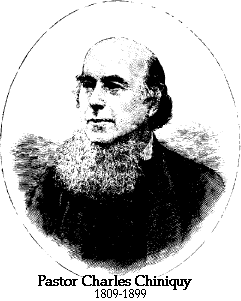
Foot Notes
CHAPTER 20
[*] "Hence Sanchez teaches,
n. 19, with Cajet. Sot. Covar. Valent, that it is lawful to persuade a man, determined
to slay some one, that he should commit theft or fornication." (Mor. Theol.
lib. iii. t. ii. cap. 2, p. 175, p. 157. Mech. 1845.)
Introduction ---New Window
CHAPTERS 1-15 of page 1 ---New Window
CHAPTERS 16-31 of page 2 (this page)
CHAPTERS 32-45 of page 3 ---New Window
CHAPTERS 46-58 of page 4 ---New Window
CHAPTERS 59-67 of page 5 ---New Window
.
.
.
Related study material:


(1808-1890)
---New Window
"How different was the Gospel of the New Testament from the Gospel of Rome!"
An official title of the Pope is the Vicar of Christ.
"Vicar" comes from the Latin, "vicarious", meaning "a substitute";
therefore, the Pope identifies himself as a substitute Christ.
Antichrist means "against Christ" or "in place of, or substitute for,
Christ".
"Little children, it is the last time: and as ye have
heard that Antichrist shall come, even now are there many antichrists; whereby we
know that it is the Last Time"
(1 John 2:18).
An
Earnest Appeal to Roman Catholics ---New Window
Or, Roman Catholicism Examined in Light
of the Scriptures
by Tom Stewart
"We would have healed Babylon, but she is not healed:
forsake her"
(Jeremiah 51:9).



"And upon her forehead was a name written,
MYSTERY, BABYLON THE GREAT, THE MOTHER OF HARLOTS
AND ABOMINATIONS OF THE EARTH" (Revelation
17:5).
by Tom Stewart
(Part 1) The Purpose and History of Babylon the Great ---New Window
Any attempt to describe the final destruction of Babylon the Great-- "THE MOTHER
OF HARLOTS AND ABOMINATIONS OF THE EARTH"-- demands an identification of that
system, i.e., its purpose, history, as well as present and prophetic future... Understanding
the true nature of Babylon the Great is as simple as knowing whether a child is good
or bad. "Even a child is known by his doings, whether
his work be pure, and whether it be right"
(Proverbs 20:11). It only remains for God's people to "judge righteous judgment" (John 7:24)
concerning Babylon the Great. To act consistently with that understanding, will require
coming out of her that "ye
be not partakers of her sins, and that ye receive not of her plagues" (Revelation 18:4).
(Part 2) The Reformation and the Church of Rome ---New Window
By Divine Authority, the Apostle John was directed to align Nimrod's Babylon with
the finally destroyed Babylon of Daniel's 70th Week (Daniel
9:27), which indicates a clear line of succession for
Babylon the Great.
Other servants of this Divine Authority Of The WORD Of God which follow this example
are--
 Charles Chiniquy (1809-1899): "Rome is... that Modern Babylon"
-Fifty Years in the Church of Rome, (1886).
Charles Chiniquy (1809-1899): "Rome is... that Modern Babylon"
-Fifty Years in the Church of Rome, (1886).
John Wycliffe (1324-1384): "the supreme authority of Scripture...
Christ's law sufficeth by itself to rule Christ's Church." -On the Truth
and Meaning of Scripture, (c.1380).
Martin Luther wrote, "I know that the Papacy is none other than
the kingdom of Babylon, and the violence of Nimrod the mighty hunter" -The
Babylonish Captivity of the Church, (October 6th 1520).
Alexander Hislop: "Rome as the Apocalyptic Babylon... Let every
Christian henceforth and for ever treat it as an outcast from the pale of Christianity.
Instead of speaking of it as a Christian Church, let it be recognised and regarded
as the Mystery of Iniquity, yea, as the very Synagogue of Satan." -The Two
Babylons: Or, The Papal Worship Proved to be the Worship of Nimrod and His Wife,
(1853)
James A. Wylie (1808-1890): "From the fourth century... the Bible
began to be hidden from the people... the clergy usurped authority over the members
of the Church... While the, 'living oracles' [Scripture] were neglected, the zeal
of the clergy began to spend itself upon rites and ceremonies borrowed from the pagans.
These were multiplied to such a degree, that [even] Augustine complained that they
were 'less tolerable than the yoke of the Jews under the law.'" -History
of Protestantism, vol. 1, pgs. 16,18, (1878).
It has always been, is, and will always be right for those who name "the Name
of Christ [to] depart from iniquity" (2Timothy
2:19) by separating themselves from Babylon the Great.
"Wherefore come out from among them, and be ye separate, saith the LORD, and
touch not the unclean thing; and I will receive you" (2Corinthians
6:17).
(Part
3) The Ecumenical Movement and the Church of Rome ---New Window
It has been an historic dogma of the Catholic Church that "outside
the [Catholic] Church there
is no salvation". "They
could not be saved who, knowing that the Catholic Church was founded as necessary
by God through Christ, would refuse either to enter it or to remain in it" (from "The Catechism of the Catholic Church" [1992], paragraph
846). This was intended by the Papacy to place the world in universal need
of coming to Rome to receive the benefits of their ecumenical salvation...
"An important affirmation made in the early phase
of collaboration between the Roman Catholic Church and the World Council of Churches
was that the two share in 'one and the same ecumenical movement'... The oneness
of the ecumenical movement refers fundamentally to its orientation towards a 'common
calling'" (from the WCC's "Towards a Common
Understanding and Vision of the World Council of Churches", paragraph 2.10)...
The Harlot Church of Rome is an implacable enemy of Jehovah Jesus, for she is the
Great Whore... and the World Council of Churches' "common
calling" collaboration with the Church of Rome
is spiritual adultery. "Can two walk together,
except they be agreed?" (Amos
3:3). Rome's doctrine damns her faithful, and her history
betrays her origin-- Babylon. "Flee out of the
midst of Babylon, and deliver every man his soul: be not cut off in her iniquity;
for this is the time of the LORD'S vengeance; he will render unto her a recompence" (Jeremiah 51:6)...
The Roman Catholic Church (RCC) is not a member
of the World Council of Churches (WCC); and, it has never applied for membership.
Rome saith, "I sit a queen, and am no widow, and
shall see no sorrow" (Revelation
18:7). "The RCC's
self-understanding has been one reason why it has not joined"
(from an FAQ at the WCC's website [1999], which asks if the Roman Catholic Church
is a member of the World Council of Churches). Rome understands that the Road
of Ecumenism does not lead to Geneva-- the WCC's headquarters-- but it leads
back to Rome...
One of the "principal concerns" of the Second Vatican Council (1962-1965) was the "restoration
of unity among all Christians" (from the Second
Vatican Council, "Decree on Ecumenism- Unitatis Redintegratio", paragraph
1)... Commenting on the term "ecumenical movement", the "Decree on Ecumenism" stated that "when
the obstacles to perfect ecclesiastical communion have been gradually overcome, all
Christians will at last, in a common celebration of the Eucharist, be gathered into
the one and only Church in that unity which Christ bestowed on His Church from the
beginning. We believe that this unity subsists in the Catholic Church as something
she can never lose, and we hope that it will continue to increase until the end of
time" (from the Second Vatican Council, "Decree
on Ecumenism- Unitatis Redintegratio", paragraph 4). And indeed, the "leopard [has not changed]
his spots"
(Jeremiah 13:23)!
(Part
4) Come Out of Her, My People ---New Window
Or, Love Alone Will Cause Us to Obey the Command to Separate From Babylon the Great
"Come out of her, My people, that ye be not partakers
of her sins, and that ye receive not of her plagues"
(Revelation 18:4).
Discussions of End Time Events, i.e., the Pre-Tribulational Rapture, and Chronologies,
i.e., an expectation of being Raptured before the Year 2000 ("Y2K"), are
intensely interesting, but our conduct in the meantime is of the utmost importance...
Thus, when the Word of God gives the command to separate from Babylon the
Great, it remains only for the instructed Believer to make the personal application
required for their situation-- and depart from Babylon. "And
I heard another Voice from Heaven, saying, Come out of her, My people, that ye be
not partakers of her sins, and that ye receive not of her plagues" (Revelation 18:4). Love will always obey, for
"if ye love me, keep My Commandments" (John 14:15)
is the cry and command of our LORD and Saviour.
If we were to "speak with the tongues of men and
of angels" (1Corinthians
13:1) without the obedience of Love, then we
would be as empty and worthless "as sounding brass,
or a tinkling cymbal" (13:1). If we possessed the "gift of
prophecy", understood "all
mysteries, and all knowledge", and had "all faith" to "remove mountains", but
did not have loving obedience to the command to come out of Babylon the Great,
then we would be as "nothing" in the sight of God (13:2). If we bestowed all our "goods
to feed the poor" and gave our bodies "to be burned", it "profiteth" us "nothing" (13:3). Whatever we say, if we will not come out of Babylon the Great,
we do not love God. "Therefore to him that
knoweth to do good, and doeth it not, to him it is sin" (James 4:17).
(Part 5) Billy Graham: Christianity's Modern
Balaam ---New
Window
"Shouldest thou help the ungodly, and love
them that hate the LORD? therefore is wrath upon thee from before the LORD"
(2Chronicles 19:2).
A thoughtful evaluation of the ministry of Billy Graham
will reveal that Billy Graham has been mightily used of Satan to break down the
walls of separation between the Godly and the ungodly. "And
ye shall be holy unto Me: for I the LORD am holy, and have severed you from other
people, that ye should be Mine" (Leviticus 20:26).
It will also reveal that Billy Graham's most effective work for Babylon the Great
has been that of masquerading as a Bible believing evangelist-- doing "the work of the LORD deceitfully"
(Jeremiah 48:10)-- seducing unwary Pilgrims into laying aside the "Sword
of the Spirit" (Ephesians 6:17) in the name of
Christian Love and Unity. If the Pope had approached the Bible-Believing-Evangelical-Community
with the need for Ecumenical Unity in previous generations, he would have been viewed
with suspicion-- on account of the corruptions of the Medieval Catholic Church, the
terrors of the Inquisition, the wicked absurdity of Papal infallibility, etc. "Ye shall know them by their fruits" (Matthew
7:16).
(Part 6) The Final Judgment of the Great
Whore ---New Window
"He hath judged the Great Whore, which did
corrupt the Earth with her fornication, and hath avenged the blood of His servants
at her hand"
(Revelation 19:1-2).
We have only focused on the most pervasive and conspicuous
manifestation of the Great Whore in this present Church Age-- the institution of
Roman Catholicism. "And here is the mind which
hath wisdom. The seven heads are seven mountains, on which the woman sitteth"
(Revelation 17:9). Rather than viewing Catholicism as
merely one of many manifestations of the LORD Jesus Christ's Church, the Church of
Rome's history demonstrates it to be entirely transformed from the Primitive Church
of the Apostles into the abominable Babylon the Great...
As we approach the Tribulation Week, the pace is quickening
as "evil men and seducers shall wax worse and worse,
deceiving, and being deceived" (2Timothy 3:13).
We need to remember that the Church of Rome has been "Satan's
seat" (Revelation 2:13) for more than a millennium...
"when the obstacles to perfect ecclesiastical communion have been gradually
overcome, all Christians will at last, in a common celebration of the Eucharist,
be gathered into the one and only Church" (from
the Second Vatican Council, "Decree on Ecumenism- Unitatis Redintegratio",
paragraph 4)... Rome's
"patience" in achieving the universal domination that describes her name,
i.e., catholic, ought to be observed by even the Godly... Pope John Paul II tenaciously
stated his commitment to the global union awaiting the Church at the New Millennium,
"I myself intend to promote every suitable initiative
aimed at making the witness of the entire Catholic community understood in its full
purity and consistency, especially considering the engagement which awaits the
Church at the threshold of the new Millennium
[WStS emphasis added]...
Does the Roman Catholic Church-- Babylon the Great--
endorse or promote the United Religions Initiative (URI)? If "in
her [Babylon the Great] was
found the blood of prophets, and of Saints, and of all that were slain upon
the Earth" (Revelation 18:24), then the UR must
eventually become attached to the Pope and the Church of Rome for the UR to be identified
as Babylon the Great... This
writer is persuaded that Babylon the Great, which is essentially Roman Catholicism,
must soon incorporate with the United Religions, if the Pope still desires the
headship of the world's religions, i.e., to be the False Prophet... Accordingly,
the Papal celebration of the "Jubilee of the Year 2000" includes:
In the Book of Revelation, we find a description
of Babylon the Great (17:1-18), her final destruction (18:1-24), and the rejoicing
in Heaven at the judgment of the Great Whore (19:1-4)... Antichrist turns against
Babylon the Great 8-9 days prior to the End of the Tribulation Week... "Come out of her, My people, that ye be not partakers of her
sins, and that ye receive not of her plagues" (Revelation
18:4). This most important
message of God to those who would be preserved from Divine Destruction is to COME
OUT OF BABYLON NOW.
End of Series.
For more material
related to this topic
please see

---New Window

Section Index for Voices
of Philadelphia

.
Homepage  Holy Bible
.Jehovah Jesus
Timeline .Prophecy Philadelphia Fellowship Promises Stories Poetry Links
Holy Bible
.Jehovah Jesus
Timeline .Prophecy Philadelphia Fellowship Promises Stories Poetry Links

Purpose ||.What's New
|| Tribulation Topics || Download Page || Today's Entry
Topical Links:
Salvation || Catholicism || Sound Doctrine || Prayer
Privacy Policy
.