|
||||||||||||||||||||||||||||||
 |
||||||||||||||||||||||||||||||
|
||||||||||||||||||||||||||||||
|
||||||||||||||||||||||||||||||
 |
||||||||||||||||||||||||||||||
|
||||||||||||||||||||||||||||||
|
||||||||||||||||||||||||||||||
|
||||||||||||||||||||||||||||||
|
||||||||||||||||||||||||||||||
|
||||||||||||||||||||||||||||||
|
||||||||||||||||||||||||||||||
|
||||||||||||||||||||||||||||||
|
||||||||||||||||||||||||||||||
|
||||||||||||||||||||||||||||||



|
Page 3 |
|


| Chapter 32 | The Miracles of Rome- Attack of Typhoid Fever- Apparition of St. Anne and St. Philomene- My Sudden Cure- The Curate of St. Anne du Nord, Mons. Ranvoize, almost a disguised Protestant |
| Chapter 33 | My Nomination as Curate of Beauport- Degradation and Ruin of that Place through Drunkenness- My Opposition to my Nomination useless- Preparation to Establish a Temperance Society- I write to Father Mathew for advice |
| Chapter 34 | The Hand of God in the Establishment of a Temperance Society in Beauport and Vicinity |
| Chapter 35 | Foundation of Temperance Societies in the Neighbouring Parishes- Providential Arrival of Monsignor De Forbin Janson, Bishop of Nancy- He Publicly Defends Me against the Bishop of Quebec and for ever Breaks the Opposition of the Clergy |
| Chapter 36 | The God of Rome Eaten by Rats |
| Chapter 37 | Visit of a Protestant Stranger- He Throws an Arrow into my Priestly Soul never to be taken out |
| Chapter 38 | Erection of the Column of Temperance- School Buildings- A noble and touching act of the People of Beauport |
| Chapter 39 | Sent to succeed Rev. Mr. Varin, Curate of Kamouraska- Stern Opposition of that Curate and the surrounding Priests and People- Hours of Desolation in Kamouraska- The Good Master allays the Tempest and bids the Waves be still |
| Chapter 40 | Organization of Temperance Societies in Kamouraska and surrounding Country- The Girl in the Garb of a Man in the Service of the Curates of Quebec and Eboulements- Frightened by the Scandals seen everywhere- Give up my Parish of Kamouraska to join the "Oblates of Mary Immaculate of Longueuil" |
| Chapter 41 | Perversion of Dr. Newman to the Church of Rome in the light of his own Explanations, Common Sense and the Word of God |
| Chapter 42 | Noviciate in the Monastery of the Oblates of Mary Immaculate of Longueuil- Some of the Thousand Acts of Folly and Idolatry which form the Life of a Monk- The Deplorable Fall of one of the Fathers- Fall of the Grand Vicar Quiblier- Sick in the Hotel Dieu of Montreal- Sister Urtubise: what she says of Maria Monk- The Two Missionaries to the Lumber Men- Fall and Punishment of a Father Oblate- What one of the best Father Oblates thinks of the Monks and the Monastery |
| Chapter 43 | I accept the hospitality of the Rev. Mr. Brassard of Longueuil- I give my Reasons for Leaving the Oblates to Bishop Bourget- He presents me with a splendid Crucifix blessed by his Holiness for me, and accepts my Services in the Cause of Temperance in the Diocese of Montreal |
| Chapter 44 | Preparations for the Last Conflict- Wise Counsel, Tears, and Distress of Father Mathew- Longueuil the First to Accept the Great Reform of Temperance- The whole District of Montreal, St. Hyacinthe and Three Rivers Conquered- The City of Montreal with the Sulpicians take the Pledge- Gold Medal- Officially named Apostle of Temperance in Canada- Gift of £500 from Parliament |
| Chapter 45 | My Sermon on the Virgin Mary- Compliments of Bishop Prince- Stormy Night- First Serious Doubts about the Church of Rome- Faithful Discussion with the Bishop- The Holy Fathers opposed to the Modern Worship of the Virgin- The Branches of the Vine |
The merchant fleet of the Fall of 1836 has filled the Marine Hospital of Quebec
with the victims of a ship-typhoid fever of the worst kind, which soon turned into
an epidemic. Within the walls of that institution Mr. Glackmeyer, the superintendent,
with two of the attending doctors, and the majority of the servants were swept away
during the winter months.
I was, in the spring of 1837, almost the only one spared by that horrible pest. In
order not to spread terror among the citizens of Quebec, the physicians and I had
determined to keep that a secret. But, at the end of May, I was forced to reveal
it to Bishop Signaie, of Quebec; for I felt in my whole frame the first symptoms
of the merciless disease. I prepared myself to die, as very few who had been attacked
by it had escaped. I went to the bishop, told him the truth about the epidemic, and
requested him to appoint a priest immediately, as chaplain in my place; for, I added,
"I feel the poison running through my veins, and it is very probable that I
have not more than ten or twelve days to live."
The young Mons. D. Estimanville was chosen, and though I felt very weak, I thought
it was my duty to initiate him in his new and perilous work. I took him immediately
to the hospital, where he never had been before, and when at a few feet from the
door, I said: "My young friend, it is my duty to tell you that there is a dangerous
epidemic raging in that house since last Fall, nothing has been able to stop it.
The superintendent, two physicians, and most of the servants have been its victims.
My escape till now is almost miraculous. But these last ten hours I feel the poison
running through my whole body. You are called by God to take my place; but before
you cross the threshold of that hospital, you must make the generous sacrifice of
your life; for you are going on the battle-field from which only few have come out
with their lives." The young priest turned pale, and said, "Is it possible
that such a deadly epidemic is raging where you are taking me?" I answered,
"Yes; my dear young brother, it is a fact, and I consider it my duty to tell
you not to enter that house, if you are afraid to die!" A few minutes of silence
followed, and it was a solemn silence indeed! He then took his handkerchief and wiped
away some big drops of sweat which were rolling from his forehead on his cheeks,
and said: "Is there a more holy and desirable way of dying than in ministering
to the spiritual and temporal wants of my brethren? No! If it is the will of God
that I should fall when fighting at this post of danger, I am ready. Let His holy
will be done."
He followed me into the pestilential house with the heroic step of the soldier who
runs at the command of his general to storm an impregnable citadel when he is sure
to fall. It took me more than an hour to show him all the rooms, and introduce him
to the poor, sick, and dying mariners.
I felt then so exhausted that two friends had to support me on my return to the parsonage
of St. Roche. My physicians were immediately called (one of them, Dr. Rosseau, is
still living), and soon pronounced my case so dangerous that three other physicians
were called in consultation. For nine days I suffered the most horrible tortures
in my brains, and the very marrow of my bones, from the fever which so devoured my
flesh as to seemingly leave but the skin. On the ninth day, the physicians told the
bishop who had visited me, that there was no hope of my recovery. The last sacraments
were administered tome, and I prepared myself to die, as taught by the Church of
Rome. The tenth day I was absolutely motionless, and not able to utter a word. My
tongue was parched like a piece of dry wood.
Through the terrible ravage on the whole system, my very eyes were so turned inside
their orbits, the white part only could be seen; no food could be taken from the
beginning of he sickness, except a few drops of cold water, which were dropped through
my teeth with much difficulty. But though all my physical faculties seemed dead,
my memory, intelligence, and soul were full of life, and acting with more power than
ever. Now and then, in the paroxysms of the fever, I used to see awful visions. At
one time, suspended by a thread at the top of a high mountain, with my head down
over a bottomless abyss; at another, surrounded by merciless enemies, whose daggers
and swords were plunged through my body. But these were of short duration, though
they have left such an impression on my mind that I still remember the minutest details.
Death had, at first, no terror for me. I had done, to the best of my ability, all
that my Church had told me to do, to be saved. I had, every day, given my last cent
to the poor, fasted and done penance almost enough to kill myself; made my confessions
with the greatest care and sincerity; preached with such zeal and earnestness as
to fill the whole city with admiration.
My pharisaical virtues and holiness, in a word, were of such a glaring and deceitful
character, and my ecclesiastical superiors were so taken by them, that they made
the greatest efforts to persuade me to become the first Bishop of Oregon and Vancouver.
One after the other, all the saints of heaven, beginning with the Holy Virgin Mary,
were invoked by me that they might pray God to look down upon me in mercy and save
my soul. On the thirteenth night, as the doctors were retiring, they whispered to
the Revs. Balillargeon and Parent, who were at my bedside: "He is dead, or if
not, he has only a few minutes to live. He is already cold and breathless, and we
cannot feel his pulse." Though these words had been said in a very low tone,
they fell upon my ears as a peal of thunder. The two young priests, who were my devoted
friends, filled the room with such cries that the curate and the priest who had gone
to rest, rushed to my room and mingled their tears and cries with theirs.
The words of the doctor, "He is dead!" were ringing in my ears as the voice
of a hurricane. I suddenly saw that I was in danger of being buried alive; no words
can express the sense of horror I felt at that idea. A cold icy wave began to move
slowly, but it seemed to me, with irresistible force, from the extremities of my
feet and hands towards the heart, as the first symptoms of approaching death. At
that moment I made a great effort to see what hope I might have of being saved, invoking
the help of the blessed Virgin Mary. With lightning rapidity, a terrible vision struck
my mind; I saw all my good works and penances, in which my Church had told me to
trust for salvation, in the balance of the justice of God. These were in one side
of the scales, and my sins on the other. My good works seemed only as a grain of
sand compared with the weight of my sins.[*]
This awful vision entirely destroyed my false and pharisaical security, and filled
my soul with an unspeakable terror. I could not cry to Jesus Christ, nor to God,
His Father, for mercy; for I sincerely believed what my Church had taught me on that
subject, that they were both angry with me on account of my sins. With much anxiety
I turned my thoughts, my soul, and hopes, towards St. Anne and St. Philomene. The
first was the object of my confidence, since the first time I had seen the numberless
crutches and other "Fx Votis" which covered the church of "La Bonne
St. Anne du Nord," and the second was the saint a la mode. It was said that
her body had lately been miraculously discovered, and the world was filled with the
noise of the miracles wrought through her intercession. Her medals were on every
breast, her pictures in every house, and her name on all lips. With entire confidence
in the will and power of these two saints to obtain any favour for me, I invoked
them to pray God to grant me a few years more of life; and with the utmost honesty
of purpose, I promised to add to my penances, and to live a more holy life, by consecrating
myself with more zeal than ever to the service of the poor and the sick. I added
to my former prayer the solemn promise to have a painting of the two saints put in
St. Anne's Church, to proclaim to the end of the world their great power in heaven,
if they would obtain my cure and restore my health. Strange to say! The last words
of my prayer were scarcely uttered, when I saw above my head St. Anne and St. Philomene
sitting in the midst of a great light, on a beautiful golden cloud. St. Anne was
very old and grave, but St. Philomene was very young and beautiful. Both were looking
at me with great kindness.
However, the kindness of St. Anne was mixed with such an air of awe and gravity that
I did not like her looks; while St. Philomene had such an expression of superhuman
love and kindness that I felt myself drawn to here by a magnetic power, when she
said, distinctly: "You will be cured," and the vision disappeared.
But I was cured, perfectly cured! At the disappearance of the two saints, I felt
as though an electric shock went through my whole frame; the pains were gone, the
tongue was untied, the nerves were restored to their natural and usual power; my
eyes were opened, the cold and icy waves which were fast going from the extremities
to the regions of my heart, seemed to be changed into a most pleasant warm bath,
restoring life and strength to every part of my body. I raised my head, stretched
out my hands, which I had not moved for three days, and looking around, I saw the
four priests. I said to them: "I am cured, please give me something to eat,
I am hungry."
Astonished beyond measure, two of them threw their arms around my shoulders to help
me to sit a moment, and change my pillow; when two others ran to the table, which
the kind nuns of Quebec had covered with delicacies in case I might want them. Their
joy was mixed with fear, for they all confessed to me afterwards that they had at
once thought that all this was nothing but the last brilliant flash of light which
the flickering lamp gives before dying away. But they soon changed their minds when
they saw that I was eating ravenously, and that I was speaking to them and thanking
God with a cheerful, though very feeble voice. "What does this mean?" they
all said. "The doctors told us last evening that you were dead; and we have
passed the night not only weeping over your death, but praying for your soul, to
rescue it from the flames of purgatory, and now you look so hungry, so cheerful and
well."
I answered: "It means that I was not dead, but very near dying, and when I felt
that I was to die, I prayed to St. Anne and St. Philomene to come to my help and
cure me; and they have come. I have seen them both, there above my head. Ah! if I
were a painter, what a beautiful picture I could make of that dear old St. Anne and
the still dearer Philomene! for it is St. Philomene who has spoken to me as the messenger
of the mercies of God. I have promised to have their portraits painted and put into
the church of The Good St. Anne du Nord."
While I was speaking thus, the priests, filled with admiration and awe, were mute;
they could not speak except with tears of gratitude. They honestly believed with
me that my cure was miraculous, and consented with pleasure to sing that beautiful
hymn of gratitude, the "Te Deum."
The next morning, the news of my miraculous cure spread through the whole city with
the rapidity of lightning, for besides a good number of the first citizens of Quebec
who were related to me by blood, I had not less than 1,800 penitents who loved and
respected me as their spiritual father.
To give an idea of the kind of interest of the numberless friends whom God had given
me when in Quebec, I will relate a single fact. The citizens who were near our parsonage,
having been told, by a physician, that the inflammation of my brain was so terrible
that the least noise, even the passing of carriages or the walking of horses on the
streets, was causing me real torture, they immediately covered all the surrounding
streets with several inches of straw to prevent the possibility of any more noise.
The physicians, having heard of my sudden cure, hastened to come and see what it
meant. At first, they could scarcely believe their eyes. The night before they had
given me up for dead, after thirteen days' suffering with the most horrible and incurable
of diseases! And, there I was, the very next morning, perfectly cured! No more pain,
not the least remnant of fever, all the faculties of my body and mind perfectly restored!
They minutely asked me all the circumstances connected with that strange, unexpected
cure; and I told them simply but plainly, how, at the very moment I expected to die,
I had fervently prayed to St. Anne and St. Philomene, and how they had come, spoken
to me and cured me. Two of my physicians were Roman Catholics, and three Protestants.
They at first looked at each other without saying a word. It was evident they were
not all partakers of my strong faith in the power of the two saints. While the Roman
Catholic doctors, Messrs. Parent and Rousseau, seemed to believe in my miraculous
cure, the Protestants energetically protested against that view in the name of science
and common sense.
Dr. Douglas put me the following questions, and received the following answers. He
said:
"Dear Father Chiniquy, you know you have not a more devoted friend in Quebec
than I, and you know me too well to suspect that I want to hurt your religious feelings
when I tell you that there is not the least appearance of a miracle in your so happy
and sudden cure. If you will be kind enough to answer my questions, you will see
that you are mistaken in attributing to a miracle a thing which is most common and
natural. Though you are perfectly cured, you are very weak; please answer only 'yes'
or 'no' to my questions, in order not to exhaust yourself. Will you be so kind as
to tell us if this is the first vision you have had during the period of that terrible
fever?"
Ans. "I have had many other visions, but I took them as being the effect of
the fever."
Doctor. "Please make your answers shorter, or else I will not ask you another
question, for it would hurt you. Tell us simply, if you have not seen in those visions,
at times, very frightful and terrible, and at others, very beautiful things."
Ans. "Yes, sir."
Doctor. "Have not those visions stamped themselves on your mind with such a
power and vividness that you never forget them, and that you deem them more realities
than mere visions of a sickly brain?"
Ans. "Yes, sir."
Doctor. "Did you not feel sometimes much worse, and sometimes much better after
those visions, according to their nature?"
Ans. "Yes, sir."
Doctor. "When at ease in your mind during that disease, were you not used to
pray to the saints, particularly to St. Anne and St. Philomene."
Ans. "Yes, sir."
Doctor. "When you considered that death was very near (and it was indeed) when
you had heard my imprudent sentence that you had only a few minutes to live, were
you not taken suddenly, by such a fear of death as you never felt before?"
Ans. "Yes, sir."
Doctor. "Did you not then make a great effort to repel death from you?"
Ans. "Yes, sir."
Doctor. "Do you know that you are a man of an exceedingly strong will, and that
very few men can resist you when you want to do something? Do you not know that your
will is such an exceptional power that mountains of difficulties have disappeared
before you, here in Quebec? Have you not seen even me, with many others, yielding
to your will almost in spite of ourselves, to do what you wanted?"
With a smile I answered, "Yes, sir."
Doctor. "Do you not remember seeing, many times, people suffering dreadfully
from toothache coming to us to have their teeth extracted, who were suddenly cured
at the sight of the knives and other surgical instruments we put upon the table to
use?"
I answered with a laugh, "Yes, sir. I have seen that very often, and it has
occurred to me once."
Doctor. "Do you think that there was a supernatural power, then, in the surgical
implements, and that those sudden cures of toothache were miraculous?"
Ans. "No, sir!"
Doctor. "Have you not read the volume of the 'Medical Directory' I lent you
on typhoid fever, where several cures exactly like yours are reported?"
Ans. "Yes, sir."
Then addressing the physicians, Doctor Douglas said to them:
"We must not exhaust our dear Father Chiniquy. We are too happy to see him full
of life again, but from his answers you understand that there is no miracle here.
His happy and sudden cure is a very natural and common thing. The vision was what
we call the turning-point of the disease, when the mind is powerfully bent on some
very exciting object, when that mysterious thing of which we know so little as yet,
called the will, the spirit, the soul, fights as a giant against death, in which
battle, pains, diseases, and even death are put to flight and conquered.
"My dear Father Chiniquy, from your own lips, we have it; you have fought, last
night, the fever and approaching death, as a giant. No wonder that you won the victory,
and I confess, it is a great victory. I know it is not the first victory you have
gained, and I am sure it will not be the last. It is surely God who has given you
that irresistible will. In that sense only does your cure come from Him. Continue
to fight and conquer as you have done last night, and you will live a long life.
Death will long remember its defeat of last night, and will not dare approach you
any more, except when you will be so old that you will ask it to come as a friend
to put an end to the miseries of this present life. Good-bye."
And with friendly smiles, all the doctors pressed my hand and left me just as the
bishop and curate of Quebec, Mons. Ballargeon, my confessor, were entering the room.
An old proverb says: "There is nothing so difficult as to persuade a man who
does not want to be persuaded." Though the reasoning and kind words of the doctor
ought to have been gladly listened to by me, they had only bothered me. It was infinitely
more pleasant, and it seemed then, more agreeable to God, and more according to my
faith in the power of the saints in heaven, to believe that I had been miraculously
cured. Of course, the bishop, with his coadjutor and my Lord Turgeon, as well as
my confessor, with the numberless priests and Roman Catholics who visited me during
my convalescence, confirmed me in my views.
The skillful painter, Mr. Plamonon, recently from Rome, was called and painted, at
the price of two hundred dollars ($200) the tableau I had promised to put in the
church of St. Anne du Nord. It was one of the most beautiful and remarkable paintings
of that artist, who had passed several years in the Capital of Fine Arts in Italy,
where he had gained a very good reputation for his ability.
Three months after my recovery, I was at the parsonage of the curate of St. Anne,
the Rev. Mr. Ranvoize, a relative of mine. He was about sixtyfive years of age, very
rich, and had a magnificent library. When young, he had enjoyed the reputation of
being one of the best preachers in Canada. Never had I been so saddened and scandalized
as I was by him on this occasion. It was evening when I arrived with my tableau.
As soon as we were left alone, the old curate said: "Is it possible, my dear
young cousin, that you will make such a fool of yourself tomorrow? That socalled
miraculous cure is nothing but 'naturoe suprema vis,' as the learned of all ages
have called it. Your so-called vision was a dream of your sickly brain, as it generally
occurs in the moment of the supreme crisis of the fever. It is what is called 'the
turning-point' of the disease, when a desperate effort of nature kills or cures the
patient. As for the vision of that beautiful girl, whom you call St. Philomene, who
had done you so much good, she is not the first girl, surely, who has come to you
in your dreams, and done you good!" At these words he laughed so heartily that
I feared he would split his sides. Twice he repeated this unbecoming joke.
I was, at first, so shocked at this unexpected rebuke, which I considered as bordering
on blasphemy, that I came very near taking my hat without answering a word, to go
and spend the night at his brother's; but after a moment's reflection, I said to
him: "How can you speak with such levity on so solemn a thing? Do you not believe
in the power of the saints, who being more holy and pure than we are, see God face
to face, speak to Him and obtain favours which He would refuse us rebels? Are you
not the daily witness of the miraculous cures wrought in your own church, under your
own eyes? Why those thousands of crutches which literally cover the walls of your
church?" My strong credulity, and the earnestness of my appeal to the daily
miracles of which he was the witness, and above all, the mention of the numberless
crutches suspended all over the walls of his church, brought again from him such
a Homeric laugh, that I was disconcerted and saddened beyond measure. I remained
absolutely mute; I wished I had never come into such company.
When he had laughed at me to his heart's content, he said: "My dear cousin,
you are the first one to whom I speak in this way. I do it because, first: I consider
you a man of intelligence, and hope you will understand me. Secondly: because you
are my cousin. Were you one of those idiotic priests, real blockheads, who form the
clergy today; or, were you a stranger to me, I would let you go your way, and believe
in those ridiculous, degrading superstitions of our poor ignorant and blind people,
but I know you from your infancy, and I have known your father, who was one of my
dearest friends; the blood which flows in your veins, passes thousands of times every
day through my heart. You are very young and I am old. It is a duty of honour and
conscience in me to reveal to you a thing which I have thought better to keep till
now, a secret between God and myself. I have been here more than thirty years, and
though our country is constantly filled with the noise of the great and small miracles
wrought in my church every day, I am ready to swear before God, and to prove to any
man of common sense, that not a single miracle has been wrought in my church since
I have come here. Every one of the facts given to the Canadian people as miraculous
cures are sheer impositions, deceptions, the work of either fools, or the work of
skillful impostors and hypocrites, whether priests or laymen. Believe me, my dear
cousin, I have studied carefully the history of all those crutches. Ninety-nine out
of a hundred have been left by poor, lazy beggars, who, at first, thought with good
reason that by walking from door to door with one or two crutches, they would create
more sympathy and bring more into their purses; for how many will indignantly turn
out of doors a lazy, strong and healthful beggar, who will feel great compassion,
and give largely to a man who is crippled, unable to work, and forced to drag himself
painfully on crutches? Those crutches are then passports from door to door, they
are the very keys to open both the hearts and purses. But the day comes when that
beggar has bought a pretty good farm with his stolen alms; or when he is really tired,
disgusted with his crutches and wants to get rid of them! How can he do that without
compromising himself? By a miracle! Then he will sometimes travel again hundreds
of miles from door to door, begging as usual, but this time he asks the prayers of
the whole family, saying: 'I am going to the "good St. Anne du Nord" to
ask her to cure my leg (or legs). I hope she will cure me, as she had cured so many
others. I have great confidence in her power!' Each one gives twice, nay, ten times
as much as before to the poor cripple, making him promise that if he is cured, he
will come back and show himself, that they may bless the good St. Anne with him.
When he arrives here, he gives me sometimes one, sometimes five dollars, to say mass
for him. I take the money, for I would be a fool to refuse it when I know that his
purse has been so well filled. During the celebration of the mass, when he receives
the communion, I hear generally, a great noise, cries of joy! A miracle! A miracle!!
The crutches are thrown on the floor, and the cripple walks well as you or I! And
the last act of that religious comedy is the most lucrative one, for he fulfill his
promise of stopping at every house he had ever been seen with his crutches. He narrates
how he was miraculously cured, how his feet and legs became suddenly all right. Tears
of joy and admiration flow from eye to eye. The last cent of that family is generally
given to the impostor, who soon grows rich at the expense of his dupes. This is the
plain but true story of ninety-nine out of every hundred of the cures wrought in
my church. The hundredth, is upon people as honest, but, pardon me the expression,
as blind and superstitious as you are; they are really cured, for they were really
sick. But their cures are the natural effects of the great effort of the will. It
is the result of a happy combination of natural causes which work together on the
frame, and kill the pain, expel the disease and restore the health, just as I was
cured of a most horrible toothache, some years ago. In the paroxysm I went to the
dentist and requested him to extract the affected tooth. Hardly had his knife and
other surgical instruments come before my eyes than the pain disappeared. I quietly
took my hat and left, bidding a hearty 'good-bye' to the dentist, who laughed at
me every time we met, to his heart's content.
"One of the weakest points of our religion is in the ridiculous, I venture to
say, diabolical miracles, performed and believed every day among us, with the so-called
relics and bones of the saints. But, don't you know that, for the most part, these
relics are nothing but chickens' or sheeps' bones. And what could I not say, were
I to tell you what I know of the daily miraculous impostures of the scapulars, holy
water, chaplets and medals of every kind. Were I a pope, I would throw all these
mummeries, which come from paganism, to the bottom of the sea, and would present
to the eyes of the sinners, nothing but Christ and Him crucified as the object of
their faith, invocation and hope, for this life and the next, just as the Apostles
Paul, Peter and James do in their Epistles."
I cannot repeat here, all that I heard that night from that old relative, against
the miracles, relics, scapulars, purgatory, false saints and ridiculous practices
of the Church of Rome. It would take too long, for he spoke three hours as a real
Protestant. Sometimes what he said seemed to me according to common sense, but as
it was against the practices of my church, and against my personal practices, I was
exceedingly scandalized and pained, and not at all convinced. I pitied him for having
lost his former faith and piety. I told him at the end, without ceremony: "I
heard, long ago, that the bishops did not like you, but I knew not why. However,
if they could hear what you think and say here about the miracles of St. Anne, they
would surely interdict you." 'Will you betray me?" he added, "and
will you report our conversation to the bishop?" "No," my cousin,
" I replied, "I would prefer to be burnt to ashes. I will not sell your
kind hospitality for the traitor's money." It was two o'clock in the morning
when we parted to go to our sleeping rooms. But that night was again a sleepless
one to me. Was it not too sad and strange for me to see that that old and learned
priest was secretly a Protestant!
The next morning the crowds began to arrive, not by hundreds, but by thousands, from
the surrounding parishes. The channel between "L'Isle d'Orleans" and St.
Anne, was literally covered with boats of every size, laden with men and women who
wanted to hear from my own lips, the history of my miraculous cure, and see, with
their own eyes, the picture of the two saints who had appeared to me. At ten a.m.,
more than 10,000 people were crowded inside and outside the wall of the church.
No words can give an idea of my emotion and of the emotion of the multitude when,
after telling them in a single and plain way, what I then considered a miraculous
fact, I disclosed the picture, and presented it to their admiration and worship.
There were tears rolling on every cheek and cries of admiration and joy from every
lip. The picture represented me dying in my bed of sufferings, and the two saints
seen at a distance above me and stretching their hands as if to say: "You will
be cured." It was hung on the walls, in a conspicuous place, where thousands
and thousands have come to worship it from that day to the year 1858, when the curate
was ordered by the bishop to burn it, for it had pleased our merciful God that very
year, to take away the scales which were on my eyes and show me His saving light,
and I had published all over Canada, my terrible, though unintentional error, in
believing in that false miracle. I was so honest in my belief in a miraculous cure,
and the apparition of the two saints had left such a deep impression on my mind,
that, I confess it to my shame, the first week after my conversion, I very often
said to myself: "How is it that I now believe that the Church of Rome is false,
when such a miracle has been wrought on me as one of her priests?" But, our
God, whose mercies are infinite, knowing my honesty when a slave of Popery, was determined
to give me the full understanding of my errors in this way.
About a month after my conversion, in 1858, I had to visit a dying Irish convert
from Romanism, who had caught in Chicago, the same fever which so nearly killed me
at the Marine Hospital of Quebec. I again caught the disease, and during twelve days,
passed through the same tortures and suffered the same agonies as in 1837. But this
time, I was really happy to die; there was no fear for me to see the good works as
a grain of sand in my favour, and the mountains of my iniquities in the balance of
God against me. I had just given up my pharisaical holiness of old; it was no more
in my good works, my alms, my penances, my personal efforts, I was trusting to be
saved; it was in Jesus alone. My good works were no more put by me in the balance
of the justice of God to pay my debts, and to appeal for mercy. It was the blood
of Jesus, the Lamb slain from the foundation of the world for me, which was in the
balance. It was the tears of Jesus, the nails, the crown of thorns, the heavy cross,
the cruel death of Jesus only, which was there to pay my debts and to cry for mercy.
I had no fear then, for I knew that I was saved by Jesus, and that that salvation
was a perfect act of His love, His mercy, and His power; consequently I was glad
to die.
But when the doctor had left me, the thirteenth day of my sufferings, saying the
very same words of the doctors of Quebec: "He had only a few minutes to live,
if he be not already dead," the kind friends who were around my bed, filled
the room with their cries! Although for three or four days I had not moved a finger,
said a single word, or given any sign of life, I was perfectly conscious. I had heard
the words of the doctor, and I was glad to exchange the miseries of this short life
for that eternity of glory which my Saviour had bought for me. I only regretted to
die before bringing more of my dear countrymen out of the idolatrous religion of
Rome, and from the lips of my soul, I said: "Dear Jesus, I am glad to go with
Thee just now, but if it be Thy will to let me live a few years more, that I may
spread the light of the Gospel among my countrymen; grant me to live a few years
more, and I will bless Thee eternally, with my converted countrymen, for Thy mercy."
This prayer had scarcely reached the mercy-seat, when I saw a dozen bishops marching
toward me, sword in hand to kill me. As the first sword raised to strike was coming
down to split my head, I made a desperate effort, wrenched it from the hand of my
would-be murderer, and struck such a blow on his neck that his head rolled on to
the floor. The second, third, fourth, and so on to the last, rushed to kill me; but
I struck such terrible blows on the necks of every one of them, that twelve heads
were rolling on the floor and swimming in a pool of blood. In my excitement I cried
to my friends around me: "Do you not see the heads rolling and the blood flowing
on the floor?"
And suddenly I felt a kind of electric shock from head to foot. I was cured! perfectly
cured!! I asked my friends for something to eat; I had not taken any food for twelve
days. And with tears of joy and gratitude to God, they complied with my request.
This last was not only the perfect cure of the body, but it was a perfect cure of
the soul. I understood then clearly that the first was not more miraculous than the
second. I had a perfect understanding of the diabolical forgeries and miracles of
Rome. It was in both cases, I was not cured or saved by the saints, the bishops or
the Popes, but by my God, through His Son Jesus.
.
CHAPTER 33 Back
to Top
The 21st of September, 1833, was a day of desolation to me. On that day I received
the letter of my bishop appointing me curate of Beauport. Many times, I had said
to the other priests, when talking about our choice of the different parishes, that
I would never consent to be curate of Beauport. That parish, which is a kind of suburb
of Quebec, was too justly considered the very nest of the drunkards of Canada. With
a soil of unsurpassed fertility, inexhaustible lime quarries, gardens covered with
most precious vegetables and fruits, forests near at hand, to furnish wood to the
city of Quebec, at their doors, the people of Beauport, were, nevertheless, classed
among the poorest, most ragged and wretched people of Canada. For almost every cent
they were getting at the market went into the hands of the saloon-keepers. Hundreds
of times I had seen the streets which led from St. Roch to the upper town of Quebec
almost impassable, when the drunkards of Beauport were leaving the market to go home.
How many times I heard them fill the air with their cries and blasphemies; and saw
the streets reddened with their blood when fighting with one another, like mad dogs!
The Rev. Mr. Begin, who was their cure since 1825, had accepted the moral principles
of the great Roman Catholic theologian Liguori, who says, "that a man is not
guilty of the sin of drunkenness, so long as he can distinguish between a small pin
and a load of hay." Of course the people would not find themselves guilty of
sin, so long as their eyes could make that distinction. After weeping to my heart's
content at the reading of the letter from my bishop, which had come to me as a thunderbolt,
my first thought was that my misfortune, though very great, was not irretrievable.
I knew that there were many priests who were as anxious to become curates of Beauport
as I was opposed to it. My hope was that the bishop would be touched by my tears,
if not convinced by my arguments, and that he would not persist in putting on my
shoulders a burden which they could not carry. I immediately went to the palace,
and did all in my power to persuade his lordship to select another priest for Beauport.
He listened to my arguments with a great deal of patience and kindness, and answered:
"My dear Mr. Chiniquy, you forget too often, that 'implicit and perfect obedience
to his superiors is the virtue of a good priest. You have given me a great deal of
trouble and disappointment by refusing to relieve the good bishop Provencher of his
too heavy burden. It was at my suggestion, you know very well, that he had selected
you to be his coworker along the coasts of the Pacific, by consenting to become the
first Bishop of Oregon. Your obstinate resistance to your superiors in that circumstance,
and in several other cases, is one of your weak points. If you continue to follow
your own mind rather than obey those whom God has chosen to guide you, I really fear
for your future. I have already too often yielded to your rebellious character. Through
respect to myself, and for your own good, today I must force you to obey me. You
have spoken of the drunkenness of the people of Beauport, as one of the reasons why
I should not put you at the head of that parish; but this is just one of the reasons
why I have chosen you. You are the only priest I know, in my diocese, able to struggle
against the long-rotted and detestable evil, with a hope of success.
"'Quod scriptum scriptum est.' Your name is entered in our official registers
as the curate of Beauport; it will remain there till I find better reasons than those
you have given me to change my mind. After all, you cannot complain; Beauport is
not only one of the most beautiful parishes of Canada, but it is one of the most
splendid spots in the world. It is, besides, a parish which gives great revenues
to its curate. In your beautiful parsonage, at the door of the old capital of Canada,
you will have the privileges of the city, and the enjoyments of some of the most
splendid sceneries of this continent. If you are not satisfied with me today, I do
not know what I can do to please you."
Though far from being reconciled to my new position, I saw there was no help; I had
to obey, as my predecessor, Mr. Begin, was to sell all his house furniture, before
taking charge of his far distant parish, La Riviere Ouelle, he kindly invited me
to go and buy, on long credit, what I wished for my own use, which I did. The whole
parish was on the spot long before me, partly to show their friendly sympathy for
their last pastor, and partly to see their new curate. I was not long in the crowd
without seeing that my small stature and my leanness were making a very bad impression
on the people, who were accustomed to pay their respects to a comparatively tall
man, whose large and square shoulders were putting me in the shade. Many jovial remarks,
though made in halfsuppressed tones, came to my ears, to tell me that I was cutting
a poor figure by the side of my jolly predecessor.
"He is hardly bigger than my tobacco box," said one not far from me: "I
think I could put him in my vest pocket."
"Has he not the appearance of a salted sardine!" whispered a woman to her
neighbour, with a hearty laugh.
Had I been a little wiser, I could have redeemed myself by some amiable or funny
words, which would have sounded pleasantly in the ears of my new parishioners. But,
unfortunately for me, that wisdom is not among the gifts I received. After a couple
of hours of auction, a large cloth was suddenly removed from a long table, and presented
to our sight an incredible number of wine and beer glasses, of empty decanters and
bottles, of all sizes and quality. This brought a burst of laughter and clapping
of hands from almost every one. All eyes were turned towards me, and I heard from
hundreds of lips: "This is for you, Mr. Chiniquy." Without weighing my
words, I instantly answered: "I do not come to Beauport to buy wine glasses
and bottles, but to break them."
These words fell upon their ears as a spark of fire on a train of powder. Nine-tenths
of that multitude, without being very drunk, had emptied from four to ten glasses
of beer or rum, which Rev. Mr. Begin himself was offering them in a corner of the
parsonage. A real deluge of insults and cursings overwhelmed me; and I soon saw that
the best thing I could do was to leave the place without noise, and by the shortest
way.
I immediately went to the bishop's place, to try again to persuade his lordship to
put another curate at the head of such a people. "You see, my lord," I
said, "that by my indiscreet and rash answer I have for ever lost the respect
and confidence of that people. They already hate me; their brutal cursings have fallen
upon me like balls of fire. I prefer to be carried to my grave next Sabbath, than
have to address such a degraded people. I feel that I have neither the moral nor
the physical power to do any good there."
"I differ from you," replied the bishop. "Evidently the people wanted
to try your mettle, by inviting you to buy those glasses, and you would have lost
yourself by yielding to their desire. Now they have seen that you are brave and fearless.
It is just what the people of Beauport want; I have known them for a long time. It
is true that they are drunkards; but, apart from that vice, there is not a nobler
people under heaven. They have, literally, no education, but they possess marvelous
common sense, and have many noble and redeeming qualities, which you will soon find
out. You took them by surprise when you boldly said you wanted to break their glasses
and decanters. Believe me, they will bless you, if by the grace of God, you fulfill
your prophecy; though it will be a miracle if you succeed in making the people of
Beauport sober. But you must not despair. Trust in God; fight as a good soldier,
and Jesus Christ will win the victory." Those kind words of my bishop did me
good, though I would have preferred being sent to the backwoods of Canada, than to
the great parish of Beauport. I felt that the only thing that I had to do was to
trust in God for success, and to fight as if I were to gain the day. It came to my
mind that I had committed a great sin by obstinately refusing to become Bishop of
Oregon, and my God, as a punishment, had given me the very parish for which I felt
an almost insurmountable repugnance.
Next Sunday was a splendid day, and the church of Beauport was filled to its utmost
capacity by the people, eager to see and hear, for the first time, their new pastor.
I had spent the last three days in prayers and fastings. God knows that never a priest,
nor any minister of the Gospel, ascended the pulpit with more exalted views of his
sublime functions than I did that day, and never a messenger of the Gospel had been
more terrified than I was, when in that pulpit, by the consciousness of his own demerits,
inability and incompetency, in the face of the tremendous responsibilities of his
position. My first sermon was on the text: "Woe is unto me, if I preach not
the Gospel" (1 Cor. ix. 16). With a soul and heart filled with the profoundest
emotions, a voice many times suffocated by uncontrollable sobs, I expounded to them
some of the awful responsibilities of a pastor. The effect of the sermon was felt
to the last day of my priestly ministry in Beauport.
After the sermon, I told them: "I have a favour to ask of you. As it is the
first, I hope you will not rebuke me. I have just now given you some of the duties
of your poor young curate towards you; I want you to come again this afternoon at
half-past two o'clock, that I may give you some of your duties towards your pastor."
At the appointed hour the church was still more crowded than in the morning, and
it seemed to me that my merciful God blessed still more that second address than
the first.
The text was: "When he (the shepherd) putteth forth his own sheep, he goeth
before them, and the sheep follow him; for they know his voice" (Jno. x. 4).
Those two sermons on the Sabbath were a startling innovation in the Roman Catholic
Church of Canada, which brought upon me, at once, many bitter remarks from the bishop
and surrounding curates. Their unanimous verdict was that I wanted to become a little
reformer. They had not the least doubt that in my pride I wanted to show the people
"that I was the most zealous priest of the country." This was not only
whispered from ear to ear among the clergy, but several times it was thrown into
my face in the most insulting manner. However, my God knew that my only motives were,
first, to keep my people away from the taverns, by having them before their altars
during the greatest part of the Sabbath day; second, to impress more on their minds
the great saving and regenerating truths I preached, by presenting them twice in
the same day under different aspects. I found such benefits from those two sermons,
that I continued the practice during the four years I remained in Beauport, though
I had to suffer and hear, in silence, many humiliating and cutting remarks from many
co-priests.
I had not been more than three months at the head of that parish, when I determined
to organize a temperance society on the same principles as Father Mathew, in Ireland.
I opened my mind, at first, on that subject to the bishop, with the hope that he
would throw the influence of his position in favour of the new association, but,
to my great dismay and surprise, not only did he turn my project into ridicule, but
absolutely forbade me to think any more of such an innovation. "These temperance
societies are a Protestant scheme," he said. "Preach against drunkenness,
but let the respectable people who are not drunkards alone. St. Paul advised his
disciple Timothy to drink wine. Do not try to be more zealous than they were in those
apostolic days."
I left the bishop much disappointed, but did not give up my plan. It seemed to me
if I could gain the neighbouring priests to join with me in my crusade I wanted to
preach against the usage of intoxicating drinks, we might bring about a glorious
reform in Canada, as Father Mathew was doing in Ireland. But the priests, without
a single exception, laughed at me, turned my plans into ridicule, and requested me,
in the name of common sense, never to speak any more to them of giving up their social
glass of wine. I shall never be able to give any idea of my sadness, when I saw that
I was to be opposed by my bishop and the whole clergy in the reform which I considered
then, more and more every day, the only plank of salvation, not only of my dear people
of Beauport, but of all Canada. God only knows the tears I shed, the long sleepless
nights I have passed in studying, praying, meditating on that great work of Beauport.
I had recourse to all the saints of heaven for more strength and light; for I was
determined, at any cost, to try and form a temperance society. But every time I wanted
to begin, I was frightened by the idea, not only of the wrath of the whole clergy,
which would hunt me down, but still more of the ridicule of the whole country, which
would overwhelm me in case of a failure. In these perplexities, I thought I would
do well to write to Father Mathew and ask him his advice and the help of his prayers.
That noble apostle of temperance of Ireland answered me in an eloquent letter, and
pressed me to begin the work in Canada as he had done in Ireland, relying on God,
without paying any attention to the opposition of man.
The wise and Christian words of that great and worthy Irish priest, came to me as
the voice of God; and I determined to begin the work at once, though the whole world
should be against me. I felt that if God was in my favour, I would succeed in reforming
my parish and my country in spite of all the priests and bishops of the world, and
I was right. Before putting the plough into the ground, I had not only prayed to
God and all His saints, almost day and night, during many months, but I had studied
all the best books written in England, France and the United States, on the evils
wrought by the use of intoxicating drinks. I had taken a pretty good course of anatomy
in the Marine Hospital under the learned Dr. Douglas.
I was then well posted on the great subject I was to bring before my country. I knew
the enemy I was to attack. And the weapons which would give him the death blow were
in my hands. I only wanted my God to strengthen my hands and direct my blows. I prayed
to Him, and in His great mercy He heard me.
.
CHAPTER 34 Back
to Top
"My thoughts are not your thoughts," saith the Lord. And, we may add,
His works are not like the works of man. This great truth has never been better exemplified
than in the marvelous rapidity with which the great temperance reformation grew in
Canada, in spite of the most formidable obstacles. To praise any man for such a work
seems to me a kind of blasphemy, when it is so visibly the work of the Lord. I had
hardly finished reading the letter of Ireland's Apostle of Temperance, when I fell
on my knees and said: "Thou knowest, O my God, that I am nothing but a sinner.
There is no light, no strength in Thy poor unprofitable servant. Therefore, come
down into my heart and soul, to direct me in that temperance reform which Thou hast
put into my mind to establish. Without Thee I can do nothing, but with Thee I can
do all things."
This was on a Saturday night, March 20, 1839. The next morning was the first Sabbath
of Lent. I said to the people after the sermon:
"I have told you, many times, that I sincerely believe it is my mission from
God to put an end to the unspeakable miseries and crimes engendered every day, here
in our whole country, by the use of intoxicating drink. Alcohol is the great enemy
of your souls and your bodies. It is the most implacable enemy of your wives, your
husbands, and your children. It is the most formidable enemy of our dear country
and our holy religion. I must destroy that enemy. But I cannot fight alone. I must
form an army and raise a banner in your midst, around which all the soldiers of the
Gospel will rally. Jesus Christ Himself will be our general. He will bless and sanctify
us He will lead us to victory. The next three days will be consecrated by you and
by me in preparing to raise that army. Let all those who wish to fill its ranks,
come and pass these three days with me in prayer and meditation before our sacred
altars. Let even those who do not want to be soldiers of Christ, or to fight the
great and glorious battles which are to be fought, come through curiosity, to see
a most marvelous spectacle. I invite every one of you, in the name of our Saviour,
Jesus Christ, whom alcohol nails anew to the cross every day. I invite you in the
name of the holy Virgin Mary, and of all the saints and angels of God, who are weeping
in heaven for the crimes committed every day by the use of intoxicating drinks. I
invite you in the names of the wives whom I see here in your midst, weeping because
they have drunken husbands. I invite you to come in the names of the fathers whose
hearts are broken by drunken children. I invite you to come in the name of so many
children who are starving, naked, and made desolate by their drunken parents. I invite
you to come in the name of your immortal souls, which are to be eternally damned
if the giant destroyer, Alcohol, be not driven from our midst."
The next morning, at eight o'clock, my church was crammed by the people. My first
address was at half-past eight o'clock, the second at 10:30 a.m., the third at 2.0
p.m., and the fourth at five. The intervals between the addresses were filled by
beautiful hymns selected for the occasion. Many times during my discourse the sobs
and the cries of the people were such that I had to stop speaking, to mix my sobs
and my tears with those of my people. That first day seventy-five men, from among
the most desperate drunkards, enrolled themselves under the banner of temperance.
The second day I gave again four addresses, the effects of which were still more
blessed in their result. Two hundred of my dear parishioners were enrolled in the
grand army which was to fight against their implacable enemy. But it would require
the hand of an angel to write the history of the third day, at the end of which,
in the midst of tears, sobs, and cries of joy, three hundred more of that noble people
swore, in the presence of their God, never to touch, taste, or handle the cursed
drinks with which Satan inundates the earth with desolation, and fills hell with
eternal cries of despair. During these three days more than two-thirds of my people
had publicly taken the pledge of temperance, and had solemnly said in the presence
of God, before their altars, "For the love of Jesus Christ, and by the grace
of God, I promise that I will never take any intoxicating drink, except as a medicine.
I also pledge myself to do all in my power, by my words and example, to persuade
others to make the same sacrifice." The majority of my people, among whom we
counted the most degraded drunkards, were changed and reformed, not by me, surely,
but by the visible, direct work of the great and merciful God, who alone can change
the heart of man.
As a great number of people from the surrounding parishes, and even from Quebec,
had come to hear me the third day through curiosity, the news of that marvelous work
spread very quickly throughout the whole country. The press, both French and English,
were unanimous in their praises and felicitations. But when the Protestants of Quebec
were blessing God for that reform, the French Canadians, at the example of their
priests denounced me as a fool and heretic.
The second day of our revival I had sent messages to four of the neighbouring curates,
respectfully requesting them to come and see what the Lord was doing, and help me
to bless Him. But they refused. They answered my note with their contemptuous silence.
One only, the Rev. Mr. Roy, curate of Charlesbourg, deigned to write me a few words,
which I cope here:
Rev. Mr. Chiniquy, Curate of Beauport.
My dear Confrere:Please forgive me if I cannot forget the respect I owe to myself,
enough to go and see your fooleries.
Truly yours,
Pierre Roy.
Charlesbourg, March 5th, 1839.
The indignation of the bishop knew no bounds. A few days after, he ordered me
to go to his palace and give an account of what he called my "strange conduct."
When alone with me he said: "Is it possible, Mr. Chiniquy, that you have so
soon forgotten my prohibition not to establish that ridiculous temperance society
in your parish? Had you compromised yourself alone by that Protestant comedy for
it is nothing but that I would remain silent, in my pity for you. But you have compromised
our holy religion by introducing a society whose origin is clearly heretical. Last
evening, the venerable Grand Vicar Demars told me that you would sooner or later
become a Protestant, and that this was your first step. Do you not see that the Protestants
only praise you? Do you not blush to be praised only by heretics? Without suspecting
it, you are just entering a road which leads to your ruin. You have publicly covered
yourself with such ridicule that I fear your usefulness is at an end, not only in
Beauport, but in all my diocese. I do not conceal it from you: my first thought,
when an eye-witness told me yesterday what you had done, was to interdict you. I
have been prevented from taking that step only by the hope that you will undo what
you have done. I hope that you will yourself dissolve that anti-Catholic association,
and promise to put an end to those novelties, which have too strong a smell of heresy
to be tolerated by your bishop."
I answered: "My lord, your lordship has not forgotten that it was absolutely
against my own will that I was appointed curate of Beauport; and God knows that you
have only to say a word, and, without a murmur, I will give you my resignation, that
you may put a better priest at the head of that people, which I consider, and which
is really, today the noblest and the most sober people of Canada. But I will put
a condition to the resignation of my position. It is, that I will be allowed to publish
before the world that the Rev. Mr. Begin, my predecessor, has never been troubled
by his bishop for having allowed his people, during twenty-three years, to swim in
the mire of drunkenness; and that I have been disgraced by my bishop, and turned
out from that same parish, for having been the instrument, by the mercy of God, in
making them the most sober people in Canada."
The poor bishop felt, at once, that he could not stand on the ground he had taken
with me. He was a few moments without knowing what to say. He saw also that his threats
had no influence over me, and that I was not ready to undo what I had done. After
a painful silence of a minute or two, he said: "Do you not see that the solemn
promises you have extorted from those poor drunkards are rash and unwise; they will
break them at the first opportunity? Their future state of degradation, after such
an excitement, will be worse than the first."
I answered: "I would partake of your fears if that change were my work; but
as it is the Lord's work, we have nothing to fear. The works of men are weak, and
of short duration, but the works of God are solid and permanent. About the prophecy
of the venerable Mr. Demars, that I have taken my first step towards Protestantism
by turning a drunken into a sober people, I have only to say that if that prophecy
be true, it would show that Protestantism is more apt than our holy religion to work
for the glory of God and the good of the people. I hope that your lordship is not
ready to accept that conclusion, and that you will not then trouble yourself with
the premises. The venerable grand Vicar, with many other priests, would do better
to come and see what the Lord is doing in Beauport, than to slander me and turn false
prophets against its curate and people. My only answer to the remarks of your lordship,
that the Protestants alone praise me, when the Roman Catholic priests and people
condemn me, proves only one thing, viz., that Protestants, on this question, understand
the Word of God, and have more respect for it than we Roman Catholics. It would prove
also that they understand the interests of humanity better than we do, and that they
have more generosity than we have, to sacrifice their selfish propensities to the
good of all. I take the liberty of saying to your lordship, that in this, as in many
other things, it is high time that we should open our eyes to our false position.
"Instead of remaining at the lowest step of the ladder of one of the most Christian
virtues, temperance, we must raise ourselves to the top, where Protestants are reaping
so many precious fruits. Besides, would your lordship be kind enough to tell me why
I am denounced and abused here, and by my fellow-priests and my bishop, for forming
a temperance society in my parish, when Father Mathew, who wrote me lately to encourage
and direct me in that work, is publicly praised by his bishops and blessed by the
Pope for covering Ireland with temperance societies? Is your lordship ready to prove
to me that Samson was a heretic in the camp of Israel when he fulfilled the promise
made by his parents that he would never drink any wine, or beer; and John the Baptist,
was not he a heretic and a Protestant as I am, when, to obey the voice of God, he
did what I do today, with my dear people of Beauport?"
At that very moment, the sub-secretary entered to tell the bishop that a gentleman
wanted to see him immediately on pressing business, and the bishop abruptly dismissed
me, to my great comfort; and my impression was that he was as glad to get rid of
me as I was to get rid of him.
With the exception of the Secretary, Mr. Cazeault, all the priests I met that day
and the next month, either gave me the cold shoulder or overwhelmed me with their
sarcasms. One of them who had friends in Beauport, was bold enough to try to go through
the whole parish to turn me into ridicule by saying that I was half crazy, and the
best thing the people could do was to drink moderately to my health when they went
to town. But at the third house he met a woman, who, after listening to the bad advice
he was giving to her husband, said to him: "I do not know if our pastor is a
fool in making people sober, but I know you are a messenger of the devil, when you
advise my husband to drink again. You know that he was one of the most desperate
drunkards of Beauport. You personally know also what blows I have received from him
when he was drunk; how poor and miserable we were; how many children had to run on
the streets, half naked, and beg in order not to starve with me! Now that my husband
has taken the pledge of temperance, we have every comfort; my dear children are well
fed and clothed, and I find myself as in a little paradise. If you do not go out
of this house at once, I will turn you out with my broomstick." And she would
have fulfilled her promise, had not the priest had the good sense to disappear at
the "double quick."
The next four months after the foundation of the society in Beauport, my position
when with the other priests was very painful and humiliating. I consequently avoided
their company as much as possible. And, as for my bishop, I took the resolution never
to go and see him, except he should order me into his presence. But my merciful God
indemnified me by the unspeakable joy I had in seeing the marvelous change wrought
by Him among my dear people. Their fidelity in keeping the pledge was really wonderful,
and soon became the object of admiration of the whole city of Quebec, and of the
surrounding country. The change was sudden, so complete and so permanent, that the
scoffing bishop and priests, with their friends, had, at last, to blush and be silent.
The public aspect of the parish was soon changed, the houses were repaired, the debts
paid, the children well clad. But what spoke most eloquently about the marvelous
reform was that the seven thriving saloons of Beauport were soon closed, and their
owners forced to take other occupations. Peace, happiness, abundance, and industry,
everywhere took the place of the riots, fighting, blasphemies and the squalid misery
which prevailed before. The gratitude and respect of that noble people for their
young curate knew no bounds; as my love and admiration for them cannot be told by
human words.
However, though the great majority of that good people had taken the pledge, and
kept it honourably, there was a small minority, composed of the few who never had
been drunkards, who had not yet enrolled themselves under our blessed banners. Though
they were glad of the reform, it was very difficult to persuade them to give up their
social glass! I thought it was my duty to show them in a tangible way, what I had
so often proved with my words only, that the drinking of the social glass of wine,
or of beer, is an act of folly, if not a crime. I asked my kind and learned friend,
Dr. Douglas, to analyze, before the people, the very wine and beer used by them,
to show that it was nothing else but a disgusting and deadly poison. He granted my
favour. During four days that noble philanthropist extracted the alcohol, which is
not only in the most common, but in the most costly and renowned wines, beer, brandy
and whisky. He gave that alcohol to several cats and dogs, which died in a few minutes
in the presence of the whole people.
These learned and most interesting experiments, coupled with his eloquent and scientific
remarks, made a most profound impression. It was the corner-stone of the holy edifice
which our merciful God built with His own hands in Beauport. The few recalcitrants
joined with the rest of their dear friends.
.
CHAPTER 35 Back
to Top
The people of Beauport had scarcely been a year enrolled under the banners of
temperance, when the seven thriving taverns of that parish were deserted and their
owners forced to try some more honourable trade for a living. This fact, published
by the whole press of Quebec, more than anything forced the opponents, especially
among the clergy, to silence, without absolutely reconciling them to my views. However,
it was becoming every day more and more evident to all that the good done in Beauport
was incalculable, both in a material and moral point of view. Several of the best
thinking people of the surrounding parishes began to say to one another: "Why
should we not try to bring into our midst this temperance reformation which is doing
so much good in Beauport?" The wives of drunkards would say: "Why does
not our curate do here what the curate of Beauport has done there?"
On a certain day, one of those unfortunate women who had received, with a good education,
a rich inheritance, which her husband had spent in dissipation, came to tell me that
she had gone to her curate to ask him to establish a temperance society in his parish,
as we had done in Beauport; but he had told her "to mind her own business."
She had then respectfully requested him to invite me to come and help to do so for
his parishioners what I had done for mine, but she had been sternly rebuked at the
mention of my name. The poor woman was weeping when she said: "Is it possible
that our priests are so indifferent to our sufferings, and that they will let the
demon of drunkenness torture us as long as we live, when God gives us such an easy
and honourable way to destroy his power for ever?"
My heart was touched by the tears of that lady, and I said to her: "I know a
way to put an end to the opposition of your curate, and force him to bring among
you the reformation you so much desire; but it is a very delicate matter for me to
mention to you. I must rely upon your most sacred promise of secrecy, before opening
my mind to you on that subject."
"I take my God to witness," she answered, "that I will never reveal
your secret." "Well, madam, if I can rely upon your discretion and secrecy,
I will tell you an infallible way to force your priest to do what has been done here."
"Oh! for God's sake," she said, "tell me what to do."
I replied: "The first time you go to confession, say to your priest that you
have a new sin to confess which is very difficult to reveal to him. He will press
you more to confess it. You will then say:
"'Father, I confess I have lost confidence in you.' Being asked 'Why?' You will
tell him: 'Father, you know the bad treatment I have received from my drunken husband,
as well as hundreds of other wives in your parish, from theirs; you know the tears
we have shed on the ruin of our children, who are destroyed by the bad examples of
their drunken fathers; you know the daily crimes and unspeakable abominations caused
by the use of intoxicating drinks; you could dry our tears and make us happy wives
and mothers, you could benefit our husbands and save our children by establishing
the society of temperance here as it is in Beauport, and you refuse to do it. How,
then, can I believe you are a good priest, and that there is any charity and compassion
in you for us?'
"Listen with a respectful silence to what he will tell you; accept his penance,
and when he asks you if you regret that sin, answer him that you cannot regret it
till he has taken the providential means which God offers him to persuade the drunkards.
"Get as many other women whom you know are suffering as you do, as you can,
to go and confess to him the same thing; and you will see that his obstinacy will
melt as the snow before the rays of the sun in May."
She was a very intelligent lady. She saw at once that she had in hand an irresistible
power to face her priest out of his shameful and criminal indifference to the welfare
of his people. A fortnight later she came to tell me that she had done what I had
advised her and that more than fifty other respectable women had confessed to their
curate that they had lost confidence in him, on account of his lack of zeal and charity
for his people.
My conjectures were correct. The poor priest was beside himself, when forced every
day to hear from the very lips of his most respectable female parishioners, that
they were losing confidence in him. He feared lest he should lose his fine parish
near Quebec, and be sent to some of the backwoods of Canada. Three weeks later he
was knocking at my door, where he had not been since the establishment of the temperance
society. He was very pale, and looked anxious. I could see in his countenance that
I owed this visit to his fair penitents. However, I was happy to see him. He was
considered a good priest, and had been one of my best friends before the formation
of the temperance society. I invited him to dine with me, and made him feel at home
as much as possible, for I knew by his embarrassed manner that he had a very difficult
proposition to make. I was not mistaken. He at last said:
"Mr. Chiniquy, we had, at first, great prejudices against your temperance society;
but we see its blessed fruits in the great transformation of Beauport. Would you
be kind enough to preach a retreat of temperance, during three days, to my people,
as you have done here?"
I answered: "Yes, sir; with the greatest pleasure. But it is on condition that
you will yourself be an example of the sacrifice, and the first to take the solemn
pledge of temperance, in the presence of your people."
"Certainly," he answered; "for the pastor must be an example to his
people."
Three weeks later his parish had nobly followed the example of Beauport, and the
good curate had no words to express his joy. Without losing a day, he went to the
two other curates of what is called "La Cote de Beaupre," persuaded them
to do what he had done, and six weeks after all the saloons from Beauport to St.
Joachim were closed; and it would have been difficult, if not impossible, to persuade
anyone in that whole region to drink a glass of any intoxicating drink.
Little by little, the country priests were thus giving up their prejudices, and were
bravely rallying around our glorious banners of temperance. But my bishop, though
less severe, was still very cold toward me. At last the good providence of God forced
him, through a great humiliation, to count our society among the greatest spiritual
and temporal blessings of the age.
At the end of August, 1840, the public press informed us that the Count de Forbin
Janson, Bishop of Nancy, in France, was just leaving New York for Montreal. That
bishop, who was the cousin and minister to Charles the Tenth, had been sent into
exile by the French people, after the king had lost his crown in the Revolution of
1830. Father Mathew had told me, in one of his letters, that this bishop had visited
him, and blessed his work in Ireland, and had also persuaded the Pope to send him
his apostolical benediction.
I saw at once the importance of gaining the approbation of this celebrated man, before
he had been prejudiced by the bishop against our temperance societies. I asked and
obtained leave of absence for a few days, and went to Montreal, which I reached just
an hour after the French bishop. I went immediately to pay my homage to him, told
him about our temperance work, asking him, in the name of God, to throw bravely the
weight of his great name and position in the scale in favour of our temperance societies.
He promised he would, adding: "I am perfectly persuaded that drunkenness is
not only the great and common sin of the people, but still more of the priests in
America, as well as in Ireland. The social habit of drinking the detestable and poisonous
wines, brandies, and beers used on this continent, and in the northern parts of Europe,
where the vine cannot grow, is so general and strong, that it is almost impossible
to save the people from becoming drunkards, except through an association in which
the elite of society will work together to change the old and pernicious habits of
common life. I have seen Father Mathew, who is doing an incalculable good in Ireland;
and, be sure of it, I shall do all in my power to strengthen your hands in that great
and good work. But do not say to anybody that you have seen me."
Some days later, the Bishop of Nancy was in Quebec, the guest of the Seminary, and
a grand dinner was given in his honour, to which more than one hundred priests were
invited, with the Archbishop of Quebec, his coadjutor, N. G. Turgeon, and the Bishop
of Montreal, M.Q.R. Bourget.
As one of the youngest curates, I had taken the last seat, which was just opposite
the four bishops, from whom I was separated only by the breadth of the table. When
the rich and rare viands had been well disposed of, and the more delicate fruits
had replaced them, bottles of the choicest wines were brought on the table in incredible
numbers. Then the superior of the college, the Rev. Mr. Demars, knocked on the table
to command silence, and rising on his feet, he said, at the top of his voice, "Please,
my lord bishops, and all of you, reverend gentlemen, let us drink to the health of
my Lord Count de Forbin Janson, Primate of Lorraine and Bishop of Nancy.
The bottles passing around were briskly emptied into the large glasses put before
everyone of the guests. But when the wine was handed to me I passed it to my neighbour
without taking a drop, and filled my glass with water. My hope was that nobody had
paid any attention to what I had done; but I was mistaken. The eyes of my bishop,
my Lord Signaie, were upon me. With a stern voice, he said: "Mr. Chiniquy, what
are you doing there? Put wine in your glass, to drink with us the health of Mgr.
de Nancy."
These unexpected words fell upon me as a thunderbolt, and really paralyzed me with
terror. I felt the approach of the most terrible tempest I had ever experienced.
My blood ran cold in my veins; I could not utter a word. For what could I say there,
without compromising myself for ever. To openly resist my bishop, in the presence
of such an august assembly, seemed impossible; but to obey him was also impossible;
for I had promised God and my country never to drink any wine. I thought, at first,
that I could disarm my superior by my modesty and my humble silence. However, I felt
that all eyes were upon me. A real chill of terror and unspeakable anxiety was running
through my whole frame. My heart began to beat so violently that I could not breathe.
I wished then I had followed my first impression, which was not to come to that dinner.
I think I would have suffocated had not a few tears rolled down from my eyes, and
help the circulation of my blood. The Rev. Mr. Lafrance, who was by me, nudged me,
and said, "Do you not hear the order of my Lord Signaie? Why do you not answer
by doing what you are requested to do?" I still remained mute, just as if nobody
had spoken to me. My eyes were cast down; I wished then I were dead. The silence
of death reigning around the tables told me that everyone was waiting for my answer;
but my lips were sealed. After a minute of that silence, which seemed as long as
a whole year, the bishop, with a loud and angry voice, which filled the large room,
repeated: "Why do you not put wine in your glass, and drink to the health of
my Lord Forbin Janson, as the rest of us are doing?"
I felt I could not be silent any longer. "My lord," I said, with a subdued
and trembling voice, "I have put in my glass what I want to drink. I have promised
God and my country that I would never drink any more wine."
The bishop, forgetting the respect he owed to himself and to those around him, answered
me in the most insulting manner: "You are nothing but a fanatic, and you want
to reform us."
These words struck me as the shock of a galvanic battery, and transformed me into
a new man. It seemed as if they had added ten feet to my stature and a thousand pounds
to my weight. I forgot that I was the subject of that bishop, and remembered that
I was a man, in the presence of another man. I raised my head and opened my eyes,
and as quick as lightning I rose to my feet, and addressing the Grand Vicar Demars,
superior of the seminary, I said, with calmness, "Sir, was it that I might be
insulted at your table that you have invited me here? Is it not your duty to defend
my honour when I am here, your guest? But, as you seem to forget what you owe to
your guests, I will make my own defense against my unjust aggressor." Then,
turning towards the Bishop de Nancy, I said: "My Lord de Nancy, I appeal to
your lordship from the unjust sentence of my own bishop. In the name of God, and
of His Son, Jesus Christ, I request you tell us here if a priest cannot, for His
Saviour's sake, and for the good of his fellow-men, as well as for his own selfdenial,
give up for ever the use of wine and other intoxicating drinks, without being abused,
slandered, and insulted, as I am here, in your presence?"
It was evident that my words had made a deep impression on the whole company. A solemn
silence followed for a few seconds, which was interrupted by my bishop, who said
to the Bishop de Nancy, "Yes, yes, my lord; give us your sentence."
No words can give an idea of the excitement of everyone in that multitude of priests,
who, accustomed from their infancy abjectly to submit to their bishop, were, for
the first time, in the presence of such a hand-to-hand conflict between a powerless,
humble, unprotected, young curate, and his all-powerful, proud, and haughty archbishop.
The Bishop of Nancy at first refused to grant my request. He felt the difficulty
of his position; but after Bishop Signaie had united his voice to mine, to press
him to give his verdict, he rose and said:
"My Lord Archbishop of Quebec, and you, Mr. Chiniquy, please withdraw your request.
Do not press me to give my views on such a new, but important subject. It is only
a few days since I came in your midst. It will not do that I should so soon become
your judge. The responsibility of a judgment in such a momentous matter is too great.
I cannot accept it."
But when the same pressing request was repeated by nine-tenths of that vast assembly
of priests, and that the archbishop pressed him more and more to pronounce his sentence,
he raised his eyes and hands to heaven, and made a silent but ardent prayer to God.
His countenance took an air of dignity, which I might call majesty, which gave him
more the appearance of an old prophet than of a man of our day. Then casting his
eyes upon his audience, he remained a considerable time meditating. All eyes were
upon him, anxiously waiting for the sentence. There was an air of grandeur in him
at that moment, which seemed to tell us that the priest blood of the great kings
of France was flowing in his veins. At last, he opened his lips, but it was again
pressingly to request me to settle the difficulty with the archbishop among ourselves,
and to discharge him of that responsibility. But we both refused again to grant him
his request, and pressed him to give his judgment. All this time I was standing,
having publicly said that I would never sit again at that table unless that insult
was wiped away.
Then he said with unspeakable dignity: "My Lord of Quebec! Here, before us,
is our young priest, Mr. Chiniquy, who, once on his knees, in the presence of God
and his angels, for the love of Jesus Christ, the good of his own soul and the good
of his country, has promised never to drink! We are the witnesses that he is faithful
to his promise, though he has been pressed to break it by your lordship. And because
he keeps his pledge with such heroism, your lordship has called him a fanatic! Now,
I am requested by everyone here to pronounce my verdict on that painful occurrence.
Here it is. Mr. Chiniquy drinks no wine! But, if I look through the past ages, when
God Himself was ruling His own people, through His prophets, I see Samson, who, by
the special order of God, never drank wine or any other intoxicating drink. If from
the Old Testament I pass to the New, I see John the Baptist, the precursor of our
Saviour, Jesus Christ, who, to obey the command of God, never drank any wine! When
I look at Mr. Chiniquy, and see Samson at his right hand to protect him, and John
the Baptist at his left to bless him, I find his position so strong and impregnable,
that I would not dare attack or condemn him!" These words were pronounced in
the most eloquent and dignified manner, and were listened to with a most respectful
and breathless attention.
Bishop de Nancy, keeping his gravity, sat down, emptied his wine glass into a tumbler,
filled it with water and drank to my health.
The poor archbishop was so completely confounded and humiliated that everyone felt
for him. The few minutes spent at the table, after this extraordinary act of justice,
seemed oppressive to everyone. Scarcely anyone dared look at his neighbour, or speak,
except in a low and subdued tone, as when a great calamity has just occurred. Nobody
thought of drinking his wine; and the health of the Bishop de Nancy was left undrunk.
But a good number of priests filled their glasses with water, and giving me a silent
sign of approbation, drank to my health. The society of temperance had been dragged
by her enemies to the battlefield, to be destroyed; but she bravely fought, and gained
the victory. Now, she was called to begin her triumphant march through Canada.
.
CHAPTER 36 Back
to Top
Has God given us ears to hear, eyes to see, and intelligence to understand? The
Pope says, no! But the Son of God says, yes. One of the most severe rebukes of our
Saviour to His disciples, was for their not paying sufficient attention to what their
eyes had seen, their ears heard, and their intelligence perceived. "Perceive
ye not yet, neither understand? Have ye your heart yet hardened? Having eyes, see
ye not? and having ears, hear ye not? and do not ye remember?" (Mark viii. 17,
18).
This solemn appeal of our Saviour to our common sense, is the most complete demolition
of the whole fabric of Rome. The day that a man ceases to believe that God would
give us our senses and our intelligence to ruin and deceive us, but that they were
given to guide us, he is lost to the Church of Rome. The Pope knows it; hence the
innumerable encyclicals, laws, and regulations by which the Roman Catholics are warned
not to trust the testimony of their ears, eyes, or intelligence.
"Shut your eyes," says the Pope to his priests and people; "I will
keep mine opened, and I will see for you. Shut your ears, for it is most dangerous
for you to hear what is said in the world. I will keep my ears opened, and will tell
you what you must know. Remember that to trust your own intelligence, in the research
of truth, and the knowledge of the Word of God, is sure perdition. If you want to
know anything, come to me: I am the only sure infallible fountain of truth,"
saith the Pope. And this stupendous imposture is accepted by the people and the priests
of Rome with a mysterious facility, and retained with a most desolating tenacity.
It is to them what the iron ring is to the nose of the ox, when a rope is once tied
to it. The poor animal loses its self-control. Its natural strength and energies
will avail it nothing; it must go left or right, at the will of the one who holds
the end of the rope. Reader, please have no contempt for the unfortunate priests
and people of Rome, but pity them, when you see them walking in the ways into which
intelligent beings ought not to take a step. They cannot help it. The ring of the
ox is at their nose, and the Pope holds the end of the rope. Had it not been for
that ring, I would not have been long at the feet of the wafer god of the Pope. Let
me tell you one of the shining rays of truth, which were evidently sent by our merciful
God, with a mighty power, to open my eyes. But I could not follow it; the iron ring
was at my nose; and the Pope was holding the end of the rope.
This was after I had been put at the head of the magnificent parish of Beauport,
in the spring of 1840. There was living at "La Jeune Lorette" an old retired
priest, who was blind. He was born in France, where he had been condemned to death
under the Reign of Terror. Escaped from the guillotine, he had fled to Canada, where
the Bishop of Quebec had put him in the elevated post of chaplain of the Ursuline
Nunnery. He had a fine voice, was a good musician, and had some pretensions to the
title of poet. Having composed a good number of church hymns, he had been called
"Pere Cantique," but his real name was "Pere Daule." His faith
and piety were of the most exalted character among the Roman Catholics; though these
did not prevent him from being one of the most amiable and jovial men I ever saw.
But his blue eyes, like the eyes of the dove; his fine yellow hair falling on his
shoulders as a golden fleece; his white rosy cheeks, and his constantly smiling lips,
had been too much for the tender hearts of the good nuns. It was not a secret that
"Pere Cantique," when young, had made several interesting conquests in
the nunnery. There was no wonder at that. Indeed, how could that young and inexperienced
butterfly escape damaging his golden wings, at the numberless burning lamps of the
fair virgins? But the mantle of charity had been put on the wounds which the old
warrior had received on that formidable battlefield, from which even the Davids,
Samsons, Solomons, and many others had escaped only after being mortally wounded.
To help the poor blind priest, the curates around Quebec used to keep him by turn
in their parsonages, and give him the care and marks of respect due to his old age.
After the Rev. Mr. Roy, curate of Charlesbourgh, had kept him five or six weeks,
I had him taken to my parsonage. It was in the month of May a month entirely consecrated
to the worship of the virgin Mary, to whom Father Daule was a most devoted priest.
His zeal was really inexhaustible, when trying to prove to us how Mary was the surest
foundation of the hope and salvation of sinners; how she was constantly appeasing
the just wrath of he son Jesus, who, were it not for His love and respect to her,
would have long since crushed us down.
The Councils of Rome have forbidden the blind priests to say their mass; but on account
of high piety, he had got from the Pope the privilege of celebrating the short mass
of the Virgin, which he knew perfectly by heart. One morning, when the old priest
was at the altar, saying his mass, and I was in the vestry, hearing the confessions
of the people, the young servant boy came to me in haste, and said, "Father
Daule calls you; please come quick."
Fearing something wrong had happened to my old friend, I lost no time, and ran to
him. I found him nervously tapping the altar with his two hands, as in anxious search
of some very precious thing. When very near to him, said: "What do you want?"
He answered with a shriek of distress: "The good god had disappeared from the
altar. He is lost! J'ai perdu le Bon Dieu. Il est disparu de dessus l'autel!"
Hoping that he was mistaken, and that he had only thrown away the good god, "Le
Bon Dieu," on the floor, by some accident, I looked on the altar, at his feet,
everywhere I could suspect that the good god might have been moved away by some mistake
of the hand. But the most minute search was of no avail; the good god could not be
found. I really felt stunned. At first, remembering the thousand miracles I had read
of the disappearance, and marvelous changes of form of the wafer god, it came to
my mind that we were in the presence of some great miracle; and that my eyes were
to see some of these great marvels of which the books of the Church of Rome are filled.
But I had soon to change my mind, when a thought flashed through my memory which
chilled the blood in my veins. The church of Beauport was inhabited by a multitude
of the boldest and most insolent rats I have ever seen. Many times, when saying my
mass, I had seen the ugly noses of several of them, who, undoubtedly attracted by
the smell of the fresh wafer, wanted to make their breakfast with the body, blood,
and soul, and divinity of my Christ. But, as I was constantly in motion, or praying
with a loud voice, the rats had invariably been frightened and fled away into their
secret quarters. I felt terror-stricken by the thought that the good god (Le Bon
Dieu) had been taken away and eaten by the rats.
Father Daule so sincerely believed what all the priests of Rome are bound to believe,
that he had the power to turn the wafer into God, that, after he had pronounced the
words by which the great marvel was wrought, he used to pass from five to fifteen
minutes in silent adoration. He was then as motionless as a marble statue, and his
feelings were so strong that often torrents of tears used to flow from his eyes on
his cheeks. Leaning my head towards the distressed old priest, I asked him: "Have
you not remained, as you are used, a long time motionless, in adoring the good god,
after the consecration?"
He quickly answered, "Yes; but what has this to do with the loss of the good
god?"
I replied in a low voice, but with a real accent of distress and awe, "Some
rats have dragged and eaten the good god!"
"What do you say?" replied Father Daule. "The good god carried away
and eaten by rats!"
"Yes," I replied, "I have not the least doubt about it." "My
God! my God! what a dreadful calamity upon me!" rejoined the old man; and raising
his hands and his eyes to heaven, he cried out again, "My God! my God! Why have
you not taken away my life before such a misfortune could fall upon me!" He
could not speak any longer; his voice was chocked by his sobs.
At first I did not know what to say; a thousand thoughts, some very grave, some exceedingly
ludicrous, crossed my mind more rapidly than I can say them. I stood there as nailed
to the floor, by the old priest, who was weeping as a child, till he asked me, with
a voice broken by his sobs, "What must I do now?" I answered him: "The
Church has foreseen occurrences of that kind, and provided for them the remedy. The
only thing you have to do is to get a new wafer, consecrate it, and continue your
mass as if nothing strange had occurred. I will go and get you, just now, new bread."
I went, without losing a moment, to the vestry, got and brought a new wafer, which
he consecrated and turned into a new god, and finished his mass, as I had told him.
After it was over, I took the disconsolate old priest by the hand to my parsonage
for breakfast. But all along the way he rent the air with his cries of distress.
He would hardly taste anything, for his soul was really drowned in a sea of distress.
I vainly tried to calm his feelings, by telling him that it was no fault of his;
that this strange and sad occurrence was not the first of that kind; and that it
had been calmly foreseen by the Church, which had told us what to do in these circumstances;
that there was no neglect, no fault, no offense against God or man on his part.
But as he would not pay the least attention to what I said, I felt the only thing
I had to do was to remain silent, and respect his grief by telling him to unburden
his heart by his lamentations and tears.
I had hoped that this good common sense would help him to overcome his feelings,
but I was mistaken; his lamentations were as long as those of Jeremiah, and the expressions
of his grief as bitter.
At last I lost patience, and said: "My dear Father Daule, allow me to tell you
respectfully that it is quite time to stop these lamentations and tears. Our great
and just God cannot like such an excess of sorrow and regret about a thing which
was only, and entirely, under the control of His power and eternal wisdom."
"What do you say there?" replied the old priest, with a vivacity which
resembled anger.
"I say that, as it was not in your power to foresee or to avoid that occurrence,
you have not the least reason to act and speak as you do. Let us keep our regrets
and our tears for our sins: we both have committed many; we cannot shed too many
tears on them. But there is no sin here, and there must be some reasonable limits
to our sorrow. If anybody had to weep and regret without measure what has happened,
it would be Christ. For He alone could foresee that event, and He alone could prevent
it. Had it been His will to oppose this sad and mysterious fact, it was in His, not
in our power to prevent it. He alone has suffered from it, because it was His will
to suffer it."
"Mr. Chiniquy," he replied, "you are quite a young man, and I see
you have the want of attention and experience which are often seen among young priests.
You do not pay sufficient attention to the awful calamity which has just occurred
in your church. If you had more faith and piety you would weep with me, instead of
laughing at my grief. How can you speak so lightly of a thing which makes the angels
of God weep? Our dear Saviour dragged and eaten by rats! Oh! great God! does not
this surpass the humiliation and horrors of Calvary?"
"My dear Father Daule," I replied, "allow me respectfully to tell
you, that I understand, as well as you do, the nature of the deplorable event of
this morning. I would have give my blood to prevent it. But let us look at that fact
in its proper light. It is not a moral action for us; it did not depend on our will
more than the spots of the sun. The only one who is accountable for that fact is
our God! For, again I say, that He was the only one who could foresee and prevent
it. And, to give you plainly my own mind, I tell you here that if I were God Almighty,
and a miserable rat would come to eat me, I would strike him dead before he could
touch me."
There is no need of confessing it here; every one who reads these pages, and pays
attention to this conversation, will understand that my former so robust faith in
my priestly power of changing the wafer into my God had melted away and evaporated
from my mind, if not entirely, at least to a great extent.
Great and new lights had flashed through my soul in that hour; evidently my God wanted
to open my eyes to the awful absurdities and impieties of a religion whose god could
be dragged and eaten by rats. Had I been faithful to the saving lights which were
in me then, I was saved in that very hour; and before the end of that day I would
have broken the shameful chains by which the Pope had tied my neck to his idol of
bread. In that hour it seemed to me evident that the dogma of transubstantiation
was a most monstrous imposture, and my priesthood an insult to God and man.
My intelligence said to me with a thundering voice: "Do not remain any longer
the priest of a god whom you make every day, and whom the rats can eat."
Though blind, Father Daule understood very well, by the stern accents of my voice,
that my faith in the god whom he had created that morning, and whom the rats had
eaten, had been seriously modified, if not entirely crumbled down. He remained silent
for some time, after which he invited me to sit by him; and he spoke to me with a
pathos and an authority which my youth and his old age alone could justify. He gave
me the most awful rebuke I ever had; he really opened on my poor wavering intelligence,
soul and heart, all the cataracts of heaven. He overwhelmed me with a deluge of Holy
Fathers, Councils, and infallible Popes who had believed and preached before the
whole world, in all ages, the dogma of transubstantiation.
If I had paid attention the voice of my intelligence, and accepted the lights which
my merciful God was giving me, I could easily have smashed the arguments of the old
priest of Rome. But what has the intelligence to do in the Church of Rome? What could
my intelligence say? I was forbidden to hear it. What was the weight of my poor,
isolated intelligence, when put in the balance against so many learned, holy, infallible
intelligences?
Alas! I was not aware then that the weight of the intelligence of God, the Father,
Son, and Holy Ghost, was on my side; and that, weighted against the intelligence
of the Popes, they were greater than all the worlds against a grain of sand.
One hour after, shedding tears of regret, I was at the feet of Father Daule, in the
confessional box, confessing the great sin I had committed by doubting, for a moment,
of the power of the priest to change a wafer into God.
The old priest, whose voice had been like a lion's voice when speaking to the unbelieving
curate of Beauport, had become sweet as the voice of a lamb when he had me at his
feet, confessing my unbelief. He gave me my pardon. For my penance he forbade me
ever to say a word on the sad end of the god he had created that morning; for, said
he, "This would destroy the faith of the most sincere Roman Catholics."
For the other part of the penance I had to go on my knees every day, during nine
days, before the fourteen images of the way of the cross, and say a penitential psalm
before every picture, which I did. But the sixth day the skin of my knees was pierced,
and the blood was flowing freely. I suffered real torture every time I knelt down,
and at every step I made. But it seemed to me that these terrible tortures were nothing
compared to my great iniquity!
I had refused, for a moment, to believe that a man can create his god with a wafer!
and I had thought that a church which adores a god eaten by rats, must be an idolatrous
church!
.
CHAPTER 37 Back
to Top
A few days before the arrival of Bishop de Forbin Janson, I was alone in my study,
considering my false position towards my ecclesiastical superiors, on account of
my establishing the temperance society against their formal protest. My heart was
sad. My partial success had not blinded me to the reality of my deplorable isolation
from the great mass of the clergy. With a very few exceptions, they were speaking
of me as a dangerous man. They had even given me the nick-name of "Le reformateur
au petit pied" (small-sized reformer) and were losing no opportunity of showing
me their supreme contempt and indignation, for what they called my obstinacy.
In that sad hour, there were many clouds around my horizon, and my mind was filled
with anxiety; when, suddenly, a stranger knocked at my door. He was a good-sized
man; his smiling lips and honest face were beaming with the utmost kindness. His
large and noble forehead told me, at once, that my visitor was a man of superior
intellect. His whole mien was that of a true gentleman.
He pressed my hand with the cordiality of an old friend and, giving me his name,
he told me at once the object of his visit, in these words:
"I do not come here only in my name: but it is in the name of many, if not of
all, the English-speaking people of Quebec and Canada; I want to tell you our admiration
for the great reform you have accomplished in Beauport. We know the stern opposition
of your superiors and fellowpriests to your efforts, and we admire you more for that.
"Go on, sir, you have on your side the great God of heaven, who has said to
us all: 'Look not thou upon the wine when it is red, when it giveth its colour in
the cup, when it moveth itself aright. At the last, it biteth like a serpent, and
stingeth like an adder.'" (Prov. xxiii. 31, 32). "Take courage, sir,"
he added; "you have, on your side, the Saviour of the world, Jesus Christ Himself.
Fear not man, sir, when God the Father, and His Son, Jesus Christ, are on your side.
If you find any opposition from some quarter; and if deluded men turn you into ridicule
when you are doing such a Christian work, bless the Lord. For Jesus Christ has said:
'Blessed are they who do hunger and thirst after righteousness, for they shall be
filled. Blessed are ye when men shall revile you and persecute you, and shall say
all manner of evil against you, falsely, for My sake.' (Matt. v. 6, 11.) I come also
to tell you sir, that if there are men to oppose you, there are many more who are
praying for you day and night, asking our heavenly Father to pour upon you His most
abundant blessings. Intoxicating drinks are the curse of this young country. It is
the most deadly foe of every father and mother, the most implacable enemy of every
child in Canada. It is the ruin of our rich families, as well as the destruction
of the poor. The use of intoxicating drinks, under any form, or pretext, is an act
of supreme folly; for alcohol kills the body and damns the soul of its blind victims.
You have, for the first time, raised the glorious banners of temperance among the
French Canadian people; though you are alone, today, to lift it up, be not discouraged.
For, before long, you will see your intelligent countrymen rallying around it, to
help you to fight and to conquer. No doubt, the seed you sow today is often watered
with your tears. But, before long, you will reap the richest crop; and your heart
will be filled with joy, when your grateful country will bless your name."
After a few other sentences of the same elevated sentiments, he hardly gave me time
enough to express my feelings of gratitude, and said: "I know you are very busy,
I do not want to trespass upon your time. Goodbye, sir. May the Lord bless you, and
be your keeper in all your ways."
He pressed my hand, and soon disappeared. I would try, in vain, to express what I
felt when alone with my God, after that strange and providential visit. My first
thought was to fall on my knees and thank that merciful God for having sent such
a messenger to cheer me in one of the darkest hours of my life; for every word from
his lips had fallen on my wounded soul as the oil of the Good Samaritan on the bleeding
wounds of the traveler to Jericho. There had been such an elevation of thought, such
a ring of true, simple, but sublime faith and piety; such love of man and fear of
God in all that he had said. It was the first time that I had heard words so conformable
to my personal views and profound convictions on that subject. That stranger, whose
visit had passed as quickly as the visit of an angel from God, had filled my heart
with such joy and surprise at the unexpected news that all the Englishspeaking people
of Canada were praying for me!
However, I did not fall on my knees to thank God; for my sentiments of gratitude
to God were suddenly chilled by the unspeakable humiliation I felt when I considered
that that stranger was a Protestant! The comparison I was forced to make between
the noble sentiments, the high philosophy, the Christian principles of that Protestant
layman, with the low expressions of contempt, the absolute want of generous and Christian
thoughts of my bishop and my fellow-priests when they were turning into ridicule
that temperance society which God was so visibly presenting to us the best, if not
the only way, to save the thousands of drunkards who were perishing around us, paralyzed
my lips, bewildered my mind, and made it impossible for me to utter a word of prayer.
My first sentiments of joy and of gratitude to God soon gave way to sentiments of
unspeakable shame and distress.
I was forced to acknowledge that these Protestants, whom my Church had taught me,
through all her councils, to anathematize and curse as the slaves and followers of
Satan, were, in their principles of morality, higher above us than the heavens are
above the earth! I had to confess to myself that those heretics, whom my church had
taught me to consider as rebels against Christ and His Church, knew the laws of God
and followed them much more closely than ourselves. They had raised themselves to
the highest degree of Christian temperance, when my bishops, with their priests,
were swimming in the deadly waters of drunkenness!
A voice seemed crying to me, "Where is the superiority of holiness of your proud
Church of Rome over those so called heretics, who follow more closely the counsels
and precepts of the gospel of Christ?" I tried to stifle that voice, but I could
not. Louder and Louder it was heard asking me, "Who is nearer God? The bishop
who so obstinately opposes a reform which is so evidently according to the Divine
Word, or those earnest followers of the gospel who make the sacrifice of their old
and most cherished usages with such pleasure, when they see it is for the good of
their fellow-men and the glory of God?" I wished them to be a hundred feet below
the ground, in order not to hear those questions answered within my soul. But there
was no help; I had to hear them, and to blush at the reality before my eyes. Pride!
yes, diabolical pride! is the vice, par excellence, of every priest of Rome. Just
as he is taught to believe and say that his church is far above every other church,
so he is taught to believe and say that, as a priest, he is above all the kings,
emperors, governors, and presidents of this world. That pride is the daily bread
of the Pope, the bishop, the priests, and even the lowest layman in the Church of
Rome. It is also the great secret of their power and strength. It is this diabolical
pride which nerves them with an iron will, to bring down everything to their feet,
subject every human being to their will, and tie every neck to the wheels of their
chariot. It is this fearful pride which so often gives them that stoical patience
and indomitable courage in the midst of the most cruel pain, of in the face of the
most appalling death, which so many deluded Protestants take for Christian courage
and heroism. The priest of Rome believes that he is called by God Almighty to rule,
subdue, and govern the world; with all those prerogatives that he fancies granted
him by heaven he builds up a high pyramid, on the top of which he sets himself, and
from that elevation looks down with the utmost contempt on the rest of the world.
If anyone suspects that I exaggerate in thus speaking of the pride of the priests,
let him read the following haughty words which Cardinal Manning puts in the lips
of the Pope in one of his lectures:
"I acknowledge no civil power; I am the subject of no prince. I am more than
this. I claim to be the supreme judge and director of the conscience of men: of the
peasant who tills his field, and of the prince who sits upon the throne; of the household
that lives in he shade of privacy, and the legislator that makes laws for the kingdom.
I am the sole, last, supreme judge of what is right or wrong."
Is it not evident that the Holy Ghost speaks of this pride of the priests and of
the Pope, the high priest of Rome, when He says: "That man of sin," that
"son of perdition, who opposeth and exalteth himself above all that is called
God, or what is worshipped; so that he, as God, sitteth in the temple of God, shewing
himself that he is God" (2 Thess. ii. 3, 4).
That caste pride which was in me, though I did not see it then, as it is in every
priest of Rome, though he does not suspect it, had received a rude check, indeed,
from that Protestant visitor. Yes, I must confess it, he had inflicted a deadly wound
on my priestly pride; he had thrown a barbed arrow into my priestly soul which I
tried many times, but always in vain, to take away. The more I attempted to get rid
of this arrow, the deeper it went through my very bones and marrow. That strange
visitor, who caused me to pass so many hours and days of humiliation, when forcing
me to blush at the inferiority of the Christian principles of my church compared
with those of the Protestants, is well known in Canada, the United States, and Great
Britain as the founder and first editor of two of the best religious papers of America,
the Montreal Witness and the New York Witness. His name is John Dougall. As he is
still living, I am happy to have this opportunity of thanking and blessing him again
for the visit he paid to the young curate of Beauport forty-five years ago. I was
not aware then that the wounds inflicted by that unknown but friendly hand was one
of the great favours bestowed upon me by my merciful God; but I understand it now.
Many rays of light have since come from the wounds which my priestly pride received
that day. Those rays of light helped much to expel the darkness which surrounded
me by leading me to see, in spite of myself, that the vaunted holiness of the Church
of Rome is a fraud.
.
CHAPTER 38 Back
to Top
The battle fought and gained at the grand dinner of the Quebec Seminary by the
society of temperance had been decisive. The triumph was as complete as it was glorious.
Hereafter her march to the conquest of Canada was to be a triumph. Her banners were
soon to be planted over all the cities, towns, and villages of my dear country. To
commemorate the expression of their joy and gratitude to God to the remotest generations,
the people of Beauport erected the beautiful Column of Temperance, which is still
seen half-way between Quebec and the Montmorency Falls. The Bishop de Nancy, my Lord
Forbin Janson, blessed that first monument of Temperance, September 7th, 1841, in
the midst of an immense multitude of people. The parishes of St. Peter, St. John,
St. Famille (Orleans Island), with St. Michael were the first, after Lange Gardien,
Chateau Richer, St. Anne and St. Joachin, to request me to preach on Temperance.
Soon after, the whole population of St. Roch, Quebec, took the pledge with a wonderful
unanimity, and kept it long with marvelous fidelity. In order to show to the whole
country their feelings of gratitude, they presented me with a fine picture of the
Column of Temperance and a complimentary address, written and delivered by one of
the most promising young men of Quebec, Mr. John Cauchon, who was raised some years
later to the dignity of a Cabinet Minister, and who has been the worthy Lieutenant-Governor
of Manitoba.
That address was soon followed by another from the citizens of Quebec and Beauport,
presented along with my portrait, by Mr. Joseph Parent, then editor of the Canadien,
and afterwards Provincial Secretary of Canada.
What a strange being man is! How fickle are his judgments! In 1842, they had no words
sufficiently flattering to praise the very man in the face of whom they were spitting
in 1838, for doing the very same thing. Was I better for establishing the society
of temperance in 1842, than I was in establishing it in 1838? No! And was I worse
when, in 1838, bishops, priests, and people, were abusing, slandering, and giving
me bad names for raising the banners of temperance over my country, than I was in
continuing to lift it up in 1842? No! The sudden and complete judgments of men in
such a short period of time had the good and providential effect of filling my mind
with the most supreme indifference, not to say contempt, for what men thought or
said of me. Yes! this sudden passage from condemnation to that of praise, when I
was doing the very same work, had the good effect to cure me of that natural pride
which one is apt to feel when publicly applauded by men.
It is to that knowledge, acquired when young, that I owe the preservation of my dignity
as a man and priest, when all my bishops and their priests were arrayed against me
at the dining table of the Seminary of Quebec. It is that knowledge, also, that taught
me not to forget that I was nothing but a worm of the dust and an unprofitable servant
of God, when the same men overwhelmed me with their unmerited praises. Let not my
readers think, however, that I was absolutely indifferent to this charge of public
feeling. For no words can tell the joy I felt at the assurance which these public
manifestations afforded me that the cause of temperance was to triumph everywhere
in my country. Let me tell here a fact too honourable to the people of Beauport to
be omitted. As soon as the demon of intemperance was driven from my parish, I felt
that my first duty was to give my attention to education, which had been so shamefully
neglected by my predecessors that there was not a single school in the parish worthy
of that name. I proposed my plan to the people, asked their co-operation, and set
to work without delay. I began by erecting the fine stone school-house near the church,
on the site of the old parsonage; the old walls were pulled down, and on the old
foundation a good structure was soon erected with the free collections raised in
the village. But the work was hardly half-finished when I found myself without a
cent to carry on. I saw at once that, having no idea of the value of education, the
people would murmur at my asking any more money. I therefore sold my horse a fine
animal given me by a rich uncle and with the money finished the building.
My people felt humiliated and pained at seeing their pastor obliged to walk when
going to Quebec or visiting the sick. They said to each other: "Is it not a
burning shame for us to have forced our young curate to sell his fine horse to build
our school-houses, when it would have been so easy to do that work ourselves? Let
us repair our faults."
On my return from establishing the society of temperance in St. John, two weeks later,
my servant man said to me:
"Please, Mr. le Cure, come to the stable and see a very curious thing."
"What curious thing can there be?" I answered.
"Well, sir, please come, and you will see."
What was both my surprise and pleasure to find one of the most splendid Canadian
horses there as mine! For my servant said to me, "During you absence the people
have raised five hundred dollars, and bought this fine horse for you. They say they
do not want any longer to see their curate walking in the mud. When they drove the
horse here, that I might present him to you as a surprise on your arrival, I heard
them saying that with the temperance society you have saved them more than five hundred
dollars every week in money, time, and health, and that it was only an act of justice
to give you the savings of a week."
The only way of expressing my gratitude to my noble people, was to redouble my exertions
in securing the benefits of a good education to their children. I soon proposed to
the people to build another schoolhouse two miles distant from the first.
But I was not long without seeing that this new enterprise was to be still more uphill
work than the first one among the people, of whom hardly one in fifty could sign
his name.
"Have not our fathers done well without those costly schools?" said many.
"What is the use of spending so much money for a thing that does not add a day
to our existence, nor an atom to our comfort?"
I soon felt confronted by such a deadly indifference, not to say opposition, on the
part of my best farmers, that I feared for a few days lest I had really gone too
far. The last cent of my own revenues was not only given, but a little personal debt
created to meet the payments, and a round sum of five hundred dollars had to be found
to finish the work. I visited the richest man of Beauport to ask him to come to my
rescue. Forty years before he had come to Beauport bare-footed, without a cent to
work. He had employed his first earned dollars in purchasing some rum, with which
he had doubled his money in two hours; and had continued to double his money, at
that rate, in the same way, till he was worth nearly two hundred thousand dollars.
He then stopped selling rum, to invest his money in city properties. He answered
me: "My dear curate, I would have no objections to give you the five hundred
dollars you want, if I had not met the Grand Vicar Demars yesterday, who warned me,
as an old friend, against what he calls your dangerous and exaggerated views in reference
to the education of the people. He advised me, for your own good, and the good of
the people, to do all in my power to induce you to desist from your plan of covering
our parishes with schools."
"Will you allow me," I answered, "to mention our conversation to Mr.
Demars, and tell him what you have just said about his advising you to oppose me
in my efforts to promote the interests of education?" "Yes,sir, by all
means," answered Mr. Des Roussell. "I allow you to repeat to the venerable
superior of the Seminary of Quebec, what he said to me yesterday; ;it was not a secret,
for there were several other farmers of Beauport to whom he said the very same thing.
If you ignore that the priests of Quebec are opposed to your plans of educating our
children, you must be the only one who does not know it, for it is a public fact.
Your difficulties in raising the funds you want, come only from the opposition of
the rest of the clergy to you in this matter; we have plenty of money in Beauport
to day, and we would feel happy to help you. But you understand that our good will
be somewhat cooled by the opposition of men whom we are accustomed to respect."
I replied: "Do you not remember, my dear Mr. Des Roussell, that those very same
priests opposed me in the same way, in my very first efforts to establish the temperance
society in your midst?"
"Yes, sir," he answered, with a smile, "we remember it well, but you
have converted them to your views now."
"Well, my dear sir, I hope we shall convert them also in this question of education."
The very next morning, I was knocking at the door of the Rev. Grand Vicar Demars,
after I had tied my splendid horse in the courtyard of the Seminary of Quebec. I
was received with the utmost marks of courtesy. Without losing any time, I repeated
to the old Superior what Mr. Des Roussell had told me of his opposition to my educational
plans, and respectfully asked him if it were true.
The poor Grand Vicar seemed as if thunderstruck by my abrupt, though polite question.
He tried, at first, to explain what he had said, by taking a long circuit, but I
mercilessly brought him to the point at issue, and forced him to say, "Yes,
I said it."
I then rejoined and said, "Mr. Grand Vicar, I am only a child before you, when
comparing my age with yours; however, I have the honour to be the curate of Beauport,
it is in that capacity that I respectfully ask you by what right you oppose my plans
for educating our children!"
"I hope, Mr. Chiniquy," he answered, "that you do not mean to say
that I am he enemy of education; for I would answer you that this is the first house
of education on this continent, and that I was at its head before you were born.
I hope that I have the right to believe and say that the old Superior of the Seminary
of Quebec understands, as well as the young curate of Beauport, the advantage of
a good education. But I will repeat to you what I said to Mr. Des Roussell, that
it is a great mistake to introduce such a general system of education as you want
to do in Beauport. Let every parish have its well-educated notary, doctor, merchants,
and a few others to do the public business; that is enough. Our parishes of Canada
are models of peace and harmony under the direction of their good curates, but they
will become unmanageable the very day your system of education spreads abroad; for
then all the bad propensities of the heart will be developed with an irresistible
force. Besides, you know that since the conquest of Canada by Protestant England,
the Protestants are waiting for their opportunity to spread the Bible among our people.
The only barrier we can oppose to that danger is to have, in future, as in the past,
only a very limited number of our people who can read or write. For as soon as the
common people are able to read, they will, like Adam and Eve, taste the forbidden
fruit; they will read the Bible, turn Protestant, and be lost for time and eternity."
In my answer, among other things, I said: "Go into the country, look at the
farm which is well-cultivated, ploughed with attention and skill, richly manured,
and sown with good seed; is it not infinitely more pleasant and beautiful to live
on such a farm, than on one which is neglected, unskillfully managed and covered
with noxious weeds? Well, the difference between a well educated and an uneducated
people is still greater in my mind. "I know that the priests of Canada, in general,
have your views, and it is for that reason that the parish of Beauport with its immense
revenues had been left without a school worthy the name, from its foundation to my
going there. But my views are absolutely different. And as for your fear of the Bible,
I confess we are antipodes to each other. I consider that one of the greatest blessings
God has bestowed upon me, is that I have read the Bible, when I was on my mother's
knees. I do not even conceal from you, that one of my objects in giving a good education
to every boy and girl of Beauport, is to put the Gospel of Christ in their hands,
as soon as they are able to read it."
At the end of our conversation, which was very excited on both sides, though kept
in the bounds of politeness during nearly two hours, I said:
"Mr. Grand Vicar, I did not come here to convert you to my views, this would
have been impertinence on my part; nor can you convert me to yours, if you are trying
it, for you know I have the bad reputation of being a hard case; I came to ask you,
as a favour, to let me work according to my conscience in a parish which is mine
and not yours. Do not interfere any more in my affairs between me and my parishioners,
than you would like me to interfere in the management of your Seminary. As you would
not like me to criticize you before your pupils and turn you into ridicule, please
cease adding to my difficulties among my people, by continuing in the future what
you have done in the past.
"You know, Mr. Grand Vicar, that I have always respected you as my father; you
have many times been my adviser, my confessor, and my friend; I hope you will grant
me the favour I ask from you in the name of our common Saviour. It is for the spiritual
and temporal good of the people and pastor of Beauport that I make this prayer."
That old priest was a kind-hearted man; these last words melted his heart. He promised
what I wanted, and we parted from each other on better terms than I had expected
at first.
When crossing the courtyard of the Seminary, I saw the Archbishop Signaie, who, coming
from taking a ride, had stopped to look at my horse and admire it. When near him,
I said: "My lord, this is a bishop's horse, and ought to be in your hands."
"It is what I was saying to my secretary," replied the bishop. "How
long is it since you got it?"
"Only a few days ago, my lord."
"Have you any intention of selling it?"
"I would, if it would please my bishop," I replied.
"What is the price?" asked the bishop.
"Those who gave it to me paid five hundred dollars for it," I replied.
"Oh! oh! that is too dear," rejoined the bishop, "with five hundred
dollars, we can get five good horses. Two hundred would be enough."
"Your lordship is joking. Were I as rich as I am poor, one thousand dollars
would not take that noble animal from my hands, except to have it put in the carosse
of my bishop."
"Go and write a cheque of two hundred dollars to the order of Mr. Chiniquy,"
said the bishop to his sub-secretary, Mr. Belisle.
When the secretary had gone to write the cheque, the bishop being alone with me,
took from his portfeuille three bank bills of one hundred dollars each, and put them
into my hands, saying: "This will make up your five hundred dollars, when my
secretary gives you the cheque. But, please, say nothing to anybody, not even to
my secretary. I do not like to have my private affairs talked of around the corners
of the streets. That horse is the most splendid I ever saw, and I am much obliged
to you for having sold it to me."
I was also very glad to have five hundred dollars in hand. For with three hundred
dollars I could finish my schoolhouse, and there was two hundred more to begin another,
three miles distant. Just two weeks later, when I was dressing myself at sunrise,
my servant man came to my room and said: "There are twenty men on horseback
who want to speak to you."
"Twenty men on horseback who want to speak to me!" I answered. "Are
you dreaming?"
"I do not dream," answered my young man; "there they are at the door,
on horseback, waiting for you."
I was soon dressed, and in the presence of twenty of my best farmers, on horseback,
who had formed themselves in a half-circle to receive me.
"What do you want, my friends?" I asked them.
One of them, who had studied a few years in the Seminary of Quebec, answered:
"Dear pastor, we come in the name of the whole people of Beauport, to ask your
pardon for having saddened your heart by not coming as we ought to your help in the
superhuman efforts you make to give good schools to our children. This is the result
of our ignorance. Having never gone to school ourselves, the greater part of us have
never known the value of education. But the heroic sacrifices you have made lately
have opened our eyes. They ought to have been opened at the sale of your first horse.
But we were in need of another lesson to understand our meanness. However, the selling
of the second horse has done more than anything else to awaken us from our shameful
lethargy. The fear of receiving a new rebuke from us, if you made another appeal
to our generosity, has forced you to make that new sacrifice. The first news came
to us as a thunderbolt. But there is always some light in a thunderbolt; through
that light we have seen our profound degradation, in shutting our ears to your earnest
and paternal appeals in favour of our own dear children. Be sure, dear pastor, that
we are ashamed of our conduct. From this day, not only our hearts, but our purses
are yours, in all you want to do to secure a good education for our families. However,
our principal object in coming here today is not to say vain words, but to do an
act of reparation and justice. Our first thought, when we heard that you had sold
the horse we had given you, was to present you with another. We have been prevented
from doing this by the certainty that you would sell it again, either to help some
poor people or to build another schoolhouse. As we cannot bear to see our pastor
walking in the mud when going to the city, or visiting us, we have determined to
put another horse into your hands, but in such a way that you will not have the right
to sell it. We ask you, then, as a favour, to select the best horse here among these
twenty which are before you, and to keep it as long as you remain in our midst, which
we hope will be very long. It will be returned to its present possessor if you leave
us; and be sure, dear pastor, that the one of us who leaves his horse in your hands
will be the most happy and proudest of all."
When speaking thus, that noble hearted man had several times been unable to conceal
the tears which were rolling down his cheeks, and more than once his trembling voice
had been choked by his emotion.
I tried in vain at first to speak. My feelings of gratitude and admiration could
be expressed only with my tears. It took some time before I could utter a single
word. At last I said: "My dear friends, this to too much for your poor pastor.
I feel overwhelmed by this grand act of kindness. I do not say that I thank you the
word thank is too small too short and insignificant to tell you what your poor unworthy
pastor feels at what his eyes see and his ears hear just now. The great and merciful
God, who has put those sentiments into your hearts, alone can repay you for the joy
with which you fill my soul. I would hurt your feelings, I know, by not accepting
your offering: I accept it. But to punish your speaker, Mr. Parent, for his complimentary
address, I will take his horse, for the time I am curate of Beauport, which, I hope,
will be till I die." And I laid my hand on the bridle of the splendid animal.
There was then a struggle which I had not expected. Every one of the nineteen whom
I left with their horses began to cry: "Oh!, do not take that horse; it is not
worth a penny; mine is much stronger," said one. "Mine is much faster,"
cried our another. "Mine is a safe rider," said a third. Every one wanted
me to take his horse, and tried to persuade me that it was the best of all; they
really felt sorry that they were not able to change my mind. Has anyone ever felt
more happy than I was in the midst of these generous friends? The memory of that
happy hour will never pass away from my mind.
.
CHAPTER 39 Back
to Top
On the morning of the 25th August, 1842, we blessed and opened the seventh school
of Beauport. From that day all the children were to receive as good an education
as could be given in any country place of Canada. Those schools had been raised on
the ruins of the seven taverns which had so long spread ruin, shame, desolation,
and death over that splendid parish. My heart was filled with an unspeakable joy
at the sight of the marvelous things which, by the hand of God, had been wrought
in such a short time.
At about two p.m. of that never-to-be-forgotten day, after I had said my vespers,
and was alone, pacing the alleys of my garden, under the shade of the old maple trees
bordering the northern part of that beautiful spot, I was reviewing the struggles
and the victories of these last four years: it seemed that everything around me,
not only the giant trees which were protecting me from the burning sun, but even
the humblest grasses and flowers of my garden, had a voice to tell me, "Bless
the Lord for His mercies."
At my feet the majestic St. Lawrence was rolling its deep waters; beyond, the old
capital of Canada, Quebec, with its massive citadel, its proud towers, its bristling
cannons, its numerous houses and steeples, with their tin roofs reflecting the light
of the sun in myriads of rays, formed such a spectacle of fairy beauty as no pen
can describe. The fresh breeze from the river, mingled with the perfume of the thousand
flowers of my parterre, bathed me in an atmosphere of fragrance. Never yet had I
enjoyed life as at that hour. All the sanguine desires of my heart and the holy aspirations
of my soul had been more than realized. Peace, harmony, industry, abundance, happiness,
religion, and education had come on the heels of temperance, to gladden and cheer
the families which God had entrusted to me. The former hard feelings of my ecclesiastical
superiors had been changed into sentiments and acts of kindness, much above my merits.
With the most sincere feelings of gratitude to God, I said with the old prophet,
"Bless the Lord, O my soul."
By the great mercy of God that parish of Beauport, which at first had appeared to
me as a bottomless abyss in which I was to perish, had been changed for me into an
earthly paradise. There was only one desire in my heart. It was that I never should
be removed from it. Like Peter on Mount Tabor, I wanted to pitch my tent in Beauport
to the end of my life. But the rebuke which had shamed Peter came as quickly as lightning
to show me the folly and vanity of my dreams.
Suddenly the carosse of the Bishop of Quebec came in sight, and rolled down to the
door of the parsonage. The sub-secretary, the Rev. Mr. Belisle, alighting from it,
directed his steps towards the garden, where he had seen me, and handed me the following
letter from the Right Rev. Turgeon, Coadjutor of Quebec:
My Dear Mons. Chiniquy:
His lordship Bishop Signaie and I wish to confer with you on a most important matter.
We have sent our carriage to bring you to Quebec. Please come without the least delay.
Truly yours,
Flav. Turgeon.
One hour after, I was with the two bishops. My Lord Signaie said:
"Monseigneur Turgeon will tell you why we have sent for you in such haste."
"Mons. Chiniquy," said Bishop Turgeon, "is not Kamouraska your birthplace?"
"Yes, my lord."
"Do you like that place, and do you interest yourself much in its welfare?"
"Of course, my lord, I like Kamouraska; not only because it is my birthplace,
and the most happy hours of my youth were spent in it, but also because, in my humble
opinion, the beauties of its scenery, the purity of its atmosphere, the fine manners
and proverbial intelligence of its people, make it the very gem of Canada."
"You know," rejoined the bishop, "that Rev. Mons. Varin has been too
infirm, these last years, to superintend the spiritual interest of that important
place, it is impossible to continue putting a young vicar at the head of such a parish,
where hundreds of the best families of our aristocracy of Quebec and Montreal resort
every summer. We have, too long, tried that experiment of young priests in the midst
of such a people. It has been a failure. Drunkenness, luxury, and immoralities of
the most degrading kind are eating up the very life of Kamouraska today. Not less
than thirty illegitimate births are known and registered in different places from
Kamouraska these last twelve months. It is quite time to stop that state of affairs,
and you are the only one, Mons. Chiniquy, on whom we can rely for that great and
difficult work."
These last words passed through my soul as a two-edged sword. My lips quivered, I
felt as if I were choking, and my tongue, with difficulty muttered: "My lord,
I hope it is not your intention to remove me from my dear parish of Beauport."
"No, Mons. Chiniquy, we will not make use of our authority to break the sacred
and sweet ties which unite you to the parish of Beauport. But we will put before
your conscience the reasons we have to wish you at the head of the great and important
parish of Kamouraska."
For more than an hour the two bishops made strong appeals to my charity for the multitudes
who were sunk into the abyss of drunkenness and every vice, and had no one to save
them.
"See how God and men are blessing you today," added the Archbishop Signaie,
"for what you have done in Beauport! Will they not bless you still more, if
you save that great and splendid parish of Kamouraska, as you have saved Beauport?
Will not a double crown be put upon your forehead by your bishops, your country,
and your God, if you consent to be the instrument of the mercies of God towards the
people of your own birthplace, and the surrounding country, as you have just been
for Beauport and its surrounding parishes? Can you rest and live in peace now in
Beauport, when you hear day and night the voice of the multitudes, who cry: 'Come
to our help, we are perishing'? What will you answer to God, at the last day, when
He will show you the thousands of precious souls lost at Kamouraska, because you
refused to go to their rescue? As Monseigneur Turgeon has said, we will not make
use of our authority to force you to leave your present position; we hope that the
prayers of your bishops will be enough for you. We know what a great sacrifice it
will be for you to leave Beauport today; but do not forget that the greater the sacrifice,
the more precious will the crown be."
My bishops had spoken to me with such kindness! Their paternal and friendly appeals
had surely more power over me than orders. Not without many tears, but with a true
good will, I consented to give up the prospects of peace and comfort which were in
store for me in Beauport, to plunge myself again into a future of endless troubles
and warfare, by going to Kamouraska.
There is no need of saying that the people of Beauport did all in their power to
induce the bishops to let me remain among them some time longer. But the sacrifice
had to be made. I gave my farewell address on the second Sabbath of September, in
the midst of indescribable cries, sobs, and tears; and on the 17th of the same month,
I was on my way to Kamouraska. I had left everything behind me at Beauport, even
to my books, in order to be freer in that formidable conflict which seemed to be
in store for me in my new parish. When I took leave of the Bishop of Quebec, they
showed me a letter just received by them from Mons. Varin, filled with the most bitter
expressions of indignation on account of the choice of such a fanatic and firebrand
as Chiniquy, for a place as well known for its peaceful habits and harmony among
all classes. The last words of the letter were as follows:
"The clergy and people of Kamouraska and vicinity consider the appointment of
Mons. Chiniquy to this parish as an insult, and we hope and pray that your lordship
may change your mind on the subject."
In showing me the letter, my lords Signaie and Turgeon said: "We fear that you
will have more trouble than we expected with the old curate and his partisans, but
we commend you to the grace of God and the protection of the Virgin Mary, remembering
that our Saviour has said: 'Be of good cheer; I have overcome the world'" (John
xvi. 33).
I arrived at Kamouraska the 21st of September, 1842, on one of the finest days of
the year.
But my heart was filled with an unspeakable desolation, for all along the way the
curates had told me that the people, with their old pastor, were unanimous in their
opposition to my going there. It was even rumoured that the doors of the church would
be shut against me the next Sunday. To this bad news were added two very strange
facts. My brother Achilles, who was living at St. Michael, was to drive me from that
place to St. Roch des Aulnets, whence my other brother Louis, would take me to Kamouraska.
But we had not traveled more than five or six miles, when the wheel of the newly-finished
and beautifully painted buggy, having struck a stone, the seat was broken into fragments,
and we both fell to the ground.
By chance, as my brother was blessing the man who had sold him that rig for a new
and first-class conveyance, a traveler going the same way passed by. I asked him
for a place in his caleche, bade adieu to my brother, and consoled him by saying:
"As you have lost your fine buggy in my service, I will give you a better one."
Two days after, my second brother was driving me to my destination, and when about
three or four miles from Kamouraska, his fine horse stepped on a long nail which
was on the road, fell down and died in the awful convulsions of tetanus. I took leave
of him, and consoled him also by promising to give him another horse.
Another carriage took me safely to the end of my journey. However, having to pass
by the church, which was about two hundred yards from the parsonage, I dismissed
my driver at the door of the sacred edifice, and took my satchel in hand, which was
my only baggage, entered the church, and spent more than an hour in fervent prayers,
or rather in cries and tears. I felt so heart-sick that I needed that hour of rest
and prayer. The tears I shed there relieved my burdened spirit.
A few steps from me, in the cemetery, lay the sacred remains of my beloved mother,
whose angelic face and memory were constantly before me. Facing me was the altar
where I had made my first communion; at my left was the pulpit which was to be the
battlefield where I had to fight the enemies of my people and of my God, who, I had
been repeatedly told, were cursing and grinding their teeth at me. But the vision
of that old curate I had soon to confront, and who had written such an impudent letter
against me to the bishops, and the public opposition of the surrounding priests to
my coming into their midst, were the most discouraging aspects of my new position.
I felt as if my soul had been crushed. My very existence seemed an unbearable burden.
My new responsibilities came so vividly before my mind in that distressing hour,
that my courage for a moment failed me. I reproached myself for the act of folly
in yielding to the request of the bishops. It seemed evident that I had accepted
a burden too heavy for me to bear. But I prayed with all the fervour of my soul to
God and to the Virgin Mary, and wept to my heart's content.
There is a marvelous power in the prayers and tears which come from the heart. I
felt like a new man. I seemed to hear the trumpet of God calling me to the battlefield.
My only business then was to go and fight, relying on Him alone for victory. I took
my traveling bag, went out of the church and walked slowly towards the parsonage,
which has been burnt since. It was a splendid two-storey building, eighty feet in
length, with capacious cellars. It had been built shortly after the conquest of Canada,
as a store for contraband goods; but after a few years of failure became the parsonage
of the parish.
The Rev. Mons. Varin, though infirm and sick, had watched me from his window, and
felt bewildered at my entering the church and remaining so long.
I knocked at the first door, but as nobody answered, I opened it, and crossed the
first large room to knock at the second door; but, here also, no answer came except
from two furious little dogs. I entered the room, fighting the dogs, which bit me
several times. I knocked at the third and fourth doors with the same results no one
to receive me.
I knew that the next was the old curate's sleeping room. At my knocking, an angry
voice called out: "Walk in."
I entered, made a step toward the old and infirm curate, who was sitting in his large
arm-chair. As I was about to salute him, he angrily said: "The people of Beauport
have made great efforts to keep you in their midst, but the people of Kamouraska
will make as great efforts to turn you out of this place."
"Mon. le Cure," I answered calmly, "God knoweth that I never desired
to leave Beauport for the is place. But I think it is that great and merciful God
who has brought me here by the hand; and I hope He will help me to overcome all opposition,
from whatever quarter it may come."
He replied angrily: "Is it to insult me that you call me 'Mons. le Cure?' I
am no more the curate of Kamouraska. You are the curate now, Mr. Chiniquy."
"I beg your pardon, my dear Mr. Varin; you are still, I hope you will remain
all your life, the honoured and beloved curate of Kamouraska. The respect and gratitude
I owe you have caused me to refuse the titles and honours which our bishop wanted
to give me."
"But, then, if I am the curate, what are you?" replied the old priest,
with more calmness.
"I am nothing but a simple soldier of Christ, and a sower of the good seed of
the Gospel!" I answered. "When I fight the common enemy in the plain, as
Joshua did, you, like Moses, will stand on the top of the mountain, lift up your
hands to heaven, send your prayers to the mercy seat, and we will gain the day. Then
both will bless the God of our salvation for the victory."
"Well! well! this is beautiful, grand, and sublime," said the old priest,
with a voice filled with friendly emotions. "But whence is your household furniture,
your library?"
"My household furniture," I answered, "is in this little bag, which
I hold in my hand. I do not want any of my books as long as I have the pleasure and
honour to be with the good Mons. Varin, who will allow me, I am sure of it, to ransack
his splendid library, and study his rare and learned books."
"But what rooms do you wish to occupy?" rejoined the good old curate.
"As the parsonage is yours and not mine," I answered, "please tell
me where you want me to sleep and rest. I will accept, with gratitude, any room you
will offer me, even if it were in your cellar or granary. I do not want to bother
you in any way. When I was young, a poor orphan in your parish, some twenty years
ago, were you not a father to me? Please continue to look upon me as your own child,
for I have always loved and considered you as a father, and I still do the same.
Were you not my guide and adviser in my first steps in the ways of God? Please continue
to be my guide and adviser to the end of your life. My only ambition is to be your
right-hand man, and to learn from your old experience and your sincere piety, how
to live and work as a good priest of Jesus Christ." I had not finished the last
sentence when the old man burst into tears, threw himself into my arms, pressed me
to his heart, bathed me with his tears, and said, with a voice half-suffocated by
his sobs: "Dear Mr. Chiniquy, forgive me the evil things I have written and
said about you. You are welcome in my parsonage, and I bless God to have sent me
such a young friend, who will help me to carry the burden of my old age."
I then handed him the bishop's letter, which had confirmed all I had said about my
mission of peace towards him.
From that day to his death, which occurred six months after, I never had a more sincere
friend than Mr. Varin.
I thanked God, who had enabled me at once, not only to disarm the chief of my opponents,
but to transform him into my most sincere and devoted friend. My hope was that the
people would soon follow their chief and be reconciled to me, but I did not expect
that this would be so soon and from such a unforeseen and unexpected cause.
The principal reason the people had to oppose my coming to Kamouraska was that I
was the nephew of the Hon. Amable Dionne, who had made a colossal fortune at their
expense. The Rev. Mr. Varin, who was always in debt, was also forced by the circumstances,
to buy everything, both for himself and the church, from him, and had to pay without
murmur the most exorbitant prices for everything.
In that way, the church and the curate, though they had very large revenues, had
never enough to clear their accounts. When the people heard that the nephew of Mons.
Dionne was their curate, they said to each other: "Now our poor church is for
ever ruined, for the nephew will, still more than the curate, favour his uncle, and
the uncle will be less scrupulous than ever in asking more unreasonable prices for
his merchandise." They felt they had more than fallen from Charybdis into Scylla.
The very next day after my arrival, the beadle told me that the church needed a few
yards of cotton for some repairs, and asked me if he would not go, as usual, to Mr.
Dionne's store. I told him to go there first, ask the price of that article, and
then go to the other stores, ordering him to buy at the cheapest one. Thirty cents
was asked at Mr. Dionne's, and only fifteen cents at Mr. St. Pierre's; of course,
we bought at the latter's store.
The day was not over, before this apparently insignificant fact was known all over
the parish, and was taking the most extraordinary and unforeseen proportions. Farmers
would meet with their neighbours and congratulate themselves that, at last, the yoke
imposed upon them by the old curate and Mr. Dionne, was broken; that the taxes they
had to pay the store were at an end, with the monopoly which had cost them so much
money. Many came to Mr. St. Pierre to hear from his own lips that their new curate
had, at once, freed them from what they considered the long and ignominious bondage,
against which they had so often but so vainly protested. For the rest of this week
this was the only subject of conversation. They congratulated themselves that they
had, at last, a priest with such an independent and honest mind, that he would not
do them any injustice even to please a relative in whose house he had spent the years
of his childhood. This simple act of fair play towards that people won over their
affection. Only one little dark spot remained in their minds against me. They had
been told that the only subject on which I could preach was: Rum, whiskey, and drunkenness.
And it seemed to them exceedingly tedious to hear nothing else from the curate, particularly
when they were more than ever determined to continue drinking their social glasses
of brandy, rum, and wine.
There was an immense crowd at church, the next Sunday. My text was: "As the
Father has love Me, so have I loved you" (John xv. 9). Showing them how Jesus
had proved that He was their friend. But their sentiments of piety and pleasure at
what they had heard were nothing compared to their surprise when they saw that I
preached nearly an hour without saying a word on whiskey, rum or beer. People are
often compared to the waters of the sea, in the Holy Scriptures. When you see the
roaring waves dashing on that rock today, as if they wanted to demolish it, do not
fear that this fury will last long. The very next day, if the wind has changed, the
same waters will leave that rock alone, to spend their fury on the opposite rock.
So it was in Kamouraska. They were full of indignation and wrath when I set my feet
in their midst; but a few days later, those very men would have given the last drop
of their blood to protect me. The dear Saviour had evidently seen the threatening
storm which was to destroy His poor unprofitable servant. He had heard the roaring
waves which were dashing against me. So He came down and bid the storm "be still"
and the waves be calm.
.
CHAPTER 40 Back
to Top
Two days after my arrival at Kamouraska, I received a letter from the surrounding
priests, at the head of whom was the Grand Vicar Mailloux, expressing the hope that
I would not try to form any temperance society in my new parish, as I had done in
Beauport; for the good reasons they said, that drunkenness was not prevailing in
that part of Canada, as it was in the city of Quebec. I answered them, politely,
that so long as I should be at the head of this new parish, I would try, as I had
ever done, to mind my own business, and I hoped that my neighbouring friends would
do the same. Not long after, I saw that the curates felt ashamed of their vain attempt
to intimidate me. The next Sabbath, the crowd was greater than at the first. Having
heard that the merchants were to start the next day, with their schooners, to buy
their winter provisions or rum, I said, in a very solemn way, before my sermon:
"My friends, I know that, to-morrow, the merchants leave for Quebec to purchase
their rum. Let me advise them, as their best friend, not to buy any; and as the ambassador
of Christ, I forbid them to bring a single drop of those poisonous drinks here. It
will surely be their ruin, if they pay no attention to this friendly advice; for
they will not sell a single drop of it, after next Sabbath. That day, I will show
to the intelligent people of this parish, that rum and all the other drugs, sold
here, under the name of brandy, wine, and beer, are nothing else than disgusting,
deadly, and cursed poisons."
I then preached on the words of our Saviour: "Be ye also ready; for in such
an hour as ye think not, the Son of Man cometh: (Matt. xxiv. 44). Though the people
seemed much pleased and impressed by that second sermon, they felt exceedingly irritated
at my few warning words to the merchants. When the service was over, they all rallied
around the merchants to tell them not to mind what they had heard.
"If our young curate," said they, "thinks he will lead us by the nose,
as he has done with the drunkards of Beauport, he will soon see his mistake. Instead
of one hundred tons, as you brought last fall, bring us two hundred, this year; we
will drink them to his health. We have a good crop and we want to spend a jolly winter."
It is probable that the church of Kamouraska had never seen within its walls such
a crowd as on the second Sabbath of October, 1842. It was literally crammed. Curiosity
had attracted the people who, not less eager to hear my first sermon against rum,
than to see the failure they expected, and wished, of my first efforts to form a
temperance society. Long before the public service, at the door of the church, as
well as during the whole preceding week, the people had pledged themselves never
to give up their strong drink, and never to join the temperance society. But what
are the resolutions of man against God? Is He not their master? The half of that
first sermon on temperance was not heard, when that whole multitude had forgotten
their public promises. The hearts were not only touched they were melted and changed
by God, who wanted to show, once more, that His works of mercy were above all the
works of His hands.
From the very day of my arrival in Kamouraska, I had made a serious and exact inquiry
about the untold miseries brought upon the people by intoxicating drinks. I had found
that, during the last twenty years, twelve men had been drowned and eight had been
frozen to death, who had left twenty widows and sixty orphans in the most distressing
poverty. Sixty farmers had lost their lands and had been obliged to emigrate to other
places, where they were suffering all the pangs of poverty from the drunkenness of
their parents; several other families had their properties mortgaged for their whole
value to the rum merchants, and were expected, every day, to be turned out from their
inheritances, to pay their rum bills. Seven mothers had died in delirium tremens,
one had hung herself, another drowned herself when drunk. One hundred thousand dollars
had been paid to the rum merchants during the last fifteen years. Two hundred thousand
more were due to the storekeeper; threefourths of which were for strong drink. Four
men had been murdered, among whom was their landlord, Achilles Tache, through their
drunken habits!
When I had recapitulated all these facts, which were public and undeniable, and depicted
the desolation of the ruined families, composed of their own brothers, sisters, and
dear children; when I brought before their minds, the tears of the widows, the cries
of the starving and naked children, the shame of the families, the red hand of the
murderers and the mangled bodies of their victims; the eternal cries of the lost
from drunkenness, the broken-hearted fathers and mothers whose children had been
destroyed by strong drink; when I proved to them that there was not a single one
in their midst who had not suffered, either in his own person, or in that of his
father or mother, brothers, sisters or children yes, when I had given them the simple
and awful story of the crimes committed in their midst; the ruin and deaths, the
misery of thousands of precious souls for whom Christ died in vain, the church was
filled with such sobs and cries that I often could not be heard. Many times my voice
was drowned by the indescribable confusion and lamentation of that whole multitude.
Unable to contain myself, several times I stopped and mingled my sobs and cries with
those of my people.
When the sermon, which lasted two hours, was finished, I asked all those who were
determined to help me in stopping the ravages of intoxicating drinks, in drying the
tears which they caused to flow, and saving the precious souls they were destroying,
to come forward and take the public pledge of temperance by kissing a crucifix which
I held in my hand. Thirteen hundred and ten came. Not fifty of the people had refused
to enroll themselves under the blessed and glorious banners of temperance! and these
few recalcitrants came forward, with a very few exceptions, the next time I spoke
on the subject.
The very same day, the wives of the merchants sent dispatches to their husbands in
Quebec, to tell them what had been done, and not a single barrel of intoxicating
drinks was brought by them. The generous example of the admirable people of Kamouraska
spoke with an irresistible eloquence to the other parishes of that district, and
before long, the banners of temperance floated over all the populations of St. Pascal,
St. Andrew, Isle Verte, Cacouna, Riviere du Loup, Rimouski, Matane, St. Anne, St.
Roch, Madawaska, St. Benoit, St. Luce, ect., on the south side of the St. Lawrence,
and the Eboulements, La Malbaye, and the other parishes on the north side of the
river; and the people kept their pledge with such fidelity that the trade in rum
was literally killed in that part of Canada, as it had been in Beauport and its vicinity.
The blessed fruits of this reform were soon felt and seen everywhere, in the public
prosperity and the spread of education. Kamouraska, which was owing two hundred thousand
dollars to the merchants in 1842, had not only paid its interest, but had reduced
its debt to one hundred thousand, when I left it to go to Montreal in 1846. God only
knows my joy at these admirable manifestations of His mercies towards my country.
However, the joys of man are never without their mixture of sadness.
In the good providence of God, being invited by all the curates to establish temperance
societies among their people, I had the sad opportunity, as no priest ever had in
Canada, to know the secret and public scandals of each parish. When I went to the
Eboulements, on the north side of the river, invited by the Rev. Noel Toussignant,
I learned from the very lips of that young priest, and the ex-priest Tetreau, the
history of the most shameful scandals.
In 1830, a young priest of Quebec, called Derome, had fallen in love with one of
his young female penitents of Vercheres, where he had preached a few days, and he
had persuaded her to follow him to the parsonage of Quebec. The better to conceal
their iniquity from the public, he persuaded his victim to dress herself as a young
man, and throw her dress into the river, to make her parents and the whole parish
believe that she was drowned. I had seen her many times at the parsonage of Quebec,
under the name of Joseph, and had much admired her refined manners, though more than
once I was very much inclined to think that the smart Joseph was no one else than
a lost girl. But the respect I had for the curate of Quebec (who was the coadjutor
of the bishop) and his young vicars, caused me to reject those suspicions as unfounded.
However many even among the first citizens of the city had the same suspicions, and
they pressed me to go to the coadjutor and warn him; but I refused, and told those
gentlemen to do that delicate work themselves, and they did it.
The position of that high dignitary and his vicar was not then a very agreeable one.
Their bark had evidently drifted into dangerous waters. To keep Joseph among themselves
was impossible, after the friendly advice from such high quarters, and to dismiss
him was not less dangerous. He knew too well how the curate of Quebec, with his vicars,
were keeping their vows of celibacy, to dismiss him without danger to themselves;
a single word from his lips would destroy them. Happily for them, Mr. Clement, then
curate of the Eboulements, was in search of such a servant, and took him to his parsonage,
after persuading the bishopcoadjutor to give Joseph a large sum of money to seal
his lips.
Things went on pretty smoothly between Joseph and the priest for several years, till
some suspicions arose in the minds of the sharp-sighted people of the parish, who
told the curate that it would be safer and more honourable for him to get rid of
his servant. In order to put an end to those suspicions, and to retain him in the
parsonage, the curate persuaded him to marry the daughter of a poor neighbour.
The banns were published three times, and the two girls were duly married by the
curate, who continued his criminal intimacies, in the hope that no one would trouble
him any more on that subject. But not long after he was removed to La Petite Riviere,
and in 1838 the Rev. M. Tetreau was appointed curate of the Eboulements. This new
priest, knowing of the abominations which his predecessor had practiced, continued
to employ Joseph. One day, when Joseph was working at the gate of the parsonage,
in the presence of several people, a stranger came and asked him if Mr. Tetreau was
at home.
"Yes, sir, Mr. Curate is at home," answered Joseph; "but as you seem
a stranger to the place, would you allow me to ask you from what parish you come?"
"I am not ashamed of my parish," answered the stranger. "I come from
Vercheres."
At the word "Vercheres," Joseph turned so pale that the stranger was puzzled.
He looked carefully at him, and exclaimed:
"Oh! my God! What do I see here? Genevieve! Genevieve! over whom we have mourned
so long as drowned! Here you are disguised as a man!"
"Dear uncle" (it was her uncle); "for God's sake, not a word more
here!"
But it was too late; the people who were there had heard the uncle and the niece.
Their long and secret suspicions were well-founded. One of their former priests had
kept a girl, under the disguise of a man, in his house; and to blind his people more
thoroughly, he had married that girl to another, in order to have them both in his
house when he pleased, without awakening any suspicion!
The news went, almost as quickly as lightning, from one end to the other of the parish,
and spread all over the country, on both sides of the St. Lawrence. I had heard of
that horror, but could not believe it. However, I had to believe it, when, on the
spot, I heard from the lips of the ex-curate, M. Tetreau, and the new curate, M.
Noel Toussignant, and from the lips of the landlord, the Honourable Laterriere, the
following details, which had come to light only a short time before.
The justice of the peace had investigated the matter, in the name of public morality.
Joseph was brought before the magistrates, who decided that a physician should be
charged to make, not a post-mortem, but an ante-mortem inquest. The Honourable Laterriere,
who made the inquest, declared that Joseph was a girl, and the bonds of marriage
were legally dissolved.
At the same time, the curate M. Tetreau, had sent a dispatch to the Right Rev. Bishop-coadjutor
of Quebec, informing him that the young man whom he had kept in his house, several
years, was legally proved a girl; a fact which, I need hardly state, was well-known
by the bishop and his vicars! They immediately sent a trustworthy man with $500,
to induce the girl to leave the country without delay, lest she should be prosecuted
and sent to the penitentiary. She accepted the offer, and crossed the lines to the
United States with her two thousand dollars, where she was soon married, and where
she still lives.
I wished that this story had never been told me, or at least, that I might be allowed
to doubt some of its circumstances; but there was no help. I was forced to acknowledge
that in my Church of Rome, there was such corruption from head to foot, which could
scarcely be surpassed in Sodom. I remember what the Rev. Mr. Perras had told me of
the tears and desolation of Bishop Plessis, when he had discovered that all the priests
of Canada, with the exception of three, were atheists.
I should not be honest, did I not confess that the personal knowledge of that fact,
which I learned in all its scandalous details from the very lips of unimpeachable
witnesses, saddened me, and for a time, shook my faith in my religion, to its foundation.
I felt secretly ashamed to belong to a body of men so completely lost to every sense
of honesty, as the priests and bishops of Canada. I had heard of many scandals before.
The infamies of the Grand Vicar Manceau and Quiblier of Montreal, Cadieux at Three
Rivers, and Viau at Riviere Oulle; the public acts of depravity of the priests Lelievre,
Tabeau, Pouliot, Belisle, Brunet, Quevillon, Huot, Lajuste, Rabby, Crevier, Bellecourt,
Valle, Nignault, Noel, Pinet, Duguez, Davely and many others, were known by me, as
well as by the whole clergy. But the abominations of which Joseph was the victim
seemed to overstep the conceivable limits of infamy. For the first time, I sincerely
regretted that I was a priest. The priesthood of Rome seemed then, to me, the very
fulfillment of the prophecy of Revelation, about the great prostitute who made the
nations drunk with wine of her prostitution (Rev. xvii. 1 5).
Auricular confession, which I knew to be the first, if not the only cause, of these
abominations, appeared to me, what it really is, a school of perdition for the priest
and his female penitents. The priest's oath of celibacy was, to my eyes, in those
hours of distress, but a shameful mask to conceal a corruption which was unknown
in the most depraved days of old paganism. New and bright lights came, then, before
my mind which, had I followed them, would have guided me to the truth of the gospel.
But I was blind! The Good Master had not yet touched my eyes with His divine and
life-giving hand. I had no idea that there could be any other church than the Church
of Rome in which I could be saved. I was, however, often saying to myself: "How
can I hope to conquer on a battlefield where so many, as strong and even much stronger
than I am, have perished?"
I felt no longer at peace. My soul was filled with trouble and anxiety. I not only
distrusted myself, but I lost confidence in the rest of the priests and bishops.
In fact, I could not see any one in whom I could trust. Though my beautiful and dear
parish of Kamouraska was, more than ever, overwhelming me with tokens of its affection,
gratitude, and respect, it had lost its attraction for me. To whatever side I turned
my eyes, I saw nothing but the most seducing examples of perversion.It seemed as
if I were surrounded by numberless snares, from which it was impossible to escape.
I wished to depart from this deceitful and lost world.
When my soul was as drowned under the waves of a bitter sea, the Rev. Mr. Guignes,
Superior of the Monastery of the Fathers of Oblates of Mary Immaculate, at Longueil,
near Montreal, came to pass a few days with me, for the benefit of his health. I
spoke to him of that shameful scandal, and did not conceal from him that my courage
failed me, when I looked at the torrent of iniquity which was sweeping everything,
under our eyes, with an irresistible force. "We are here alone, in the presence
of God," I said to him. "I confess that I feel an unspeakable horror at
the moral ruin which I see everywhere in our church. My priesthood, of which I was
so proud till lately, seems to me, today, the most ignominious yoke, when I see it
dragged in the mud of the most infamous vices, not only by the immense majority of
the priests, but even by our bishops. How can I hope to save myself, when I see so
many, stronger than I am, perishing all around me?"
The Reverend Superior, with the kindness of a father and becoming gravity, answered
me: "I understand your fears, perfectly. They are legitimate and too well-founded.
Like you, I am a priest; and like you, if not more than you, I know the numberless
and formidable dangers which surround the priest. It is because I know them too well,
that I have not dared to be a secular priest a single day. I knew the humiliating
and disgraceful history of Joseph and the coadjutor Bishop of Quebec. Nay! I know
many things still more horrible and unspeakable which I have learned when preaching
and hearing confessions in France and in Canada. My fear is that, today, there are
not many more undefiled souls among the priests than in Sodom, in the days of Lot.
The fact is, that it is morally impossible for a secular priest to keep his vows
of celibacy, except by a miracle of the grace of God. Our holy church would be a
modern Sodom long ago, had not our merciful God granted her the grace that many of
her priests have always enrolled themselves among the armies of the regular priests
in the different religious orders which are, to the church, what the ark was to Noah
and his children in the days of the deluge. Only the priests whom God calls, in His
mercy, to become members of any of those orders, are safe. For they are under the
paternal care and surveillance of superiors whose zeal and charity are like a shield
to protect them. Their holy and strict laws are like strong walls and high towers
which the enemy cannot storm."
He then spoke to me, with an irresistible eloquence, of the peace of soul which a
regular priest enjoys within the walls of his monastery. He represented, in the most
attractive colours, the spiritual and constant joys of the heart which one feels
when living, day and night, under the eyes of a superior to whom he has vowed a perfect
submission. He added, "Your providential work is finished in the diocese of
Quebec. The temperance societies are established almost everywhere. We are in need
of your long experience and your profound studies on that subject in the diocese
of Montreal. It is true that the good Bishop de Nancy had done what he could to support
that holy cause, but, though he is working with the utmost zeal, he has not studies
that subject enough to make a lasting impression on the people. Come with us. We
are more than thirty priests, Oblates of Mary Immaculate, who will be too happy to
second your efforts in that noble work, which is too much for one man alone. Moreover,
you cannot do justice to your great parish of Kamouraska and to the temperance cause
together. You must give up one, to consecrate yourself to the other. Take courage,
my young friend! Offer to God the sacrifice of your dear Kamouraska, as you made
the sacrifice of your beautiful Beauport, some years ago, for the good of Canada
and in the interest of the Church, which calls you to its help."
It seemed to me that I could oppose no reasonable argument to these considerations.
I fell on my knees, and made the sacrifice of my beautiful and precious Kamouraska.
The last Sabbath of September I gave my farewell address to the dear and intelligent
people of Kamouraska, to go to Longueil and become a novice of the Oblates of Mary
Immaculate.
.
CHAPTER 41 Back
to Top
The year 1843 will be long remembered in the Church of Rome for the submission
of Dr. Newman to her authority. This was considered by many Roman Catholics as one
of the greatest triumphs ever gained by their church against Protestantism. But some
of us, more acquainted with the daily contradictions and tergiversations of the Oxford
divine, could not associate ourselves in the public rejoicings of our church.
From almost the very beginning of his public life, Dr. Newman as well as Dr. Pusey
appeared to many of us as cowards and traitors in the Protestant camp, whose object
was to betray the church which was feeding them, and which they were sworn to defend.
They both seemed to us to be skillful but dishonest conspirators.
Dr. Newman, caught in the very act of that conspiracy, has boldly denied it. Brought
before the tribunal of public opinion as a traitor who, though enrolled under the
banners of the Church of England, was giving help and comfort to its foe, the Church
of Rome, he has published a remarkable book under the title of "apologia pro
vita sua," to exculpate himself. I hold in my hands the New York edition of
1865. Few men will read that book from beginning to end; and still fewer will understand
it at its first reading. The art of throwing dust in the eyes of the public is brought
to perfection in that work. I have read many books in my long life, but I have never
met with anything like the Jesuit ability shown by Dr. Newman in giving a colour
of truth to the most palpable errors and falsehoods. I have had to read it at least
four times, with the utmost attention, before being sure of having unlocked all its
dark corners and sophistries.
That we may be perfectly fair towards Dr. Newman, let us forget what his adversaries
have written against him, and let us hear only what he says in his own defense. Here
it is. I dare say that his most bitter enemies could never have been able to write
a book so damaging against him as this one, which he has given us for his apology.
Let me tell the reader at once that I, with many other priests of Rome, felt at first
an unspeakable joy at the reading of many of the "Tracts for the Times."
It is true that we keenly felt the blows Dr. Newman was giving us now and then; but
we were soon consoled by the more deadly blows which he was striking at his own Church
the Church of England. Besides that, it soon became evident that the more he was
advancing in his controversial work, the nearer he was coming to us. We were not
long without saying to each other: "Dr. Newman is evidently, though secretly,
for us; he is a Roman Catholic at heart, and will soon join us. It is only from want
of moral courage and honesty that he remains a Protestant."
But from the very beginning there was a cloud in my mind, and in the minds of many
other of my co-priests, about him. His contradictions were so numerous, his sudden
transitions from one side to the other extreme, when speaking of Romanism and Anglicanism;
his eulogiums of our Church today, and his abuses of it the very next day; his expressions
of love and respect for his own Church in one tract, so suddenly followed by the
condemnation of her dearest doctrines and practices in the next, caused many others,
as well as myself, to suspect that he had no settled principles, or faith in any
religion.
What was my surprise, when reading this strange book, I found that my suspicions
were too well founded; that Dr. Newman was nothing else than one of those free-thinkers
who had no real faith in any of the secret dogmas he was preaching, and on which
he was writing so eloquently! What was my astonishment when, in 1865, I read in his
own book the confession made by that unfortunate man that he was nothing else but
a giant weathercock, when the whole people of England were looking upon him as one
of the most sincere and learned ministers of the Gospel. Here in his own confession,
pages 111, 112. Speaking of the years he had spent in the Episcopal Church as a minister,
he says: "Alas! It was my portion, for whole years, to remain without any satisfactory
basis for my religious profession; in a state of moral sickness, neither able to
acquiesce in Anglicanism, or able to go to Rome!" This is Cardinal Newman, painted
by himself! He tells us how miserable he was when an Episcopalian minister, by feeling
that his religion had no basis no foundation!
hat is a preacher of religion who feels that he has no basis, no foundation, no reason
to believe in that religion? Is he not that blind man of whom Christ speaks, "who
leads other blind men into the ditch?"
Note it is not Rev. Charles Kingsley; it is not any of the able Protestant controversialists;
it is not even the old Chiniquy who says that Dr. Newman was nothing else but an
unbeliever, when the Protestant people were looking upon him as one of their most
pious and sincere Christian theologians. It is Dr. Newman himself who, without suspecting
it, is forced by the marvelous providence of God to reveal that deplorable fact in
his "Apologia pro vita sua."
Now, what was the opinion entertained by him on the high and low sections of his
church? Here are his very words, p. 91: "As to the High Church and the Low Church,
I thought that the one had not much more of a logical basis than the other; while
I had a thorough contempt for the Evangelical!" But please observe that, when
this minister of the Church of England had found, with the help of Dr. Pusey, that
this church had no logical basis, and that he had a "thorough contempt for the
Evangelical," he kept a firm and continuous hold upon the living which he was
enjoying from day to day. Nay, it is when paid by his church to preach her doctrines
and fight her battles, that he set at work to raise another church! Of course, the
new church was to have a firm basis of logic, history, and the Gospel: the new church
was to be worthy of the British people it was to be the modern ark to save the perishing
world!
The reader will, perhaps, think I am joking, and that I am caricaturing Dr. Newman.
No! the hour in which we live is too solemn to be spent in jokes it is rather with
tears and sobs that we must approach the subject. Here are the very words of Dr.
Newman about the new church he wished to build after demolishing the Church of England
as established by law. He says (page 116): "I have said enough on what I consider
to have been the general objects of the various works which I wrote, edited, or prompted
in the years which I am reviewing. I wanted to bring out in a substantive form a
living Church of England, in a position proper to herself and founded on distinct
principles; as far as paper could do it, and as earnestly preaching it and influencing
others towards it could tend to make it a fact; a living church, made of flesh and
blood, with voice, complexion, motion, and action, and a will of its own." If
I had not said that these words were written by Dr. Newman, would the reader have
suspected?
What is to be the name of the new church? Dr. Newman himself called it "Via
Media." As the phrase indicates, it was to stand between the rival Churches
of England and Rome, and it was to be built with the materials taken, as much as
possible, from the ruins of both.
The first thing to be done was, then, to demolish that huge, illogical, unscriptural,
unchristian church restored by the English Reformers. Dr. Newman bravely set to work,
under the eye and direction of Dr. Pusey. His merciless hammer was heard almost day
and night, from 1833 to 1843, striking alternately with hard blows, now against the
church of the Pope, whom he called Antichrist, and then against his own church, which
he was, very soon, to find still more corrupted and defiled than its anti-Christian
rival. For as he was proceeding in his work of demolition, he tells us that he found
more clearly, every day, that the materials and the foundations of the Church of
Rome were exceedingly better than those of his own. He then determined to give a
coup de grace to the Church of England, and strike such a blow that her walls would
be for ever pulverized. His perfidious Tract XC. aims at this object.
Nothing can surpass the ability and the pious cunning with which Dr. Newman tries
to conceal his shameful conspiracy in his "Apologia."
Hear the un-British and unmanly excuses which he gives for having deceived his readers,
when he was looked upon as the most reliable theologian of the day, in defense of
the doctrines of the Church of England. In pages 236 7 he says: "How could I
ever hope to make them believe in a second theology, when I had cheated them in the
first? With what face could I publish a new edition of a dogmatic creed, and ask
them to receive it as gospel? Would it not be plain to them that no certainty was
to be found anywhere? Well, in my defense I could but make a lame apology; however,
it was the true one, viz., that I had not read the Fathers critically enough; that
in such nice points as those which determine the angle of divergence between the
two churches, I had made considerable miscalculations; and how came this about? Why,
the fact was, unpleasant as it was to avow, that I had leaned too much upon the assertions
of Usher, Jeremy Taylor, or Barrow, and had been deceived by them."
Here is a specimen of the learning and honesty of the great Oxford divine! Dr. Newman
confesses that when he was telling his people, "St. Augustine says this, St.
Jerome says that" when he assured them that St. Gregory supported this doctrine,
and Origen that, it was all false. Those holy fathers had never taught such doctrines.
It was Usher, Taylor, and Barrow who were citing them, and they had deceived him!
Is it not a strange thing that such a shrewd man as Dr. Newman should have so completely
destroyed his own good name in the very book he wrote, with so much care and ingenuity,
to defend himself? One remains confounded he can hardly believe his own eyes at such
want of honesty in such a man. It is evident that his mind was troubled at the souvenir
of such a course of procedure. But he wanted to excuse himself by saying it was the
fault of Usher, Taylor, and Barrow!
Are we not forcibly brought to the solemn and terrible drama in the Garden of Eden?
Adam hoped to be excused by saying, "The woman whom Thou gavest to be with me,
she gave me the fruit of the tree, and I did eat." The woman said, "The
serpent beguiled me, and I did eat." But what was the result of those excuses?
We read: "Therefore the Lord God sent him forth from the Garden of Eden."
Dr. Newman has lost the precious inheritance God had given him. He has lost the lamp
he had received to guide his steps, and he is now in the dark dungeon of Popery,
worshiping, as a poor slave, the wafer god of Rome.
But what has become of that new church, or religion, the Via Media which had just
come out from the sickly brain of the Oxford professor? Let us hear its sad and premature
end from Dr. Newman himself. Let me, however, premise, that when Dr. Newman began
his attack against his church, he at first so skillfully mixed the most eloquent
eulogiums with his criticisms, that, though many sincere Christians were grieved,
few dared to complain. The names of Pusey and Newman commanded such respect that
few raised their voice against the conspiracy. This emboldened them. Month after
month they become unguarded in their denunciations of the Church of England, and
more explicit in their support of Romanism. In the meantime the Church of Rome was
reaping a rich harvest of perverts; for many Protestants were unsettled in their
faith, and were going the whole length of the road to Rome so cunningly indicated
by the conspirators. At last, the 90th Tract appeared in 1843. It fell as a thunderbolt
on the church. A loud cry of indignation was raised all over England against those
who had so mercilessly struck at the heart of that church which they had sworn to
defend. The bishops almost unanimously denounced Dr. Newman and his Romish tendencies,
and showed the absurdity of his Via Media.
Now, let us hear him telling himself this episode of his life. For I want to be perfectly
fair to Dr. Newman. It is only from his own words and public acts that I want the
reader to judge him.
Here is what he says of himself, after being publicly condemned: "I saw indeed
clearly that my place in the movement was lost. Public confidence was at an end.
My occupation was gone. It was simply an impossibility that I could say anything
henceforth to good effect, when I had been posted up by the Marshal on the buttery
hatch of every college of my University after the manner of discommend pastry-cooks,
and when, in every part of the country, and every class of society, through every
organ and occasion of opinion, in newspapers, in periodicals, at meetings, in pulpits,
at dinner tables, in coffee-rooms, in railway carriages, I was denounced as a traitor
who had laid his train, and was detected in the very act of firing it against the
time-honoured establishment."....."Confidence in me was lost. But I had
already lost full confidence in myself" (p 132).
Let the reader hear these words from the very lips of Dr. Newman "Confidence
in me was lost! But I had already lost full confidence in myself" (p. 132).
Are these words the indications of a brave, innocent man? Or are they not the cry
of despair of a cowardly and guilty conscience?
Was it not when Wishart heard that the Pope and his millions of slaves had condemned
him to death, that he raised his head as a giant, and showed that he was more above
his accusers and his judges than the heavens are above the earth? He had lost his
confidence in himself and in his God and when he said, "I am happy to suffer
and die for the cause of Truth?" Did Luther lose confidence in himself and in
his God when condemned by the Pope and all his Bishops, and ordered to go before
he Emperor to be condemned to death, if he would not retract? No! it is in those
hours of trial the he made the world to re-echo the sublime words of David: "God
is our refuge and our strength, a present help in trouble. Therefore we will not
fear, though the earth be removed, and though the mountains be carried into the midst
of the sea. Though the waters thereof roar and be troubled, though the mountains
shake with the swelling thereof." But Luther had a good cause. He knew, he felt
that the God of Heaven was on his side, when Dr. Newman knew well that he was deceiving
the world, after having deceived himself. Luther was strong and fearless; for the
voice of Jesus had come through the fifteen centuries to tell him: "Fear not,
I am with thee." Dr. Newman was weak, trembling before the storm, for his conscience
was reproaching him for his treachery and his unbelief.
Did Latimer falter and lose his confidence in himself and in his God, when condemned
by his judges and tied to the stake to be burnt? No! It is then that he uttered those
immortal and sublime words: "Master Ridley: Be of good comfort and play the
man; we shall, this day, light a candle, by God's grace, in England, as I trust shall
never be put out!"
This is the language of men who are fighting for Christ and His Gospel. Dr. Newman
could not use such noble language when he was betraying Christ and His Gospel.
Now, let us hear from himself when, after having lost the confidence of his Church
and his country, and had also lost his own confidence in himself, he saw a ghost
and found that the Church of Rome was right. At page 157, he says: "My friend,
an anxiously religious man, pointed out the palmary words of St. Augustine which
were contained in one of the extracts made in the (Dublin) Review, and which had
escaped my observation, 'Securus judicat obis terrarum.' He repeated these words
again and again; and when he was gone, they kept ringing in my ears....The words
of St. Augustine struck me with a power which I never had felt from any words before.
To take a familiar instance, they were like the 'Turn again, Whittington' of the
chime; or to take a more serious one, they were like the 'tolle lege' of a child
which converted St. Augustine himself. 'Securus judicat orbis terrarum!' By those
great words of the ancient father, the theory of the Via Media was absolutely pulverized.
I became excited at the view thus opened upon me....I had seen the shadow of a hand
upon the wall....He who has seen a ghost cannot be as if he had never seen it. The
heaven had opened and closed again. The thought, for the moment, had been: 'The Church
of Rome will be found right, after all'" (158).
It would be amusing, indeed, if it were not so humiliating, to see the naivete with
which Dr. Newman confesses his own aberrations, want of judgment and honesty in reference
to the pet scheme of his whole theological existence at Oxford. "By these words,"
he says, "the Via Media was absolutely pulverized!"
We all know the history of the mountain in travail, which gave birth to a mouse.
Dr. Newman tells us frankly that, after ten years of hard and painful travail, he
produced something less than a mouse. His via Media was pulverized; it turned to
be only a handful of dust.
Remember the high sounding of his trumpet about his plan of a new church, that New
Jerusalem on earth, the church of the future, which was to take the place of his
rotten Church of England. Let me repeat to you his very words about that new ark
of salvation with which the professor of Oxford was to save the world. (Page 116):
"I wanted to bring out, in a substantive form, a living Church of England, in
a position proper to herself and founded on distinct principles, as far as paper
could do it, and as earnestly preaching in an influencing others towards it could
tend to make it a fact; a living church, made of flesh and blood, with voice, complexion,
and motion, and action, and a will of its own."
Now, what was the end of that masterpiece of theological architecture of Dr. Newman?
Here is its history, given by the great architect himself: "I read the palmary
words of St. Augustine, 'securus judical orbis terrarum!' By those great words of
the ancient father, the theory of the Via Media was pulverized! I become excited
at the view thus opened before me. I had seen the shadow of a hand on the wall. He
who has seen a ghost can never be as if he had not see it; the heavens had opened
and closed again. The thought, for a moment, was 'The Church of Rome will be found
right, after all'" (158). Have we ever seen a man destroying himself more completely
at the very moment that he tries to defend himself? Here he does ingeniously confess
what everyone knew before, that his whole work, for the last ten years, was not only
a self-deception, but a supreme effort to deceive the world his Via Media was a perfect
string of infidelity, sophism, and folly. The whole fabric had fallen to the ground
at the sight of a ghost! To build a grand structure, in the place of his Church which
he wanted to demolish, he had thought it was sufficient to throw a great deal of
glittering sand, with some blue, white, and red dust, in the air! He tells us that
one sad hour came when he heard five Latin words from St. Augustine, saw a ghost
and his great structure fell to the ground!
What does this all mean? It simply means that God Almighty has dealt with Dr. Newman
as He did with the impious Pharaoh in the Red Sea, when he was marching at the head
of his army against the church of old, His chosen people, to destroy them.
Dr. Newman was not only marching with Dr. Pusey at the head of an army of theologians
to destroy the Church of God, but he was employing all the resources of his intellect,
all his false and delusive science, to raise a idolatrous church in its place; and
when Pharaoh and Dr. Newman thought themselves sure of success, the God of heaven
confounded them both. The first went down with his army to the bottom of the sea
as a piece of lead. The second lost, not his life, but something infinitely more
precious he lost his reputation for intelligence, science, and integrity; he lost
the light of the Gospel, and became perfectly blind, after having lost his place
in the kingdom of Christ!
I have never judged a man by the hearsay of any one, and I would prefer to have my
tongue cut out than to repeat a word of what the adversaries of Dr. Newman have said
against him. But we have the right, and I think it is our duty, to hear and consider
what he says of himself, and to judge him on his own confession.
At page 174 we read these words from his own pen to a friend: "I cannot disguise
from myself that my preaching is not calculated to defend that system of religion
which has been received for three hundred years, and of which the Heads of Houses
are the legitimate maintainers in this place....I fear I must allow that, whether
I will or no, I am disposing them (the young men) towards Rome." Here Dr. Newman
declares, in plain English, that he was disposing his hearers and students at Oxford
to join the Church of Rome! I ask it: what can we think of a man who is paid and
sworn to do a thing, who not only does it not, but who does the very contrary? Who
would hesitate to call such a man dishonest? Who would hesitate to say that such
a one has no respect for those who employ him, and no respect for himself?
Dr. Newman writes this whole book to refute the public accusation that he was a traitor,
that he was preparing the people to leave the Church of England and to submit to
the Pope. But, strange to say, it is in that very book we find the irrefutable proof
of his shameful and ignominious treachery! In a letter to Dr. Russell, President
of the Roman Catholic College of Maynooth, he wrote, page 227: "Roman Catholics
will find this to be the state of things in time to come, whatever promise they may
fancy there is of a large secession to their church. This man or that may leave us,
but thee will be no general movement. There is, indeed, an incipient movement of
our church towards yours, and this your leading men are doing all they can to frustrate
by their unwearied efforts, at all risks, to carry off individuals. When will they
know their position, and embrace a larger and wiser policy?" Is not evident
here that God was blinding Dr. Newman, and that He was making him confess his treachery
in the very moment the he was trying to conceal it? Do we not see clearly that he
was complaining of the unwise policy of the leaders of the Church of Rome who were
retarding that incipient movement of his church towards Romanism, for which he was
working day and night with Dr. Pusey?
But had not Dr. Newman confessed his own treachery, we have, today, its undeniable
proof in the letter of Dr. Pusey to the English Church Union, written in 1879. Speaking
of Dr. Newman and the other Tractarians, he says: "An acute man, Dr. Hawkins,
Provost of Oriel, said of the 'Tracts,' on their first appearance, 'I know they have
a forced circulation.' We put the leaven into the meal, and waited to see what would
come of it. Our object was to Catholicism England."
And this confession of Dr. Pusey, that he wanted to Catholicism England, is fully
confirmed by Dr. Newman (pages 108, 109) where he says: "I suspect it was Dr.
Pusey's influence and example which set me and made me set others on the larger and
more careful works in defense of the principles of the movement which followed"
(towards Rome) "in a course of years."
Nothing is more curious than to hear from Dr. Newman himself with what skill he was
trying to conceal his perfidious efforts in preparing that movement towards Rome.
He says on that subject, page 124: "I was embarrassed in consequence of my wish
to go as far as was possible in interpreting the articles in the direction of Roman
dogma, without disclosing what I was doing to the parties whose doubts I was meeting,
who might be, thereby, encouraged to go still further than, at present, they found
in themselves any call to do."
A straw fallen on the water indicates the way the tide goes. Here we have the straw,
taken by Dr. Newman himself, and thrown by him on the water. A thousand volumes written
by the ex-Professor of Oxford to deny that he was a conspirator at work to lead his
people to Rome, when in the service of the Church of England, could not destroy the
evident proof of his guilt given by himself in this strange book.
If we want to have a proof of the supreme contempt Dr. Newman had for his readers,
and his daily habit of deceiving them by sophistries and incorrect assertions, we
have it in the remarkable lines which I find at page 123 of his Apologia. Speaking
of his "Doctrinal Development," he says: "I wanted to ascertain what
was the limit of that elasticity in the direction of Roman dogma. But, next, I had
a way of inquiry of my own which I state without defending. I instanced it afterward
in my essay on 'Doctrinal Development.' That work, I believe, I have not read since
I published it, and I doubt not at all that I have made many mistakes in it, partly
from my ignorance of the details of doctrine as the Church of Rome holds them, but
partly from my impatience to clear as large a range for the Principles of doctrinal
development (waiving the question of historical fact) as was consistent with the
strict apostolicity and identity of the Catholic creed. In like manner, as regards
the Thirty Nine Articles, my method of inquiry was to leap in medias res" (123-124).
Dr. Newman is the author of two new systems of theology; and, from his own confession,
the two systems are a compendium of error, absurdities, and folly. His Via Media
was "pulverized" by the vision of a ghost, when he heard the four words
of St. Augustine: "Securus judicat obis terrarum." The second, known under
the name of "Doctrinal Development," is, from his own confession, full
of errors on account of his ignorance of the subject on which he was writing, and
his own impatience to support his sophisms.
Dr. Newman is really unfortunate in his paternity. He is the father of two literary
children. The first-born was called Via Media; but as it had neither head nor feet,
it was suffocated on the day of its birth by a "ghost." The second, called
"Doctrinal Development," was not viable. The father is so shocked with
the sight of the monster, that he publicly confesses its deformities and cries out,
"Mistake! mistake! mistake!" (pages 123, 124 "Apologia pro vita sua.")
The troubled conscience of Dr. Newman has forced him to confess (page 111) that he
was miserable, from his want of faith, when a minister of the Church of England and
a Professor of Theology of Oxford: "Alas! it was my portion for whole years
to remain without any satisfactory basis for my religious profession!" At pages
174 and 175 he tells us how miserable and anxious he was when the voice of his conscience
reproached him in the position he held in the Church of England, while leading her
people to Rome. At page 158 he confesses his unspeakable confusion when he saw his
supreme folly in building up the Via Media, and heard its crash at the appearance
of a ghost. At page 123 he acknowledges how he deceived his readers, and deceived
himself, in his "Doctrinal Development." At page 132 he tell us how he
had not only completely lost the confidence of his country, but lost confidence in
himself. And it is after this humiliating and shameful course of life that he finds
out "that the Church of Rome is right!"
Must we not thank God for having forced Dr. Newman to tell us through what dark and
tortuous ways a Protestant, a disciple of the Gospel, a minister of Christ, a Professor
of Oxford, fell into that sea of Sodom called Romanism or Papism! A great lesson
is given us here. We see the fulfillment of Christ's words about those who have received
great talents and have not used them for the "Good Master's honour and glory."
Dr. Newman, without suspecting it, tells us that it was his course of action towards
that branch of the Church of Christ of which he was a minister, that caused him to
lose the confidence of his country, and troubled him so much that it caused him to
lose that self-confidence which is founded on our faith and our union with Christ,
who is our rock, our only strength in the hour of trial. Having lost her sails, her
anchor, and her helm, the poor ship was evidently doomed to become a wreck. Nothing
could prevent her from drifting into the engulfing abyss of Popery.
Dr. Newman confesses that it is only when his guilty conscience was uniting its thundering
voice with that of his whole country to condemn him that he said, "After all,
the Church of Rome is right!" These are the arguments, the motives, the lights
which have led Dr. Newman to Rome! And it is from himself that we have it! It is
a just, an avenging God who forces His adversary to glorify Him and say the truth
in spite of himself in this "Apologia pro vita sua."
No one can read that book, written almost with a superhuman skill, ability, and fineness,
without a feeling of unspeakable sadness at the sight of such bright talents, such
eloquence, such extensive studies, employed by the author to deceive himself and
deceive his readers; for it is evident, on every page, that Dr. Newman has deceived
himself before deceiving his readers. But no one can read that book without feeling
a sense of terror also. For he will hear, at every page, the thundering voice of
the God of the Gospel, "Because they received not the love of the truth that
they might be saved, God shall send them strong delusions, that they should believe
a lie" (2 Thess. ii. 10-11).
What, at first, most painfully puzzles the mind of the Christian reader of this book
is the horror which Dr. Newman has for the Holy Scriptures. The unfortunate man who
is perishing from hydrophobia does not keep himself more at a distance from water
than he does from the Word of God. It seems incredible, but it is the fact, that
from the first page of the history of his "Religious Opinions" to page
261, where he joins the Church of Rome, we have not a single line to tell us that
he has gone to the Word of God for light and comfort in his search after truth. We
see Dr Newman at the feet of Daniel Wilson, Scott, Milner, Whately, Hawkins, Blanco,
White, William James, Butler, Keble, Froude, Pusey, ect., asking them what to believe,
what to do to be saved; but you do not see him a single minute, no, not a single
minute, at the feet of the Saviour, asking him, "Master, what must I do to have
'Eternal Life'?" The sublime words of Peter to Christ, which are filling all
the echoes of heaven and earth, these eighteen hundred years, "Lord! to whom
shall we go? Thou hast the words of eternal life!" have never reached his ears!
In the long and gloomy hours, when his soul was chilled and trembling in the dark
night of infidelity; when his uncertain feet were tired by vainly going here and
there, to find the true way, he has never heard Christ telling him: "Come unto
Me. I am the Way; I am the Door; I am the Life!" In those terrible hours of
distress of which he speaks so eloquently, when he cries (page 111) "Alas, I
was without any basis for my religious profession, in a state of moral sickness:
neither able to acquiesce in Anglicanism, nor able to go to Rome:" when his
lips were parched with thirst after truth, he never, no never, went to the fountain
from which flow the waters of eternal life!
One day he goes to the Holy Fathers. But what will he find there? Will he see how
St. Cyprian sternly rebuked the impudence of Stephen, Bishop of Rome, who pretended
to have some jurisdiction over the See of Carthage? Will he find how Gregory positively
says that the Bishop who will pretend to be the "Universal Bishop" is the
forerunner of Antichrist? Will he hear St. Augustine declaring that when Christ said
to Peter, "Thou art Peter, and upon this rock I will build my Church,"
He was speaking of Himself as the rock upon which the Church would stand? No. The
only thing which Dr. Newman brings us from the Holy Fathers is so ridiculous and
so unbecoming that I am ashamed to have to repeat it. He tells us (page 78), "I
have an idea. The mass of the Fathers (Justin, Athenagoras, Ireanaeus, Clement, Tertullian,
Origen, Ambrose) hold that, though Satan fell from the beginning, the angels fell
before the deluge, falling in love with the daughters of men. This has lately come
across me as a remarkable solution of a notion I cannot help holding."
Allow me here to remind the reader that, though the Fathers have written many beautiful
evangelical pages, some of them have written the greatest nonsense and the most absurd
things which human folly can imagine. Many of them were born and educated as pagans.
They had learned and believed the history and immorality of their demi-gods; they
had brought those notions with them into the Church; and they had attributed to the
angels of God, the passions and love for women which was one of the most conspicuous
characters of Jupiter, Mars, Cupid, Bacchus, ect. And Dr. Newman, whose want of accuracy
and judgment is so often revealed and confessed by him in this book, has not been
able to see that those sayings of the Fathers were nothing but human aberrations.
He has accepted that as Gospel truth, and he has been silly enough to boast of it.
The bees go to the flowers to make their precious honey; they wisely choose what
is more perfect, pure and wholesome in the flowers to feed themselves. Dr. Newman
does the very contrary; he goes to those flowers of past ages, the Holy Fathers,
and takes from them what is impure for his food. After this, is it a wonder that
he has so easily put his lips to the cup of the great enchantress who is poisoning
the world with the wine of her prostitution?
When he reader has followed with attention the history of the religious opinions
of Dr. Newman in his "Apologia pro vita sua," and he sees him approaching,
day after day, the bottomless abyss of folly, corruption, slavery, and idolatry of
Rome, into which he suddenly falls (page 261), he is forcibly reminded of the strange
spectacle recorded in the eloquent pages of Chateaubriand, about the Niagara Falls.
More than once, travelers standing at the foot of that marvel of the marvels of the
works of God, looking up towards heaven, have been struck by the sight of a small,
dark spot moving in large circles, at a great distance above the fall. Gazing at
that strange object, they soon remarked, that in its circular march in the sky, the
small dark spot was rapidly growing larger, as it was coming down towards the thundering
fall. They soon discovered the majestic form of one of the giant eagles of America!
And the eagle, balancing himself in the air, seemed to looked down on the marvelous
fall as if absolutely taken with admiration at its grandeur and magnificence! For
some time, the giant of the air remained above the majestic cataract describing his
large circles. But when coming down nearer and nearer the terrific abyss, he was
suddenly dragged as by an irresistible power into the bottomless abyss to disappear.
Some time later the body, bruised and lifeless, is seen floating on the rapid and
dark waters, to be for ever lost in the bitter waters of the sea, at a long distance
below.
Rome is a fall. It is the name which God Himself has given her: "There come
a falling away" (2 Thess. ii. 3). As the giant eagle of America, when imprudently
coming too near the mighty Fall of Niagara, is often caught in the irresistible vortex
which attracts it from a long distance, so that eagle of Oxford, Dr. Newman, whom
God has created for better things, his imprudently come too near the terrific papal
fall. He has been enchanted by its beauty, its thousand bright rainbows: he has taken
for real suns the fantastic jets of light which encircle its misty head, and conceal
its dark and bottomless abyss. Bewildered by the bewitching voice of the enchantress,
he has been unable to save himself from her perfidious and almost irresistible attractions.
The eagle of Oxford has been caught in the whirlpool of the engulfing powers of Rome,
and you see him today, bruised, lifeless, dragged on the dark waters of Popery towards
the shore of a still darker eternity.
Dr. Newman could not make his submission to Rome without perjuring himself. He swore
that he would never interpret the Holy Scriptures except according to the unanimous
consent of the Holy Fathers. Well, I challenge him here, to meet me and show me that
the Holy Fathers are unanimous on the supremacy of the power of the Pope over the
other bishops; that he is infallible; that the priest has the power to make his God
with a wafer; that the Virgin Mary is the only hope of sinners. I challenge him to
show us that auricular confession is an ordinance of Christ. Dr. Newman knows well
that those things are impostures. He has never believed, he never will believe them.
The fact is that Dr. Newman confesses that he never had any faith when he was a minister
of the Church of England; and it is clear that he is the same since he became a Roman
Catholic. In page 282 we read this strange exposition of his faith: "We are
called upon not to profess anything, but to submit and be silent," which is
just the faith of the mute animal which obeys the motion of the bridle, without any
resistance or thought of its own. This is I cannot deny it the true, the only faith
in the Church of Rome; it is the faith which leads directly to Atheism or idiotism.
But Christ gave us a very different idea of the faith He asks from His disciples
when He said: "The hour cometh, and now is, when the true worshipers shall worship
the Father in spirit and in truth" (John iv. 23).
That degrading and brutal religion of Dr. Newman surely was not the religion of Paul,
when he wrote, "I speak as to wise men; judge ye what I say" (1 Cor. x.
15). Dr. Newman honestly tells us (page 228), when speaking of the worship of the
Virgin Mary: "Such devotional manifestations in honour of our Lady had been
my great Crux as regards Catholicism. I say frankly I do not fully enter into them
now...they are suitable for Italy, but are not suitable for England." He has
only changed his appearance his heart is what it was formerly, when a minister of
the Church of England. He wanted then another creed, another Church for England.
So now, he finds that this and that practice of Rome may do for the Italians, but
not for the English people!
Was he pleased with the promulgation of Papal infallibility? No. It is a public fact
that one of his most solemn actions, a few years since his connection with the Church
of Rome, was to protest against the promulgation of that dogma. More than that, he
expressed his doubts about the wisdom and the right of the Council to proclaim it.
Let us read his interesting letter to Bishop Ullathorne "Rome ought to be a
name to lighten the heart at all times; and a council's proper office is, when some
great heresy or other evil impends, to inspire hope and confidence in the faithful.
But now we have the greatest meeting which ever has been, and that at Rome, infusing
into us by the accredited organs of Rome and of its partisans (such as the Civilta,
the Armonia, the Univers, and the Tablet) little else than fear and dismay! When
we are all at rest and have no doubts, and at least practically, not to say doctrinally
hold the Holy Father to be infallible, suddenly there is thunder in the clear sky,
and we are told to prepare for something, we know not what, to try our faith, we
know not how no impending danger is to be averted, but a great difficulty is to be
created. Is this the proper work of an Ecumenical Council? As to myself personally,
please God, I do not expect any trial at all: but I cannot help suffering with the
many souls who are suffering, and I look with anxiety at the prospect of having to
defend decisions which may not be difficult to my own private judgment, but may be
most difficult to maintain logically in the face of historical facts.
"What have we done to be treated as the faithful never were treated before?
When has a definition de fide been a luxury of devotion, and not a stern, painful
necessity? Why should an aggressive, insolent faction be allowed to 'make the heart
of the just sad, whom the Lord hath not made sorrowful?' why cannot we be let alone,
when we have pursued peace, and thought no evil!
"I assure you, my Lord, some of the truest minds are driven one way and another,
and do not know where to rest their feet one day determining 'to give up all theology
as a bed job,' and recklessly to believe henceforth almost that the Pope is impeccable:
at another, tempted to 'believe all the worst which a book like Janus says:' others
doubting about 'the capacity possessed by bishops drawn from corners of the earth,
to judge what is fitting for European society'; and then, again, angry with the Holy
See for listening to 'the flattery of a clique of Jesuits, redemptorists, and converts.'
"Then, again, think of the store of Pontifical scandals in the history of eighteen
centuries, which have partly been poured forth and partly are still to come. What
Murphy inflicted upon us in one way, M. Veuillot is indirectly bringing on us in
another. And then, again, the blight which is falling upon the multitude of Anglican
Ritualists, ect., who, themselves, perhaps at least, their leaders may never become
Catholics, but who are leavening the various English denominations and parties (far
beyond their own range), with principles and sentiments tending towards their ultimate
absorption into the Catholic Church.
"With these thoughts ever before me, I am continually asking myself whether
I ought not to make my feelings public: but all I do is to pray those early doctors
of the Church whose intercession would decide the matter (Augustine, Ambrose, and
Jerome, Athanasius, Chrysostom, and Basil) to avert this great calamity.
"If it is God's will that the Pope's infallibility be defined, then is it God's
will to throw back 'the times and movements' of that triumph which He has destined
for His kingdom, and I shall feel I have but to bow my head to His adorable, inscrutable
providence.
"You have not touched upon the subject yourself, but I think you will allow
me to express to you feelings, which, for the most part, I keep to myself."[*]
These eloquent complaints of the new convert exceedingly irritated Pius IX. and the
Jesuits at Rome: they entirely destroyed their confidence in him. They were too shrewd
to ignore that he had never been anything else but a kind of free-thinker, whose
Christian faith was without any basis, as he has himself confessed. They had received
him, of course, with pleasure, for he was the very best man in England to unsettle
the minds of the young ministers of the Church, but they had left him alone in his
oratory of Birmingham, where they seemed to ignore him.
However, when the protest of the new so-called convert showed that his submission
was but a sham, and that he was more Protestant than ever, they lashed him without
mercy. But before we hear the stern answers of the Roman Catholics to their new recruit,
let us remember the fact the when that letter appeared, Dr. Newman has lost the memory
of it; he boldly denied its paternity at first; it was only when the proofs were
publicly given the he had written it, that he acknowledged it, saying for his excuse
that he had forgotten his writing it!!
Now let us hear the answer to the Civilta, the organ of the Pope, to Dr. Newman:
"Do you not see that it is only temptation that makes you see everything black?
If the holy doctors whom you invoke, Ambrose, Jerome, ect., do not decide the controversy
in your way, it is not, as the Protestant Pall Mall Gazette fancies, because they
will not or cannot interpose, but because they agree with St. Peter and with the
petition of the majority. Would you have us make procession in sackcloth and ashes
to avert this scourge of the definition of a verity?" (Ibid., p. 271).
The clergy of France, through their organ L'Univers (Vol. II., pp. 31 34), were still
more severe and sarcastic. They had just collected $4,000 to help Dr. Newman to pay
the enormous expenses of the suit for his slanders against Father Achilli, which
he had lost.
Dr. Newman, as it appears by the article from the pen of the celebrated editor of
the Univers, had not even had the courtesy to acknowledge the gift, not the exertions
of those who had collected that large sum of money. Now let us see what they thought
and said in France about the ex-professor of Oxford whom they called the "Respectable
convict." Speaking of the $4,000 sent from France, Veuillot says: "The
respectable convict received it, and was pleased; but he gave no thanks and showed
no courtesy. Father Newman ought to be more careful in what he says: everything that
is comely demands it of him. But, at any rate, if his Liberal passion carries him
away, till he forgets what he owes to us and to himself, what answer must one give
him, but that he had better go on as he set out, silently ungrateful." (L'Univers,
Vol. II. pp. 32 34; Ibid., p. 272).
These public rebukes, addressed from Paris and Rome by the two most popular organs
of the Church of Rome, tell us the old story; the services of traitors may be accepted,
but they are never trusted. Father Newman had not the confidence of the Roman Catholics.
But some will say: "Has not the dignity of Cardinal, to which he has lately
been raised, proved that the present Pope has the greatest confidence in Dr. Newman?"
Had I not been twenty-five years a priest of Rome, I would say "Yes!" But
I know too much of their tactics for that. The dignity of Cardinal has been given
to Drs. Manning and Newman as the baits which the fishermen of Prince Edward Island
throw into the sea to attract the mackerels. The Pope, with those long scarlet robes
thrown over the shoulders of the two renegades from the Church of England, hopes
to catch more English mackerel.
Besides that, we all know the remarkable words of St. Paul: "And those members
of the body which we think to be less honourable, upon these we bestow more abundant
honour, and our uncomely parts have more abundant comeliness" (1 Cor. xii. 23).
It is on that principle that the Pope has acted. He knew well that Dr. Newman had
played the act of a traitor at Oxford, that he had been caught in the very act of
conspiracy by his Bishops, that he had entirely lost the confidence of the English
people. These public facts paralyzed the usefulness of the new convert. He was really
a member of the Church of Rome, but he was one of the most uncomely ones; so much
so that the last Pope, Pius IX., had left him alone, in a dark corner, for nearly
eighteen years. Leo XIII. was more shrewd. He felt that Newman might become one of
the most powerful agents of Romanism in England, if he were only covering his uncomeliness
with the rich red Cardinal robe.
But will the scarlet colours which now clothe Dr. Newman make us forget that, today,
he belongs to the most absurd, immoral, abject, and degrading form of idolatry the
world has ever seen? Will we forget that Romanism, these last six centuries, is nothing
else but old paganism in its most degrading forms, coming back under a Christian
name? What is the divinity which is adored in those splendid temples of modern Rome?
Is it anything else but the old Jupiter Tonans! Yes, the Pope has stolen the old
gods of paganism, and he has sacrilegiously written the adorable name of Jesus in
their faces, that the deluded modern nations may have less objection to accept the
worship of their pagan ancestors. They adore a Christ in the Church of Rome: they
sing beautiful hymns to His honour: they build Him magnificent temples; they are
exceedingly devoted to Him they make daily enormous sacrifices to extend His power
and glory all over the world. But what is that Christ? It is simply an idol of bread,
baked every day by the servant-girl of the priest, or the neighbouring nuns.
I have been twenty-five years one of the most sincere and zealous priests of that
Christ. I have made Him with mine own hands, and the help of my servants, for a quarter
of a century; I have a right to say that I know Him perfectly well. It is that I
may tell what I know of that Christ that the God of the Gospel has taken me by the
hand, and granted me to give my testimony before the world. Hundreds of times I have
said to my servant-girl what Dr. Newman and all the priests of Rome say, every day,
to their own servants or their nuns: "Please make me some wafers, that I may
say mass and give the communion to those who want to receive it." And the dutiful
girl took some wheat flour, mixed it with water, and put the dough between those
tow well-polished and engraven irons, which she had well heated before. In less time
than I can write it, the dough was baked into wafers. Handing them to me, I brought
them to the altar, and performed a ceremony which is called "the mass."
In the very midst of that mass, I pronounced on that wafer five magic words, "Hoc
est enim corpus meum," and had to believe, what Dr. Newman and all the priests
of Rome profess to believe, that there were no more wafers, no more bread before
me, but that what were wafers, had been turned into the great Eternal God who had
created the world. I had to prostrate myself, and ask my people to prostrate themselves
before the god I had just made with five words from my lips; and the people, on their
knees, bowing their heads, and bringing their faces to the dust, adored god whom
I had just made, with the help of these heated irons and my servant-girl.
Now, is this not a form of idolatry more degrading, more insulting to the infinite
majesty of God than the worship of the gold calf? Where is the difference between
the idolatry of Aaron and the Israelites adoring the gold calf in the wilderness
and the idolatry of Dr. Newman adoring the wafer in his temple? The only difference
is, that Aaron worshipped a god infinitely more respectable and powerful, in melted
gold, than Dr. Newman worshiping his baked dough.
The idolatry of Dr. Newman is more degrading than the idolatry of the worshipers
of the sun.
When the Persians adore the sun, they give their homage to the greatest, the most
glorious being which is before us. That magnificent fiery orb, millions of miles
in circumference, which rises as a giant, every morning, from behind the horizon,
to march over the world and pour everywhere its floods of heat, light an life, cannot
be contemplated without feelings of respect, admiration, and awe. Man must raise
his eyes up to see that glorious sun he must take the eagle's wings to follow his
giant strides throughout the myriads of worlds which are there, to speak to us of
the wisdom, the power, and love of our God. It is easy to understand that poor, fallen,
blind men may take that great being for their god. Would not every one perish and
die, if the sun would forget to come every day, that we may bathe and swim in his
ocean of light and life?
Then, when I see the Persian priests of the sun, in their magnificent temple, with
censors in their hands, waiting for the appearance of its first rays, to intone their
melodious hymns and sing their sublime canticles, I know their error and I understand
it; I was about to say, I almost excuse it. I feel an immense compassion for these
deluded idolaters. However, I feel they are raised above the dust of the earth: their
intelligence, their souls cannot but receive some sparks of life and life from the
contemplation of that inexhaustible focus of light an life. But is not Dr. Newman
wit his Roman Catholic people a thousand times more worthy of our compassion and
our tears, when they are abjectly prostrated before his ignoble wafer to adore it
as their Saviour, their Creator, their God? Is it possible to imagine a spectacle
more humiliating, blasphemous, and sacrilegious, than a multitude of men and women
prostrating their faces to the dust to adore a god whom the rats and mice have, thousands
of times, dragged and eaten in their dark holes? Where are the rays of light and
life coming from that wafer? Instead of being enlarged and elevated at the approach
of this ridiculous modern divinity, is not the human intelligence contracted, diminished,
paralyzed, chilled, and struck with idiocy and death at its feet?
Can we be surprised that the Roman Catholic nations are so fast falling into the
abyss of infidelity and atheism, when they hear their priests telling them that more
than 200,000 times, every day, this contemptible wafer is changed by them into the
great God who has created heaven and earth at the beginning, and who has saved this
perishing world by sacrificing the body and the blood which He has taken as His tabernacle
to show us His eternal love!
Come with me and see those multitudes of people with their faces prostrated in the
dust, adoring their white elephant of Siam.
Oh! what ignorance and superstition! what blindness and folly! you will exclaim.
To adore a white elephant as God!
But there is a spectacle more humiliating and more deplorable: there is a superstition,
an idolatry below that of the Siamese. It is the idolatry practiced by Dr. Newman
and his millions of co-religionists today. Yes! the elephant god of the Asiatic people
is infinitely more respectable than the wafer god of Dr. Newman. That elephant may
be taken as the symbol of strength, magnanimity,patience, ect. There is life, motion
in that noble animal he sees with his eyes, he walks with his feet. Let some one
attack him, he will protect himself with his mighty trunk he will throw his enemy
high in the air he will crush him under his feet.
But look at this modern divinity of Rome. It has eyes, but does not see; feet, but
does not move; a mouth, but does not speak. There is neither life nor strength in
the wafer god of Rome.
But if the fall of Dr. Newman into the bottomless abyss of the idolatry of Rome is
a deplorable fact, there is another fact still more deplorable.
How many fervent Christians, how many venerable ministers of Christ everywhere, are,
just now, prostrated at the dear Saviour's feet, telling Him with tears: "Didst
Thou not sow the good Gospel seed all over our dear country, through the hands of
our heroic and martyred fathers? From whence, then, hath it these Popish and idolatrous
tares?" And the "Good Master" answers, today, what He answered eighteen
hundred years ago: "While men slept, the enemy came during the night; he has
sowed those tares among the wheat, and he went away" (Matthew xii. 25).
And if you want to know the name of the enemy who has sowed tares, in the night,
amongst the wheat, and went away, you have only to read this "Apologia pro vita
sua." You will find this confession of Dr. Newman at page 174: -
"I cannot disguise from myself that my preaching is not calculated to defend
that system of religion which has been received for three hundred years, and of which
the Heads of Houses are the legitimate maintainers in this place....I must allow
that I was disposing 'the minds of young men' towards Rome!"
Now, having obtained from the very enemy's lips how he has sowed tares during the
night (secretly), read page 262, and you will see how he went away and prostrated
himself at the feet of the most implacable enemy of all the rights and liberties
of men, to call him "Most Holy Father." Read how he fell at the knees of
the very power which prepared and blessed the Armada destined to cover his native
land, England, with desolation, ruins, tears and blood, and enchain those of her
people who would not have been slaughtered on the battle-field! See how the enemy,
after having sown the tares, wet away to the feet of a Sergius III., the public lover
of Marozia and to the feet of his bastard, John XI., who was still more debauched
than his father and to the feet of Leo VI., killed by an outraged citizen of Rome,
in the act of such an infamous crime that I cannot name it here to the feet of an
Alexander, who seduced his own daughter, and surpassed in cruelty and debauchery
Nero and Caligula. Let us see Dr. Newman falling at the feet of all these monsters
of depravity, to call them, "Most Holy Fathers," "Most Holy Heads
of the Church," "Most Holy and Infallible Vicars of Jesus Christ!"
At the sight of such a fall, what can we do, but say with Isaiah:
"The Lord has broken the staff of the wicked, and the sceptre of the ruler....How
art thou fallen, O Lucifer, Son of the morning! how are thou cut down to the ground?"
(Is. xiv.)
.
CHAPTER 42 Back
to Top
On the first Sabbath of November, 1846, after a retreat of eight days, I fell
on my knees, and asked as a favour, to be received as a novice of the religious order
of the Oblates of Mary Immaculate of Longueuil, whose object is to preach retreats
(revivals) among the people. No child of the Church of Rome ever enrolled himself
with more earnestness and sincerity under the mysterious banners of her monastic
armies than I did, that day. It is impossible to entertain more exalted views of
the beauty and holiness of the monastic life, than I had. To live among the holy
men who had made the solemn vows of poverty, obedience, and chastity, seemed to me
the greatest and the most blessed privilege which my God could grant on earth.
Within the walls of the peaceful monastery of Longueuil, among those holy men who
had, long since, put an impassable barrier between themselves and that corrupted
world, from the snares of which I was just escaping, my conviction was that I should
see nothing but actions of the most exalted piety; and that the deadly weapons of
the enemy could not pierce those walls protected by the Immaculate Mother of God!
The frightful storms which had covered with wrecks the roaring sea, where I had so
often nearly perished, could not trouble the calm waters of the port where my bark
had just entered. Every one of the members of the community was to be like an angel
of charity, humility, modesty, whose example was to guide my steps in the ways of
God. My superior appeared to be less a superior than a father, whose protecting care,
by day and night, would be a shield over me. Noah, in the ark, safe from the raging
waves which were destroying the world, did not feel more grateful to God than I was,
when once in this holy solitude. The vow of perfect poverty was to save me for ever
from the cares of the world. Having, hereafter, no right to possess a cent, the world
would become to me a paradise, where food, clothing, and lodging would come without
anxiety or care. My father superior would supply all these things, without any other
condition on my part, than to love and obey a man of God whose whole life was to
be spent in guiding my steps in the ways of the most exalted evangelical virtues.
Had not that father himself made a solemn vow to renounce not only all the honours
and dignities of the church, that his whole mind and heart might be devoted to my
holiness on earth, and my salvation in heaven?
How easy to secure that salvation now! I had only to look to that father on earth,
and obey him as my Father in Heaven. Yes! The will of that father was to be, for
me, the will of my God. Though I might err in obeying him, my errors would not be
laid to my charge. To save my soul, I should have only to be like a corpse, or a
stick in the hands of my father superior. Without any anxiety or any responsibility
whatever on my own, I was to be led to heaven as the new-born child in the arms of
his loving mother, without any fear, thoughts, or anxiety of his own.
With the Christian poet I could have sung:
"Rocks and storms I fear no more,
When on that eternal shore,
Drop the anchor! Furl the sail!
I am safe within the vail."
But how short were to be these fine dream of my poor deluded mind! When on my
knees, Father Guigues handed me, with great solemnity, the Latin books of the rules
of that monastic order, which is their real gospel, warning me that it was a secret
book, that there were things in it I ought not to reveal to anyone; and he made me
solemnly promise that I would never show it to any one outside the order.
When alone, the next morning, in my cell, I thanked God and the Virgin Mary for the
favours of the last day, and the thought came involuntarily to my mind: "Have
you not, a thousand times, heard and said that the Holy Church of Rome absolutely
condemns and anathematizes secret societies. And do you not belong, today, to a secret
society? How can you reconcile the solemn promise of secrecy you made last night,
with the anathemas hurled by all your popes against secret societies?" After
having, in vain, tried, in my mind, to reconcile these two things, I happily remembered
that I was a corpse, that I had for ever given up my private judgment that my only
business now was to obey. "Does a corpse argue against those who turn it from
side to side? Is it not in perfect peace, whatever may be the usage to which it is
exposed, or to whatever place it is dragged. Shall I lose the rich crown which is
before me, at my first step in the ways of perfection?"
I bade my rebellious intelligence to be still, my private judgment to be mute, and,
to distract my mind from this first temptation, I read that book of rules with the
utmost attention. I had not gone through it all before I understood why it was kept
from the eyes of the curates and the other secular priests. To my unspeakable amazement,
I found that, from the beginning to the end, it speaks with the most profound contempt
for them all. I said to myself: "What would be the indignation of the curates,
if they should suspect that these strangers from France have such a bad opinion of
them all! Would the good curates receive them as angels from heaven, and raise them
so high in the esteem of the people, if they knew that the first thing an Oblate
has to learn, is that the secular priest is, today, steeped in immorality, ignorance,
wordiness, laziness, gluttony, ect.; that he is the disgrace of the church, which
would speedily be destroyed, was she not providentially sustained, and kept in the
ways of God, by the holy monastic men whom she nurses as her only hope! Clear as
the light of the sun on a bright day, the whole fabric of the order of the Oblates
presented itself to my mind, as the most perfect system of Pharisaism the world had
ever seen."
The Oblate, who studies his book of rules, his only gospel, must have his mind filled
with the idea of his superior holiness, not only over the poor sinful, secular priest,
but over every one else. The Oblate alone is Christian, holy, and sacred; the rest
of the world is lost! The Oblate alone is the salt of the earth, the light of the
world! I said to myself: "Is it to attain to this pharisaical perfection that
I have left my beautiful and dear parish of Kamouraska, and given up the honourable
position which my God had given me in my country!"
However, after some time spent in these sad and despondent reflections, I again felt
angry with myself. I quickly directed my mind to the frightful, unsuspected, and
numberless scandals I had known in almost every parish I had visited. I remembered
the drunkenness of the curate, the impurities of this, the ignorance of another,
the worldliness and absolute want of faith of others, and concluded that, after all,
the Oblates were not far from the truth in their bad opinion of the secular clergy.
I ended my sad afflictions by saying to myself: "After all, if the Oblates live
a life of holiness, as I expect to find here, is it a crime that they should see,
feel, and express among themselves, the difference which exists between a regular
and a secular clergy? Am I come here to judge and condemn these holy men? No! I came
here to save myself by the practice of the most heroic Christian virtues, the first
of which, is that I should absolutely and for ever, give up my private judgment consider
myself as a corpse in the hand of my superior."
With all the fervour of my soul, I prayed to God and to the Virgin Mary, day and
night, that week, that I might attain that supreme state of perfection, when I would
have no will, no judgment of my own. The days of that first week passed very quickly,
spent in prayer, reading and meditation of the Scriptures, study of ecclesiastical
history and ascetical books, from half-past five in the morning till half-past nine
at night. The meals were taken at the regular hours of seven, twelve, and six o'clock,
during which, with rare exceptions, silence was kept, and pious books were read.
The quality of the food was good; but, at first, before they got a female cook to
preside over the kitchen,everything was so unclean, that I had to shut my eyes at
meals, not to see what I was eating. I should have complained, had not my lips been
sealed by that strange monastic view of perfection that every religious man is a
corpse! What does a corpse care about the cleanliness or uncleanliness of what is
put into its mouth? The third day, having drank at breakfast a glass of milk which
was literally mixed with the dung of a cow, my stomach rebelled; a circumstance which
I regretted exceedingly, attributing it to my want of monastic perfection. I envied
the high state of holiness of the other fathers who had so perfectly attained to
the sublime perfection of submission that they could drink that impure milk just
as if it had been clean.
Everything went on well the first week, with the exception of a dreadful scare I
had at the dinner of the first Friday. Just after eating soup, when listening with
the greatest attention to the reading of the life of a saint, I suddenly felt as
if the devil had taken hold of my feet; I threw down my knife and fork, and I cried
at the top of my voice, "My God! my God! what is there?" and as quick as
lightning I jumped on my chair to save myself from Satan's grasp. My cries were soon
followed by an inexpressible burst of convulsive laughter from everyone.
"But what does that mean? Who has taken hold of my feet?" I asked. Father
Guigues tried to explain the matter to me, but it took him a considerable time. When
he began to speak, an irrepressible burst of laughter prevented his saying a word.
The fits of laughter became still more uncontrollable, on account of the seriousness
with which I was repeatedly asking them who could have taken hold of my feet! At
last some one said, "It is Father Lagier who wanted to kiss your feet!"
At the same time, Lagier walking on his hands and knees, his face covered with sweat,
dust, and dirt, was crawling out from under the table; literally rolling on the floor,
in such an uncontrollable fit of laughter that he was unable to stand on his feet.
Of course, when I understood that no devil had tried to drag me by the feet, but
that it was simply one of the father Oblates, who, to go through one of the common
practices of humility in that monastery, had crawled under the table, to take hold
of the feet of every one and kiss them, I joined with the rest of the community,
and laughed to my heart's content.
Not many days after this, we were going, after tea, from the dining-room to the chapel,
to pass five or ten minutes in adoration of the wafer god; we had two doors to cross,
and it was pretty dark. Being the last who had entered the monastery, I had to walk
first, the other monks following me. We were reciting, with a loud voice, the Latin
Psalm: "Miserere mei Deus." We were all marching pretty fast, when, suddenly,
my feet met a large, though unseen object, and down I fell, and rolled on the floor;
my next companion did the same, and rolled over me, and so did five or six others,
who, in the dark, had also struck their feet on that object. In a moment, we were
five or six "Holy Fathers" rolling on each other on the floor, unable to
rise up, splitting our sides with convulsive laughter. Father Brunette, in one of
his fits of humility, had left the table a little before the rest, with the permission
of the Superior, to lay himself flat on the floor, across the door. Not suspecting
it, and unable to see anything, from the want of sufficient light, I had entangled
my feet on that living corpse, as also the rest of those who were walking too close
behind me, to stop before tumbling over one another.
No words can describe my feelings of shame when I saw, almost every day, some performance
of this kind going on, under the name of Christian humility. In vain I tried to silence
the voice of my intelligence, which was crying to me, day and night, that this was
a mere diabolical caricature of the humility of Christ. Striving to silence my untamed
reason, by telling it that it had no right to speak, and argue, and criticize, within
the holy walls of a monastery, it, nevertheless, spoke louder, day after day, telling
me that such acts of humility were a mockery. In vain, I said to myself, "Chiniquy,
thou art not come here to philosophize on this and that, but to sanctify thyself
by becoming like a corpse, which has no preconceived ideas, no acquired store of
knowledge, no rule of common sense to guide it! Poor, wretched, sinful Chiniquy,
thou art here to save thyself by admiring every iota of the holy rules of your superiors,
and to obey every word of their lips!"
I felt angry against myself, and unspeakably sad when, after whole weeks and months
of efforts, not only to silence the voice of my reason, but to kill it, it had more
life than ever, and was more and more loudly protesting against the unmanly, unchristian,
and ridiculous daily usages and rules of the monastery. I envied the humble piety
of the other good Fathers, who were apparently so happy, having conquered themselves
so completely, as to destroy that haughty reason, which was constantly rebelling
in me.
Twice, every week, I went to reveal to my guide and confessor, Father Allard, the
master of novices, my interior struggles; my constant, though vain efforts, to subdue
my rebellious reason. He always gladdened me with the promise that, sooner or later,
I should have that interior perfect peace which is promised to the humble monk when
he has attained the supreme monastic perfection of considering himself as a corpse,
as regards the rules and will of his superiors. My sincere and constant efforts to
reconcile myself to the rules of the monastery were, however, soon to receive a new
and rude check. I had read in the book of rules, that a true monk must closely watch
those who live with him, and secretly report to his superior the defects and sins
which he detects in them. The first time I read that strange rule, my mind was so
taken up by other things, that I did not pay much attention to it. But the second
time I studied that clause, the blush came to my face, and in spite of myself, I
said: "Is it possible that we are a band of spies?" I was not long in seeing
the disastrous effects of this most degrading and immoral rule. One of the fathers,
for whom I had a particular affection for his many good qualities, and who had many
times given me the sincere proof of his friendship, said to me one day: "For
God's sake, my dear Father Chiniquy, tell me if it is you who denounced me to the
Superior for having said that the conduct of Father Guigues towards me was uncharitable?"
"No! my dear friend," I answered, "I never said such a thing against
you, for two reasons: The first is, that you have never said a word in my presence
which could give me the idea that you had such an opinion of our good Father Superior;
the second reason is, that though you might have told me anything of that kind, I
would prefer to have my tongue cut, and eaten by dogs, than to be a spy, and denounce
you!"
"I am glad t know that," he rejoined, "for I was told by some of the
fathers that you were the one who had reported me to the Superior as guilty, though
I am innocent of that offense, but I could not believe it." He added with tears,
"I regret having left my parish to be an Oblate, on account of that abominable
law which we are sworn to fulfill. That law makes a real hell of this monastery,
and, I suppose, of all the monastic orders, for I think it is a general law with
all the religious houses. When you have passed more time here, you will see that
that law of detection puts an insurmountable wall between us all; it destroys every
spring of Christian and social happiness."
"I understand, perfectly well, what you say," I answered him; "the
last time I was alone with Father Superior, he asked me why I had said that the present
Pope was an old fool; he persisted in telling me that I must have said it, 'for,'
he added, 'one of our most reliable fathers has assured me you said it.' 'Well, my
dear Father Superior,' I answered him, 'that reliable father has told you a big lie;
I never said such a thing, for the good reason that I sincerely think that our present
Pope is one of the wisest that ever ruled the church.' I added, 'Now I understand
why there is so much unpleasantness in our mutual intercourse, during the hours we
are allowed to talk. I see that nobody dares to speak his mind on any grave subject.
The conversations are colourless and without life.'" "That is just the
reason," answered my friend. When some of the fathers, like you and me, would
prefer to be hung rather than become spies, the great majority of them, particularly
among the French priests recently imported from France, will not hear ten words from
your lips on any subject, without finding an opportunity of reporting eight of them
as unbecoming and unchristian, to the superiors. I do not say that it is always through
malice that they give such false reports; it is more through want of judgment. They
are very narrow minded; they do not understand the half of what they hear in its
true sense; and they give their false impressions to the superiors, who, unfortunately,
encourage that system of spying, as the best way of transforming every one of us
into corpses. As we are never confronted with our false accusers, we can never know
them, and we lose confidence in each other; thus it is that the sweetest and holiest
springs of true Christian love are for ever dried up. It is on this spying system
which is the curse and the hell of our monastic houses, that a celebrated French
writer, who had been a monk himself, wrote of all the monks:
"Ils rentrent dans leurs monasteres sans so connaaitre; ils y vivent, sans s'aimr:
et ils se separent sans se regretter" (Monks enter a monastery without knowing
each other; they live there, without loving each other; and they depart from each
other without any regret.)
However, though I sincerely deplored that there was such a law of espionage among
us, I tried to persuade myself that it was like the dark spots of the sun, which
do not diminish its beauty, its grandeur and its innumerable blessings. The Society
of the Oblates was still to me the blessed ark where I should find a sure shelter
against the storms which were desolating the rest of the world.
Not long after my reception as a novice, the providence of God put before our eyes
one of those terrible wrecks which would make the strongest of us tremble. Suddenly,
at the hour of breakfast, the superior of the Seminary of St. Sulpice, and grand
vicar of the Diocese of Montreal, the Rev. Mr. Quiblier, knocked at our door, to
rest an hour, and breakfast with us, when on his way to France.
This unfortunate priest, who was among the best orators and the best looking men
Montreal had ever seen, had lived such a profligate life with his penitent nuns and
ladies of Montreal, that a cry of indignation from the whole people had forced Bishop
Bourget to send him back to France. Our father superior took the opportunity of the
fall of that talented priest, to make us bless God for having gathered us behind
the walls of our monastery, where the efforts of the enemy were powerless. But, alas!
we were soon to know, at our own expense, that the heart of man is weak and deceitful
everywhere.
It was not long after the public fall of the grand vicar of Montreal, when a fine-looking
widow was engaged to preside over our kitchen. She was more than forty years old,
and had very good manners. Unfortunately, she had not been four months in the monastery,
when she fell in love with her father confessor, one of the most pious of the French
father Oblates. The modern Adam was not stronger than the old one against the charms
of the new Eve. Both were found, in an evil hour, forgetting one of the holy laws
of God. The guilty priest was punished and the weak woman dismissed. But an unspeakable
shame remained upon us all! I would have preferred to have my sentence of death,
than the news of such a fall inside the walls of that house where I had so foolishly
believed that Satan could not lay his snares. From that day, it was the will of God
that the strange and beautiful illusions which had brought me to that monastery,
should fade away one after the other, like the white mist which conceals the bright
rays of the morning sun. The Oblates began to appear to me pretty much like other
men. Till then, I had looked at them with my eyes shut, and I had seen nothing but
the glittering colours with which my imagination was painting them. From that day,
I studied them with my eyes opened, and I saw them just as they were.
In the spring of 1847, having a severe indisposition, the doctor ordered me to go
to the Hotel Dieu of Montreal, which was, then, near the splendid St. Mary's Church.
I made there, for the first time, the acquaintance of a venerable old nun, who was
very talkative. She was one of the superiors of the house; her family name was Urtubise.
Her mind was still full of indignation at the bad conduct of two father Oblates,
who, under the pretext of sickness, had lately come to her monastery to seduce the
young nuns who were serving them. She told me how she had turned them out ignominiously,
forbidding them ever to come again, under any pretext, into the hospital. She was
young, when Bishop Lartigue, being driven away from the Sulpician Seminary of Montreal,
in 1823, had taken refuge, with his secretary, the Rev. Ignace Bourget, into the
modest walls of that nunnery. She told me how the nuns had soon to repent having
received the bishop with his secretary and other priests.
"It was nearly the ruin of our community. The intercourse of the priests with
a certain number of nuns" she said, "was the cause of so much disorder
and scandal, that I was deputed with some other nuns, to the bishop to respectfully
request him not to prolong his stay in our nunnery. I told him, in my name, and in
the name of many others, that if he would not comply with our legitimate request,
we should instantly leave the house, go back to our families and get married, that
it was better to be honestly married than to continue to live as the priests, even
our father confessors, wanted us to do."
After she had given me several other spicy stories of those interesting distant days,
I asked her if she had known Maria Monk, when she was in their house, and what she
thought of her book, "Awful Disclosures?" "I have known her well,"
she said. "She spent six months with us. I have read her book, which was given
me, that I might refute it. But after reading it, I refused to have anything to do
with that deplorable exposure. There are surely some inventions and suppositions
in that book. But there is sufficient amount of truth to cause all our nunneries
to be pulled down by the people, if only the half of them were known to the public!"
She then said to me: "For God's sake, do not reveal these things to the world,
till the last one of us is dead, if God spares you." She then covered her face
with her hands, burst into tears, and left the room.
I remained horrified. Her words fell upon me as a thunderbolt. I regretted having
heard them, though I was determined to respect her request not to reveal the terrible
secret she had entrusted to me. My God knows that I never repeated a word of it till
now. But I think it is my duty to reveal to my country and the whole world the truth
on that grave subject, as it was given me by a most respectable and unimpeachable
eyewitness.
The terrible secrets which Sister Urtubise had revealed to me rendered my stay in
the Hotel Dieu as unpleasant as it had been agreeable at first. Though not quiet
recovered I left, the same day, for Longueuil, where I entered the monastery with
a heavy heart. The day before, two of the fathers had come back from a two or three
months' evangelical excursion among the lumber men, who were cutting wood in the
forests along the Ottawa River and its tributaries, from one to two hundred miles
north-west of Montreal. I was glad to hear of their arrival. I hoped that the interesting
history of their evangelical excursions, narrow escapes from the bears and the wolves
of the forests; their hearty receptions by the honest and sturdy lumber men, which
the superior had requested me, some weeks before, to write, would cause a happy diversion
from the deplorable things I had recently learned. But only one of those fathers
could be seen, and his conversation was anything but interesting and pleasant. There
was evidently a dark cloud around him. And the other Oblate, his companion, where
was he? The very day of his arrival, he had been ordered to keep his room, and make
a retreat of ten days, during which time he was forbidden to speak to anyone.
I inquired from a devoted friend among the old Oblates the reason of such a strange
thing. After promising never to reveal to the superiors the sad secret he trusted
me with, he said: "Poor Father Dhas seduced one of his fair penitents, on the
way. She was a married woman, the lady of the house where our missionaries used to
receive the most cordial hospitality. The husband having discovered the infidelity
of his wife, came very near killing her; he ignominiously turned out the two fathers,
and wrote a terrible letter to the superior. The companion of the guilty father denounced
him, an confessed everything to the superior, who has seen that the letter of the
enraged husband was only giving too true and correct a version of the whole unfortunate
and shameful occurrence. Now, the poor, weak father for his penance, is condemned
to ten days of seclusion from the rest of the community. He must pass that whole
time in prayer, fasting, and acts of humiliation, dictated by the superior."
"Do these deplorable facts occur very often among the father Oblates?"
I asked.
My friend raised his eyes, filled with tears, to heaven, and with a deep sigh, he
answered: "Dear Father Chiniquy, would to God that I might be able to tell you
that it is the first crime of that nature committed by an Oblate. But alas! you know,
by what has occurred with our female cook not long ago, that it is not the first
time that some of our fathers have brought disgrace upon us all. And you know also
the abominable life of Father Telmont with the two nuns at Ottawa!"
"If it be so," I replied, "where is the spiritual advantage of the
regular clergy over the secular?"
"The only advantage I see," answered my friend, "is that the regular
clergy gives himself with more impunity to every kind of debauch and licentiousness
than the secular. The monks being concealed from the eyes of the public, inside the
walls of their monastery, where nobody, or at least very few people, have any access,
are more easily conquered by the devil, and more firmly kept in his chains, than
the secular priests. The sharp eyes of the public, and the daily intercourse the
secular priests have with their relations and parishioners, form a powerful and salutary
restraint upon the bad inclinations of our depraved nature. In the monastery, there
is no restraint except the childish and ridiculous punishments of retreats, kissing
of the floor, or of the feet, prostration upon the ground, as Father Burnette did,
a few days after your coming among us.
"There is surely more hypocrisy and selfishness among the regular than the secular
clergy. That great social organization which forms the human family is a divine work.
Yes! those great social organizations which are called the city, the township, the
country, the parish, and the household, where every one is called to work in the
light of day, is a divine organization, and makes society as strong, pure, and holy
as it can be.
"I confess that there are also terrible temptations, and deplorable falls there,
but the temptations are not so unconquerable, and the falls not so irreparable, as
in these dark recesses and unhealthy prisons raised by Satan only for the birds of
night, called monasteries or nunneries.
"The priest and the woman who falls in the midst of a well-organized Christian
society, break the hearts of the beloved mother, covers with shame a venerable father,
cause the tears of cherished sisters and brothers to flow, pierce, with a barbed
arrow, the hearts of thousands of friends; they for ever lose their honour and good
name. These considerations are so many providential, I dare say Divine, shields,
to protect the sons and daughters of Eve against their own frailty. The secular priest
and the women shrink before throwing themselves into such a bottomless abyss of shame,
misery, and regret. But behind the thick and dark walls of the monastery, or the
nunnery, what has the fallen monk or nun to fear? Nobody will hear of it, no bad
consequences worth mentioning will follow, except a few days of retreat, some insignificant,
childish, ridiculous penances, which the most devoted in the monastery are practicing
almost every day.
"As you ask me in earnest what are the advantages of a monastic life over a
secular, in a moral and social point of view, I will answer you. In the monastery,
man, as the image of God, forgets his divine origin, loses his dignity; and as a
Christian, he loses the most holy weapons Christ has given to His disciples to fight
the battle of life. He, at once and for ever, loses that law of self-respect, and
respect for others, which is one of the most powerful and legitimate barriers against
vice. Yes! That great and divine law of self-respect, which God Himself has implanted
in the heart of every man and woman who live in a Christian society, is completely
destroyed in the monastery and nunnery. The foundation of perfection in the monk
and the nun is that they must consider themselves as corpses. Do you not see that
this principle strikes at the root of all that God has made good, grand, and holy
in man? Does it not sweep away every idea of holiness, purity, greatness! every principle
of life which the Gospel of Christ had for its mission to reveal to the fallen children
of Adam?
"What self-respect can we expect from a corpse? and what respect can a corpse
feel for the other corpses which surround it? Thus it is that the very idea of monastic
perfection carries with it the destruction of all that is good, pure, holy, and spiritual
in the religion of the Gospel. It destroys the very idea of life to put death into
its place.
"It is for that reason that if you study the true history, not the lying history,
of monachism, you will find the details of a corruption impossible, anywhere else,
not even among the lowest houses of prostitution. Read the Memoirs of Scipio de Ricci,
one of the most pious and intelligent bishops our Church has ever had, and you will
see that the monks and the nuns of Italy live the very life of the brutes in the
fields. Yes! read the terrible revelations of what is going on among those unfortunate
men and women, whom in the iron hand of monachism keeps tied in their dark dungeons,
you will hear from the very lips of the nuns that the monks are more free with them
than the husbands are with their legitimate wives; you will see that every one of
those monastic institutions is a new Sodom!
"The monastic axiom, that the highest point of perfection is attained only when
you consider yourself a corpse in the hand of your superior, is anti-social and Antichristian:
it is simply diabolical. It transforms into a vile machine that man whom God had
created in His likeness, and made for ever free. It degrades below the brute that
man whom Christ, by His death, has raised to the dignity of a child of God, and an
inheritor of an eternal kingdom in Heaven. Everything is mechanical, material, false,
in the life of a monk and a nun. Even the best virtues are deceptions and lies. The
monks and the nuns being perfect only when they have renounced their own free-will
and intelligence to become corpses, can have neither virtues or vices.
"Their best actions are mechanical. Their acts of humility are to crawl under
the table and kiss the feet of each other, or to make a cross on a dirty floor with
the tongue, or lie down in the dust to let the rest of the monks or the nuns pass
over them! Have you not remarked how those so-called monks speak with the utmost
contempt of the rest of the world? One must have opportunities as I have had of seeing
the profound hatred which exists among all monastic orders against each other. How
the Dominicans have always hated the Franciscans, and how they both hate the Jesuits,
who pay them back in the same coin! What a strong and nameless hatred divides the
Oblates, to whom we belong, from the Jesuits! The Jesuits never lose an opportunity
of showing us their supreme contempt! You are aware that, on account of those bad
feelings, it is absolutely forbidden to an Oblate to confess to a Jesuit, as we know
it is forbidden to the Jesuits to confess to an Oblate, or to any other priest.
"I need not tell you, for you know, that their vow of poverty is a mask to help
them to become rich with more rapidity than the rest of the world. Is it not under
the mask of that vow that the monks of England, Scotland, and France became the masters
of the richest lands of those countries, which the nations were forced, by bloody
revolutions, to wrench from their grasp?
"Is it not still under the mask of extreme poverty that the monks of Italy are
among the richest proprietors in that unfortunate country?
"I have seen much more of the world than you. When a young priest, I was the
chaplain, confessor, and intimate friend of the Duchess de Berry, the mother of Henry
V, now the only legitimate king of France. When, in the midst of those great and
rich princes and nobles of France, I never saw such a love of money, of honour, of
vain glory, as I have seen among the monks since I have become one of them. When
the Duchess de Berry finished her providential work in France, after making the false
step which ruined her, I threw myself into the religious order of the Chartreux.
I have lived several years in their palatial monastery of Rome; have cultivated and
enjoyed their sweet fruits in their magnificent gardens; but I was not there long
without seeing the fatal error I had committed in becoming a monk. During the many
years I resided in that splendid mansion, where laziness, stupidity, filthiness,
gluttony, superstition, tediousness, ignorance, pride, and unmentionable immoralities,
with very few exceptional cases, reigned supreme, I had every opportunity to know
what was going on in their midst. Life soon became an unbearable burden, but for
the hope I had of breaking my fetters. At last I found out that the best, if not
the only way of doing this, was to declare to the Pope that I wanted to go and preach
the gospel to the savages of America, which was, and is still true.
"I made my declaration, and by the Pope's permission the doors of my goal were
opened, with the condition that I should join the order of the Oblates Immaculate,
in connection with which I should evangelize the savages of the Rocky Mountains.
"I have found among the monks of Canada the very same things I have seen among
those of France and Italy. With very few exceptions they are all corpses, absolutely
dead to every sentiment of true honesty and real Christianity; they are putrid carcasses,
which have lost the dignity of manhood.
"My dear Father Chiniquy," he added, "I trust you as I trust myself,
when I tell you for our own good a secret which is known to God alone. When I am
on the Rocky Mountains, I will raise myself up, as the eagles of those vast countries,
and I shall go up to the regions of liberty, light, and life; I will cease being
a corpse, to become what my God has made me a free and intelligent man: I will cease
to be a corpse, in order to become one of the redeemed of Christ, who serve God in
spirit and in truth.
"Christ is the light of the world; monachism is its night! Christ is the strength,
the glory, the life of man; monachism is its decay, shame, and death! Christ died
to make us free; the monastery is built up to make slaves of us! Christ died that
we might be raised to the dignity of children of God; monachism is established to
bring us down much below he living brutes, for it transforms us into corpses! Christ
is the highest conception of humanity; monachism is its lowest!
"Yes, yes, I hope my God will soon give me the favour I have asked so long!
When I shall be on the top of the Rocky Mountains, I will, for ever, break my fetters.
I will rise from my tomb; I will come out from among the dead, to sit at the table
of the redeemed, and eat the bread of the living children of God!"
I do regret that the remarkable monk, whose abridged views on monachism I have here
given, should have requested me never to give his name, when he allows me to tell
some of his adventures, which will make a most interesting romance. Faithful to his
promise, he went, as an Oblate, to preach to the savages of the Rocky Mountains,
and there, without noise, he slipped out of their hands; broke his chains to live
the life of a freedman of Christ, in the holy bonds of a Christian marriage with
a respectable American lady.
Weak and timid soldier that I was once; frightened by the ruins spread everywhere
on the battle-field, I looked around to find a shelter against the impending danger;
I thought that the monastery of the Oblates of Mary Immaculate was one of those strong
towers, built by my God, where the arrows of the enemy could not reach me, and I
threw myself into it.
But, hardly beginning to hope that I was out of danger, behind those dark and high
walls, when I saw them shaking like a drunken man; and the voice of God passed like
a hurricane over me.
Suddenly, the high towers and walls around me fell to the ground, and were turned
into dust. Not one stone remained on another.
And I heard a voice saying to me: "Soldier! come out and get in the light of
the sun; trust no more in the walls built by the hand of man; they are nothing but
dust. Come and fight in the open day, under the eyes of God, protected only by the
gospel banner of Christ! come out from behind those walls they are a diabolical deception,
a snare, a fraud!"
I listened to the voice, and I bade adieu to the inmates of the monastery of the
Oblates of Mary Immaculate.
When, on the 1st of November, 1847, I pressed them on my heart for the last time,
I felt the burning tears of many of them falling on my cheeks, and my tears moistened
their faces: for they loved me, and I loved them. I had met there several noble hearts
and precious souls worthy of a better fate. Oh! if I could have, at the price of
my life, given them the light and liberty which my merciful God had given me! But
they were in the dark; and there was no power in me to change their darkness into
light. The hand of God brought me back to my dear Canada, that I might again offer
it the sweat and the labours, the love and life of the least of its sons.
.
CHAPTER 43 Back
to Top
The eleven months spent in the monastery of the Oblates of Mary Immaculate, were
among the greatest favours God has granted me. What I had read of the monastic orders,
and what my honest, though deluded imagination, had painted of the holiness, purity,
and happiness of the monastic life, could not be blotted out of my mind, except by
a kind of miraculous interposition. No testimony whatever could have convinced me
that the monastic institutions were not one of the most blessed of the Gospel. Their
existence, in the bosom of the Church of Rome, was, for me, an infallible token of
her divine institution, and miraculous preservation; and their absence among Protestants,
one of the strongest proofs that these heretics were entirely separated from Christ.
Without religious orders the Protestant denominations were to me, as dead and decayed
branches cut from the true vine, which are doomed to perish.
But, just as the eyes of Thomas were opened, and his intelligence was convinced of
the divinity of Christ, only after he had seen the wounds in his hands and side,
so I could never have believed that the monastic institutions were of heathen and
diabolical origin, if my God had not forced me to see with my own eyes, and to touch
with my fingers, their unspeakable corruptions.
Though I remained, for some time longer, a sincere Catholic priest, I dare say that
God Himself had just broken the strongest tie of my affections and respect for that
Church.
It is true that several pillars remained, on which my robust faith in the holiness
and apostolicity of the Church rested for a few years longer, but I must here confess
to the glory of God, that the most solid of these pillars had for ever crumbled to
pieces, when in the monastery of Longueuil.
Long before my leaving the Oblates, many influential priests of the district of Montreal
had told me that my only chance of success, if I wanted to continue my crusade against
the demon of drunkenness, was to work alone. "Those monks are pretty good speakers
on temperance," they unanimously said, "but they are nothing else than
a band of comedians. After delivering their eloquent tirades against the use of intoxicating
drinks, to the people, the first thing they do is to ask for a bottle of wine, which
soon disappears! What fruit can we expect from the preaching of men who do not believe
a word of what they say, and who are the first, among themselves, to turn their own
arguments into ridicule? It is very different with you; you believe what you say;
you are consistent with yourself; your hearers feel it; your profound, scientific,
and Christian convictions pass into them with an irresistible power. God visibly
blesses your work with a marvelous success! Come to us," said the curates, "not
as sent by the superior of the Oblates, but as sent, by God Himself, to regenerate
Canada. Present yourself as a French
Canadian priest; a child of the people. That people will hear you with more pleasure,
and follow your advice with more perseverance. Let them know and feel that Canadian
blood runs in your veins; that a Canadian heart beats in your breast; continue to
be, in the future, what you have been in the past. Let the sentiments of the true
patriot be united with those of a Catholic priest; and when you address the people
of Canada, the citadels of Satan will crumble everywhere before you in the district
of Montreal, as they have done in that of Quebec."
At the head of the French Canadian curates, who thus spoke, was my venerable personal
friend and benefactor, the Rev. Mr. Brassard, curate of Longueuil. He had not only
been one of my most devoted friends and teachers, when I was studying in the college
at Nicolet, but had helped me, with his own money, to go through the last four years
of my studies, when I was too poor to meet my collegiate expenses. No one had thought
more highly than he of the Oblates of Mary Immaculate, when they first settled in
Canada. But their monastery was too near his parsonage for their own benefit. His
sharp eyes, high intelligence, and integrity of character, soon detected that there
was more false varnish than pure gold, on their glittering escutcheon. Several love
scrapes between some of the Oblates and the pretty young ladies of his parish, and
the long hours of night spent by Father Allard with the nuns, established in his
village, under the pretext of teaching them grammar and arithmetic, had filled him
with disgust. But what had absolutely destroyed his confidence, was the discovery
of a long-suspected iniquity, which at first seemed incredible to him. Father Guigues,
the superior, after his nomination, but before his installation to the Bishopric
of Ottawa, had been closely watched, and at last discovered when opening the letters
of Mr. Brassard, which, many times, had passed from the post office, through his
hands. That criminal action had come very near to being brought before the legal
courts by Mr. Brassard; this was avoided only by Father Guigues acknowledging his
guilt, asking pardon in the most humiliating way, before me and several other witnesses.
Long before I left the Oblates, Mr. Brassard had said to me: "The Oblates are
not the men you think them to be. I have been sorely disappointed in them, and your
disappointment will be no less than mine, when your eyes are opened. I know that
you will not remain long in their midst. I offer you, in advance, the hospitality
of my parsonage, when your conscience calls you out of their monastery!"
I availed myself of this kind invitation on the evening of the 1st of November, 1847.
The next week was spent in preparing the memoir which I intended to present to my
Lord Bourget, Bishop of Montreal, as an explanation of my leaving the Oblates. I
knew that he was disappointed and displeased with the step I had taken.
The curate of Chambly, Rev. Mr. Mignault, having gone to the bishop, to express his
joy that I had left the monks, in order to serve again in the church, in the ranks
of the secular clergy, had been very badly received. The bishop had answered him:
"Mr. Chiniquy may leave the Oblates if he likes; but he will be disappointed
if he expects to work in my diocese. I do not want his services."
This did not surprise me. I knew that those monks had been imported by him, from
France, and that they were pets of his. When I entered their monastery, just eleven
months before, he was just starting for Rome, and expressed to me the pleasure he
felt that I was to join them. My reasons, however, were so good, and the memoir I
was preparing was so full of undoubted facts and unanswerable arguments, that I was
pretty sure, not only to appease the wrath of my bishop, but to gain his esteem more
firmly than before. I was not disappointed in my expectation.
A few days later I called upon his lordship, and was received very coldly. He said:
"I cannot conceal from you my surprise and pain at the rasp step you have taken.
What a shame, for all your friends to see your want of consistency and perseverance!
Had you remained among those good monks, your moral strength, could have been increased
more than tenfold. But you have stultified yourself in the eyes of the people, as
well as in mine; you have lost the confidence of your best friends, by leaving, without
good reasons, the company of such holy men. Some bad rumours are already afloat against
you, which give us to understand that you are an unmanageable man, a selfish priest,
whom the superiors have been forced to turn out as a black sheep, whose presence
could not be any longer tolerated inside the peaceful walls of that holy monastery."
Those words were uttered with an expression of bad feeling which told me that I had
not heard the tenth part of what he had in his heart. However, as I came into his
presence prepared to hear all kinds of bad reports, angry reproaches, and humiliating
insinuations, I remained perfectly calm. I had, in advance, resolved to hear all
his unfriendly, insulting remarks, just as if they were addressed to another person,
a perfect stranger to me. The last three days had been spent in prayers to obtain
that favour. My God had evidently head me; for the storm passed over me without exciting
the least unpleasant feelings in my soul.
I answered: "My lord, allow me to tell you that, in taking the solemn step of
leaving the monastery of Longueuil, I was not afraid of what the world would say,
or think of me. My only desire is to save my soul, and give the rest of my life to
my country and my God, in a more efficacious way than I have yet done. The rumours
which seem to trouble your lordship about my supposed expulsion from the Oblates
do not affect me in the least, for they are without the least foundation. From the
first to the last day of my stay in that monastery, all the inmates, from the superior
to the last one, have overwhelmed me with the most sincere marks of kindness, and
even of respect. If you had seen the tears which were shed by the brothers, when
I bade them adieu, you would have understood that I never had more devoted and sincere
friends than the members of that religious community. Please read this important
document, and you will see that I have kept my good name during my stay in that monastery."
I handed him the following testimonial letter which the superior had given me when
I left:
"I, the undersigned, Superior of the Noviciate of the Oblates of Mary Immaculate
at Longueuil, do certify that the conduct of Mr. Chiniquy, when in our monastery,
has been worthy of the sacred character which he possesses, and after this year of
solitude, he does not less deserve the confidence of his brethren in the holy ministry
than before. We wish, moreover, to give our testimony of his preserving zeal in the
cause of temperance. We think that nothing was more of a nature to give a character
of stability to that admirable reform, and to secure its perfect success, than the
profound reflections and studies of Mr. Chiniquy, when in the solitude of Longueuil,
on the importance of that work.
"T. F. Allard,
"Superior of the Noviciate O.M.I."
It was really most pleasant for me to see that every line of that document read
by the bishop was blotting out some of the stern and unfriendly lines which were
on his face, when speaking to me. Nothing was more amiable than his manners, when
he handed it back to me, saying: "I thank God to see that you are still as worthy
of my esteem and confidence, as when you entered that monastery. But would you be
kind enough to give me the real reasons why you have so abruptly separated from the
Oblates?"
"Yes, my lord, I will give them to you; but your lordship knows that there are
things of such a delicate nature, that the lips of man shiver and rebel when required
to utter them. Such are some of the deplorable things which I have to mention to
your lordship. I have put those reasons in these pages, which I respectfully request
your lordship to read," and I handed him the Memoir, about thirty pages long,
which I had prepared. The bishop read, very carefully five or six pages, and said:
"Are you positive as to the exactness of what you write here?"
"Yes, my lord! They are as true and real as I am here."
The bishop turned pale and remained a few minutes silent, biting his lips, and after
a deep sigh, said: "Is it your intention to reveal those sad mysteries to the
world, or can we hope that you will keep that secret?"
"My lord," I answered, "if your lordship and the Oblates deal with
me, as I hope they will do, as with an honourable Catholic priest; if I am kept in
the position which an honest priest has a right to fill in the church, I consider
myself bound, in conscience and honour, to keep those things secret. But, if from
any abuse, persecutions emanating from the Oblates, or any other party, I am obliged
to give to the world the true reasons of my leaving that monastic order, your lordship
understands that, in self-defense, I will be forced to make these revelations!"
"But the Oblates cannot say a word, or do anything wrong against you,"
promptly answered the bishop, "after the honourable testimony they have given
you."
"It is true, my lord, that I have no reason to fear anything from the Oblates!"
I answered; "but those religious men are not the only ones who might force me
to defend myself. You know another who has my future destinies in his hands. You
know that my future course will be shaped by h is own toward me."
With an amiable smile the bishop answered:
"I understand you. But I pledge myself that you have nothing to fear from that
quarter. Though I frankly tell you that I would have preferred seeing you work as
a member of that monastic institution, it may be that it is more according to the
will of God, that you should go among the people, as sent by God, rather than by
a superior, who might be your inferior in the eyes of many, in that glorious temperance,
of which you are evidently the blessed apostle in Canada. I am glad to tell you that
I have spoken of you to his holiness, and he requested me to give you a precious
medal, which bears his most perfect features, with a splendid crucifix. His holiness
has graciously attached three hundred days' for indulgences to every one who will
take the pledge of temperance in kissing the feet of that crucifix. Wait a moment,"
added the bishop, "I will go and get them and present them to you."
When the bishop returned, holding in his hands those two infallible tokens of the
kind sentiments of the Pope towards me, I fell on my knees to receive them and press
them both to my lips with the utmost respect. My feelings of joy and gratitude in
that happy hour cannot be expressed. I remained mute, for some time, with surprise
and admiration, when holding those precious things which were coming to me, as I
then sincerely believed, from the very successor of Peter, and the true Vicar of
Christ Himself. When handing me those sacred gifts, the bishop addressed me the kindest
words which a bishop can utter to his priest, or a father to his beloved son. He
granted me the power to preach and hear confessions all over his diocese, and he
dismissed me only after having put his hand on my head and asked God to pour upon
me His most abundant benedictions everywhere I should go to work in the holy cause
of temperance in Canada.
.
CHAPTER 44 Back
to Top
Our adorable Saviour said: "What king, going to make war against another
king, sitteth not down first, and consulteth whether he be able, with ten thousand,
to meet him that cometh against him with twenty thousand? (Luke xiv. 31). To follow
that advice, how often had I fallen on my knees before my God, to implore the necessary
strength and wisdom to meet that terrible enemy which was marching against me and
my brethren! Often I was so discouraged by the sense of my personal incapacity, that
I came near fainting and flying away at the sight of the power and resources of the
foe! But the dear Saviour's voice had as many times strengthened me, saying! "Fear
not, I am with thee!" He seemed at every hour to whisper in my ears, "Be
of good cheer, I have overcome the world!" (John xvi. 33). Trusting, then, in
my God, alone, for victory, I nevertheless understood that my duty was to arm myself
with the weapons which the learned and the wise men of the past ages had prepared.
I again studied the best works written on the subject of wine, from the learned naturalist,
Pliny, to the celebrated Sir Astley Cooper. I not only compiled a multitude of scientific
notes, arguments, and facts from these books, but prepared a "Manual of Temperance,"
which obtained so great a success, for such a small country as Canada, that it went
through four editions of twenty-five thousand copies in less than four years. But
my best source of information and wisdom was from letters received from Father Mathew,
and my personal interviews with him, when he visited the United States.
The first time I met him, in Boston, he told me how he regretted his having, at first,
too much relied on the excitement and enthusiasm of the multitudes. "Those fits,"
he said, "pass away as quickly as the clouds of the storm; and they, too often,
leave no more traces of their passage. Persevere in the resolution you have taken
in the beginning, never to give the pledge, except when you give a complete course
of lectures on the damning effects of intoxicating drinks. How can we expect that
the people will for ever give up beverages which they honestly, though ignorantly,
believe to be beneficial and necessary to their body? The first thing we do we must
demonstrate to them that these alcoholic drinks are absolutely destructive of their
temporal, as well as of their eternal life. So long as the priest and the people
believe, as they do today, that rum, brandy, wine, beer, and cider give strength
to help man to keep up his health in the midst of his hard labours; that they warm
his blood in winter and cool it in the summer; all our efforts, and even our successes,
will be like the bundle of straw, which makes a bright light, attracts the attention
for a moment, and leaves nothing but smoke and cinders.
"Hundreds of times I have seen my Irish countrymen honestly taking the pledge
for life; but before a week had elapsed, they had obtained a release from their priests,
under the impression that they were unable to earn their own living and support their
families, without drinking those detestable drugs. Very few priests in Ireland have
taken the pledge, and still fewer have kept it. In New York, only two Irish priests
have given up their intoxicating glass, and the very next week I met both of them
drunk! Archbishop Hughes turned my humble efforts into ridicule, before his priests,
in my own presence, and drank a glass of brandy to my health with them at his own
table to mock me. And here in Boston the drinking habits of the bishop and his priests
are such, that I have been forced, through self-respect, to quietly withdraw from
his palace and come to this hotel. This bad conduct paralyses and kills me."
In saying these last words, that good and noble man burst into a fit of convulsive
sobs and tears; his breast was heaving under his vain efforts to suppress his sighs.
He concealed his face in his hands, and for nearly ten minutes he could not utter
a word. The spectacle of the desolation of a man whom God has raised so high, and
so much blessed, and the tears of one who had himself dried so many tears, and brought
so much joy, peace, and comfort, to so many desolate homes, has been one of the most
solemn lessons my God ever gave me. I then learned more clearly than ever, that all
the glory of the world is Vanity, and that one of the greatest acts of folly is to
rely, for happiness, on the praises of men and the success of our own labours. For
who had received more merited praises, and who had seen his own labours more blessed
by God and man, than Father Mathew, whom all ages will call "The Apostle of
Temperance of Ireland?"
My gratitude to Mr. Brassard caused me to choose his parish, near Montreal, for the
first grand battlefield of the impending struggle against the enemy of my God and
my country; and the first week of Advent determined upon for the opening of the campaign.
But the nearer the day chosen to draw the sword against the modern Goliath, the more
I felt the solemnity of my position, and the more I needed the help of Him on whom
alone we can trust for light and strength.
I had determined never to lecture on temperance in any place, without having previously
inquired, from the most reliable sources, about: (1) The number of deaths and accidents
caused by drunkenness the last fifteen or twenty years. (2) The number of orphans
and widows made by drunkenness. (3) The number of rich families ruined, and the number
of poor families made poorer by the same cause. (4) The approximate sum of money
expended by the people during the last twenty years.
As the result of my enquiries, I learned that during that short period, that 32 men
had lost their lives when drunk; and through their drunkenness 25 widows and 73 orphans
had been left in the lowest degree of poverty! 72 rich families had been entirely
ruined and turned out of their once happy homes by the demon of intemperance, and
90 kept poor. More than three hundred thousand dollars (300,000 dollars) had been
paid in cash, without counting the loss of time, for the intoxicating beverages drank
by the people of Longueuil during the last twenty years.
For three days, I spoke twice a day to crowded houses. My first text was: "Look
not thou upon the wine when it is red, when it giveth his colour in the cup: when
it moveth itself aright. At the last it biteth like a serpent, and stingeth like
an adder" (Prov. xxiii. 31,32).
The first day I showed how alcoholic beverages were biting like a serpent and stinging
like an adder, by destroying the lungs, the brains, and the liver, the nerves and
the muscles, the blood and the very life of man. The second day I proved that intoxicating
drinks were the most implacable and cruel enemies of the fathers, the mothers, the
children; of the young and the old; of the rich and the poor; of the farmers, the
merchants, and the mechanics; the parish and the country. The third day I proved,
clearly, that those intoxicating liquors were the enemy of the intelligence, and
the soul of man; the gospel of Christ and of His holy Church; the enemy of all the
rights of man and the laws of God. My conclusion was, that we were all bound to raise
our hands against that gigantic and implacable foe, whose arm was raised against
every one of us. I presented the thrilling tableau of our friends, near and dear
relations, and neighbours, fallen and destroyed around us; the thousands of orphans
and widows, whose fathers and husbands had been slaughtered by strong drink. I brought
before their minds the true picture of the starving children, the destitute widows
and mothers, whose life had to be spent in tears, ignominy, desolation and unspeakable
miseries, from the daily use of strong drink. I was not half through my address when
tears flowed from every eye. The cries and sobs so much drowned my voice, that I
had several times to stop speaking for a few minutes.
Then holding the crucifix, blessed and given to me by the Pope, I showed what Christ
had suffered on the cross for sins engendered by the use of intoxicating drinks.
And I requested them to listen to the voices of the thousands of desolate orphans,
widows, wives and mothers, coming from every corner of the land; the voices of their
priests and their church; the voices of the angels, the Virgin Mary and the saints
in heaven; the voice of Jesus Christ their Saviour, calling them to put an end to
the deluge of evils and unspeakable iniquities caused by the use of those cursed
drinks; "for," said I, "those liquors are cursed by millions of mothers
and children, widows and orphans, who owe to them a life of shame, tears, and untold
desolation. They are cursed by the Virgin Mary and the angels who are the daily witnesses
of the iniquities with which they deluge the world. They are cursed by the millions
of souls which they have plunged into eternal misery. They are cursed by Jesus Christ,
from whose hands they have wrenched untold millions of souls, for whom He died on
Calvary."
Every one of those truths, incontrovertible for Roman Catholics, were falling with
irresistible power on that multitude of people. The distress and consternation were
so profound and universal, that they reacted, at last, on the poor speaker, who several
times could not express what he himself felt except with his tears and his sobs.
When I hoped that, by the great mercy of God, all resistances were subdued, the obstacles
removed, the intelligence enlightened, the wills conquered, I closed the address,
which had lasted more than two hours, by an ardent prayer to God to grant us the
grace to give up for ever the use of those terrible poisons, and I requested everyone
to repeat with me, in their hearts, the solemn pledge of temperance in the following
words:
"Adorable and dear Saviour, Jesus Christ, who died on the cross to take away
my sins and save my guilty soul, for Thy glory, the good of my brethren and of my
country, as well as for my own good, I promise, with Thy help, never to drink, not
to give to anybody any intoxicating beverages, except when ordered by an honest physician."
Our merciful God had visibly blessed the work and His unprofitable servant. The success
was above our sanguine expectations. Two thousand three hundred citizens of Longueuil
enrolled under the pledge, I asked them to come to the foot of the altar and kiss
the crucifix I was holding, as the public and solemn pledge of their engagement.
The first thing done by the majority of the intelligent farmers of Longueuil, on
the return from the church, was to break their decanters and their barrels, and spill
the last drop of the accursed drink on the ground. Seven days later, there were eighty
requests in my hands to go and show the ravages of alcoholic liquors to man other
parishes. Boucherville, Chambly, Varennes, St. Hyacinthe, ect., Three Rivers, the
great city of Montreal, Three Rivers, and St. Hyacinthe, one after the other, raised
the war cry against the usages of intoxicating drinks, with a unanimity and determination
which seemed to be more miraculous than natural. During the four years, I gave 1,800
public addresses, in 200 parishes, with the same fruits, and enrolled more than 200,000
people under the banners of temperance. Everywhere, the taverns, the distilleries
and breweries were shut, and their owners forced to take other trades to make a living;
not on account of any stringent law, but by the simple fact that the whole people
had ceased drinking their beverages, after having been fully persuaded that they
were injurious to their bodies, opposed to their happiness, and ruinous to their
souls.
The convictions were so unanimous and strong on that subject, that, in many places,
the last evening I spent in their midst, the merchants used to take all their barrels
or rum, beer, wine and brandy to the public squares, make a pyramid of them, to which
I was invited to set fire. The whole population, attracted by the novelty and sublimity
of that spectacle, would then fill the air with their cries and shouts of joy. When
the husbands and wives, the parents and children of the redeemed drunkards rent the
air with their cries of joy at the destruction of their enemy, and the fire was in
full blaze, one of the merchants would give me an axe to stave in the last barrel
of rum. After the last drop was emptied, I usually stood on it to address some parting
words to the people.
Such a spectacle baffles any description. The brilliant light of the pine and cedar
trees, mixed with all kinds of inflammable materials which everyone had been invited
to bring, changed the darkest hour of that night into the brightest of days. The
flames, fed by the fiery liquid, shot forth their tongues of fire towards heaven,
as if to praise their great God, whose merciful hand had brought the marvelous reformation
we were celebrating. The thousand faces, illuminated by the blaze, beamed with joy.
The noise of the cracking barrels, mixed with that of a raging fire; the cries and
shouts of that multitude, with the singing of the Te Deum, formed a harmony which
filled every soul with sentiments of unspeakable happiness. But where shall I find
words to express my feelings, when I had finished speaking! The mothers and wives
to whom our blessed temperance had given back a loving husband and some dear children,
were crowding around me with their families and redeemed ones, to thank me, press
my hands to their lips, and water them with their grateful tears.
The only thing which marred that joy were the exaggerated honours and unmerited praises
with which I was really overwhelmed. I was, at first, forced to received an ovation
from the curates and people of Longueuil and the surrounding parishes, when they
presented to me my portrait, painted by the artist Hamel, which filled me with confusion,
for I felt so keenly that I did not deserve such honours. But it was still worse
at the end of May, 1849. Judge Mondelet was deputed by the bishop and the priests
and the city of Montreal, accompanied by 15,000 people, to present me with a gold
medal, and a gift of four hundred dollars.
But the greatest surprise my God had in store for me, was kept for the end of June,
1850. At that time, I was deputed by 40,000 tee-totalers, to present a petition to
the Parliament of Toronto, in order to make the rum sellers responsible for the ravages
caused to the families of the poor drunkards to whom they had sold their poisonous
drugs. The House of Commons having kindly appointed a committee of ten members to
help me to frame that bill, it was an easy matter to have it pass through the three
branches. I was present when they discussed and accepted that bill. Napoleon was
not more happy after he had won the battle of Austerlitz, than I was when I heard
that my pet bill had become law, and that hereafter, the innocent victims of the
drunken father or husband would receive an indemnity from the landsharks who were
fattening on their poverty and unspeakable miseries.
But what was my surprise and consternation, when, immediately after the passing of
that bill, the Hon. Dewitt rose and proposed that a public expression of gratitude
should be given me by Parliament, under the form of a large pecuniary gift! His speech
seemed to me filled with such exaggerated eulogiums, that I would have been tempted
to think it was mockery, had I not known that the Protestant gentleman was one of
my most sincere friends. He was followed by the Honourables Baldwin and Lafontaine,
Ministers at that time, and half a dozen other members, who went still further into
what I so justly consider the regions of exaggeration. It seemed to me bordering
on blasphemy to attribute to Chiniquy a reformation which was so clearly the work
of my merciful God. The speeches on that subject lasted two hours, and were followed
by a unanimous vote to present me with $500, as a public testimony of the gratitude
of the people for my labours in the temperance reform of Canada. Previous to that,
the Bishops of Quebec and Montreal had given me tokens of their esteem which, though
unmerited, had been better appreciated by me.
When in May, 1850, Archbishop Turgeon, of Quebec, sent the Rev. Charles Baillargeon,
curate of Quebec, to Rome, to become his successor, he advised him to come to Longueuil,
and get a letter from me, which he might present to the Pope, with a volume of my
"Temperance Manual." I complied with his request, and wrote to the Pope.
Some months later, I received the following lines:
Rome, Aug. 10th, 1850.
Rev. Mr. Chiniquy,
Sir and dear friend;Monday, the 12th was the first opportunity given me to have a
private audience with the Sovereign Pontiff. I presented him your book, with your
letter, which he received, I will not say with that goodness which is so eminently
characteristic of him, but with all special marks of satisfaction and approbation,
while charging me to state to you that he accords his apostolic benediction to you
and to the holy work of temperance you preach. I consider myself happy to have had
to offer on your behalf, to the Vicar of Jesus Christ, a book which, after it had
done so much good to my countrymen, had been able to draw from his venerable lips,
such solemn words of approbation of the temperance society and of blessings on those
who are its apostles; and it is also, for my heart, a very sweet pleasure to transmit
them to you.
Your friend,
Charles Baillargeon
Priest.
A short time before I received that letter from Rome, Bishop Bourget, of Montreal, had officially given me the title of "Apostle of Temperance;" in the following document, which, on account of its importance, the readers will probably like to have in its original Latin:-
"IGNATIUS BOURGET, Miseratioine Divina et St e. Sedis Apostolic e Gratia, Episcopus
Marianopolitanensis, Etc., Etc., Etc."
"Universis praesentes litteras inspecturis, notum facimus et attestamur Venerabilem
Carolum Chiniquy, Temperantiae Apostolum, Nostrae Diocoecis Sacerdotem, Nobis optime
notum esse, exploratumque habere illum vitam laudabilem et professione Ecclesiastica
consonam agere, nullisque ecclesiasticis censuris, saltem quae ad nostram devenerunt
Notitiam innodatum; qua propter, per viscera Misericordiae Dei Nostri, obsecramus
omnes et Singulos Archiepiscopos, Episcopos, coeterasque Ecclesiae dignitates ad
quos ipsum declinare contingerit, ut eum, pro Christi Amore, benigne tractare digentur,
et quando cumque ab eo fuerint requisiti, Sacrum Missae Sacrificium ipsi celebrare,
nec non alia munia Ecclesiastica, et pietatis opera exercere permittant, paratos
nos ad similia et majora exhibentes: In quorum fidem, praesentes litteras signo sigilloque
nostris, ac Secretarii Episcopatus nostri subscriptione communitas expediri mandavimus
Marianopoli, in (Edibus Nostris Beati Jacobi, anno millesimo quinquagesimo. Die vero
mensis Junii Sexta.
IG. EPIS. MARIANOPOLITANENSIS.
"J. O. Pare, Can, Secrius."
Translation
"IGNATIUS BOURGET, By the Divine Mercy and Grace of the Holy Apostolic See,
Bishop of Montreal.
"To all who inspect the present letters, we make known and certify that the
venerable Charles Chiniquy, 'Apostle of Temperance,' Priest of our Diocese, is very
well known to us, and we regard him as proved, to lead a praiseworthy life, and one
agreeable to his ecclesiastical profession. Through the tender mercies of our God,
he is under no ecclesiastical censures, at least, which have come to our knowledge.
"We entreat each and all, Archbishop, Bishop, and other dignitaries of the Church,
to whom it may happen that he may go, that they, for the love of Christ, entertain
him kindly and courteously, and as often as they may be asked by him, permit him
to celebrate the holy sacrifice of the mass, and exercise other ecclesiastical privileges
of piety, being ourselves ready to grant him these and other greater privileges.
In proof of this we have ordered the present letters and to be prepared under our
sign and seal, and with subscription of our secretary, in our palace of the blessed
James, in the year one thousand eight hundred and fifty, on the sixth day of the
month of June.
IGNATIUS, Bishop of Marianopolis.
"By order of the most illustrious and most Reverend Bishop of Marianopolis,
D.D.
"J. O. Pare, Canon, Secretary."
No words from my pen can give an idea of the distress and shame I felt when these
unmerited praises and public honours began to flow upon me. For, when the siren voice
of my natural pride was near to deceive me, there was the noise of a sudden storm
in my conscience, crying with a louder voice: "Chiniquy, thou art a sinner,
unworthy of such praises and honours."
This conflict made me very miserable. I said to myself, "Are those great successes
due to my merits, my virtues and my eloquence? NO! Surely, No! They are due to the
great mercy of God for my dear country. Shall I not for ever be put to shame if I
consent to these flattering voices which come to me from morning till night, to make
me forget that to my God alone, and not to me, must be given the praise and glory
of that marvelous reform?"
These praises were coming every day, thinker and thicker, through the thousand trumpets
of the press, as well as through the addresses daily presented me from the places
which had been so thoroughly reformed. Those unmerited honours were bestowed on me
by multitudes who came in carriages and on horseback, bearing flags, with bands of
music, to receive me on the borders of their parishes where the last parishes had
just brought me with the same kind of ovations. Sometimes, the roads were lined on
both sides, by thousands and thousands of maple, pine or spruce trees, which they
had carried from distant forests, in spite of all my protests.
How many times the curates, who were sitting by me in the best carriages, drawn by
the most splendid horses, asked me: "Why do you look so sad, when you see all
these faces beaming with joy?" I answered, "I am sad, because these unmerited
honours these good people do me, seem to be the shortest way the devil has found
to destroy me." "But the reform you have brought about is so admirable
and so complete the good which is done to the individuals, as well as to the whole
country, is so great and universal, that the people want to show you their gratitude."
"Do you know, my dear friends," I answered, "that that marvelous change
is too great to be the work of man? It is not evidently the work of God? To Him,
and Him alone, then we ought to give the praise and the glory."
My constant habit, after these days of ovation, was to pass a part of the night in
prayer to God, to the Virgin Mary, and to all the saints in heaven, to prevent me
from being hurt by these worldly honours. It was my custom then to read the passion
of Jesus Christ, from His triumphant entry into Jerusalem to His death on the cross,
in order to prevent this shining dust from adhering to my soul. There was a verse
of the Gospel which I used to repeat very often in the midst of these exhibitions
of the vanities of this world: "What is a man profited, if he shall gain the
whole world and lose his own soul?" (Matt. xvi. 26).
Another source of serious anxiety for me was then coming from the large sums of money
constantly flowing from the hands of my too kind and grateful reformed countrymen
into mine. It was very seldom that the public expression of gratitude presented me
in their rhetorical addresses were not accompanied by a gift of from fifty dollars
to two hundred dollars, according to the means and importance of the place. Those
sums multiplies by the 365 days of the year would have soon made of me one of the
richest men of Canada. Had I been able to trust in my own strength against the dangers
of riches, I should have been able, easily, to accumulate a sum of at least seventy
thousand dollars, with which I might have done a great amount of good.
But I confess that, when in the presence of God, I went to the bottom of my heart,
to see if it were strong enough to carry such a glittering weight, I found it, by
far, too weak. I knew so many who, though evidently stronger than I was, had fallen
on the way and perished under too heavy burden of their treasures, that I feared
for myself at the sight of such unexpected and immense fortune. Besides, when only
eighteen years old, my venerable and dear benefactor, the Rev. Mr. Leprohon, director
of the College of Nicolet, had told me a thing I never had forgotten: "Chiniquy,"
he said, "I am sure you will be what we call a successful man in the world.
You will easily make your way among your contemporaries; and, consequently, it is
probable that you will have many opportunities of becoming rich. But when the silver
and gold flow into your hands, do not pile and keep it. For, if you set your affection
on it, you will be miserable in this world and damned in the next. You must not do
like the fattened hogs which give their grease only after their death. Give it while
you are living. Then you will not be blessed only by God and man, but you will be
blessed by your own conscience. You will live in peace and die in joy."
These solemn warnings from one of the wisest and best friends God had ever given
me, when young, has never gone out of my mind. I found them corroborated in every
page of that Bible which I loved so much, and studied every day. I found them also
written, by God, in my heart. I then, on my knees, took the resolution, without making
an absolute vow to it, to keep only what I wanted for my daily support and give the
rest to the poor, or some Christian or patriotic object. I kept that promise. The
$500 given me by Parliament did not remain three weeks in my hands. I never put a
cent in Canada in the vaults of any bank; and when I left for Illinois, in the fall
of 1851, instead of taking with me 70,000 dollars, as it would have been very easy,
had I been so minded, I had hardly 1,500 dollars in hand, the price of a part of
my library, which was too heavy to be carried so far away.
.
CHAPTER 45 Back
to Top
The 15th of August, 1850, I preached in the Cathedral of Montreal, on the Blessed
Virgin Mary's power in heaven, when interceding for sinners, I was sincerely devoted
to the Virgin Mary. Nothing seemed to me more natural than to pray to her, and rely
on her protection. The object of my sermon was to show that Jesus Christ cannot refuse
any of the petitions presented to Him by His mother; that she has always obtained
the favours she asked her Son, Jesus, to grant to her devotees. Of course, my address
was more sentimental than scriptural, as it is the style among the priests of Rome.
But I was honest; and I sincerely believed what I said.
"Who among you, my dear brethren," I said to the people, "will refuse
any of the reasonable demands of a beloved mother? Who will break and sadden her
loving heart when, with supplicating voice and tears, she presents to you a petition
which it is in your power, nay, to your interest, to grant? For my own part, were
my beloved mother still living, I would prefer to have my right hand crushed and
burned into cinders, to have my tongue cut out, than to say, No! to my mother, asking
me any favour which it was in my power to bestow. These are the sentiments which
the God of Sinai wanted to engrave in the very hearts of humanity, when giving His
laws to Moses, in the midst of lightning and thunders, and these are the sentiments
which the God of the Gospel wanted to impress on our souls by the shedding of His
blood on Calvary. The sentiments of filial respect and obedience to our mothers,
Christ Jesus, the Son of God and Son of Mary, practiced to perfection. Although God
and man, He was still in perfect submission to the will of His mother, of which He
makes a law to each of us. The Gospel says, in reference to His parents, Joseph and
Mary, He 'was subject unto them' (Luke ii. 51). What a grand and shining revelation
we have in these few short words: Jesus was subject unto Mary! Is it not written,
that Jesus is the same today, as He was yesterday, and will be for ever? (Heb. xiii.
8). He has not changed. He is still the Son of Mary, as He was when only twelve years
old. In His divine humanity, He is still subject unto Mary, as He was then. This
is why our holy Church, which is the pillar and fountain of Truth, invites you and
me, today, to put an unbounded confidence in her intercession. Remembering that Jesus
has always granted the petitions presented to Him by His divine mother, let us put
our petitions in her hands, if we want to receive the favours we are in need of.
"The second reason why we must all go to Mary, for the favours we want from
heaven, is that we are sinners rebels in the sight of God. Jesus Christ is our Saviour.
Yes! but He is also our God, infinitely just, infinitely holy. He hates our sins
with an infinite hatred. He abhors our rebellions with an infinite, a godly hatred.
If we had loved and served Him faithfully we might go to Him, not only with the hope,
but with the assurance of being welcomed. But we have forgotten and offended Him;
we have trampled His blood under our feet; we have joined with those who nailed Him
on the cross, pierced His heart with the lance, and shed His blood to the last drop.
We belong to the crowd which mocked at His tortures, and insulted Him at His death.
How can we dare to look at Him and meet His eyes? Must we not tremble in His presence?
Must we not fear before that Lion of the tribe of Judah whom we have wounded and
nailed to the cross? Where is the rebel who does not shiver, when he is dragged to
the feet of the mighty Prince against whom he has drawn the sword? What will he do
if he wants to obtain pardon? Will he go himself and speak to that offended Majesty?
No! But he looks around the throne to see if he can find some of the great officers,
and friends, or some powerful and influential person through whose intercession he
can obtain pardon. If he finds any such, he goes immediately to him, puts his petitions
into their hands, and they go to the foot of the throne to plead for the rebel, and
the favour which would have been indignantly refused to the guilty subject, had he
dared to speak himself, is granted, when it is asked by a faithful officer, a kind
friend, a dear sister, or a beloved mother. This is why our holy church, speaking
through her infallible supreme pontiff, the Vicar of Christ, Gregory XVI., has told
us, in the most solemn manner, that 'Mary is the only hope of sinners.'"
Winding up my arguments, I added: "We are those insolent ungrateful rebels.
Jesus is that King of kings against whom we have, a thousand times, risen in rebellion.
He has a thousand good reasons to refuse our petitions, if we are impudent enough
to speak to Him ourselves. But look at the right hand of the offended King, and behold
His dear and divine mother. She is your mother also. For it is to every one of us,
as well as to John, that Christ said on the cross, speaking of Mary, 'Behold thy
mother' (John xix. 27). Jesus has never refused any favour asked by that Queen of
Heaven. He cannot rebuke His mother. Let us go to her; let us ask her to be our advocate
and plead our cause, and she will do it. Let us suppliantly request her to ask for
our pardon, and she will get it."
I then sincerely took these glittering sophisms for the true religion of Christ,
as all the priests and people of Rome are bound to take them today, and presented
them with all the earnestness of an honest, though deluded mind.
My sermon had made a visible and deep impression. Bishop Prince, coadjutor of my
Lord Bourget, who was among my hearers, thanked and congratulated me for the good
effect it would have on the people, and I sincerely thought I had said what was true
and right before God.
But when night came, before going to bed, I took my Bible as usual, knelt down before
God, in the neat little room I occupied in the bishop's palace, and read the twelfth
chapter of Matthew, with a praying heart and a sincere desire to understand it, and
be benefited thereby. Strange to say! when I reached the 40th verse, I felt a mysterious
awe, as if I had entered for the first time into a new and most holy land. Though
I had read that verse and the following many times, they came to my mind with a freshness
and newness as if I had never seen them before. There was a lull in my mind for some
moments. Slowly, and with breathless attention, supreme veneration and respect, I
read the history of that visit of Mary to the sacred spot where Jesus, my Saviour,
was standing in the midst of the crowd feeding His happy hearers with the bread of
life.
When I contemplated that blessed Mary, whom I loved, as so tenderly approaching the
house where she was to meet her divine Son, who had been so long absent from her,
my heart suddenly throbbed in sympathy with hers. I felt as if sharing her unspeakable
joy at every step which brought her nearer to her adorable and beloved Son. What
tears had she not shed when Jesus had left her alone, in her now, poor, and cheerless
home, that He might preach the Gospel in the distant places, where His Father had
sent Him! With Jesus in her humble home, was she not more happy then than the greatest
queen on her throne! Did she not possess a treasure more precious than all the world!
How sweet to her ears and heart were the words she had heard from His lips!
How lovely the face of the most beautiful among the sons of men! How happy she must
have felt, when she heard that He was, now, near enough to allow her to go and see
Him! How quick were her steps. How cheerful and interesting the meeting! How the
beloved Saviour will repay by His respectful and divine love to His beloved mother,
the trouble and the fatigue of her long journey! My heart beat with joy at the privilege
of witnessing that interview, and of hearing the respectful words Jesus would address
to His mother!
With heart and soul throbbing with these feelings, I slowly read "While He yet
talked to the people, behold His mother and His brethren stood without, desiring
to speak with Him. Then one said unto Him: Behold, Thy mother and Thy brethren stand
without, desiring to speak with Thee. But He answered and said unto him that told
Him: Who is My mother? and Who are My brethren? And He stretched forth His hands
towards His disciples, and said: Behold My mother and My brethren! For whosoever
shall do the will of My Father which is in Heaven, the same is My brother, and sister,
and mother."
I had hardly finished reading the last verse, when big drops of sweat began to flow
from my face, my heart beat with a tremendous speed, and I came near fainting; I
sat in my large arm-chair, expecting every minute to fall on the floor. Those alone
who have stood several hours at the falls of the marvelous Niagara, heard the thundering
noise of its waters, and felt the shaking of the rocks under their feet, can have
any idea of what I felt in that hour of agony.
A voice, the voice of my conscience, whose thunders were like the voice of a thousand
Niagaras was telling me: "Do you not see that you have preached a sacrilegious
lie this morning, when, from the pulpit, you said to your ignorant and deluded people,
that Jesus always granted the petitions of His mother, Mary? Are you not ashamed
to deceive yourself, and deceive your poor countrymen with such silly falsehoods?"
"Read, read again these words! and understand that, far from granting all the
petitions of Mary, Jesus has always, except when a child, said No! to her requests.
He has always rebuked her, when she asked Him anything in public! Here she comes
to ask Him a favour before the whole people. It is the easiest, the most natural
favour that a mother ever asked of her son. It is a favour that a son has never refused
to a mother. He answers by a rebuke, a public and solemn rebuke! It is through want
of love and respect for Mary that He gave her that rebuke? No! Never a son loved
and respected a mother as He did. But it was a solemn protest against the blasphemous
worship of Mary as practiced in the Church of Rome."
I felt at once so bewildered and confounded, by the voice which was shaking my very
bones, that I thought it was the devil's voice; and, for a moment, I feared less
I was possessed of a demon. "My God," I cried, "have mercy on me!
Come to my help! Save me from my enemy's hands!" As quick as lightning the answer
came: "It is not Satan's voice you hear. It is I, thy Saviour and thy God, who
speaks to thee. Read what Mark, Luke, and John tell you about the way I received
her petitions, from the very day I began to work, and speak publicly as the Son of
God, and the Saviour of the world."
These cries of my awakening intelligence were sounding in my ears for more than one
hour, before I consented to obey them. At last, with a trembling hand, and a distressed
mind, I took my Bible and read in St. Mark: "There came then His brethren and
his mother, and standing without, sent unto Him, calling Him. And the multitude sat
about Him and they said unto Him, Behold, Thy mother and Thy brethren without, seek
for Thee. And He answered them, saying, Who is My mother, or My brethren? And He
looked around about on them which sat about Him, and said, Behold My mother and My
brethren. For whosoever shall do the will of God, the same is My brother, and My
sister, and mother" (Mark iii. 31 35).
The reading of these words acted upon me as the shock of a sword going through and
through the body of one who had already been mortally wounded. I felt absolutely
confounded. The voice continued to sound in my ears: "Do you not see you have
presented a blasphemous lie, every time you said that Jesus always granted the petitions
of His mother?"
I remained again, a considerable time, bewildered, not knowing how to fight down
thoughts which were so mercilessly shaking my faith, and demolishing the respect
I had kept, till then, for my Church. After more than half an hour of vain struggle
to silence these thoughts, it came to my mind that St. Luke had narrated this interview
of Mary and Jesus in a very different way. I opened the holy book again to read the
eighth chapter. But how shall I find words to express my distress when I saw that
the rebuke of Jesus Christ was expressed in a still sterner way by St. Luke than
by the two other evangelists! "Then came to Him His mother and His brethren,
and could not come at Him for the press. And it was told Him by certain which said,
Thy mother and Thy brethren stand without, desiring to see Thee. And He answered
and said unto them, My mother and My brethren are these which hear the word of God,
and do it" (Luke viii. 19-21).
It then seemed to me as if those three evangelists said to me: "How dare you
preach with your apostate and lying Church, that Jesus has always granted all the
petitions of Mary, when we were ordered by God to write and proclaim that all the
public petitions she had presented to Him, when working as the Son of God, and the
Saviour of the world, had been answered by a public rebuke?"
What could I answer? How could I stand the rebuke of these three evangelists? Trembling
from head to foot, I fell upon my knees, crying to the Virgin Mary to come to my
help and pray that I might not succumb to this temptation, and lose my faith and
confidence in her. But the more I prayed, the louder the voice seemed to say: "How
dare you preach that Jesus has always granted the petitions of Mary, when we tell
you the contrary by the order of God Himself?"
My desolation became such, that a cold sweat covered my whole frame again; my head
was aching, and I think I would have fainted had I not been released by a torrent
of tears. In my distress, I cried: "Oh! my God! my God! look down upon me in
Thy mercy; strengthen my faith in Thy Holy Church! Grant me to follow her voice and
obey her commands with more and more fidelity; she is Thy beloved Church. She cannot
err. She cannot be an apostate Church." But in vain I wept and cried for help.
My whole being was filled with dismay and terror from the voices of the three witnesses,
who were crying louder and louder:
"How dare you preach that Christ has always granted the petitions of Mary, when
the gospels, written under the inspiration of the Holy Ghost, tell you so clearly
the contrary?"
When I had, in vain, wept, prayed, cried, and struggled from ten at night till three
in the morning, the miraculous change of water into wine, by Christ, at the request
of his mother, suddenly came to my mind. I felt a momentary relief from my terrible
distress, by the hope that I could prove to myself that in this case the Saviour
had obeyed he demands of His holy mother. I eagerly opened my Bible again and read:
"And the third day there was a marriage in Cana of Galilee; and the mother of
Jesus was there. And both Jesus was called, and His disciples, to the marriage. And
when they wanted wine, the mother of Jesus saith unto Him, They have no wine. Jesus
saith unto her, Woman, what have I to do with thee? Mine hour is not yet come. His
mother saith unto the servants, Whatsoever He saith unto you, do it" (John ii.
1-5).
Till that hour I had always accepted that text in the sense given in the Church of
Rome, as proving that the very first miracle of Jesus Christ was wrought at the request
of His mother. And I was preparing myself to answer the three mysterious witnesses:
"Here is the proof that you are three devils, and not three evangelists, when
you tell me that Jesus has never granted the petitions of His mother, except when
a child. Here is the glorious title of Mary to my confidence in her intercession;
here is the seal of her irresistible superhuman power over her divine Son; here is
the undeniable evidence that Jesus cannot refuse anything asked by His divine mother!"
But when, armed with these explanations of the church, I was preparing to meet what
Matthew, St. Mark, and St. Luke had just told me, a sudden distressing thought came
to my mind; and this thought was as if I heard the three witnesses saying: "How
can you be so blind as not to see that instead of being a favour granted to Mary,
this first miracle is the first opportunity chosen by Christ to protest against her
intercession. It is a solemn warning to Mary never to ask anything from Him, and
to us, never to put any confidence in her requests. Here, Mary, evidently full of
compassion for those poor people, who had not the means to provide the wine for the
guests who had come with Jesus, wants her Son to give them the wine they wanted.
How does Christ answer her requests? He answers it by a rebuke, a most solemn rebuke.
Instead of saying, "Yes, mother, I will do as you wish," He says, "Woman,
what have I to do with thee?" which clearly means, "Woman, thou hast nothing
to do in this matter. I do not want you to speak to me of the bridegroom's distress.
It was My desire to come to their help and show My divine power. I do not want you
to put yourself between the wants of humanity and Me. I do not want the world to
believe that you had any right, any power or influence over me, or more compassion
on the miseries of man than I have. Is it not to Me and Me alone, the lost children
of Adam must look to be saved? Woman, what have I to do with thee in My great work
of saving this perishing world? Nothing, absolutely nothing. I know what I have to
do to fulfill, not our will, but My Father's will!"
This is what Jesus meant by the solemn rebuke given to Mary. He wanted to banish
all idea of her ever becoming an intercessor between man and Christ. He wanted to
protest against the doctrine of the Church of Rome, that it is through Mary that
He will bestow His favour to His disciples, and Mary understood it well when she
said, "Whatsoever He saith unto you, do it." Never come to me, but got
to Him. "For there is none other name under heaven given among men, whereby
we must be saved" (Acts iv. 12).
Every one of these thoughts passed over my distressed soul like a hurricane. Every
sentence was like a flash of lightning in a dark night. I was like the poor dismantled
ship suddenly overtaken by the tempest in the midst of the ocean.
Till the dawn of day, I felt powerless against the efforts of God to pull down and
demolish the huge fortress of sophisms, falsehoods, idolatries, which Rome had built
around my soul. What a fearful thing it is to fight against the Lord!
During the long hours of that night, my God was contending with me, and I was struggling
against Him. But though brought down to the dust, I was not conquered. My understanding
was very nearly convinced. My rebellious and proud will was not yet ready to yield.
The chains by which I was tied to the feet of the idols of Rome, though rudely shaken,
were not yet broken. However, to say the truth, my views about the worship of Mary
had received a severe shock, and were much modified. That night had been sleepless;
and in the morning my eyes were red, and my face swollen with my tears. When at breakfast,
Bishop Prince, who was sitting by me, asked: "Are you sick? Your eyes are as
if you had wept all night?" "Your lordship is not mistaken, I have wept
the whole night!" I answered. "Wept all the night!" replied the bishop.
"Might I know the cause of your sorrow?" "Yes, my lord. You can, you
must know it. But please come to your room. What I have to say is of such a private
and delicate nature, that I want to be alone with your lordship, when opening my
mind to the cause of my tears."
Bishop Prince, then coadjutor of Bishop Bourget and late bishop of St. Hyacinthe,
where he became insane in 1858 and died in 1860, had been my personal friend from
the time I entered the college at Nicolet, where he was professor of Rhetoric. He
very often came to confession to me, and had taken a lively interest in my labours
on temperance.
When alone with him, I said: "My lord, I thank you for your kindness in allowing
me to unburden my heart to you. I have passed the most horrible night of my life.
Temptations against our holy religion such as I never had before, have assailed me
all night. Your lordship remembers the kind words you addressed to me yesterday about
the sermon I preached. But, last night, very different things came to my mind, which
have changed the joys of yesterday into the most unspeakable desolation. You congratulated
me yesterday on the manner I had proved that Jesus had always granted the requests
of His mother, and that He cannot refuse any of her petitions. The whole night it
has been told me that this was a blasphemous lie, and from the Holy Scriptures themselves,
I have been nearly convinced that you and I, nay, that our holy church, are preaching
a blasphemous falsehood every time we proclaim the doctrines of the worship of Mary
as the Gospel truth."
The poor bishop, thunderstruck by this simple and honest declaration, quickly answered:
"I hope you have not yielded to these temptations, and that you will not become
a Protestant as so many of your enemies whisper to each other."
"It is my hope, my lord, that our merciful God will keep me, to the end of my
life, a dutiful and faithful priest of our holy church. However, I cannot conceal
from your lordship that my faith was terribly shaken last night.
"As a bishop, your portion of light and wisdom must be greater than mine. I
hope you will grant me some of the lights which will brightly shine before your eyes:
I have never been so much in need of the counsels of your piety and the help of your
scriptural knowledge as today. Please help me to come out from the intellectual slough
in which I spent the night.
"Your lordship has congratulated me for having said that Jesus Christ has always
granted the petitions of Mary. Please tell me how you reconcile that proposition
with the text;" and I handed him the Gospel of Matthew, pointing to the last
five verses of the twelfth chapter, I requested him to read them aloud.
He read them and said: "Now, what do you want from me?"
"My lord, I want respectfully to ask you how we can say that Jesus has always
granted the requests of His mother, when this evangelist tells us that He never granted
her petitions, when acting in His capacity of Saviour of the world.
"Must we not fear that we proclaim a blasphemous falsehood when we support a
proposition directly opposed to the Gospel?"
The poor bishop seemed absolutely confounded by this simple and honest question.
I also felt confused and sorry for his humiliation. Beginning a phrase, he would
give it up; trying arguments, he could not push to their conclusion. It seemed to
me that he had never read that text, of if he had read it, he, like myself and the
rest of the priests of Rome, had never noted that they entirely demolish the stupendous
impostures of the church, in reference to the worship of Mary.
In order to help him out of the inextricable difficulties into which I had at once
pushed him, I said: "My lord, will you allow me to put a few more questions
to you?"
"With pleasure," he answered.
"Well! my lord, who came to this world to save you and me? Is it Jesus or Mary?"
"It is Jesus," answered the bishop.
"Now, please allow me a few more questions."
"When Jesus and Mary were on earth, whose heart was most devoted to sinners?
Who loved them with a more efficacious and saving love; was it Jesus or Mary?"
"Jesus, being God, His love was evidently more efficacious and saving than Mary's,"
answered the bishop.
"In the days of Jesus and Mary, to whom did Jesus invite sinners to go for their
salvation; was it to Himself or Mary?" I asked again.
The bishop answered: "Jesus has said to all sinners, 'Come unto Me.' He never
said, come or go to Mary."
"Have we any examples, in the Scriptures, of sinners, who, fearing to be rebuked
by Jesus, have gone to Mary and obtained access to Him through her, and been saved
through her intercessions?"
"I do not remember of any such cases," replied the bishop.
I then asked: "To whom did the penitent thief on the cross address himself to
be saved; was it to Jesus or Mary?"
"It was to Jesus," replied the bishop.
"Did that penitent thief do well to address himself to Jesus on the cross, rather
than to Mary who was at his feet?" said I.
"Surely he did better," answered the bishop.
"Now, my lord, allow me only one question more. You told me that Jesus loved
sinners, when on earth, infinitely more than Mary; that He was infinitely more their
true friend than she was; that He infinitely took more interest in their salvation
than Mary; that it was infinitely better for sinners to go to Jesus than to Mary,
to be saved; will you please tell me if you think that Jesus has lost, in heaven,
since He is sitting at the right hand of His Father, any of His divine and infinite
superiority of love and mercy over Mary for sinners; and can you show me that what
Jesus has lost has been gained by Mary?"
"I do not think that Christ has lost any of His love and power to save us now
that He is in heaven," answered the bishop.
"Now, my lord, if Jesus is still my best friend, my most powerful, merciful,
and loving friend, why should I not go directly to Him? Why should we, for a moment,
go to any one who is infinitely inferior, in power, love, and mercy, for our salvation?"
The bishop was stunned by my question.
He stammered some unintelligible answer, excused himself for not being able to remain
any longer, on account of some pressing business; and extending his hand to me before
leaving, he said, "You will find an answer to your questions and difficulties
in the Holy Fathers."
"Can you lend me the Holy Fathers, my lord?"
He replied, "No, sir, I have them not."
This last answer, from my bishop, shook my faith to its foundation, and left my mind
in a state of great distress. With the sincere hope of finding in the Holy Fathers
some explanations which would dispel my painful doubts, I immediately went to Mr.
Fabre, the great bookseller of Montreal, who got me, from France, the splendid edition
of the Holy Fathers, by Migne. I studied, with the utmost attention, every page where
I might find what they taught of the worship of Mary, and the doctrines that Jesus
Christ had never refused any of her prayers.
What was my desolation, my shame, and my surprise to find that the Holy Fathers of
the first six centuries had never advocated the worship of Mary, and that the many
eloquent pages on the power of Mary in heaven, and her love for sinners, found in
every page of my theologians, and other ascetic books I had read till then, were
but impudent lies; additions interpolated in their works, a hundred years after their
death. When discovering these forgeries, under the name of the Holy Fathers, of which
my church was guilty, how many times, in the silence of my long nights of study and
prayerful meditations, did I hear a voice telling me: "Come out of Babylon!"
But where could I go? Out of the Church of Rome, where could I find that salvation
which was to be found only within her walls? I said to myself, "Surely there
are some errors in my dear church! The dust of ages may have fallen on the precious
gold of her treasures, but will I not find still more damnable errors among those
hundreds of Protestant churches, which, under the name of Episcopalians, Presbyterians,
Baptists, Methodists, ect., ect., are divided and subdivided into scores of contemptible
sects, anathematizing and denouncing each other before the world?"
My ideas of the great family of evangelical churches, comprised under the broad name
of Protestantism, were so exaggerated then, that it was absolutely impossible for
me to find in them that unity, which I considered the essentials of the church of
Christ. The hour was not yet come, but it was coming fast, when my dear Saviour would
make me understand His sublime words: "I am the vine, and ye are the branches."
It was some time later, when under the beautiful vine I had planted in my own garden,
and which I had cultivated with mine own hands, I saw that there was not a single
branch like another in that prolific vine. Some branches were very big, some very
thin, some very long, some very short, some going up, some going down, some straight
as an arrow, some crooked as a flash of lightning, some turning to the west, some
to the east, some to the north, and others to the south. But, although the branches
were so different from each other in so many things, they all gave me excellent fruit,
so long as they remained united to the vine.
.
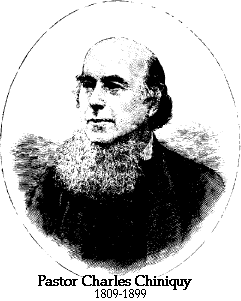
Foot Notes
CHAPTER 32
[*] In order to be understood
by those of my readers who have never been deceived by the diabolical doctrines of
the Church of Rome, I must say here, that when young I had learned in my catechism,
and when a priest I had believed and preached what Rome says on that subject. Here
is her doctrine as taught in her Catechism:-
"Who are those who go to heaven?"
Ans. "Those only who have never offended God, or who, having offended Him, have
done penance."
CHAPTER 41
[*] "The Pope, the Kings,
and the People" (Mullan & Son, Paternoster Square), pp. 269-70. Also see
(London) Standard, 7th April, 1870.
Introduction ---New Window
CHAPTERS 1-15 of page 1 ---New Window
CHAPTERS 16-31 of page 2 ---New Window
CHAPTERS 32-45 of page 3 (this page)
CHAPTERS 46-58 of page 4 ---New Window
CHAPTERS 59-67 of page 5 ---New Window
.
.
.
Related study material:


(1808-1890)
---New Window
"How different was the Gospel of the New Testament from the Gospel of Rome!"
An official title of the Pope is the Vicar of Christ.
"Vicar" comes from the Latin, "vicarious", meaning "a substitute";
therefore, the Pope identifies himself as a substitute Christ.
Antichrist means "against Christ" or "in place of, or substitute for,
Christ".
"Little children, it is the last time: and as ye have
heard that Antichrist shall come, even now are there many antichrists; whereby we
know that it is the Last Time"
(1 John 2:18).
An
Earnest Appeal to Roman Catholics ---New Window
Or, Roman Catholicism Examined in Light
of the Scriptures
by Tom Stewart
"We would have healed Babylon, but she is not healed:
forsake her"
(Jeremiah 51:9).



"And upon her forehead was a name written,
MYSTERY, BABYLON THE GREAT, THE MOTHER OF HARLOTS
AND ABOMINATIONS OF THE EARTH" (Revelation
17:5).
by Tom Stewart
(Part 1) The Purpose and History of Babylon the Great ---New Window
Any attempt to describe the final destruction of Babylon the Great-- "THE MOTHER
OF HARLOTS AND ABOMINATIONS OF THE EARTH"-- demands an identification of that
system, i.e., its purpose, history, as well as present and prophetic future... Understanding
the true nature of Babylon the Great is as simple as knowing whether a child is good
or bad. "Even a child is known by his doings, whether
his work be pure, and whether it be right"
(Proverbs 20:11). It only remains for God's people to "judge righteous judgment" (John 7:24)
concerning Babylon the Great. To act consistently with that understanding, will require
coming out of her that "ye
be not partakers of her sins, and that ye receive not of her plagues" (Revelation 18:4).
(Part 2) The Reformation and the Church of Rome ---New Window
By Divine Authority, the Apostle John was directed to align Nimrod's Babylon with
the finally destroyed Babylon of Daniel's 70th Week (Daniel
9:27), which indicates a clear line of succession for
Babylon the Great.
Other servants of this Divine Authority Of The WORD Of God which follow this example
are--
 Charles Chiniquy (1809-1899): "Rome is... that Modern Babylon"
-Fifty Years in the Church of Rome, (1886).
Charles Chiniquy (1809-1899): "Rome is... that Modern Babylon"
-Fifty Years in the Church of Rome, (1886).
John Wycliffe (1324-1384): "the supreme authority of Scripture...
Christ's law sufficeth by itself to rule Christ's Church." -On the Truth
and Meaning of Scripture, (c.1380).
Martin Luther wrote, "I know that the Papacy is none other than
the kingdom of Babylon, and the violence of Nimrod the mighty hunter" -The
Babylonish Captivity of the Church, (October 6th 1520).
Alexander Hislop: "Rome as the Apocalyptic Babylon... Let every
Christian henceforth and for ever treat it as an outcast from the pale of Christianity.
Instead of speaking of it as a Christian Church, let it be recognised and regarded
as the Mystery of Iniquity, yea, as the very Synagogue of Satan." -The Two
Babylons: Or, The Papal Worship Proved to be the Worship of Nimrod and His Wife,
(1853)
James A. Wylie (1808-1890): "From the fourth century... the Bible
began to be hidden from the people... the clergy usurped authority over the members
of the Church... While the, 'living oracles' [Scripture] were neglected, the zeal
of the clergy began to spend itself upon rites and ceremonies borrowed from the pagans.
These were multiplied to such a degree, that [even] Augustine complained that they
were 'less tolerable than the yoke of the Jews under the law.'" -History
of Protestantism, vol. 1, pgs. 16,18, (1878).
It has always been, is, and will always be right for those who name "the Name
of Christ [to] depart from iniquity" (2Timothy
2:19) by separating themselves from Babylon the Great.
"Wherefore come out from among them, and be ye separate, saith the LORD, and
touch not the unclean thing; and I will receive you" (2Corinthians
6:17).
(Part
3) The Ecumenical Movement and the Church of Rome ---New Window
It has been an historic dogma of the Catholic Church that "outside
the [Catholic] Church there
is no salvation". "They
could not be saved who, knowing that the Catholic Church was founded as necessary
by God through Christ, would refuse either to enter it or to remain in it" (from "The Catechism of the Catholic Church" [1992], paragraph
846). This was intended by the Papacy to place the world in universal need
of coming to Rome to receive the benefits of their ecumenical salvation...
"An important affirmation made in the early phase
of collaboration between the Roman Catholic Church and the World Council of Churches
was that the two share in 'one and the same ecumenical movement'... The oneness
of the ecumenical movement refers fundamentally to its orientation towards a 'common
calling'" (from the WCC's "Towards a Common
Understanding and Vision of the World Council of Churches", paragraph 2.10)...
The Harlot Church of Rome is an implacable enemy of Jehovah Jesus, for she is the
Great Whore... and the World Council of Churches' "common
calling" collaboration with the Church of Rome
is spiritual adultery. "Can two walk together,
except they be agreed?" (Amos
3:3). Rome's doctrine damns her faithful, and her history
betrays her origin-- Babylon. "Flee out of the
midst of Babylon, and deliver every man his soul: be not cut off in her iniquity;
for this is the time of the LORD'S vengeance; he will render unto her a recompence" (Jeremiah 51:6)...
The Roman Catholic Church (RCC) is not a member
of the World Council of Churches (WCC); and, it has never applied for membership.
Rome saith, "I sit a queen, and am no widow, and
shall see no sorrow" (Revelation
18:7). "The RCC's
self-understanding has been one reason why it has not joined"
(from an FAQ at the WCC's website [1999], which asks if the Roman Catholic Church
is a member of the World Council of Churches). Rome understands that the Road
of Ecumenism does not lead to Geneva-- the WCC's headquarters-- but it leads
back to Rome...
One of the "principal concerns" of the Second Vatican Council (1962-1965) was the "restoration
of unity among all Christians" (from the Second
Vatican Council, "Decree on Ecumenism- Unitatis Redintegratio", paragraph
1)... Commenting on the term "ecumenical movement", the "Decree on Ecumenism" stated that "when
the obstacles to perfect ecclesiastical communion have been gradually overcome, all
Christians will at last, in a common celebration of the Eucharist, be gathered into
the one and only Church in that unity which Christ bestowed on His Church from the
beginning. We believe that this unity subsists in the Catholic Church as something
she can never lose, and we hope that it will continue to increase until the end of
time" (from the Second Vatican Council, "Decree
on Ecumenism- Unitatis Redintegratio", paragraph 4). And indeed, the "leopard [has not changed]
his spots"
(Jeremiah 13:23)!
(Part
4) Come Out of Her, My People ---New Window
Or, Love Alone Will Cause Us to Obey the Command to Separate From Babylon the Great
"Come out of her, My people, that ye be not partakers
of her sins, and that ye receive not of her plagues"
(Revelation 18:4).
Discussions of End Time Events, i.e., the Pre-Tribulational Rapture, and Chronologies,
i.e., an expectation of being Raptured before the Year 2000 ("Y2K"), are
intensely interesting, but our conduct in the meantime is of the utmost importance...
Thus, when the Word of God gives the command to separate from Babylon the
Great, it remains only for the instructed Believer to make the personal application
required for their situation-- and depart from Babylon. "And
I heard another Voice from Heaven, saying, Come out of her, My people, that ye be
not partakers of her sins, and that ye receive not of her plagues" (Revelation 18:4). Love will always obey, for
"if ye love me, keep My Commandments" (John 14:15)
is the cry and command of our LORD and Saviour.
If we were to "speak with the tongues of men and
of angels" (1Corinthians
13:1) without the obedience of Love, then we
would be as empty and worthless "as sounding brass,
or a tinkling cymbal" (13:1). If we possessed the "gift of
prophecy", understood "all
mysteries, and all knowledge", and had "all faith" to "remove mountains", but
did not have loving obedience to the command to come out of Babylon the Great,
then we would be as "nothing" in the sight of God (13:2). If we bestowed all our "goods
to feed the poor" and gave our bodies "to be burned", it "profiteth" us "nothing" (13:3). Whatever we say, if we will not come out of Babylon the Great,
we do not love God. "Therefore to him that
knoweth to do good, and doeth it not, to him it is sin" (James 4:17).
(Part 5) Billy Graham: Christianity's Modern
Balaam ---New
Window
"Shouldest thou help the ungodly, and love
them that hate the LORD? therefore is wrath upon thee from before the LORD"
(2Chronicles 19:2).
A thoughtful evaluation of the ministry of Billy Graham
will reveal that Billy Graham has been mightily used of Satan to break down the
walls of separation between the Godly and the ungodly. "And
ye shall be holy unto Me: for I the LORD am holy, and have severed you from other
people, that ye should be Mine" (Leviticus 20:26).
It will also reveal that Billy Graham's most effective work for Babylon the Great
has been that of masquerading as a Bible believing evangelist-- doing "the work of the LORD deceitfully"
(Jeremiah 48:10)-- seducing unwary Pilgrims into laying aside the "Sword
of the Spirit" (Ephesians 6:17) in the name of
Christian Love and Unity. If the Pope had approached the Bible-Believing-Evangelical-Community
with the need for Ecumenical Unity in previous generations, he would have been viewed
with suspicion-- on account of the corruptions of the Medieval Catholic Church, the
terrors of the Inquisition, the wicked absurdity of Papal infallibility, etc. "Ye shall know them by their fruits" (Matthew
7:16).
(Part 6) The Final Judgment of the Great
Whore ---New Window
"He hath judged the Great Whore, which did
corrupt the Earth with her fornication, and hath avenged the blood of His servants
at her hand"
(Revelation 19:1-2).
We have only focused on the most pervasive and conspicuous
manifestation of the Great Whore in this present Church Age-- the institution of
Roman Catholicism. "And here is the mind which
hath wisdom. The seven heads are seven mountains, on which the woman sitteth"
(Revelation 17:9). Rather than viewing Catholicism as
merely one of many manifestations of the LORD Jesus Christ's Church, the Church of
Rome's history demonstrates it to be entirely transformed from the Primitive Church
of the Apostles into the abominable Babylon the Great...
As we approach the Tribulation Week, the pace is quickening
as "evil men and seducers shall wax worse and worse,
deceiving, and being deceived" (2Timothy 3:13).
We need to remember that the Church of Rome has been "Satan's
seat" (Revelation 2:13) for more than a millennium...
"when the obstacles to perfect ecclesiastical communion have been gradually
overcome, all Christians will at last, in a common celebration of the Eucharist,
be gathered into the one and only Church" (from
the Second Vatican Council, "Decree on Ecumenism- Unitatis Redintegratio",
paragraph 4)... Rome's
"patience" in achieving the universal domination that describes her name,
i.e., catholic, ought to be observed by even the Godly... Pope John Paul II tenaciously
stated his commitment to the global union awaiting the Church at the New Millennium,
"I myself intend to promote every suitable initiative
aimed at making the witness of the entire Catholic community understood in its full
purity and consistency, especially considering the engagement which awaits the
Church at the threshold of the new Millennium
[WStS emphasis added]...
Does the Roman Catholic Church-- Babylon the Great--
endorse or promote the United Religions Initiative (URI)? If "in
her [Babylon the Great] was
found the blood of prophets, and of Saints, and of all that were slain upon
the Earth" (Revelation 18:24), then the UR must
eventually become attached to the Pope and the Church of Rome for the UR to be identified
as Babylon the Great... This
writer is persuaded that Babylon the Great, which is essentially Roman Catholicism,
must soon incorporate with the United Religions, if the Pope still desires the
headship of the world's religions, i.e., to be the False Prophet... Accordingly,
the Papal celebration of the "Jubilee of the Year 2000" includes:
In the Book of Revelation, we find a description
of Babylon the Great (17:1-18), her final destruction (18:1-24), and the rejoicing
in Heaven at the judgment of the Great Whore (19:1-4)... Antichrist turns against
Babylon the Great 8-9 days prior to the End of the Tribulation Week... "Come out of her, My people, that ye be not partakers of her
sins, and that ye receive not of her plagues" (Revelation
18:4). This most important
message of God to those who would be preserved from Divine Destruction is to COME
OUT OF BABYLON NOW.
End of Series.
For more material
related to this topic
please see

---New Window

Section Index for Voices
of Philadelphia

.
Homepage  Holy Bible
.Jehovah Jesus
Timeline .Prophecy Philadelphia Fellowship Promises Stories Poetry Links
Holy Bible
.Jehovah Jesus
Timeline .Prophecy Philadelphia Fellowship Promises Stories Poetry Links

Purpose ||.What's New
|| Tribulation Topics || Download Page || Today's Entry
Topical Links:
Salvation || Catholicism || Sound Doctrine || Prayer
Privacy Policy
.